

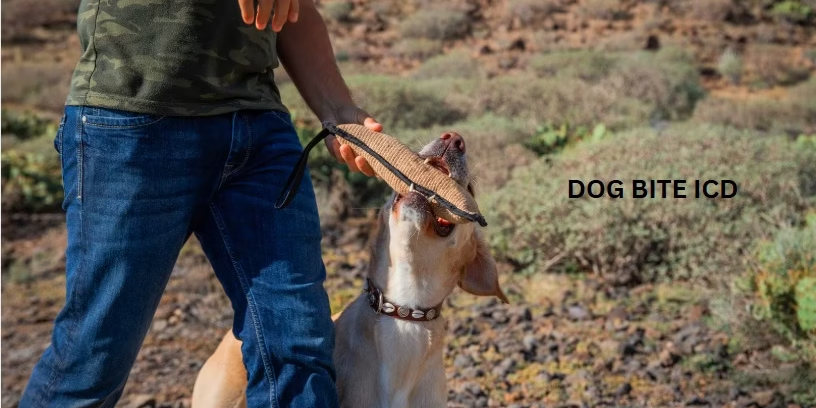
Dog bites account for a significant number of emergency room visits globally, with over 4.5 million incidents annually in the United States alone. While the physical impact of dog bites is evident, accurate Dog Bite ICD-10 Code with medical documentation plays an equally important role in managing these cases.
Healthcare providers rely on ICD-10-CM codes like W54.0xxa to capture essential details about dog bite injuries. This code is a cornerstone for billing, epidemiological tracking, and ensuring comprehensive patient care. This guide will provide an in-depth understanding of W54.0xxa, related codes, and best practices for healthcare providers treating dog bite injuries.
Understanding Dog Bite ICD-10 Code W54.0xxa
What Does W54.0xxa Represent?
The code W54.0xxa in the ICD-10-CM system specifies:
- W54: Dog as the external cause of the injury.
- 0: Indicates a bite injury.
- xx: Placeholder characters for potential future code expansions.
- a: Identifies the encounter as an initial visit for treatment.
This code is crucial for the documentation of dog bite incidents during the initial treatment phase and is used alongside injury and treatment-specific codes.
Clinical Impact of Dog Bites
Immediate Medical Concerns
Wound Assessment and Management
Types of Wounds: Dog bites often result in puncture wounds, lacerations, or crush injuries.
Debridement and Cleaning: Thorough cleaning is necessary to prevent infection.
Closure Options: For deep wounds, suturing or advanced surgical repair may be needed.
Infection Risk
Dog bites introduce bacteria such as:
- Pasteurella multocida (most common).
- Capnocytophaga canimorsus.
Signs of infection include redness, swelling, and pus formation.
Rabies Concerns
A key consideration, especially when the dog’s vaccination status is unknown.
Rabies post-exposure prophylaxis (PEP) is initiated if necessary.
Tetanus Risk
Administer a tetanus booster if the patient hasn’t received one in the last five years.
Special Considerations for Children
Children under 12 are at higher risk of severe injuries, often to the face or hands.
Secondary Concerns in Dog Bite Cases
Physical Complications
Nerve damage, fractures, or joint injuries may result from severe bites.
Long-term consequences include scarring and reduced mobility.
Psychological Impact
Dog bites can trigger anxiety, depression, or post-traumatic stress disorder (PTSD).
Codes like F43.10 (PTSD) may apply in these scenarios.
Detailed ICD-10-CM Code Applications
Primary Coding
When coding for a dog bite:
Use W54.0xxa as the external cause code for the dog bite.
Pair it with injury codes to specify the nature of the wound:
- S61.401A: Puncture wound without foreign body of the hand, initial encounter.
- S01.81XA: Open wound of the face, initial encounter.
Encounter Types
The encounter type suffix (a, d, s) is crucial for proper coding:
- Initial Encounter (a): Active treatment during the first visit (e.g., cleaning, suturing).
- Subsequent Encounter (d): Follow-up care for a healing wound or infection.
- Sequela (s): Complications such as keloid scarring or chronic pain from the bite.
External Cause Codes
- Y92.XXX: Location of the incident, such as Y92.010 (home).
- Y93.89: Activity during the bite (e.g., playing with the dog).
Injury Complications and Related Codes
- L03.11: Cellulitis from a dog bite.
- T79.3XXA: Post-traumatic wound infection.
Best Practices for Healthcare Providers
Documentation Tips
Accurate documentation ensures appropriate treatment and smooth insurance claims:
- Record the circumstances of the bite: Was the dog known to the patient?
- Specify the injury details: Location, depth, and size.
- Include vaccination history of both the dog and the patient.
Multidisciplinary Approach
Severe dog bites may require input from multiple specialists:
- Plastic Surgeons: For facial injuries or scar revision.
- Infectious Disease Specialists: For complex infections or rabies risk.
- Mental Health Providers: To address trauma and anxiety.
Coding for Comprehensive Reimbursement
Ensure that all aspects of the injury are coded:
- Use procedural codes for treatments like:
- 12001: Simple wound closure.
- 97597: Debridement of open wound.
- Include follow-up visits for infection management or suture removal.
Common Errors in Dog Bite Coding
Misclassification of Injury
- Using W54.1xxa (bitten by another mammal) instead of W54.0xxa.
Incomplete Use of External Cause Codes
- Omitting location or activity codes can lead to claim delays.
Failure to Update Encounter Type
- Submitting initial encounter codes for follow-up visits results in claim denials.
Case Studies
Case1: Simple Dog Bite on the Hand
- Patient: 30-year-old male bitten on the right hand by a pet dog.
- Injury: Minor puncture wound.
- Codes:
- W54.0xxa (Dog bite, initial encounter).
- S61.401A (Puncture wound without foreign body, right hand).
- Treatment: Wound cleaning, antibiotics, and tetanus shot.
Case2: Severe Dog Bite with Rabies Risk
- Patient: 7-year-old girl bitten on the leg by a stray dog.
- Injury: Deep lacerations with rabies risk.
- Codes:
- W54.0xxa (Dog bite, initial encounter).
- S81.801A (Open wound, lower leg).
- Z20.3 (Contact with rabies).
- Treatment: Surgical repair and rabies PEP.
Case3: Psychological Trauma Post-Dog Bite
- Patient: 45-year-old woman bitten by a neighbor’s dog.
- Impact: Anxiety and insomnia following the incident.
- Codes:
- W54.0xxs (Dog bite, sequela).
- F43.10 (Post-traumatic stress disorder, unspecified).
- Treatment: Counseling and trauma-focused therapy.
The Role of Public Health and Reporting
Rabies Surveillance
Healthcare providers must report bites to public health departments to monitor rabies risks.
Community Awareness
Educating communities about dog safety and bite prevention is critical.
Data Collection
Accurate coding contributes to national injury databases, helping policymakers address trends in dog bites.
Frequently Asked Questions
Dog Bite ICD-10 Code
What does ICD-10 code W54.0xxa specifically represent?
ICD-10 code W54.0xxa is used to document the initial encounter for injuries caused by a dog bite. The code includes:
- W54.0: Dog identified as the external cause of the injury.
- xx: Placeholder characters for future code expansions.
- a: Indicates that the patient is receiving active treatment during their first visit for this condition.
When should W54.0xxa be used in documentation?
W54.0xxa should be used:
- When the patient is treated for a dog bite injury for the first time.
- During an encounter involving active treatment, such as cleaning the wound, administering antibiotics, or performing a surgical procedure.
For follow-up visits, W54.0xxd (subsequent encounter) should be used, and for long-term effects, W54.0xxs (sequela) is appropriate.
What is the difference between W54.0xxa and other animal bite codes?
The primary difference lies in the type of animal causing the injury:
- W54.0xxa: Specific to dog bites.
- W54.1xxa: Used for bites caused by other mammals (excluding dogs).
- Other codes exist for bites from reptiles, insects, or birds. Selecting the correct code ensures precise documentation and reimbursement.
Can W54.0xxa be used as the primary diagnosis code?
No, W54.0xxa is an external cause code and should always be used as a secondary code to explain how the injury occurred.
- The primary code should describe the specific injury caused by the bite, such as:
- S61.401A: Puncture wound of the hand.
- S01.81XA: Open wound of the face.
What additional codes should be included when documenting a dog bite?
In addition to W54.0xxa, healthcare providers should include:
Injury Codes: To describe the type and location of the wound.
External Cause Codes: To document:
Location of the incident (e.g., Y92.010 for home).
Activity during the bite (e.g., Y93.89 for playing with the dog).
Preventative Care Codes: If applicable, such as:
Z23: For tetanus vaccination.
Z20.3: Rabies exposure.
How does encounter type impact coding for dog bites?
Encounter type determines the suffix in the ICD-10 code:
- A (Initial Encounter): Used for active treatment of the injury, such as cleaning, suturing, or administering prophylaxis.
- D (Subsequent Encounter): Used for follow-up care, such as monitoring infection or removing stitches.
- S (Sequela): Used for long-term effects, such as scarring or chronic pain resulting from the bite.
How should complications like infections or rabies exposure be documented?
Add additional codes to the documentation for complications arising from a dog bite.
- L03.11: Cellulitis from the bite wound.
- T81.4: Infection following a procedure (e.g., surgery or wound closure).
- Z20.3: Rabies exposure for patients undergoing post-exposure prophylaxis.
These codes complement W54.0xxa and ensure comprehensive documentation.
What procedural codes are commonly paired with W54.0xxa?
Procedural codes depend on the treatment provided. Common examples include:
- 12001: Simple repair of a superficial wound.
- 97597: Debridement of a wound.
- 90675: Rabies vaccine administration.
Pairing the correct procedural codes ensures accurate billing and timely reimbursement.
Why is accurate coding of dog bites important for healthcare providers?
Accurate coding of dog bites is crucial for several reasons:
- Reimbursement: Ensures providers are paid correctly for their services.
- Legal Documentation: Provides an official record of the injury in case of lawsuits or insurance claims.
- Public Health Data: Helps track the prevalence of dog bites and associated complications, contributing to policy-making and awareness campaigns.
What are the common errors in coding dog bite cases, and how can they be avoided?
Common errors:
Using the wrong code (e.g., W54.1xxa instead of W54.0xxa).
Omitting the encounter type or external cause codes.
Failing to document follow-up visits with appropriate codes.
How to avoid them:
- Train staff to understand the ICD-10 system.
- Use checklists to ensure all relevant details are recorded.
- Perform periodic audits of medical records to catch and correct errors.
Final Thoughts
Dog bite cases require a thorough clinical and administrative approach to ensure optimal patient care and reimbursement. ICD-10 code W54.0xxa is pivotal in documenting initial encounters and serves as the foundation for broader injury management. By understanding the complexities of coding and treatment, healthcare providers can enhance patient outcomes, reduce complications, and contribute to public health efforts.
For healthcare providers, staying informed about coding updates and implementing best practices ensures the seamless integration of clinical care and medical billing. In doing so, we can mitigate the short- and long-term effects of dog bites while improving the overall healthcare delivery process.
Key Market Player
Ready to optimize your medical billing and boost your revenue? Look no further. Zmed Solutions LLC is your trusted partner in professional Medical Billing Services.
Join hundreds of satisfied healthcare providers who have already elevated their revenue with our expert services. Don't miss out on what could be your practice's most profitable decision.
Schedule a Consultation Today!
Contact Us Now, and experience the difference. Your financial success starts here!