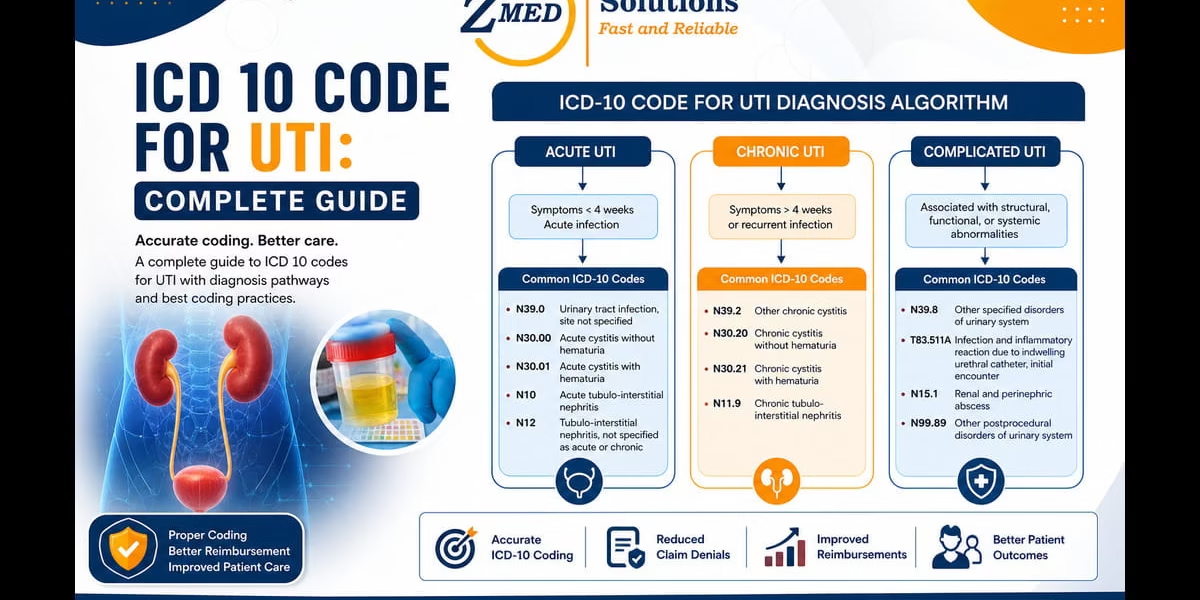
The most common icd 10 code for uti is N39.0, which represents a urinary tract infection without a specified site. This code applies to acute, uncomplicated lower UTIs. However, coders must use different codes for recurrent UTIs, chronic cases, or infections with complications.
Urinary tract infections (UTIs) are among the most frequent diagnoses in clinical practice. Accurate coding ensures proper reimbursement and patient records. This guide covers every icd 10 code for uti you will ever need.
Medical coders face many challenges with urinary tract infection icd 10 codes. Different clinical scenarios demand different codes. One simple code does not fit all UTI cases.
This article explains all code variations, clinical conditions, and billing rules. You will learn about recurrent uti icd 10, chronic uti icd 10, and complicated uti icd 10. We also cover uti unspecified icd 10, uti with e coli icd 10, and acute uti icd 10.
Special situations like catheter associated urinary tract infection icd 10 require careful attention. Understanding uti symptoms icd 10 also helps coders select the right code. By the end, you will master every aspect of UTI coding.
What Is the ICD 10 Code for UTI?
The most common icd 10 code for uti is N39.0. This code represents a urinary tract infection without a specified site. Physicians use it for lower UTIs like cystitis or urethritis. But it does not fit every clinical picture.
Healthcare providers must understand what is the icd 10 code for uti in different contexts. The answer changes based on infection location, recurrence, and complications. For example, acute cystitis may use N30.00 instead of N39.0.
The correct icd 10 code for uti depends on documentation. Coders must read the physician’s notes carefully. Key details include infection site, causative organism, and patient history. Without these details, coding errors occur.
Urinary tract infection icd 10 codes belong to Chapter 14 of ICD-10-CM. This chapter covers diseases of the genitourinary system. N39.0 falls under “other disorders of the urinary system.” Always verify the latest guidelines before finalizing any code.
Why Accurate UTI Coding Matters?
Accurate icd 10 code for uti selection affects patient care and revenue. Incorrect codes can lead to claim denials or audits. They also distort public health data about infection rates.
Uti icd 10 code errors cost practices thousands of dollars yearly. Insurance companies may reject claims with mismatched codes. This delays payment and increases administrative work.
Proper coding also supports clinical research. Researchers track urinary tract infection icd 10 trends using coded data. Inaccurate codes hide true disease patterns.
Uti diagnosis code icd 10 accuracy protects against legal risks. Auditors review coding patterns during investigations. Consistent, correct coding demonstrates compliance with regulations.
Finally, correct coding helps individual patients. Their medical records follow them across providers. An incorrect icd 10 code for uti could affect future treatment decisions. Always prioritize accuracy over speed.
Detailed Breakdown of UTI ICD-10 Codes
N39.0 – Unspecified Urinary Tract Infection
Code N39.0 represents icd 10 uti unspecified. This is the default icd 10 code for uti when documentation lacks specificity. Use it for acute, uncomplicated lower UTIs without further details.
However, uti unspecified icd 10 should not become a habit. Whenever possible, use more specific codes. For example, if the physician documents cystitis, use N30.00 instead.
Uti icd 10 diagnosis code N39.0 excludes several conditions. It does not cover pyelonephritis (N10) or urolithiasis with infection. It also excludes infections with identified organisms like E. coli when specified.
Coders often ask what is the icd 10 code for uti for elderly patients. N39.0 works for uncomplicated cases. But elderly patients may have atypical symptoms. Always review the entire clinical picture before coding.
Remember that icd 10 code for uti N39.0 requires no additional digits. It is a valid, billable code. But you should strive for greater specificity when the record allows.
Recurrent UTI ICD-10 (N39.0 + R39.81? Or N39.0 with Excludes1?)
Many coders ask about recurrent uti icd 10. ICD-10-CM does not have a dedicated single code for recurrent UTIs. Instead, you code the current infection plus a history code.
For recurrent uti icd 10, use N39.0 for the active infection. Then add Z87.440 (personal history of urinary tract infection). This combination indicates recurring episodes over time.
Alternatively, some coders use N39.0 with R39.81 (other difficulties with micturition). But this is less precise. The best practice is N39.0 plus Z87.440.
Recurrent uti in women icd 10 follows the same rule. Women experience more recurrences than men. Document each episode separately with the combination above.
Insurance companies look for recurrent uti icd 10 patterns. They may deny frequent claims without Z87.440. Always add the history code to show the recurrent nature.
Chronic UTI ICD-10 (N39.0 with Chronic Cystitis Codes)
Chronic uti icd 10 coding requires more nuance. Infections often involve persistent bacteria despite treatment. Use N30.20 (chronic cystitis without hematuria) for these cases.
But chronic uti icd 10 may also use N30.21 (chronic cystitis with hematuria). This depends on laboratory findings. Check the urinalysis report before selecting a code.
Some physicians document chronic uti icd 10 as “chronic pyelonephritis.” In that case, use N11.0 (nonobstructive reflux-associated chronic pyelonephritis) or N11.8 (other chronic tubulo-interstitial nephritis).
Chronic uti icd 10 excludes several conditions. Do not use chronic codes for acute flare-ups. Acute exacerbation of chronic cystitis requires N30.20 plus an acute infection code.
Documentation is critical for chronic uti icd 10. The physician must state “chronic” explicitly. Without that word, default to acute codes. Always clarify with the provider when in doubt.
Complicated UTI ICD-10 (N39.0 + Underlying Condition Code)
A complicated uti icd 10 occurs in patients with structural or functional abnormalities. This includes kidney stones, catheters, or immunosuppression. Use N39.0 plus a code for the complicating condition.
For example, complicated uti icd 10 in a patient with nephrolithiasis uses N39.0 and N20.0. The stone complicates infection treatment. Both codes must appear on the claim.
Catheter associated urinary tract infection icd 10 follows special rules. Use T83.511A (infection due to indwelling urinary catheter) plus N39.0. This shows the infection source clearly.
Uti in pregnancy icd 10 represents another complication. Use O23.4 (infection of urinary tract in pregnancy) instead of N39.0. Pregnancy changes physiology and treatment options.
Complicated uti icd 10 codes often trigger higher reimbursement. But they require stronger documentation. Ensure the physician notes all complicating factors in the medical record.
UTI Unspecified ICD-10 (N39.0 vs. Other Unspecified Codes)
Uti unspecified icd 10 is N39.0. But this code has limits. It does not specify the infection site (upper vs. lower). It also does not identify the causative organism.
Icd 10 uti unspecified remains appropriate for emergency department visits. The physician may not have culture results yet. Once results arrive, update the code if needed.
Uti unspecified icd 10 differs from “unspecified site of urinary tract infection.” The latter uses N39.0 as well. Both phrases point to the same code.
Avoid using icd 10 uti unspecified for documented conditions. If the record says “E. coli UTI,” do not use N39.0 alone. Instead, add B96.20 (E. coli infection) as a secondary code.
Uti unspecified icd 10 should be a temporary code. Work with providers to obtain specificity. Better coding improves patient tracking and quality metrics.
UTI with E. coli ICD-10 (N39.0 + B96.20)
Uti with e coli icd 10 requires two codes. The primary code is N39.0 for the infection. The secondary code is B96.20 (unidentified Escherichia coli infection).
Uti with e coli icd 10 helps public health tracking. E. coli causes over 75% of community-acquired UTIs. Knowing this pattern guides antibiotic stewardship.
Some coders ask about uti with e coli icd 10 when culture shows resistance. Use the same codes but add Z16.9 (resistance to unspecified antimicrobial drug). Resistance codes affect treatment choices.
Uti with e coli icd 10 documentation must include culture results. Without a positive culture, you cannot use B96.20. Empirical treatment without culture uses N39.0 alone.
Remember that uti with e coli icd 10 excludes neonatal or gastrointestinal E. coli infections. Only use this combination for confirmed urinary sources.
Acute UTI ICD-10 (N39.0 or N30.00)
Acute uti icd 10 coding depends on the specific diagnosis. For acute cystitis (bladder infection), use N30.00. Acute urethritis, use N34.1. For unspecified acute UTI, use N39.0.
Acute uti icd 10 requires the word “acute” in documentation. Without it, the default is unspecified. Do not assume acute status from medication orders alone.
Emergency physicians often document acute uti icd 10 as N39.0. This is acceptable for lower UTIs without localization. But if they specify “acute pyelonephritis,” use N10 instead.
Acute uti icd 10 also requires laterality when applicable. For example, acute pyelonephritis can be left, right, or bilateral. Use N10 with laterality codes when documented.
Uti icd 10 code for acute cases affects antibiotic prescribing patterns. Code choices influence hospital reporting metrics. Choose the most specific code your documentation supports.
Catheter Associated Urinary Tract Infection ICD-10 (T83.511A + N39.0)
Catheter associated urinary tract infection icd 10 follows a specific sequence. First, list the external cause code T83.511A. This code means infection due to indwelling urinary catheter.
Then add N39.0 for the infection itself. This two-code combination fully describes catheter associated urinary tract infection icd 10. Do not use N39.0 alone in catheterized patients.
Catheter associated urinary tract infection icd 10 also requires a seventh character. The “A” in T83.511A indicates initial encounter. Use “D” for subsequent encounters and “S” for sequelae.
Hospitals face high scrutiny for catheter associated urinary tract infection icd 10 codes. These infections are often preventable. Accurate coding helps quality improvement teams track rates.
If the catheter was removed before infection diagnosis, use T83.511A still applies. The infection source remains the catheter. Document the removal date in your notes.
UTI Symptoms ICD-10 (Symptom Codes with N39.0)
Uti symptoms icd 10 codes support the diagnosis but do not replace it. Common symptom codes include R30.0 (dysuria), R30.9 (painful urination), and R35.0 (frequency).
List uti symptoms icd 10 codes after the definitive diagnosis code. For example, use N39.0 followed by R30.0 for dysuria. The symptom code adds specificity to the claim.
Uti symptoms icd 10 become primary codes only when no diagnosis is confirmed. A patient with dysuria but negative cultures would use R30.0 alone. The physician must document “rule out UTI” in such cases.
Common uti symptoms icd 10 include:
- Dysuria icd 10: R30.0
- Hematuria icd 10: R31.9
- Urinary frequency icd 10: R35.0
- Flank pain icd 10: R10.31 (left) or R10.32 (right)
Symptom codes do not require confirmation of a diagnosis. They reflect patient-reported complaints. Use them freely when the physician documents symptoms without a definitive UTI diagnosis.
Related Diagnostic Codes for UTI Workup
Dysuria ICD-10 (R30.0)
Dysuria icd 10 code R30.0 represents painful urination. This symptom often accompanies UTIs. Use R30.0 as a secondary code with N39.0 or as a primary code for symptom-only visits.
Dysuria icd 10 does not indicate infection by itself. Many conditions cause dysuria, including STDs or interstitial cystitis. Only use N39.0 when the physician confirms infection.
Dysuria icd 10 has no age or gender restrictions. Children and adults can receive this code. But pediatric dysuria requires ruling out anatomical causes.
Hematuria ICD-10 (R31.9)
Hematuria icd 10 code R31.9 means blood in the urine. UTIs cause microscopic or gross hematuria. Use this code alongside icd 10 code for uti when documented.
Hematuria icd 10 requires laterality? No, hematuria does not use laterality codes. The bladder and kidneys sit midline. Blood appears throughout the urinary stream.
Pyuria icd 10 (R82.81) represents pus in the urine. This finding strongly suggests infection. Use pyuria codes with urinary tract infection icd 10 codes for complete documentation.
Bacteriuria icd 10 (R82.81) also uses R82.81. Significant bacteriuria means over 100,000 CFU/mL. This finding supports an infection diagnosis but does not confirm symptoms.
Urinary frequency icd 10 code R35.0 applies to urinating more often than usual. Frequency often accompanies UTIs. Use it as a secondary code for complete symptom documentation.
Flank pain icd 10 codes (R10.31 or R10.32) suggest possible pyelonephritis. Flank pain with fever should raise suspicion for upper tract infection. Ensure the physician evaluates for kidney involvement.
Associated Conditions Coding Guide
BPH ICD-10 Code (N40.0, N40.1, N40.2)
Bph icd 10 code selections depend on symptoms. N40.0 represents benign prostatic hyperplasia without lower urinary tract symptoms. N40.1 adds LUTS. N40.2 describes BPH with hematuria.
Bph icd 10 code often appears with UTI codes. Prostate enlargement causes urinary retention. Retention leads to infection. Use both codes when clinically appropriate.
Bph icd 10 code N40.1 requires documenting LUTS. Symptoms include frequency, urgency, or weak stream. Without these symptoms, use N40.0 instead.
Men with BPH and recurrent UTIs need careful coding. Use N40.1 plus N39.0 for each infection episode. Add Z87.440 for recurrence history.
Bph icd 10 code impacts severity ratings. N40.2 (with hematuria) represents more advanced disease. This may affect treatment decisions and coding audits.
Urolithiasis ICD-10 (N20.0, N20.1, N20.9)
Urolithiasis icd 10 codes describe kidney stones. N20.0 represents calculus of the kidney. N20.1 is calculus of the ureter. N20.9 is unspecified urinary calculus.
Urolithiasis icd 10 with infection requires two codes. Use the stone code plus N39.0. The stone complicates treatment and may require surgical intervention.
Nephrolithiasis icd 10 (N20.0) specifically means kidney stones. This term is more precise than urolithiasis. Use N20.0 when the physician documents “nephrolithiasis.”
Cystitis icd 10 codes (N30.00-N30.91) specify bladder inflammation. N30.00 is acute cystitis without hematuria. N30.01 adds hematuria. Use these instead of N39.0 for confirmed cystitis.
Pyelonephritis icd 10 (N10, N11.0-N11.9) covers kidney infections. Acute pyelonephritis uses N10. Chronic uses N11.x codes. Upper tract infections carry more severity than lower UTIs.
Urinary retention icd 10 (R33.8, R33.9) describes incomplete bladder emptying. Retention predisposes patients to UTIs. Code retention alongside infection when documented.
Patient Demographics and Risk Factor Coding
Recurrent UTI in Women ICD-10
Recurrent uti in women icd 10 follows the same rules as general recurrence. Use N39.0 for the active infection plus Z87.440 for history. Women have shorter urethras, increasing recurrence risk.
Recurrent uti in women icd 10 also may require menopausal status codes. Estrogen decline changes vaginal flora. Use Z78.0 (other specified menopausal status) when relevant.
Young women with recurrent uti in women icd 10 often need prophylaxis coding. Add Z79.899 (other long-term current drug therapy) for antibiotic prevention. Document the medication name.
Sexual activity affects recurrent uti in women icd 10 risk. Postcoital UTIs may use Z72.52 (high-risk sexual behavior) or simply the recurrence codes. Avoid over-assuming behavioral causes without documentation.
Recurrent infections in elderly women may need functional status codes. Use Z74.09 (other need for assistance with activities of daily living) if mobility affects hygiene.
UTI in Pregnancy ICD-10 (O23.4)
Uti in pregnancy icd 10 code O23.4 replaces N39.0 during pregnancy. Pregnancy changes UTI management. Asymptomatic bacteriuria also threatens pregnancy outcomes.
Uti in pregnancy icd 10 requires a trimester code. Fifth digits specify trimester: O23.41 (first), O23.42 (second), O23.43 (third). Use O23.49 for unspecified trimester.
Uti in pregnancy icd 10 excludes postpartum infections. Postpartum UTIs use N39.0 with O90.8 (other complications of puerperium). The 6-week postpartum period matters for coding.
Pyelonephritis in pregnancy uses O23.4 with N10? No, O23.4 covers all UTIs in pregnancy. But you may need additional codes for complications like sepsis.
Uti in pregnancy icd 10 codes affect risk adjustment. Pregnant patients with UTIs need closer monitoring. Accurate coding ensures proper prenatal care coordination.
Pediatric UTI ICD-10 (N39.0 with Age-Specific Codes)
Pediatric uti icd 10 uses N39.0 as the base code. But children may need additional codes for congenital anomalies. Q60-Q64 codes describe urinary system malformations.
Pediatric uti icd 10 in infants requires ruling out sepsis. Use P36.0-P36.9 for neonatal sepsis if present. Do not assume UTI alone causes systemic illness.
Vesicoureteral reflux (VUR) complicates pediatric uti icd 10. Use N13.70-N13.73 for reflux severity. VUR increases pyelonephritis risk in young children.
Pediatric uti icd 10 documentation must include growth parameters? Not directly, but code R62.51 (failure to thrive) may apply. Recurrent infections sometimes affect weight gain.
Circumcision status does not directly affect pediatric uti icd 10. Uncircumcised infant boys have higher UTI risk. But coding does not require circumcision status documentation.
Elderly UTI ICD-10 (N39.0 with Atypical Presentation Codes)
Elderly uti icd 10 cases often lack classic symptoms. Delirium or falls may be the only signs. Code R41.0 (disorientation) or R26.81 (falls) alongside N39.0.
Elderly uti icd 10 requires caution with asymptomatic bacteriuria. Many elderly patients have bacteria without infection. Do not code UTI without clinical symptoms.
Functional incontinence in elderly uti icd 10 patients uses N39.3? No, incontinence codes (N39.3-N39.498) describe bladder control loss. Use them with UTIs when both conditions exist.
Elderly uti icd 10 with dementia needs F01-F03 codes. Behavioral changes from UTI may mimic dementia worsening. Document both the infection and dementia status.
Dehydration (E86.0) often accompanies elderly uti icd 10. Poor fluid intake predisposes to infections. Code dehydration separately when the physician documents it.
Neurogenic Bladder UTI ICD-10 (N31.9 + N39.0)
Neurogenic bladder uti icd 10 requires two codes. First, code the neurogenic bladder (N31.9 for unspecified type). Then add N39.0 for the current infection.
Neurogenic bladder uti icd 10 patients need high vigilance. Incomplete emptying increases infection risk dramatically. Code both conditions every time an infection occurs.
Specific neurogenic bladder types have different codes:
- N31.0: Atonic bladder
- N31.1: Reflex bladder
- N31.2: Flaccid bladder
- N31.8: Other neuromuscular dysfunction
Neurogenic bladder uti icd 10 documentation should include the underlying cause. Use G89.3 for spinal cord injury. Use G35 for multiple sclerosis. The cause affects treatment planning.
Intermittent catheterization for neurogenic bladder uti icd 10 requires procedure codes. Use Z93.6 (artificial opening status for urinary tract) if an indwelling device exists. This supports medical necessity.
Documentation and Billing Best Practices
What Is the Correct ICD 10 Code for UTI?
The correct icd 10 code for uti depends entirely on documentation. Default to N39.0 for uncomplicated, unspecified lower UTIs. But always check for details that change the code.
Correct icd 10 code for uti for cystitis: N30.00 or N30.01. For pyelonephritis: N10. Pregnancy: O23.4x. For catheter-associated: T83.511A + N39.0.
Correct icd 10 code for uti requires reading the entire note. Do not just glance at the assessment section. The problem list, physical exam, and plan often contain specificity.
When in doubt, query the provider. A simple, “Did you mean acute cystitis or unspecified UTI?” can save denials. Most physicians appreciate coding guidance.
Correct icd 10 code for uti also follows sequencing rules. The definitive diagnosis goes first. Then add symptom codes and complication codes. Never sequence symptoms before the confirmed infection.
Primary Diagnosis Code for UTI
The primary diagnosis code for uti is usually N39.0 in outpatient settings. This code drives coverage and reimbursement. But hospital stays may use more specific codes.
Primary diagnosis code for uti becomes the reason for the encounter. If a patient presents with dysuria, fever, and frequency, N39.0 works. But if pyelonephritis is confirmed, N10 becomes primary.
Primary diagnosis code for uti cannot be a symptom code when infection is confirmed. Do not list R30.0 (dysuria) first when the physician documents N39.0. The confirmed diagnosis always takes priority.
Same-day visits for UTI follow-up use the same primary diagnosis code for uti. Unless the infection is resolved. Resolved infections use Z09 (follow-up exam after treatment).
Insurance companies evaluate primary diagnosis code for uti for medical necessity. Antibiotic prescriptions must match the diagnosis. A UTI code supports oral antibiotics. Pyelonephritis may justify IV drugs.
UTI ICD-10 Code Guidelines (Official 2025 Rules)
Uti icd 10 code guidelines come from CDC and CMS. First, code the definitive diagnosis when known. Second, add symptom codes for additional specificity. Third, never code suspected conditions.
Uti icd 10 code guidelines require culture confirmation for organism codes. Do not guess E. coli without a positive culture. Empirical treatment codes use N39.0 alone until results return.
Uti icd 10 code guidelines for multiple sites: The highest anatomical site determines the code. Pyelonephritis (kidney) overrides cystitis (bladder). Document the most severe site.
Uti icd 10 code guidelines forbid coding asymptomatic bacteriuria in non-pregnant adults. R82.81 (bacteriuria) is not a billable diagnosis. Only code UTIs when symptoms exist.
Yearly updates may change uti icd 10 code guidelines. New codes appear each October. Subscribe to CMS updates to stay current. Outdated codes cause automatic denials.
ICD-10 Coding for Urinary Tract Infection – Common Mistakes
Icd 10 coding for urinary tract infection errors include using N39.0 for pyelonephritis. N10 is the correct code for kidney infections. N39.0 is only for unspecified site or lower tract.
Icd 10 coding for urinary tract infection also fails with missing complication codes. Catheter-associated cases need T83.511A. Pregnancy needs O23.4x. Recurrence needs Z87.440.
Another icd 10 coding for urinary tract infection mistake is sequencing errors. Symptoms never come before the confirmed diagnosis. Always list N39.0 first, then R30.0 or R35.0.
Icd 10 coding for urinary tract infection with negative cultures: Do not code N39.0. Instead, code the symptoms (R30.0, R31.9, etc.) with Z71.1 for no diagnosis. Do not force a UTI code without evidence.
Finally, icd 10 coding for urinary tract infection requires consistent documentation. The problem list, assessment, and plan must agree. Mismatched documents cause coding confusion and potential audits.
Frequently Asked Questions
What is the most common ICD 10 code for UTI?
The most common icd 10 code for uti is N39.0. This code stands for a urinary tract infection without a specified site. Physicians use it for acute, uncomplicated infections of the lower urinary tract. However, if the documentation specifies cystitis or pyelonephritis, you must use N30.00 or N10 instead. Always review the complete medical record before selecting N39.0.
How do I code a recurrent UTI in the same patient?
For recurrent uti icd 10, use two codes together. First, code the current active infection (usually N39.0). Second, add Z87.440, which represents a personal history of urinary tract infection. This combination tells payers that the patient has experienced multiple episodes over time. Do not use N39.0 alone for recurrences, as this may trigger claim denials.
Can I use N39.0 for a catheter-associated UTI?
No, catheter associated urinary tract infection icd 10 requires two specific codes. First, list T83.511A (infection due to indwelling urinary catheter). Second, add N39.0 for the infection itself. Using N39.0 alone for a catheterized patient is incorrect and may trigger audits. Always document the catheter status and use the external cause code to show the infection source.
Do I need a separate code for E. coli as the causative organism?
Yes, uti with e coli icd 10 requires two codes. Use N39.0 as the primary diagnosis code. Then add B96.20 (unidentified Escherichia coli infection). This secondary code is only valid with a positive urine culture. Without culture confirmation, you cannot code E. coli. Empirical treatment based on symptoms alone uses only N39.0.
What is the ICD-10 code for UTI in a pregnant patient?
Uti in pregnancy icd 10 uses O23.4 instead of N39.0. Pregnancy changes UTI management and risks. You must also add a fifth digit to specify the trimester: O23.41 for first trimester, O23.42 for second, O23.43 for third, or O23.49 for unspecified trimester. Do not use N39.0 during pregnancy, as this code does not reflect the obstetrical context and may lead to denial.
Final Thoughts
Mastering the icd 10 code for uti requires attention to clinical details. The default code N39.0 works for many uncomplicated cases. But recurrent, chronic, and complicated infections demand more specific coding.
We covered recurrent uti icd 10 using N39.0 plus Z87.440. Chronic uti icd 10 often uses N30.20 for cystitis or N11.x for pyelonephritis. Complicated uti icd 10 adds codes for conditions like stones or catheters.
Uti unspecified icd 10 should be a temporary code. Always seek specificity from providers. Uti with e coli icd 10 requires culture confirmation and B96.20. Acute uti icd 10 contrasts with chronic codes based on documentation.
Catheter associated urinary tract infection icd 10 follows a two-code sequence starting with T83.511A. Uti symptoms icd 10 supplement diagnosis codes but never replace them when infection is confirmed.
Remember special populations. Recurrent uti in women icd 10, uti in pregnancy icd 10, pediatric uti icd 10, elderly uti icd 10, and neurogenic bladder uti icd 10 each have unique coding rules.
Accurate icd 10 coding for urinary tract infection protects revenue and patient safety. Follow official guidelines, query providers when needed, and stay updated on code changes. Your precision makes a difference in healthcare quality.
Key Market Player
Ready to optimize your medical billing and boost your revenue? Look no further. Zmed Solutions LLC is your trusted partner in professional Medical Billing Services.
Join hundreds of satisfied healthcare providers who have already elevated their revenue with our expert services. Don't miss out on what could be your practice's most profitable decision.
Schedule a Consultation Today!
Contact Us Now, and experience the difference. Your financial success starts here!