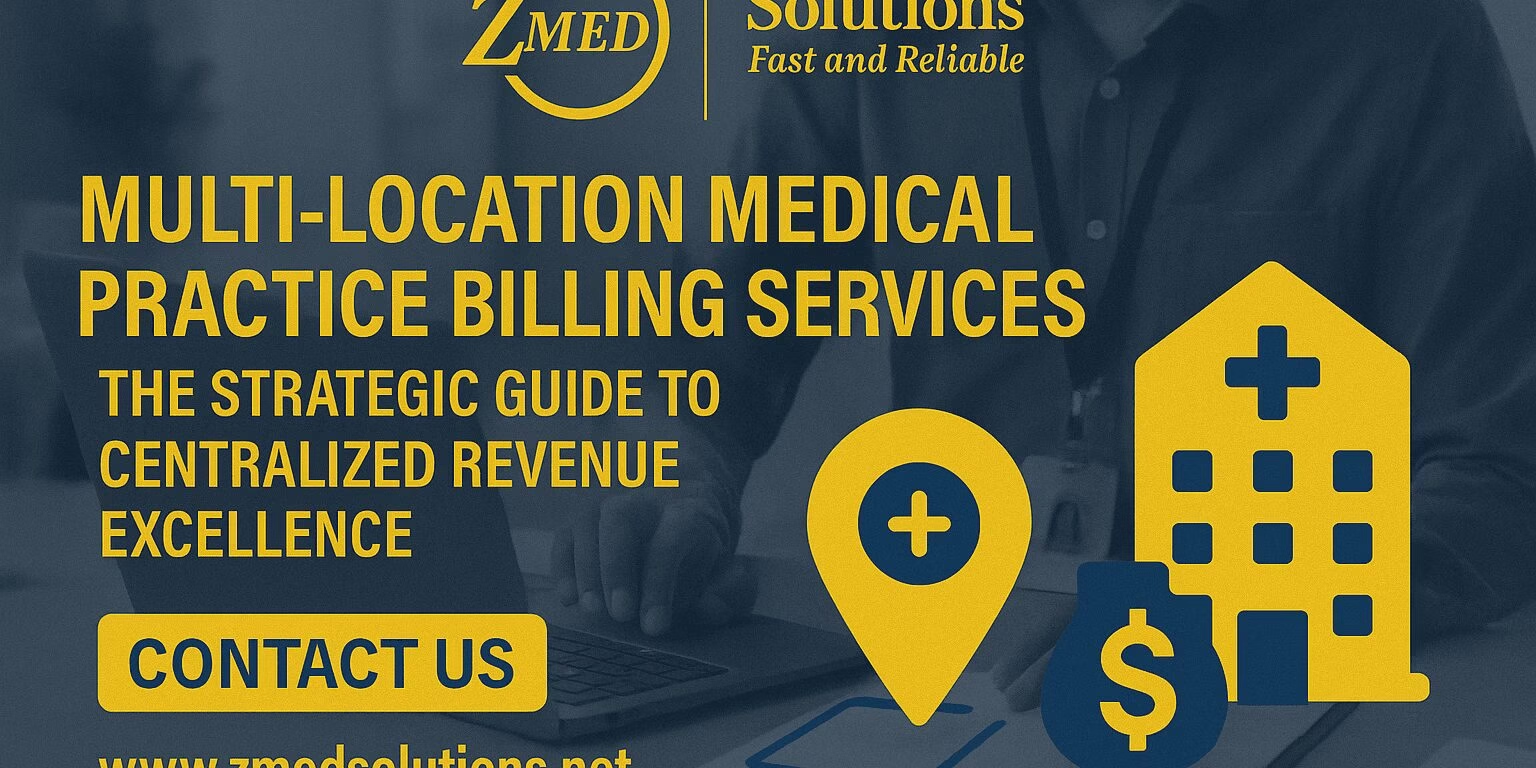
For growing healthcare systems, group practices, and multi-site medical organizations, expansion brings not only clinical reach but also formidable administrative complexity. Each new location introduces potential for inconsistent billing practices, fragmented revenue cycle data, and diluted financial oversight. Multi-location medical billing transforms this challenge into a strategic advantage by replacing a collection of disjointed billing operations with a unified, enterprise-grade financial engine. This is not merely about processing claims from several addresses; it is about implementing centralized billing for practices that delivers standardized compliance protocols, consolidated financial reporting, and economies of scale unattainable with disparate systems.
This guide provides a comprehensive 360-degree examination of the strategies, technologies, and operational models that define successful enterprise medical billing. Whether you manage a multi-specialty group, an urgent care chain, or a hospital-affiliated practice network, mastering multi-facility revenue cycle management is essential for financial control, regulatory safety, and sustainable growth. We will explore how to eliminate administrative redundancy, achieve enhanced financial visibility, and create a scalable billing infrastructure that supports your organization’s ambitions.
The Inherent Challenges of Decentralized Billing
Before exploring solutions, it’s critical to understand the specific pain points that plague decentralized multi-site operations. These challenges erode revenue and increase risk.
Inconsistent Billing Practices Across Locations:
Without centralized governance, each location may develop its own coding preferences, charge capture methods, and follow-up timelines. One clinic may aggressively use modifier -25, while another underutilizes it, leading to uneven reimbursement and compliance risk. This inconsistency makes it impossible to benchmark performance or ensure uniform quality.
Fragmented Revenue Cycle Data:
When each location operates on its own software or isolated instance of a system, leadership views financial health through a fractured lens. Getting a unified view of total Accounts Receivable (A/R), net collection rate, or denial trends requires manually aggregating reports—a slow, error-prone process that hinders proactive decision-making.
Duplicate Patient Records Management:
Patients who visit multiple locations within the same network risk having separate medical records and financial accounts created at each site. This leads to clinical safety issues, billing errors, and a poor patient experience. Duplicate patient records management is a massive technical and operational hurdle.
Varying Payer Contracts by Location:
A multi-site group may have different fee schedules and contractual terms with the same payer in different geographic regions. Managing and applying these correctly requires sophisticated system configuration and expert knowledge to ensure each claim is priced accurately according to its specific contract.
Compliance Consistency & Audit Risk:
A compliance violation at one location jeopardizes the entire organization. Ensuring every site adheres to the same HIPAA compliance standards, OIG guidance, and coding regulations requires centralized policy governance and monitoring, which is difficult with scattered teams.
Staff Training and Denial Management Across Locations:
Training billing staff uniformly is challenging when they are physically separated. Similarly, denial management becomes reactive and siloed; one location might be successfully appealing a particular payer denial while another location simply writes off the same denial, representing lost revenue capture.
The Centralized Model: Architecture for Control and Efficiency
The antidote to fragmentation is centralization. A centralized billing office (CBO) model consolidates key revenue cycle functions into a single, expert-led unit that serves all practice locations.
Core Functions of a Centralized Billing Office:
- Single Database Billing System: All locations feed patient demographic, clinical, and financial data into one unified system. This is the technical foundation for consolidated medical billing and eliminates data silos.
- Standardized Billing Processes: The CBO establishes and enforces one set of policies for charge entry, coding, claim submission, payment posting, and follow-up. This ensures improved billing consistency and quality control.
- Centralized Clearinghouse Management: All claims, regardless of origin, flow through a single clearinghouse connection, simplifying monitoring, reporting, and reconciliation.
- Unified Provider Credentialing & Payer Contracting: A dedicated team manages provider credentialing across locations and maintains a master database of payer contracts for multi-site groups, ensuring every provider is properly enrolled at every location they serve.
Operational Benefits of Centralization:
- Economies of Scale: Consolidating staff, software licenses, and management reduces per-claim operational costs.
- Reduced Administrative Redundancy: Eliminates duplicate roles (e.g., a billing manager at each site) and standardizes back-office functions.
- Specialized Expertise: Allows for the creation of specialized teams (e.g., a complex denial appeals unit, a Medicare compliance team) that would be unsustainable at individual locations.
The Technology Backbone: Enterprise Systems & Integration
A centralized billing office is only as strong as the technology that enables it. Multi-location medical billing demands an enterprise-grade technology stack.
Enterprise Practice Management (PM) & EHR Software: This is non-negotiable. The system must be a true multi-tenant platform designed for multi-site operations, not a collection of separate instances. Key features include:
- Role-Based Security & Location-Specific Data Views: Staff see only the data for locations they are authorized to manage, while leadership has an enterprise-wide dashboard.
- Inter-Facility Data Synchronization: Real-time sharing of patient records, provider schedules, and charges across locations to support cross-location charge capture and coordinated care.
- Cloud-Based Infrastructure: Cloud-based billing for multiple locations ensures universal access, automatic updates, and eliminates the IT burden of maintaining on-premise servers at each site.
API Connectivity & Interoperability: The enterprise PM/EHR must connect seamlessly via API connectivity to other critical systems: hospital ADT feeds, laboratory interfaces, patient engagement platforms, and advanced analytics tools. This creates a cohesive digital ecosystem.
Centralized Analytics & Reporting Platform: The true power of consolidation is unlocked through data. A robust analytics platform should provide:
- Consolidated Financial Reporting: A single source of truth for cash flow, A/R aging, and net revenue.
- Comparative Performance Analytics: Benchmarking between facilities for key metrics like collections per provider, cost to collect, and denial rates.
- Payer Performance Tracking Across Locations: Identifying which payers are underperforming network-wide versus in a single market.
- Unified Key Performance Indicators (KPIs): Establishing and monitoring standard KPIs for every location drives accountability and performance.
Standardizing for Success: Processes, Compliance, and Patient Experience
Technology enables standardization, but leadership must deliberately design and implement the standardized frameworks.
Developing Standardized Billing Processes: This involves mapping the ideal revenue cycle from patient scheduling to zero-balance account, then creating detailed procedure manuals and system workflows that every location must follow. This includes billing workflow coordination for scenarios like cross-location referrals.
Ensuring Compliance Consistency: A central compliance officer establishes standardized compliance policies covering coding, documentation, privacy, and security. This team conducts regular centralized audit management, performing internal audits across locations to identify and correct variances before they become external liabilities.
Creating a Unified Patient Financial Experience: Patients should have the same financial experience whether they visit location A or B. This means:
- Standardized financial policies (collections, payment plans, financial assistance).
- A single, recognizable patient statement format and brand.
- A unified patient portal where they can view bills and make payments for services at any network location.
- Consistent upfront communication about costs and insurance.
This unified patient financial experience builds brand trust and reduces confusion-driven calls to the billing office.
The Tangible Value Proposition: From Cost Center to Strategic Asset
Investing in a sophisticated multi-location medical billing strategy delivers measurable returns that justify the operational transformation.
Financial Performance & Visibility:
- Enhanced Financial Visibility: Leadership gains a real-time, accurate view of the entire organization’s financial health through an enterprise-wide dashboard, enabling data-driven strategic decisions.
- Improved Cash Flow: Standardized processes and expert denial management reduce A/R days and accelerate collections across the network.
- Maximized Reimbursement: Consistent, accurate coding and contract management ensure the organization is paid fully and correctly according to each location-specific payer agreement.
Operational Efficiency & Risk Mitigation:
- Reduced Operational Costs: Economies of scale and the elimination of administrative redundancy lower the overall cost to collect.
- Scalable Billing Infrastructure: Adding a new location becomes a matter of onboarding and training, not building an entirely new billing office, supporting agile growth.
- Proactive Risk Management: Centralized audit management and standardized compliance protocols significantly reduce the risk of costly audits, fines, and reputational damage.
Strategic Advantage:
- Data-Driven Management: Comparative performance analytics allow leadership to identify high-performing locations and replicate their success, while providing support to underperformers.
- Improved Negotiating Power: Consolidated financial reporting provides leverage when negotiating payer contracts for multi-site groups, as you can demonstrate your total patient volume and value to the payer.
Frequently Asked Questions
We have different specialties across our locations. Can billing really be standardized?
Absolutely. Standardized billing processes do not mean forcing a cardiology coder to bill like a dermatology coder. It means standardizing the framework and governance of the revenue cycle. For a multi-specialty group, standardization involves: 1) A single enterprise practice management software configured with all necessary specialty-specific code sets and rules. 2) Uniform policies for core functions: timelines for charge submission, payment posting protocols, denial appeal workflows, and patient communication standards. 3) Centralized billing office teams that include specialty-specific coding experts. The system and policies are consistent; the application of clinical coding expertise within them is specialized.
How do we handle payer contracts that have different fee schedules for different locations?
This is a core function of sophisticated multi-location medical billing. The solution involves both technology and expert management. Technologically, your enterprise practice management software must be able to store and apply multiple fee schedules for the same payer, linked to specific provider IDs, tax IDs, or location codes. When a claim is generated, the system automatically selects the correct contract based on where the service was rendered. Operationally, a central contracting team within your centralized billing office is responsible for maintaining this master database of payer contracts for multi-site groups, ensuring it is always current and correctly configured in the system. This prevents underpayments and compliance issues.
What are the first steps in moving from decentralized to centralized billing?
The transition requires careful planning: 1) Current State Assessment: Conduct a detailed audit of processes, software, and performance metrics at each location to understand the starting point. 2) Technology Selection/Unification: Choose or configure your single database billing system. This often means migrating all locations onto one cloud-based enterprise platform. 3) Process Design: Design the ideal, standardized workflows for your centralized billing office. 4) Team Building & Training: Establish the CBO, define roles, and train all staff on new, unified processes and systems. 5) Phased Migration: Transition locations in phases, not all at once, to manage risk and learn from each implementation. Strong project management is essential.
How does centralized billing improve the patient experience?
Centralized billing creates a unified patient financial experience, which significantly reduces patient frustration. Patients receive consistent statements with the same look, feel, and brand, regardless of which location they visited. They interact with one billing office for questions about any service, eliminating being transferred between sites. A unified patient portal allows them to see all their charges and make payments in one place. Standardized financial policies mean the rules about payments, financial assistance, and collections are the same everywhere, creating fairness and transparency. This consistency builds trust and reduces confusion-driven calls.
Isn’t there a risk that centralizing will make us less agile or disconnected from local operations?
This is a common concern, but a well-designed centralized billing office model actually enhances local support. While strategic oversight and back-end processing are centralize, each location can still have an onsite practice administrator or a designated billing liaison within the CBO. Furthermore, location-specific financial reporting ensures local managers have the data they need to manage their operations. The key is billing workflow coordination and communication. The CBO should have service level agreements (SLAs) with each location and use technology (like share ticketing systems) to ensure local issues are resolve quickly. The agility comes from having a deep bench of experts to handle complex issues, which a single location could not afford on its own.
Final Thoughts
For multi-site healthcare organizations, the billing function cannot remain an afterthought or a collection of disconnected fiefdoms. In an era of margin pressure and increasing regulatory scrutiny, fragmented revenue cycle data and inconsistent practices are existential threats. The strategic implementation of multi-location medical billing—through centralization, enterprise technology, and rigorous standardization. Transforms the revenue cycle from a decentralized cost center into a unified strategic asset.
This journey requires commitment: to invest in enterprise practice management software. To establish a centralized billing office with clear governance, Multi-Location Medical Billing and to champion standardized processes across all locations. The reward is nothing less than enhanced financial visibility, reduced risk, and a scalable infrastructure that not only supports current operations but actively enables future growth.
By mastering multi-facility revenue cycle management, healthcare leaders can ensure their organization’s financial operations are as integrated, efficient, and forward-looking as the clinical care they provide, securing stability and enabling a focus on what matters most: patient care across the community.
Key Market Player
Ready to optimize your medical billing and boost your revenue? Look no further. Zmed Solutions LLC is your trusted partner in professional Medical Billing Services.
Join hundreds of satisfied healthcare providers who have already elevated their revenue with our expert services. Don't miss out on what could be your practice's most profitable decision.
Schedule a Consultation Today!
Contact Us Now, and experience the difference. Your financial success starts here!