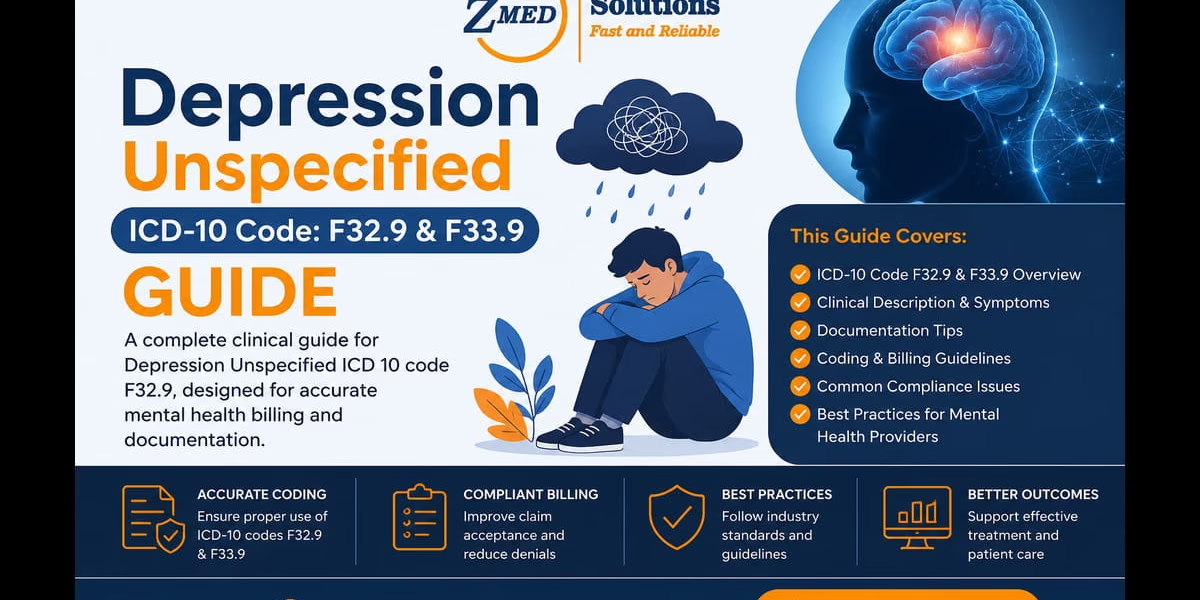
Depression, unspecified is coded F32.A (added October 1, 2021) when the provider documents depression without a major depressive disorder diagnosis. Use F32.9 for major depressive disorder, single episode, unspecified, and F33.9 for major depressive disorder, recurrent, unspecified. Documenting episode history and severity supports a more specific code.
What Is the Depression Unspecified ICD-10 Code?
When healthcare professionals document a patient’s depressive condition but cannot yet determine the episode type or severity level, they rely on the depression unspecified ICD 10 code. This code is part of ICD-10-CM (International Classification of Diseases, 10th Revision, Clinical Modification), the U.S. version of the World Health Organization’s ICD-10, maintained by the CDC’s National Center for Health Statistics (NCHS) together with the Centers for Medicare & Medicaid Services (CMS).
When the provider documents depression without specifying major depressive disorder, the code is F32.A (Depression, unspecified). When major depressive disorder is documented but severity is not, the code is F32.9 for a single episode or F33.9 for recurrent episodes. All three sit in the F32 and F33 categories of the ICD-10-CM mental health chapter.
These codes serve a critical role in medical billing and clinical documentation. Healthcare providers use them when the clinical picture is evolving, when further evaluation is pending, or when the available data does not yet support a more specific classification. Understanding the correct application of the ICD 10 CM depression code ensures that patients receive appropriate care pathways and that providers receive accurate reimbursements for services rendered.
The diagnosis code for depression within this “unspecified” category does not imply a lesser degree of clinical concern. Rather, it reflects an honest assessment of diagnostic certainty at a given point in time. Payers, auditors, and clinical documentation improvement (CDI) specialists all recognize these codes as clinically valid when properly documented.
F32.A vs F32.9: Which Code Fits “Depression, Unspecified”?
The most common mistake with this keyword is treating F32.9 as the catch-all for any depression note. Since October 1, 2021, ICD-10-CM has a separate code for depression that is not documented as major depressive disorder. The deciding factor is the exact diagnosis the provider writes, not the symptoms listed in the note.
| What the provider documents | Code | Official description |
| “Depression”, “depression NOS”, “depressive disorder NOS” | F32.A | Depression, unspecified |
| “Major depressive disorder” or “major depression”, no episode or severity | F32.9 | Major depressive disorder, single episode, unspecified |
| “MDD, recurrent”, severity not stated | F33.9 | Major depressive disorder, recurrent, unspecified |
| “MDD, single episode, moderate” | F32.1 | Major depressive disorder, single episode, moderate |
| Premenstrual dysphoric disorder | F32.81 | Premenstrual dysphoric disorder |
| Persistent depressive disorder (dysthymia) | F34.1 | Dysthymic disorder |
| Depression within bipolar disorder | F31.- | Excluded from F32; code in the bipolar category |
F32.A is a valid, billable code. Even so, some behavioral health payers expect a more specific diagnosis before approving ongoing psychotherapy, so check the payer’s policy if F32.A will stay on the claim beyond the first visits. The better long-term fix is documentation: once the provider confirms major depressive disorder, episode history and severity, the code moves to F32.0–F32.5 or F33.0–F33.42.
Understanding the ICD-10-CM Depression Code Structure
Before diving into specific codes, it is important to understand how the ICD-10-CM depression code list is organized. The F30–F39 block in ICD-10-CM covers mood (affective) disorders. Within this block, the F32 and F33 categories are the most directly relevant to depressive disorders.
The F32 Category — Depressive Episodes
The F32 category covers depressive episodes, specifically single-episode major depressive disorder. Within this category, severity levels are coded as follows:
- F32.0 — Major depressive disorder, single episode, mild
- F32.1 — Major depressive disorder, single episode, moderate
- F32.2 — Major depressive disorder, single episode, severe without psychotic features
- F32.3 — Major depressive disorder, single episode, severe with psychotic features
- F32.4 — Major depressive disorder, single episode, in partial remission
- F32.5 — Major depressive disorder, single episode, in full remission
- F32.89 — Other specified depressive episodes
- F32.9 — Major depressive disorder, single episode, unspecified (Focus code)
- F32.81 — Premenstrual dysphoric disorder
- F32.A — Depression, unspecified (added October 1, 2021)
The F33 Category — Recurrent Depressive Episodes
The F33 category applies when patients have a history of prior depressive episodes and are experiencing a recurrence. Subcodes mirror the F32 structure for severity:
- F33.0 — Major depressive disorder, recurrent, mild
- F33.1 — Major depressive disorder, recurrent, moderate
- F33.2 — Major depressive disorder, recurrent, severe without psychotic features
- F33.3 — Major depressive disorder, recurrent, severe with psychotic features
- F33.40 — Major depressive disorder, recurrent, in remission, unspecified
- F33.41 — Major depressive disorder, recurrent, in partial remission
- F33.42 — Major depressive disorder, recurrent, in full remission
- F33.8 — Other specified recurrent depressive disorders
- F33.9 — Major depressive disorder, recurrent, unspecified (Focus code)
Understanding this structure helps clinicians and coders select the most specific depressive disorder diagnosis code available based on documented clinical evidence. The goal is always to code to the highest level of specificity that is supported by the medical record.
F32.9 ICD-10 — Major Depressive Disorder, Single Episode, Unspecified
The F32.9 ICD 10 code is one of the most frequently used psychiatric diagnosis codes in outpatient mental health settings. It applies to patients presenting with a first-time depressive episode where the clinician has not yet determined or documented the severity level.
When Is F32.9 Appropriate?
Using F32.9 is clinically appropriate in the following scenarios:
- Initial evaluation visits where full diagnostic workup is still in progress.
- Intake assessments at behavioral health clinics where severity rating scales have not yet been administered.
- Telehealth encounters where full clinical assessment tools are pending.
- Documentation gaps where the provider notes depression but does not specify mild, moderate, or severe.
- Transitional care records received from another provider without full severity detail.
ICD-10 Official Description of F32.9
According to the ICD-10-CM official guidelines, F32.9 is described as “Major depressive disorder, single episode, unspecified.” This code falls under the broader description of a depressive episode unspecified, meaning the provider recognizes the depressive condition but has not classified its level of functional impairment, symptom count, or severity markers.
Clinical Documentation Requirements for F32.9
To support the use of F32.9, the clinical record should include:
- A confirmed diagnosis of depression based on clinical interview or standardized assessment
- Documentation that this represents the patient’s first known episode
- A note explaining why severity has not been specified at this time
- Any differential diagnoses being considered or ruled out
- The treatment plan initiated, including therapy referrals or medication considerations
Good documentation is the foundation of accurate depression medical coding. Coders reviewing charts should flag records where only “depression” is noted without severity or episode type, and query the treating provider for clarification before defaulting to F32.9.
F33.9 ICD-10 Code — Recurrent Depressive Disorder, Unspecified
The F33.9 ICD 10 code represents a different but equally important clinical scenario. This code is reserved for patients who have experienced two or more separate depressive episodes and are currently experiencing a recurrence, but where the current episode’s severity has not been specified.
Distinguishing F33.9 from F32.9
The key distinction between these two unspecified depressive disorder ICD 10 codes lies in episode history:
| Feature | F32.9 | F33.9 |
| Episode history | First/single episode | Recurrent (2+ episodes) |
| Severity specified | No | No |
| Prior episode documentation | Not applicable | Required in chart |
| Recurrence interval | N/A | Separated by ≥2 months of recovery |
| Common setting | Initial assessment | Established patients |
When to Use F33.9 in Practice
Clinicians should apply F33.9 when the medical record confirms a prior depressive episode — whether treated or untreated — and the current episode’s severity is undetermined. This might occur during routine follow-up visits where the provider updates the diagnosis without reassessing severity, or when a patient presents in crisis and the initial encounter focuses on stabilization rather than full severity classification.
Important Note for Coders: The recurrent depressive disorder ICD 10 code F33.9 requires evidence of prior episodes in the record. If that documentation is absent, coders should query the provider before applying this code. Assigning F33.9 without adequate episode history documentation may trigger a payer audit or claim denial.
ICD-10 Code for Depression NOS — What Does It Mean?
The term “NOS” stands for “Not Otherwise Specified,” a designation carried over from older DSM-IV and ICD-9 coding conventions. In current ICD-10-CM practice, “unspecified” and “NOS” are largely synonymous. Since October 1, 2021, the ICD 10 code for depression NOS is F32.A. F32.9 or F33.9 applies only when the provider documents major depressive disorder but not its severity.
Transition from ICD-9 to ICD-10 NOS Codes
Under ICD-9-CM, the commonly used code was 296.90 (Unspecified episodic mood disorder) and 311 (Depressive disorder, not elsewhere classified). With the U.S. transition to ICD-10-CM in October 2015, these older codes became obsolete. Healthcare organizations and billing departments migrated to the F32 and F33 categories for all depressive disorders.
The ICD 10 code for depression NOS was originally indexed to F32.9, but since October 1, 2021 it has its own code, F32.A. Apply F32.A, F32.9 or F33.9 based on the diagnosis the provider documents
- Review the full record for any severity indicators
- Determine if prior episodes are documented (indicating recurrence)
- Query the provider if ambiguity remains
- Apply F32.9 or F33.9 based on available evidence
Defaulting to the depression unspecified ICD 10 code is appropriate when documentation genuinely does not support a more specific assignment. However, it should never be used as a shortcut to avoid proper clinical documentation.
Unspecified Depression Symptoms: Clinical Overview
Understanding unspecified depression symptoms helps clinicians recognize when a diagnosis has been made but cannot be fully classified. Depression, in its most general form, is a mood disorder characterized by persistent feelings of sadness, hopelessness, and a loss of interest in daily activities. When a patient presents with these features but the clinician cannot yet determine the severity or episode type, the depression unspecified ICD 10 code captures the diagnosis without overstating clinical certainty.
Core Symptoms of Unspecified Depression
The following unspecified depression symptoms are commonly documented in records where F32.9 or F33.9 is applied:
- Persistent depressed mood lasting most of the day, nearly every day
- Anhedonia — reduced interest or pleasure in previously enjoyed activities
- Sleep disturbances — insomnia or hypersomnia
- Changes in appetite or weight — significant loss or gain without dieting
- Psychomotor agitation or retardation observable by others
- Fatigue or loss of energy nearly every day
- Feelings of worthlessness or excessive guilt
- Difficulty concentrating, thinking, or making decisions
- Recurrent thoughts of death or suicidal ideation (without a specific plan)
When five or more of these symptoms are present for at least two weeks and cause significant functional impairment, a formal diagnosis of major depressive disorder is warranted. If the severity dimension (mild, moderate, severe) has not been determined, the depressive episode unspecified coding category applies.
Why Severity May Remain Unspecified?
Clinicians may leave severity unspecified for several legitimate reasons. First-time encounters often yield incomplete data. Patients may underreport symptoms due to stigma. Cultural factors can affect how depression is expressed and communicated. Comorbid medical conditions — such as thyroid disorders, chronic pain, or substance use — may cloud the clinical picture. In all these cases, the diagnosis code for depression in its unspecified form is the most honest and clinically defensible choice.
How the DSM-5 Depression Diagnosis Maps to ICD-10?
The DSM-5 depression diagnosis framework and ICD-10-CM coding work side by side in U.S. mental health practice. The DSM-5 (Diagnostic and Statistical Manual of Mental Disorders, Fifth Edition) provides the clinical criteria for diagnosis, while the ICD-10 CM depression code provides the billing language required by payers.
DSM-5 Diagnostic Criteria for Major Depressive Disorder
The DSM-5 requires the following for a diagnosis of Major Depressive Disorder (MDD):
- Five or more symptoms from the defined list during the same two-week period
- At least one symptom must be either depressed mood or loss of interest/pleasure
- Symptoms cause clinically significant distress or functional impairment
- Symptoms are not attributable to substance use or a medical condition
- Symptoms are not better explained by a psychotic disorder
The DSM-5 itself provides ICD-10-CM codes alongside each diagnosis. For Major Depressive Disorder, Single Episode, the reference codes range from F32.0 (mild) through F32.9 (unspecified). For Major Depressive Disorder, Recurrent, the codes range from F33.0 through F33.9.
Crosswalk Table — DSM-5 to ICD-10-CM
| DSM-5 Specifier | ICD-10-CM Code |
| MDD, Single Episode, Mild | F32.0 |
| MDD, Single Episode, Moderate | F32.1 |
| MDD, Single Episode, Severe | F32.2 |
| MDD, Single Episode, Severe with Psychosis | F32.3 |
| MDD, Single Episode, Unspecified | F32.9 |
| MDD, Recurrent, Mild | F33.0 |
| MDD, Recurrent, Moderate | F33.1 |
| MDD, Recurrent, Severe | F33.2 |
| MDD, Recurrent, Severe with Psychosis | F33.3 |
| MDD, Recurrent, Unspecified | F33.9 |
Using the DSM 5 depression diagnosis criteria to justify the ICD-10 code selection strengthens clinical documentation and reduces payer denials. Every depressive disorder diagnosis code should be traceable to a documented clinical rationale within the medical record.
Depression Without Psychosis ICD-10 Codes Explained
One frequently searched clinical distinction is depression without psychosis ICD 10 coding. The ICD-10-CM system makes a clear distinction between depressive episodes with and without psychotic features.
What Are Psychotic Features in Depression?
Psychotic features in depression include hallucinations (hearing or seeing things that are not present) and delusions (fixed, false beliefs that are not culturally normative). When these features accompany a depressive episode, the codes F32.3 or F33.3 apply.
For depression without psychosis ICD 10 coding, the applicable codes are:
- F32.0, F32.1, F32.2 — Single episode without psychosis (by severity)
- F32.9 — Single episode, unspecified (use when psychosis status and severity are not documented)
- F33.0, F33.1, F33.2 — Recurrent episode without psychosis (by severity)
- F33.9 — Recurrent episode without psychosis, unspecified severity
Clinical Documentation Tip
When a provider documents that a patient is experiencing depression and specifically rules out psychotic features, coders should avoid codes ending in “.3” (which denote psychosis). In the absence of severity specification, F32.9 or F33.9 remains the correct depression unspecified ICD 10 code for non-psychotic presentations.
Accurate coding of the psychosis specifier is important for care planning, insurance authorization, and inpatient vs. outpatient level-of-care determinations. Misapplication of the psychosis codes can trigger authorization denials for outpatient services or, conversely, may delay appropriate intensive care for patients who actually require it.
Mild, Moderate, and Severe Depression ICD Codes Compared
While the focus of this article is on depression unspecified ICD 10 code usage, understanding how it compares to severity-specific codes is essential for coders, clinicians, and billing teams.
Mild Depression ICD-10 (F32.0 / F33.0)
Mild depression is characterized by the minimum required number of symptoms (approximately five) causing some, but not severe, functional impairment. The patient is typically still able to carry on most activities. The mild moderate severe depression ICD coding begins at the “mild” level when severity can be documented.
Moderate Depression ICD-10 (F32.1 / F33.1)
Moderate depression involves symptoms that cause more marked functional impairment. The patient may struggle significantly at work or in relationships. Standardized screening tools such as the PHQ-9 (Patient Health Questionnaire) can help clinicians assign the moderate severity designation. A PHQ-9 score of 10–14 typically corresponds to moderate depression.
Severe Depression Without Psychosis (F32.2 / F33.2)
Severe depression is marked by nearly all depressive symptoms, intense symptom severity, and significant functional impairment. The patient may be unable to work, care for themselves, or maintain relationships. PHQ-9 scores of 15 to 19 are usually read as moderately severe, and 20 to 27 as severe. The clinician, not the coder, decides how that maps to the documented severity.
When Unspecified Is the Right Choice?
If the clinical record does not contain PHQ-9 scores, severity rating descriptions, or explicit provider statements about mild, moderate, or severe levels, the depression unspecified ICD 10 code (F32.9 or F33.9) is the appropriate and defensible selection. Coders should not presume severity from symptom counts alone without explicit clinician documentation.
Anxiety and Depression ICD-10 Codes: Dual Diagnosis Coding
A significant proportion of patients presenting with depression also meet criteria for anxiety disorders. Accurate anxiety and depression ICD 10 coding requires understanding how to apply multiple codes when comorbidities are clinically documented.
Common Anxiety Diagnoses Paired with Depression
The most frequent anxiety diagnoses coded alongside major depressive disorder unspecified ICD 10 codes include:
- F41.1 — Generalized Anxiety Disorder (GAD)
- F41.0 — Panic disorder without agoraphobia
- F40.10 — Social anxiety disorder (social phobia)
- F41.9 — Anxiety disorder, unspecified
- F41.8 — Other specified anxiety disorders
ICD-10-CM Coding Rules for Comorbid Depression and Anxiety
ICD-10-CM does not have a single combination code for anxiety with depression (unlike some older ICD-9 conventions). Instead, both diagnoses are coded separately and sequenced based on which condition is the primary reason for the encounter.
For example, a patient seen for depression unspecified ICD 10 code with comorbid GAD would be coded as:
- Primary: F32.9 (if depression is the main focus of the visit)
- Secondary: F41.1 (GAD, documented as comorbid)
The ICD-10-CM official guidelines instruct providers to code all documented conditions that are addressed, monitored, evaluated, or treated during the encounter. Dual coding for anxiety and depression ICD 10 ensures complete clinical representation and supports appropriate resource allocation.
Mixed Anxiety and Depressive Disorder
In some cases, patients present with a combination of anxiety and depressive symptoms that do not meet full criteria for either disorder independently. The code F41.8 (Other specified anxiety disorders) is sometimes used for this “mixed anxious depression” presentation, although clinicians should consult ICD-10-CM official guidelines for their specific jurisdiction and payer requirements.
Mental Health ICD-10 Codes: The Broader F32–F33 Landscape
The mental health ICD 10 codes within the F-chapter extend far beyond depression, but the F32 and F33 categories remain among the highest-volume codes in behavioral health billing. Understanding the complete landscape of psychiatric diagnosis codes helps coders and providers situate the depression unspecified ICD 10 code within a broader clinical taxonomy.
Key ICD-10 F-Chapter Categories for Mental Health
| Code Range | Category |
| F01–F09 | Organic mental disorders |
| F10–F19 | Substance use disorders |
| F20–F29 | Schizophrenia spectrum disorders |
| F30–F39 | Mood (affective) disorders — includes all depression codes |
| F40–F48 | Anxiety, obsessive-compulsive, and stress-related disorders |
| F50–F59 | Behavioral syndromes |
| F60–F69 | Personality disorders |
| F70–F79 | Intellectual disabilities |
| F80–F89 | Neurodevelopmental disorders |
| F90–F98 | Childhood/adolescent behavioral disorders |
Within F30–F39, the mood disorder diagnosis code spectrum includes not only depression but also bipolar disorder, cyclothymia, and persistent depressive disorder (dysthymia). This context is important because misidentification of a depressive disorder diagnosis code as a bipolar code — or vice versa — has significant clinical and legal implications.
Persistent Depressive Disorder (Dysthymia) — F34.1
For patients with chronic, low-grade depressive symptoms lasting at least two years that do not meet full criteria for major depressive disorder, the ICD-10-CM code F34.1 (Persistent depressive disorder/dysthymia) is the appropriate selection. This is distinct from the depression unspecified ICD 10 code (F32.9/F33.9) and should not be used interchangeably.
Depression Medical Coding Best Practices for Clinicians
Accurate depression medical coding requires collaboration between treating clinicians and the medical coding team. Providers who understand coding conventions can document in ways that support precise code assignment and reduce claim denials.
Tip 1 — Be Specific About Episode History
Always document whether the current depressive episode is the patient’s first or a recurrence. This single data point determines whether F32.x or F33.x applies. A note stating “patient has experienced prior depressive episodes” is sufficient to justify the recurrent category.
Tip 2 — Use Validated Severity Scales
Administering and documenting a standardized severity rating at each encounter eliminates ambiguity. The most commonly used tools include:
- PHQ-9 (Patient Health Questionnaire-9) — widely accepted, easy to administer
- HAM-D (Hamilton Rating Scale for Depression) — used in research and specialty settings
- BDI-II (Beck Depression Inventory-II) — comprehensive self-report measure
- MADRS (Montgomery-Åsberg Depression Rating Scale) — often used in clinical trials
When providers document these scores, coders can assign F32.0, F32.1, or F32.2 with confidence and avoid using the unspecified depression ICD-10 code when the documentation supports a more specific code.
Tip 3 — Document Psychosis Status Explicitly
Always note whether psychotic features are present or absent. A simple statement — “depression without psychotic features” — rules out the F32.3/F33.3 codes and supports the non-psychotic severity range. This is especially important in inpatient and emergency settings.
Tip 4 — Avoid “Depression” Alone as a Diagnosis
The word “depression” alone in a clinical note is insufficient for coding purposes. Coders need episode type, severity, and psychosis status to assign the most specific code. “Major depressive disorder, single episode, moderate severity” maps cleanly to F32.1, while “depression” alone forces the coder toward the depression unspecified ICD 10 code by default.
Tip 5 — Review and Update Codes at Each Encounter
The unspecified depressive disorder ICD 10 code should be considered a temporary placeholder, not a permanent diagnosis assignment. At each subsequent visit, clinicians should re-evaluate severity and update the diagnosis code to reflect current clinical status. Persistent use of F32.9 or F33.9 without progression to specificity may raise flags in payer audits.
Depression Billing Code: Avoiding Common Reimbursement Errors
The depression billing code landscape is complex, and errors in code selection can result in claim denials, audit exposure, and delayed reimbursements. The following section addresses the most common billing pitfalls associated with the depression unspecified ICD 10 code and related codes.
Error 1 — Using Outdated ICD-9 Codes
Some older electronic health record (EHR) systems or templates may still reference ICD-9 codes such as 296.90 or 311. These codes are no longer valid for claims submitted in the United States. All depression billing code submissions must use ICD-10-CM codes effective October 1, 2015.
Error 2 — Applying F32.9 to Clearly Documented Severity
Coders assign severity from the provider’s documented diagnosis, not from a screening score. If the note records a PHQ-9 of 12 but the provider only writes “major depressive disorder”, the coder should not change the code to F32.1 on their own. The compliant step is a query: show the provider the PHQ-9 result and other clinical evidence, and offer clinically supported options, including “unable to determine”.Once the provider documents a severity, assign the matching code. Undercoding with F32.9 when severity is clearly stated is still an error, because it weakens medical necessity and quality reporting. The rule cuts both ways: use the documented severity when it is there, and query when it is only implied.
Error 3 — Confusing F32.9 with F32.89
F32.89 represents “Other specified depressive episodes” and applies to atypical or unusual presentations that do not fit the standard F32 subcategories. Do not confuse it with F32.9, which represents unspecified depression. Using F32.89 without specific documentation of an atypical presentation may lead to payer inquiries or denials.
Error 4 — Missing Secondary Codes for Comorbidities
When a patient with major depressive disorder, unspecified ICD-10 (F32.9 or F33.9) also has documented comorbidities, such as GAD (F41.1), PTSD (F43.10), or substance use disorder, providers should list all comorbid diagnoses addressed during the encounter. Incomplete code lists can reduce the medical necessity justification for the level of service billed.
Error 5 — Neglecting Z-Codes for Social Determinants
ICD-10-CM includes Z-codes (Z55–Z65) that capture social determinants of health such as housing instability, food insecurity, and social isolation. These factors frequently co-occur with depression and, when documented, should be added as secondary codes. Including relevant Z-codes alongside the depression unspecified ICD 10 code supports a comprehensive clinical picture and may satisfy payer requirements for certain care management programs.
Depression CPT Code and ICD-10 Pairing Guide
The depression CPT code (Current Procedural Terminology) represents the service or procedure performed, while the ICD-10-CM code represents the diagnosis supporting that service. Both must appear on a claim, and they must be clinically linked.
Common CPT Codes Paired with Depression ICD-10 Codes
| CPT Code | Description | Typical ICD-10 Pairing |
| 99213 | Office visit, established patient, low medical decision making | F32.A, F32.9, F33.9 |
| 99214 | Office visit, established patient, moderate medical decision making | F32.1, F33.1, F32.9 |
| 90791 | Psychiatric diagnostic evaluation | F32.9, F33.9 (initial) |
| 90837 | Psychotherapy, 60 minutes | F32.x, F33.x |
| 90834 | Psychotherapy, 45 minutes | F32.x, F33.x |
| 90832 | Psychotherapy, 30 minutes | F32.x, F33.x |
| 96127 | Brief emotional/behavioral assessment (PHQ-9) | Z13.31 when screening only; the diagnosis code when monitoring a known condition |
| 90853 | Group psychotherapy | F32.x, F33.x |
For Medicare patients, annual depression screening in primary care has its own coverage rules; see Medicare’s depression screening coverage page.
Medical Necessity and CPT-ICD Pairing
Payers require that the ICD-10 depression billing code submitted supports the medical necessity of the CPT code billed. For example, billing 90837 (60-minute psychotherapy) with a diagnosis of F32.9 (unspecified) is generally acceptable, provided the clinical record includes documentation that justifies the extended therapy session — such as complex symptom presentation, suicidal ideation, or significant psychosocial stressors.
When billing for a psychiatric evaluation (90791), providers often use the unspecified depression ICD-10 code (F32.9 or F33.9) because the evaluation helps establish a more specific diagnosis. Subsequent encounters should then reflect more specific coding where possible.
ICD-10 Code Lookup for Depression — Practical Tools and Tips
Clinicians and coders searching for ICD 10 code lookup depression resources have access to a variety of authoritative databases and tools. Knowing where and how to look up codes accurately prevents coding errors and streamlines the documentation workflow.
Official ICD-10-CM Code Lookup Resources
- CMS ICD-10-CM Browser (cms.gov) — The official source for all valid ICD-10-CM codes, updated annually on October 1
- CDC ICD-10-CM Tabular List (cdc.gov/nchs) — Includes guidelines, instructional notes, and excludes/includes notes
- AHA Coding Clinic — Published by the American Hospital Association, provides official coding guidance and clarification
- AAPC and AHIMA — Professional coding organizations offering code lookup tools, training, and credentialing
Using ICD-10 Code Lookup Tools Effectively
When using an ICD 10 code lookup depression tool, search the index using the following pathways:
- Main Term: Disorder
- Depressive
- Major, single episode → F32.x
- Major, recurrent → F33.x
- Depressive
- Main Term: Depression
- Major → F32.9 (if severity unspecified)
- Recurrent → F33.9 (if severity unspecified)
- Depression (NOS) → F32.A
Always verify the code in the Tabular List to confirm inclusion and exclusion notes. For example, bipolar depression is excluded from F32/F33 and coded under F31.x. Using a code lookup tool without verifying the Tabular List can lead to these exclusion errors.
Annual ICD-10-CM Code Updates
ICD-10-CM codes are updated annually, with changes effective October 1 of each fiscal year. Coders and billing departments must review the annual addenda for changes to the F32 and F33 categories. New codes, revised descriptions, or deleted codes can affect depression medical coding workflows. Staying current with these updates is a professional responsibility for all mental health diagnosis billing teams.
Mood Disorder Diagnosis Code Reference Sheet
For quick reference, the following table consolidates the most relevant mood disorder diagnosis codes from the ICD-10-CM F30–F39 block that mental health coders encounter regularly.
Quick Reference — Mood Disorder ICD-10-CM Codes
| Code | Description |
| F32.0 | Major depressive disorder, single episode, mild |
| F32.1 | Major depressive disorder, single episode, moderate |
| F32.2 | Major depressive disorder, single episode, severe, no psychosis |
| F32.3 | Major depressive disorder, single episode, severe, with psychosis |
| F32.4 | Major depressive disorder, single episode, partial remission |
| F32.5 | Major depressive disorder, single episode, full remission |
| F32.89 | Other specified depressive episodes |
| F32.9 | Major depressive disorder, single episode, unspecified |
| F33.0 | Major depressive disorder, recurrent, mild |
| F33.1 | Major depressive disorder, recurrent, moderate |
| F33.2 | Major depressive disorder, recurrent, severe, no psychosis |
| F33.3 | Major depressive disorder, recurrent, severe, with psychosis |
| F33.40 | Major depressive disorder, recurrent, remission, unspecified |
| F33.41 | Major depressive disorder, recurrent, partial remission |
| F33.42 | Major depressive disorder, recurrent, full remission |
| F33.8 | Other specified recurrent depressive disorders |
| F33.9 | Major depressive disorder, recurrent, unspecified |
| F34.1 | Persistent depressive disorder (dysthymia) |
| F34.81 | Disruptive mood dysregulation disorder |
| F34.89 | Other specified persistent mood disorders |
| F41.1 | Generalized anxiety disorder (commonly comorbid) |
| F41.9 | Anxiety disorder, unspecified (commonly comorbid) |
| F32.81 | Premenstrual dysphoric disorder |
| F32.A | Depression, unspecified |
This reference sheet supports fast, accurate ICD-10 code lookup depression during documentation review, billing audits, and clinical supervision sessions.
Frequently Asked Questions
What is the most commonly used depression unspecified ICD 10 code?
The most commonly used depression unspecified ICD 10 code is F32.9, which stands for “Major Depressive Disorder, Single Episode, Unspecified.” This code is apply when a clinician diagnoses a patient with a first-time depressive episode but has not yet documented or determined the severity level — mild, moderate, or severe. It is widely use in outpatient mental health settings, particularly during initial evaluations and intake visits where a complete severity assessment has not yet been complete. For patients with a history of prior depressive episodes experiencing a recurrence of unspecified severity, the appropriate code is F33.9 instead.
What is the difference between F32.9 and F33.9?
F32.9 and F33.9 both represent unspecified depressive disorder ICD 10 presentations, but they differ in episode history. F32.9 is used for a patient experiencing their first or only known depressive episode where severity has not been specified. F33.9 applies when the patient has a documented history of two or more separate depressive episodes — a recurrent pattern — and the current episode’s severity is unspecified. The distinction requires the coder and clinician to review the patient’s full medical history to confirm whether prior episodes are document. Without evidence of prior episodes, F32.9 is the default depression unspecified ICD 10 code.
Can F32.9 be use for billing purposes alongside CPT codes for psychotherapy?
Yes. F32.9 is a valid depression billing code that can be pair with a wide range of CPT codes for psychotherapy services, including 90832 (30-minute therapy), 90834 (45-minute therapy), 90837 (60-minute therapy), and 90791 (psychiatric diagnostic evaluation). The key requirement is that the medical record supports the medical necessity of the service billed. As long as the clinical documentation reflects a genuine diagnosis of unspecified major depressive disorder — with appropriate detail about symptom presentation, functional impairment, and the reason severity has not been specified — payers generally accept F32.9 as the supporting diagnosis code for depression on mental health service claims.
Is the depression unspecified ICD 10 code the same as depression NOS?
Yes, and since October 1, 2021 that code is F32.A (Depression, unspecified). Its inclusion terms are depression NOS and depressive disorder NOS. Before that date the index sent these terms to F32.9, which is why older guides still list F32.9. Use F32.9 or F33.9 only when the provider documents major depressive disorder without severity.
How often should the depression unspecified ICD 10 code be updated to a more specific code?
The depression unspecified ICD 10 code (F32.9 or F33.9) should ideally be updated to a severity-specific code. Such as F32.0 (mild), F32.1 (moderate), or F32.2 (severe) — as soon as the clinical documentation supports that level of specificity. Best practice recommends that providers administer a validated severity scale such as the PHQ-9 at each encounter and document the score. Once the score is document, a more specific ICD-10 CM depression code can and should be assigned. Persistent use of the depression unspecified ICD 10 code beyond the initial evaluation period may raise quality reporting flags and could indicate a clinical documentation gap. The unspecified code is intended as a temporary placeholder, not a long-term diagnosis assignment.
What is the difference between F32.A and F32.9?
F32.A is depression, unspecified, used when the provider documents depression without a major depressive disorder diagnosis. F32.9 is major depressive disorder, single episode, unspecified, used when MDD is documented but severity is not.
Can a coder assign depression severity based on a PHQ-9 score?
No. Severity must come from the provider’s documented diagnosis. If the PHQ-9 suggests a severity the provider has not stated, the coder should send a non-leading query that presents the clinical evidence and lets the provider choose.
Final Thoughts
The depression unspecified ICD 10 code — primarily represented by F32.9 and F33.9 — is an essential but often misunderstood component of the ICD-10-CM mental health coding framework. These codes serve a legitimate clinical purpose: they capture confirmed diagnoses of major depressive disorder in situations where severity or episode history cannot yet be fully specified. Used correctly, they support accurate medical billing, appropriate care planning, and honest clinical documentation.
For clinicians, the key takeaway is to document as specifically as possible — using validated severity scales, noting episode history, and specifying psychosis status — while using the unspecified depressive disorder ICD 10 codes as temporary placeholders rather than permanent diagnoses. For coders and billing professionals, the imperative is to query providers when documentation is ambiguous, to avoid miscoding comorbidities, and to stay current with annual ICD-10-CM updates. Many of these errors are covered in more depth in our guide to mental health billing challenges.
The broader landscape of mental health ICD 10 codes, including the full F32–F33 hierarchy, the DSM 5 depression diagnosis crosswalk, and the anxiety and depression ICD 10 comorbidity framework, equips both clinical and administrative teams to navigate the complexity of behavioral health billing with confidence and accuracy.
When in doubt, always refer back to the official CMS ICD-10-CM guidelines, consult credentialing resources from AAPC or AHIMA, and use clinical documentation improvement tools to drive coding specificity. Accurate depression medical coding is not just a billing function — it is a direct reflection of the quality and integrity of clinical care.
Key Market Player
Ready to optimize your medical billing and boost your revenue? Look no further. Zmed Solutions LLC is your trusted partner in professional Medical Billing Services.
Join our growing network of healthcare providers who have already elevated their revenue with our expert services. Don't miss out on what could be your practice's most profitable decision.
Schedule a Consultation Today!
Contact Us Now, and experience the difference. Your financial success starts here!