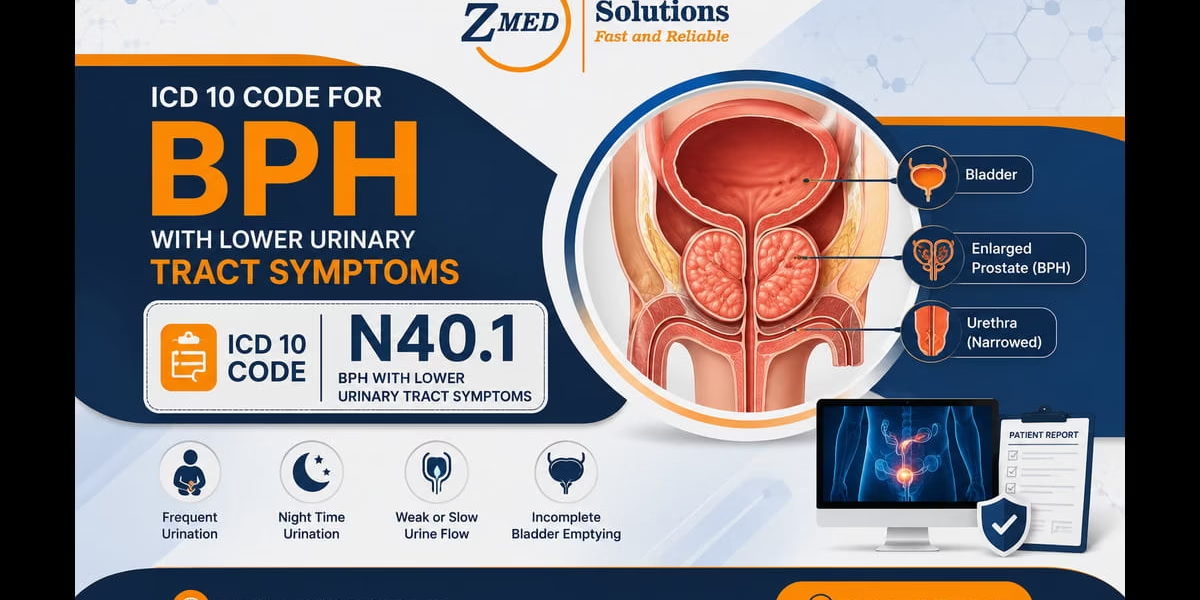
The ICD 10 code for BPH with lower urinary tract symptoms is N40.1, which stands for Benign Prostatic Hyperplasia with Lower Urinary Tract Symptoms. This code is used when a patient has an enlarged prostate that is actively causing urinary symptoms such as nocturia, urinary frequency, urgency, weak stream, or urinary retention. It differs from N40.0, which is used when BPH is confirmed but no symptoms are present. Accurate use of N40.1 is critical for proper medical billing, insurance reimbursement, and clinical documentation.
Maximize Your Practice’s Financial Performance with Zmed Solutions.
Stop leaving revenue on the table. Our expert medical billing, coding, and revenue cycle management services are designed to minimize claim denials, accelerate reimbursements, and keep your cash flow healthy — so you can focus on what matters most: your patients.
Explore Our Professional Services or Visit Us to discover how we can transform your practice’s financial outcomes.
Accurate medical coding is the backbone of modern healthcare. It ensures proper patient records, correct insurance reimbursements, and consistent clinical communication. For urologists, general practitioners, and medical coders, one of the most commonly encountered diagnosis codes involves an enlarged prostate causing urinary difficulties in men. The ICD 10 code for BPH with lower urinary tract symptoms is a critical code to understand fully.
N40.1 ICD 10 code
This comprehensive guide explores everything about the N40.1 ICD 10 code — from its official definition to practical billing applications. Whether you are a medical professional, a healthcare coder, or a patient trying to understand your diagnosis paperwork, this article provides 360-degree coverage of the topic. We will also explore the difference between N40.0 and N40.1, outline the BPH coding guidelines 2024, and demonstrate how to apply this code in real clinical settings.
By the end of this guide, you will have a thorough understanding of the benign prostatic hyperplasia with LUTS code, its related codes, and how to use it with full compliance and precision.
What Is BPH (Benign Prostatic Hyperplasia)?
Benign Prostatic Hyperplasia (BPH) is a non-cancerous enlargement of the prostate gland. It is one of the most prevalent conditions affecting men over the age of 50. The prostate gland naturally grows as men age, and in many cases, this growth begins to compress the urethra, causing problems with urination. This is where the clinical concept of lower urinary tract symptoms diagnosis code becomes vital.
BPH is not prostate cancer, and having BPH does not increase a man’s risk of developing cancer. However, the symptoms it causes — including urinary frequency, urgency, nocturia, a weak urine stream, and difficulty initiating urination — can significantly reduce quality of life. According to epidemiological data, more than 50% of men in their sixties and up to 90% of men in their eighties have some degree of BPH.
The condition is progressive. Without proper management, BPH can lead to complications such as urinary retention, recurrent urinary tract infections, bladder stones, and even kidney damage in severe cases. From a medical coding perspective, distinguishing whether the condition is symptomatic or asymptomatic has major implications, which is why the ICD 10 BPH urinary obstruction classification uses different codes for these scenarios.
Understanding the pathophysiology of BPH helps coders and clinicians select the most accurate diagnosis code. When the enlarged prostate actively causes urinary difficulties, the correct code is N40.1. When it is confirmed but silent, it is N40.0.
Understanding Lower Urinary Tract Symptoms (LUTS)
Lower Urinary Tract Symptoms (LUTS) is a clinical umbrella term that encompasses a range of urinary complaints related to the bladder, prostate, and urethra. LUTS can be categorized into three main groups: storage symptoms, voiding symptoms, and post-micturition symptoms. All of these are relevant to the LUTS male diagnosis code classification.
Storage Symptoms
Storage symptoms occur while the bladder is filling with urine. These include:
- Urinary frequency — needing to urinate more often than normal, typically more than eight times in 24 hours
- Urgency — a sudden, strong desire to urinate that is difficult to postpone
- Nocturia — waking up one or more times during the night to urinate
- Urge incontinence — leaking urine due to an uncontrollable urge
The ICD 10 code nocturia frequency urgency symptoms are among the most common complaints in BPH patients. These are directly captured when using N40.1.
Voiding Symptoms
Voiding symptoms occur during urination and include:
- Weak or slow urine stream — reduced force of the urinary stream
- Straining to void — needing to push or bear down to start or maintain urination
- Intermittent stream — urine flow that starts and stops repeatedly
- Hesitancy — difficulty initiating urination
- Incomplete emptying — the feeling that the bladder has not been fully emptied
These symptoms are directly caused by the physical obstruction of the urethra by the enlarged prostate, making this a textbook case for ICD 10 code for enlarged prostate with symptoms.
Post-Micturition Symptoms
Post-micturition symptoms occur after urination:
- Post-void dribbling — involuntary loss of urine immediately after urination
- Sensation of incomplete emptying — persistent feeling that the bladder still contains urine
All three categories of LUTS can coexist in a single patient with BPH, and their presence is the clinical trigger that warrants the use of N40.1 rather than N40.0 in the N40 ICD 10 code prostate category.
What Is the ICD-10-CM Coding System?
The International Classification of Diseases, Tenth Revision, Clinical Modification (ICD-10-CM) is the official coding system used in the United States for classifying diagnoses, symptoms, diseases, injuries, and other health conditions. It is maintained and updated annually by the Centers for Medicare & Medicaid Services (CMS) and the National Center for Health Statistics (NCHS).
ICD-10-CM replaced ICD-9-CM on October 1, 2015, and brought with it a dramatically expanded code set — going from approximately 14,000 codes to over 70,000 codes. This expansion allows for far greater specificity in documenting patient conditions. The BPH ICD 10 code structure is one example of how this specificity helps distinguish between clinical presentations.
Why ICD-10 Coding Matters?
Correct ICD-10 coding is essential for several reasons:
- Insurance Reimbursement: Payers use diagnosis codes to determine whether a procedure or service is medically necessary. An incorrect code can result in claim denial.
- Clinical Research: Aggregated diagnosis codes help researchers track disease prevalence and outcomes.
- Public Health Surveillance: Coding data informs public health decisions at a national level.
- Legal and Compliance: Inaccurate coding can trigger audits, fraud investigations, or penalties under the False Claims Act.
For BPH specifically, the difference between N40.0 and N40.1 directly impacts whether certain treatments — such as alpha-blocker medications, minimally invasive procedures, or surgery — are considered medically necessary by the payer. This is why understanding the medical billing code for BPH is so commercially important.
Structure of ICD-10-CM Codes
ICD-10-CM codes are alphanumeric and can be three to seven characters long. The first character is always a letter. Characters two and three are numeric. Characters four through seven provide increasing levels of specificity. For BPH, the codes fall under Chapter 14: Diseases of the Genitourinary System (N00–N99), specifically under category N40 — Benign prostatic hyperplasia.
ICD 10 Code for BPH With Lower Urinary Tract Symptoms: N40.1
The official ICD 10 code for BPH with lower urinary tract symptoms is:
N40.1 — Benign Prostatic Hyperplasia with Lower Urinary Tract Symptoms
This is the single most important code in this article. It is used whenever a patient has a confirmed enlarged prostate (BPH) that is actively producing urinary symptoms. The code belongs to the N40 category group and is the symptomatic counterpart to N40.0.
Official ICD-10-CM Description
| Code | Full Description |
| N40.1 | Benign prostatic hyperplasia with lower urinary tract symptoms |
This code is valid for use in adult male patients. It is not gender-neutral — BPH is a male-specific condition, and the code should only be assigned to male patients.
What Qualifies a Patient for N40.1?
A patient qualifies for the N40.1 ICD 10 code when ALL of the following conditions are met:
- The patient has a confirmed diagnosis of Benign Prostatic Hyperplasia (either by digital rectal exam, PSA levels, ultrasound, or urodynamic testing)
- The patient is experiencing at least one active lower urinary tract symptom attributable to BPH
- The physician has documented a causal relationship between the BPH and the symptoms
The symptoms that trigger the use of N40.1 include but are not limited to:
- Nocturia (waking at night to urinate)
- Urinary frequency (urinating more than eight times per day)
- Urinary urgency (sudden strong urge to urinate)
- Dysuria (painful urination)
- Weak urinary stream
- Urinary hesitancy
- Urinary retention (inability to fully empty the bladder)
- Post-void dribbling
When any of these symptoms are clinically linked to BPH, the coder must use N40.1, not N40.0.
Synonyms and Alternate Descriptions for N40.1
The following clinical terms are all correctly captured by N40.1:
- Benign enlargement of the prostate with LUTS
- BPH with obstructive symptoms
- Adenomatous hypertrophy of prostate with symptoms
- Benign hypertrophy of the prostate with lower urinary tract symptoms
- Benign prostatic hypertrophy ICD 10 with symptoms — also maps to N40.1
- Fibrous prostate with LUTS
- Nodular hyperplasia of the prostate with LUTS
- Polyp of prostate with LUTS
It is worth noting that both “hyperplasia” and “hypertrophy” of the prostate map to the same ICD-10 code category. Despite being distinct pathological processes, ICD-10-CM uses them interchangeably under the N40 code group.
N40.1 vs N40.0: Key Differences You Must Know
One of the most consequential distinctions in prostate-related medical coding is the difference between N40.0 and N40.1 ICD 10 codes. Confusing these two codes is a common and impactful coding error.
N40.0 — BPH Without Lower Urinary Tract Symptoms
| Code | Description |
| N40.0 | Benign prostatic hyperplasia without lower urinary tract symptoms |
This code is used when a patient’s prostate is confirmed to be enlarged, but the patient does NOT have any active LUTS. This is often the case when BPH is detected incidentally during a routine physical exam or PSA screening, and the patient reports no urinary complaints at the time of the visit.
Clinical Scenario for N40.0: A 58-year-old male presents for a routine wellness exam. His PSA is mildly elevated. Rectal exam confirms a slightly enlarged prostate. He reports no difficulty urinating, no frequency, no urgency, and no nocturia. He sleeps through the night without waking to urinate. In this case, the correct code is N40.0.
N40.1 — BPH With Lower Urinary Tract Symptoms
In contrast, N40.1 applies when the BPH is symptomatic.
Clinical Scenario for N40.1: A 65-year-old male presents with a three-month history of waking two to three times per night to urinate (nocturia), a noticeably weaker urine stream compared to prior years, and occasional urgency. Physical exam and ultrasound confirm BPH. In this case, the correct code is N40.1.
Why the Distinction Matters?
| Factor | N40.0 | N40.1 |
| Symptoms present | No | Yes |
| Triggers treatment need | Watchful waiting | Active management |
| Supports medication authorization | Sometimes | Yes |
| Supports procedural billing | Limited | Strong |
| Impacts medical necessity | Lower | Higher |
From a medical billing code for BPH perspective, N40.1 is the code that most strongly supports medical necessity for treatments including alpha-blockers (tamsulosin, alfuzosin), 5-alpha reductase inhibitors (finasteride, dutasteride), minimally invasive procedures like TURP (transurethral resection of the prostate), laser therapy, and newer interventions like UroLift or Rezum.
Complete N40 Code Family Breakdown
The N40 ICD 10 code prostate category includes four distinct codes. Understanding all four is essential for comprehensive coding accuracy.
Full N40 Code Table
| ICD-10 Code | Description | LUTS Present? |
| N40.0 | Benign prostatic hyperplasia without lower urinary tract symptoms | No |
| N40.1 | Benign prostatic hyperplasia with lower urinary tract symptoms | Yes |
| N40.2 | Nodular prostate without lower urinary tract symptoms | No |
| N40.3 | Nodular prostate with lower urinary tract symptoms | Yes |
N40.2 — Nodular Prostate Without LUTS
N40.2 applies to a nodular prostate — a prostate with a distinct nodule or nodules — where no urinary symptoms are present. This is different from diffuse hyperplasia.
N40.3 — Nodular Prostate With LUTS
N40.3 is the symptomatic counterpart to N40.2. It is used when a nodular prostate is causing active lower urinary tract symptoms. The nodular nature of the prostate must be documented in the clinical notes to justify this code over N40.1.
When to Use N40.2 or N40.3 vs N40.1?
The key differentiator is the pathological description of the prostate. If the provider documents a “nodular prostate” or “prostate with distinct nodule,” use N40.2 or N40.3 accordingly. If the documentation says “enlarged prostate,” “BPH,” “benign prostatic hyperplasia,” or “prostatic hypertrophy,” use N40.0 or N40.1.
BPH Coding Guidelines 2024: Official Rules
The BPH coding guidelines 2024 continue to follow the ICD-10-CM Official Guidelines for Coding and Reporting. Here are the most critical rules that govern the use of N40.1 and related codes.
Coding from the Physician’s Documentation
Coders must assign codes based solely on what the physician or qualified healthcare provider has documented. If the record does not explicitly document lower urinary tract symptoms, the coder cannot assume their presence and assign N40.1. They must use N40.0.
Guideline: If the documentation states “BPH” without mentioning symptoms, query the physician before assigning N40.1.
Use the Code That Reflects the Current Encounter
ICD-10-CM guidelines require that codes reflect the patient’s condition at the time of the encounter. A patient who previously had LUTS but is currently asymptomatic after treatment should be coded with N40.0 at that visit, not N40.1.
Use Additional Codes for Specific Symptoms
When a patient with BPH presents with a specific urinary symptom that is separately significant, the guidelines permit — and in some cases require — the use of additional codes. For example, if BPH causes urinary retention, the coder should assign both N40.1 and R33.8 (Other retention of urine).
No 7th Character Required for N40.1
Unlike many injury-related ICD-10 codes, the N40.1 ICD 10 code does NOT require a 7th character extension. The code is complete as written. There are no laterality modifiers, episode-of-care designators, or anatomical detail extensions needed for this code. This is a common question in coding audits, and the answer is straightforward: N40.1 is a standalone, complete code.
Sequence N40.1 as the Principal Diagnosis
When a patient is admitted specifically due to BPH with LUTS — for instance, for a TURP procedure or due to acute urinary retention caused by BPH — N40.1 should be sequenced as the principal diagnosis. Secondary codes for the specific symptoms or complications follow.
Coding for Incidental BPH Findings
If BPH is found incidentally during a visit for another condition and no symptoms are present, use N40.0 as a secondary diagnosis. Do not use N40.1 unless LUTS are documented and attributed to the BPH.
How to Use N40.1 in Medical Billing?
The medical billing code for BPH — particularly N40.1 — has significant commercial implications for both providers and payers. Correct use ensures maximum reimbursement while maintaining compliance.
Linking N40.1 to CPT Procedures
When billing for procedures to treat BPH, the diagnosis code N40.1 must be linked to the corresponding CPT code to establish medical necessity. Common CPT codes used alongside N40.1 include:
| CPT Code | Procedure Description |
| 52601 | Transurethral resection of prostate (TURP), complete |
| 52648 | Laser vaporization of prostate |
| 52441 | UroLift (prostatic urethral lift) |
| 55899 | Unlisted procedure, male genital system |
| 76872 | Transrectal ultrasound of prostate |
| 51798 | Measurement of post-void residual urine volume |
| 51741 | Complex uroflowmetry |
Each of these procedures is medically justified by the presence of BPH with lower urinary tract symptoms diagnosis billing code N40.1.
Insurance Coverage and Medical Necessity
Most major private insurers and Medicare consider BPH procedures medically necessary when:
- The patient has documented LUTS attributed to BPH (supporting the use of N40.1)
- Conservative treatments have been attempted and failed
- The patient’s International Prostate Symptom Score (IPSS) is moderate to severe
Without a properly documented N40.1 code, insurers may deny claims for procedural reimbursement. This makes the BPH with lower urinary tract symptoms diagnosis billing code one of the most commercially significant codes in men’s urology billing.
Evaluation and Management (E&M) Coding With N40.1
N40.1 is also used as the diagnosis code for office visits, follow-up appointments, and telemedicine consultations related to BPH management. Common E&M codes billed with N40.1 include:
- 99213 — Office visit, established patient, low complexity
- 99214 — Office visit, established patient, moderate complexity
- 99215 — Office visit, established patient, high complexity
- 99202–99205 — New patient office visits
The complexity level selected should match the documented complexity of medical decision-making at the visit.
Common Coding Errors and How to Avoid Them?
Medical coders make several recurring errors when working with the ICD 10 code for BPH with lower urinary tract symptoms. Understanding these pitfalls prevents claim denials and compliance issues.
Using N40.1 Without Documented LUTS
The most common error is assigning N40.1 when the clinical documentation only confirms BPH without specifically noting any symptoms. The correct code in that scenario is N40.0. Coders should carefully review the physician’s notes for documented complaints such as urgency, frequency, nocturia, weak stream, or hesitancy before selecting N40.1.
Confusing N40.1 With N40.3
N40.1 applies to diffuse BPH with LUTS, while N40.3 applies specifically to a nodular prostate with LUTS. Assigning N40.1 when the documentation says “nodular prostate” is technically incorrect, though it may not always result in a claim denial. Careful reading of the pathological description prevents this error.
Omitting Secondary Codes for Specific Symptoms
When a patient presents with BPH and a specific, separately significant symptom such as acute urinary retention, the coder must report both N40.1 and the code for urinary retention (such as R33.8). Reporting N40.1 alone misses important clinical detail and may underrepresent the severity of the patient’s condition.
Using Outdated ICD-9 Codes
Some older practice management systems or templates may still reference legacy ICD-9 codes like 600.01 (BPH with urinary obstruction) or 600.00 (BPH without urinary obstruction). These are no longer valid. Only ICD-10-CM codes are accepted in current medical billing, and the correct modern equivalents are N40.1 and N40.0 respectively.
Wrong Code for Female Patients
BPH is a male-only condition. Assigning N40.1 to a female patient is an error that will typically result in claim rejection. Women may experience LUTS due to other causes, which require entirely different codes.
Clinical Documentation Requirements for N40.1
Proper clinical documentation is the foundation of correct coding. For N40.1 to be properly assigned, the medical record must contain specific documented elements.
Required Documentation Elements
A complete clinical note supporting N40.1 should include:
- Chief Complaint — patient-reported urinary symptoms (e.g., “patient reports waking three times per night to urinate and a weak stream”)
- History of Present Illness (HPI) — duration, severity, progression, and impact of symptoms
- Physical Examination — digital rectal exam (DRE) findings confirming prostate enlargement
- Diagnostic Workup — PSA level, transrectal ultrasound (TRUS) findings, uroflowmetry results, post-void residual (PVR) measurement
- Assessment — explicit physician diagnosis of “BPH with LUTS” or equivalent language
- Plan — treatment or management plan tied to the BPH diagnosis
International Prostate Symptom Score (IPSS)
The IPSS is a validated, seven-question tool used to quantify LUTS severity. Scores range from 0 to 35:
| IPSS Score | Severity |
| 0–7 | Mild symptoms |
| 8–19 | Moderate symptoms |
| 20–35 | Severe symptoms |
Documenting the IPSS in the chart strengthens the clinical justification for N40.1 and supports medical necessity for treatment. Many payers require an IPSS score as part of prior authorization for BPH procedures.
Query Physician When Documentation Is Unclear
When the physician documents only “enlarged prostate” or “prostatism” without specifying symptom status, the coder should query the provider before assigning N40.1 or N40.0. A provider query form should be used, and the response should be incorporated into the medical record.
ICD 10 Code for Urinary Retention in BPH
Urinary retention is one of the most serious complications of BPH. The ICD 10 code urinary retention BPH scenario requires dual coding in most cases.
Acute vs Chronic Urinary Retention
| Condition | ICD-10 Code | Description |
| Urinary retention, unspecified | R33.9 | Retention without specification |
| Urinary retention, other | R33.8 | Retention due to specified cause (e.g., BPH) |
| Acute urinary retention | R33.0 | Not available as a separate code in ICD-10-CM; use R33.8 with causal documentation |
When a patient with BPH presents with urinary retention, the coding should be:
- Primary: N40.1 (BPH with LUTS)
- Secondary: R33.8 (Other retention of urine)
This dual-code approach fully captures the clinical picture and provides maximum clarity in the medical record.
ICD 10 BPH Urinary Obstruction
Prostate obstruction caused by BPH is another common scenario. The prostate obstruction ICD 10 coding follows the same dual-code principle:
- Primary: N40.1
- Secondary: N13.8 (Other obstructive and reflux uropathy) — if ureteral obstruction is present
- Secondary: N32.0 (Bladder-neck obstruction) — if the obstruction is specifically at the bladder neck
The ICD 10 BPH urinary obstruction combination coding provides insurers and clinical reviewers with a comprehensive picture of the patient’s urological condition.
Additional Codes Used Alongside N40.1
Several secondary codes are commonly reported alongside N40.1 to capture the full clinical picture of a BPH patient’s presentation.
Symptom-Specific Secondary Codes
| Symptom | ICD-10 Code |
| Nocturia | R35.1 |
| Urinary frequency | R35.0 |
| Urinary urgency | R39.15 |
| Dysuria | R30.0 |
| Weak urinary stream | R39.12 |
| Post-void dribbling | R39.43 |
| Incomplete bladder emptying | R39.14 |
| Urinary hesitancy | R39.11 |
| Urge incontinence | N39.41 |
These symptom codes can be reported in addition to N40.1 when the symptoms are documented and managed separately or when clinical specificity is required. However, coders should note that coding guidelines allow — but do not always require — these additional symptom codes when N40.1 already accounts for the symptomatic nature of the condition.
Procedure-Related Secondary Codes
After a TURP or other BPH procedure, follow-up visits may require status codes:
- Z87.39 — Personal history of other conditions of genitourinary system
- Z96.0 — Presence of urogenital implants (if applicable)
Comorbidity Codes
BPH patients often have comorbidities that are relevant to coding:
- N39.0 — Urinary tract infection (UTI) — frequently complicates BPH
- N20.0 — Calculus of kidney (kidney stone)
- N21.0 — Calculus in bladder
- E11.65 — Type 2 diabetes with hyperglycemia — relevant in diabetic BPH patients
Real-World Coding Scenarios and Examples
Applying coding knowledge to real clinical cases reinforces understanding. Below are four detailed scenarios illustrating the use of N40.1 and related codes.
Scenario 1: Routine BPH Office Visit
Patient: 67-year-old male, established patient Complaint: Waking 3 times per night to urinate, weak stream for 6 months Findings: IPSS score 18 (moderate). DRE: mildly enlarged, smooth prostate. Post-void residual: 80 mL. Diagnosis documented: BPH with LUTS Plan: Start tamsulosin 0.4 mg daily, return in 6 weeks
Codes Assigned:
- N40.1 (BPH with LUTS) — primary
- R35.1 (Nocturia) — secondary
- R39.12 (Weak urinary stream) — secondary
- E&M: 99214
Scenario 2: Emergency Admission for Acute Urinary Retention
Patient: 72-year-old male Complaint: Unable to urinate for 12 hours, significant discomfort Findings: Bladder scan shows 750 mL retained urine. Known history of BPH. Diagnosis documented: Acute urinary retention secondary to BPH
Codes Assigned:
- N40.1 (BPH with LUTS) — principal diagnosis
- R33.8 (Other retention of urine) — secondary
Scenario 3: Pre-operative Assessment for TURP
Patient: 70-year-old male Background: 18-month history of BPH with progressive LUTS. Failed medical management with tamsulosin and finasteride. IPSS 24. Plan: Scheduled for transurethral resection of the prostate (TURP)
Codes Assigned:
- N40.1 — primary (supports medical necessity for surgical procedure)
- CPT 52601 (TURP) linked to N40.1
Scenario 4: Asymptomatic BPH Follow-Up
Patient: 63-year-old male on watchful waiting Visit purpose: Annual PSA and prostate check Complaint: None. Patient denies any urinary symptoms. Sleeps through the night. Findings: Stable prostate size, PSA 2.1
Codes Assigned:
- N40.0 (BPH without LUTS) — primary
- NOT N40.1, because no symptoms are documented
This scenario reinforces the critical difference between N40.0 and N40.1 ICD 10 in clinical practice.
Impact of Correct BPH Coding on Patient Care
Accurate use of the ICD 10 code for BPH with lower urinary tract symptoms has far-reaching effects beyond billing. It directly impacts patient care quality.
Appropriate Treatment Authorization
When N40.1 is correctly used, it enables timely authorization for medications and procedures. Patients receive the right treatment without unnecessary delays caused by claim denials due to incorrect codes.
Population Health Analytics
Healthcare systems and insurance networks use diagnosis code data to identify high-risk populations, track disease trends, and develop care management programs. Accurate N40.1 coding ensures that BPH patients with active symptoms are identified for appropriate outreach and management.
Clinical Registry Participation
Many hospitals and health systems participate in urology registries that collect quality metrics on BPH management. These registries rely on ICD-10 codes to identify eligible patients. Correct use of N40.1 ensures that BPH patients are appropriately enrolled and that their outcomes contribute to quality improvement initiatives.
Value-Based Care Programs
Under value-based care models such as MIPS (Merit-based Incentive Payment System) and ACO programs, diagnosis coding accuracy affects quality scores, risk adjustment, and payment calculations. The N40.1 ICD 10 code contributes to accurate Hierarchical Condition Category (HCC) risk adjustment for at-risk populations.
Patient Empowerment
When patients understand their diagnosis code, they can more effectively communicate with their healthcare providers and insurers. Knowing that N40.1 means their prostate condition is actively causing symptoms empowers them to advocate for appropriate care.
Frequently Asked Questions
What is the ICD 10 code for BPH with urinary symptoms?
The ICD 10 code for BPH with urinary symptoms is N40.1, which stands for Benign Prostatic Hyperplasia with Lower Urinary Tract Symptoms. This code is used when an enlarged prostate is actively causing urinary problems such as urgency, frequency, nocturia, weak stream, hesitancy, or urinary retention.
What is the difference between N40.0 and N40.1?
N40.0 is used when a patient has confirmed BPH but no urinary symptoms are present — the prostate is enlarged but not causing problems. N40.1 is used when the BPH is symptomatic — the patient is experiencing lower urinary tract symptoms caused by the enlarged prostate. The presence or absence of LUTS is the single deciding factor between these two codes.
Does N40.1 require a 7th character or additional specificity?
No. The N40.1 ICD 10 code is complete as a five-character code and does not require any 7th character extension, laterality modifier, or additional specificity designator. It is a valid, billable code on its own.
Can N40.1 be used for female patients?
No. BPH is a condition of the prostate gland, which is a male-specific organ. N40.1 is only applicable to male patients. Female patients who experience lower urinary tract symptoms require completely different diagnosis codes.
Should I code N40.1 or the specific symptoms like nocturia and urinary frequency separately?
It depends on the clinical context. N40.1 already captures the symptomatic nature of BPH, so additional symptom codes are not always required. However, when a specific symptom — such as urinary retention or urge incontinence — is separately evaluated and managed, it is appropriate to add a secondary code for that symptom. Always follow official ICD-10-CM guidelines and payer-specific requirements.
Final Thoughts
Mastering the ICD 10 code for BPH with lower urinary tract symptoms is essential for every healthcare professional involved in urology, primary care, and medical coding. The code N40.1 serves as the cornerstone of accurate BPH documentation and billing when symptoms are present. Understanding the difference between N40.0 and N40.1 ICD 10 ensures that clinical documentation reflects the patient’s true condition, prevents claim denials, and supports appropriate treatment authorization.
The BPH coding guidelines 2024 emphasize physician documentation as the foundation of code assignment. Coders must always base their selections on what is explicitly documented — not assumed. When the medical record confirms benign prostatic hyperplasia with LUTS, N40.1 is the definitive code. When BPH is confirmed but asymptomatic, N40.0 is correct.
The broader N40 category — encompassing N40.0 through N40.3 — provides a nuanced framework for N40 ICD 10 code prostate documentation that serves patients, providers, payers, and public health alike. By applying this knowledge consistently, healthcare coders and clinicians contribute to a healthcare system that is more efficient, compliant, and patient-centered.
Key Market Player
Ready to optimize your medical billing and boost your revenue? Look no further. Zmed Solutions LLC is your trusted partner in professional Medical Billing Services.
Join hundreds of satisfied healthcare providers who have already elevated their revenue with our expert services. Don't miss out on what could be your practice's most profitable decision.
Schedule a Consultation Today!
Contact Us Now, and experience the difference. Your financial success starts here!