The CO 197 denial code means the payer zeroed out a service because a required precertification, authorization, notification or pre-treatment step was not on file. Because the group code is CO, the practice carries the loss and cannot bill the patient. This guide covers how to read the denial, why it happens, how to fix or appeal it, how it differs from similar codes and how to prevent it.
| Key takeaways CO 197 means no required authorization or notice was on file for the billed service.The CO group code makes the balance a provider adjustment, not a patient bill.With an approval on file, correct the claim and resubmit; without one, seek retro authorization, appeal or adjust off.Front-end checks at scheduling, verification and claim scrubbing prevent most CO 197 denials. |
What Does Denial Code CO 197 Mean?
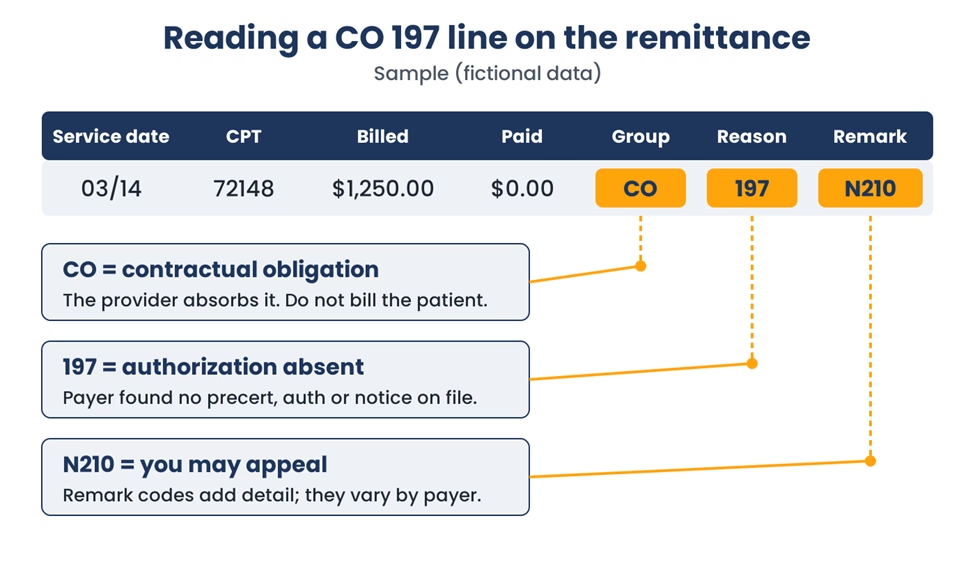
CO 197 is a Claim Adjustment Reason Code (CARC), used on an electronic remittance advice (ERA) or explanation of benefits (EOB) to explain why a line was not paid as billed. Its description is precertification, authorization, notification or pre-treatment absent: the plan required approval or advance notice, and found none that matched the claim.
CO, the group code, stands for contractual obligation: the payer is applying your contract, and the provider absorbs the amount. Our guide to the CO 45 denial code and contractual adjustments explains how CO adjustments post. Authorization misses are among the most preventable denials that denial management and appeals services handle.
Payers often add a Remittance Advice Remark Code (RARC). On Medicare equipment claims, the Noridian JA DME denial resolution guidance for reason code 197 pairs it with remark code N210, which signals the decision can be appealed.
Why CO 197 Denials Happen
Most CO 197 denials trace back to one of these gaps:
- No request was made for a service on the payer’s authorization list, such as advanced imaging, surgery, therapy or infusions.
- The number is not on the claim. It was left off CMS-1500 Item 23 or the REF segment of the 837 claim.
- The approval does not match the claim. The CPT code, units, dates or rendering provider differ, such as an MRI approved without contrast but done with contrast.
- The wrong plan was checked, for example Original Medicare instead of the patient’s Medicare Advantage plan.
- The ordering office kept the approval and never shared the number with the performing provider.
New staff can start with our overview of why prior authorization matters in health insurance.
CO 197 Rules for Medicare, Medicare Advantage and Commercial Plans
Original Medicare requires prior authorization only in specific programs, listed on the CMS Prior Authorization and Pre-Claim Review Initiatives page, such as certain hospital outpatient services, repetitive scheduled non-emergent ambulance transport and certain equipment items. The Medicare Administrative Contractor (MAC) issues the decision, and the claim must carry its unique tracking number.
Other payers set their own, changing lists:
| Payer type | Who sets the authorization rules | Where to check before the visit |
| Original Medicare | CMS, named programs only | CMS program pages and your MAC |
| Medicare Advantage | Each plan | Provider manual and portal |
| Medicaid and CHIP | State agency or managed care plan | State manual or plan portal |
| Commercial plans | Each plan, under your contract | Contract, manual and portal |
Per the CMS fact sheet on the interoperability and prior authorization final rule, Medicare Advantage, Medicaid and CHIP payers must generally decide expedited requests within 72 hours and standard requests within seven calendar days starting January 1, 2026, with a specific reason for any denial. Our breakdown of the CMS interoperability and prior authorization final rule covers the timeline.
How to Fix a CO 197 Denial
The fix depends on one question: did a valid approval exist for this exact service?
- Read the full line, including any remark code.
- Search for an approval in your authorization log and the payer portal for this patient, service, dates and provider.
- If one exists, correct the claim. Add the number, align the CPT code, units, dates and NPI (National Provider Identifier) with the approval, and send a corrected claim or reopening.
- If the service changed, ask whether the payer will update the approval.
- If none exists, ask about retro authorization. Some payers grant it, usually for urgent care requested promptly with notes; others never do.
- If retro authorization is refused, appeal when you have a real case; otherwise post a CO adjustment and do not bill the patient.
- Track the deadline. Original Medicare allows 120 days from receipt of the initial determination to request a redetermination, per CMS appeals guidance; commercial deadlines are in each contract.
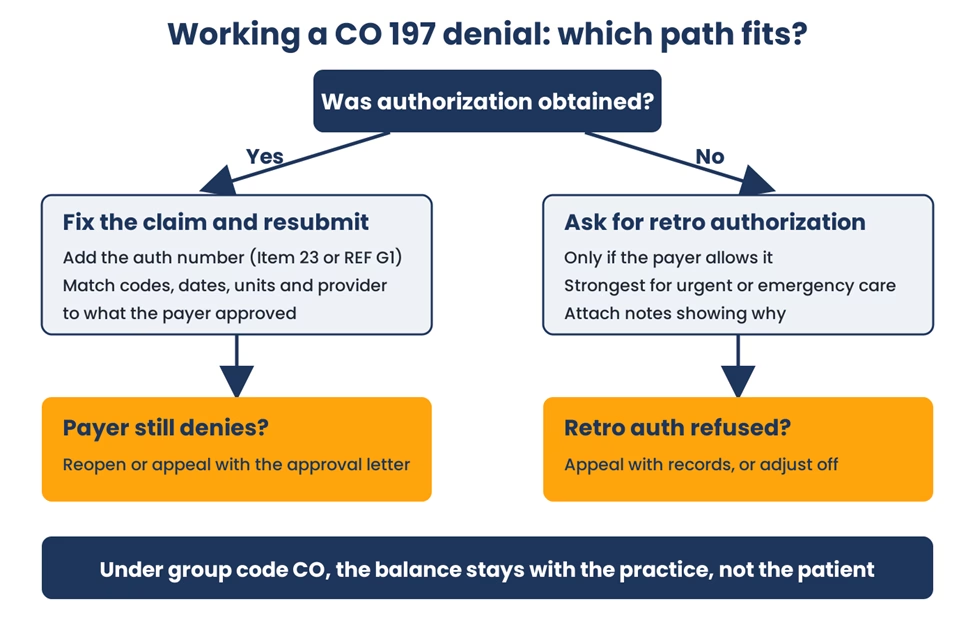
In short: with an approval, fix and resubmit; without one, seek retro authorization, then appeal or adjust off.
When an Appeal Makes Sense
- The service was an emergency; federal rules generally bar health plans from requiring prior authorization for emergency care.
- The payer’s portal or call record shows an approval in place on the date of service.
- The service was not on the payer’s authorization list on that date.
Sample CO 197 Appeal Letter
Sample (fictional data). Replace the names, dates, numbers and reason with your own claim details.
March 28, 2026
Appeals Department, Lakeside Health Plan, PO Box 4410, Springfield, IL 62701
Re: CO 197 denial. Patient Jordan Miles, member ID LHP448210, claim 2026031900417, March 14, 2026, CPT 72148 lumbar MRI without contrast.
Northfield Imaging Center requests reconsideration. The ordering physician, Dr. Ana Ruiz, obtained authorization LHP-AUTH-55821 for this exact service, valid March 10 to April 9, 2026. The number was left off the original claim in error. Enclosed are the approval letter, order and report. Please reprocess the claim under that approval.
Sincerely, Dana Price, Billing Manager, Northfield Imaging Center, (555) 014-2290
CO 197 vs CO 198, CO 15 and CO 39
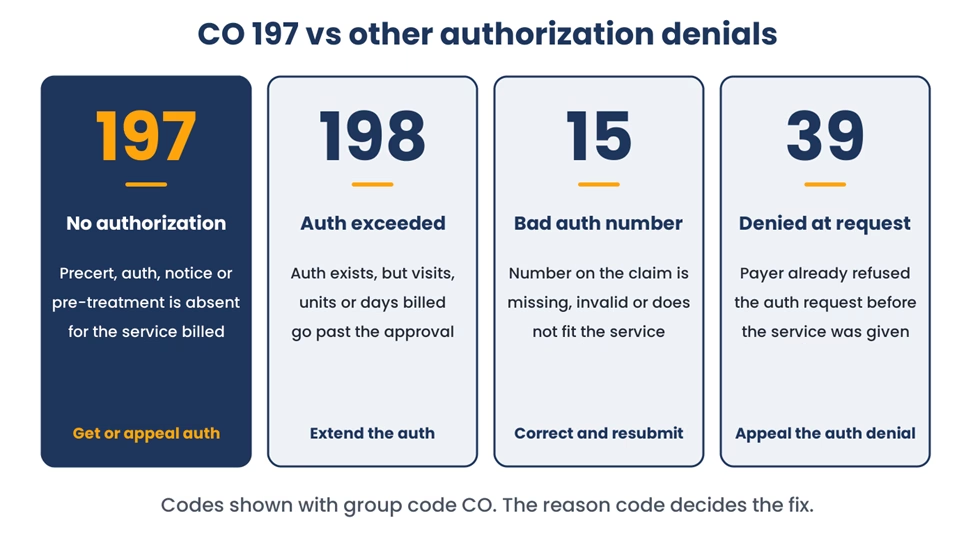
Several reason codes involve authorizations, and each points to a different fix.
| Reason code | What it means | Typical fix |
| 197 | Authorization, precertification or notice absent | Correct the claim or seek retro authorization |
| 198 | Authorization exceeded | Bill within approved units or extend the approval |
| 15 | Problem with the authorization number on the claim | Correct the number and resubmit |
| 39 | Denied when authorization was requested | Appeal the authorization decision |
How to Prevent CO 197 Denials
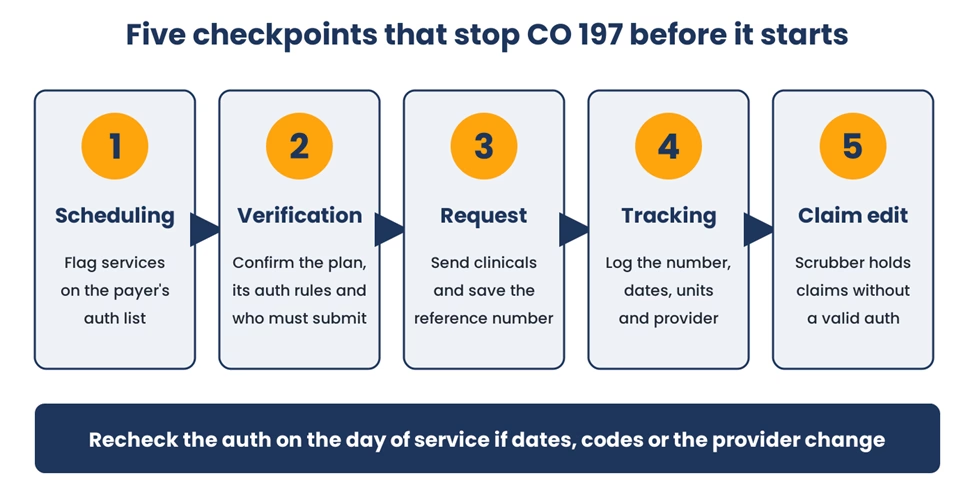
Run every scheduled service through the same five checks:
- Scheduling: flag any service that appears on the patient’s plan authorization list.
- Verification: confirm the plan and who must submit, as part of a full verification of benefits before each visit.
- Request: send the clinical notes and save the reference number.
- Tracking: log the number, approved codes, units, dates and provider where billers can see it.
- Claim edit: have the scrubber hold claims for listed services without a valid number.
CO 197 Denial Code FAQs
Can I bill the patient for a CO 197 denial?
No. With group code CO, the payer is applying your contract, so the amount is the provider’s responsibility, and billing the patient can breach that contract. Correct the claim, request retro authorization or appeal, and if none of those work, post the balance as a contractual adjustment.
What is the difference between CO 197 and PR 197?
The reason code is the same, but the group code changes who owes the balance. CO means the provider absorbs it under the contract. PR means the payer has assigned patient responsibility, for example when the plan holds the member responsible for a missed notice. Read the EOB and your contract before billing the patient.
Can a corrected claim fix a CO 197 denial?
Yes, when an approval existed and the problem was a missing or mismatched number, code, date or provider. Send a corrected claim or reopening with the right authorization details. When no approval existed, a corrected claim will not help; you need retro authorization or an appeal.
How long do I have to appeal a CO 197 denial?
It depends on the payer. Original Medicare allows 120 days from receipt of the initial determination to request a redetermination. Medicare Advantage, Medicaid and commercial plans set their own limits in the contract and provider manual, so check the payer’s manual and act as soon as the denial posts.
Get Help Clearing CO 197 Denials
The CO 197 denial code is one of the most fixable denials, but only when your team works it quickly and stops the cause at the front desk. If authorization denials keep reaching your appeals queue, Zmed Solutions offers revenue cycle management services covering front-end checks, claims and denial follow-up, and you can reach the team through the Zmed Solutions contact page.
Sources and note: X12 claim adjustment reason code descriptions as published by Noridian and the Louisiana Department of Health; CMS Prior Authorization and Pre-Claim Review Initiatives; CMS fact sheet on the Interoperability and Prior Authorization Final Rule (CMS-0057-F); CMS guidance on Medicare redeterminations; Noridian JA DME denial resolution guidance. This article is general billing education, not legal advice. Payer rules vary, so check each payer’s contract and provider manual.
Ready to optimize your medical billing and boost your revenue? Look no further. Zmed Solutions LLC is your trusted partner in professional Medical Billing Services.
Join our growing network of healthcare providers who have already elevated their revenue with our expert services. Don't miss out on what could be your practice's most profitable decision.
Schedule a Consultation Today!
Contact Us Now, and experience the difference. Your financial success starts here!