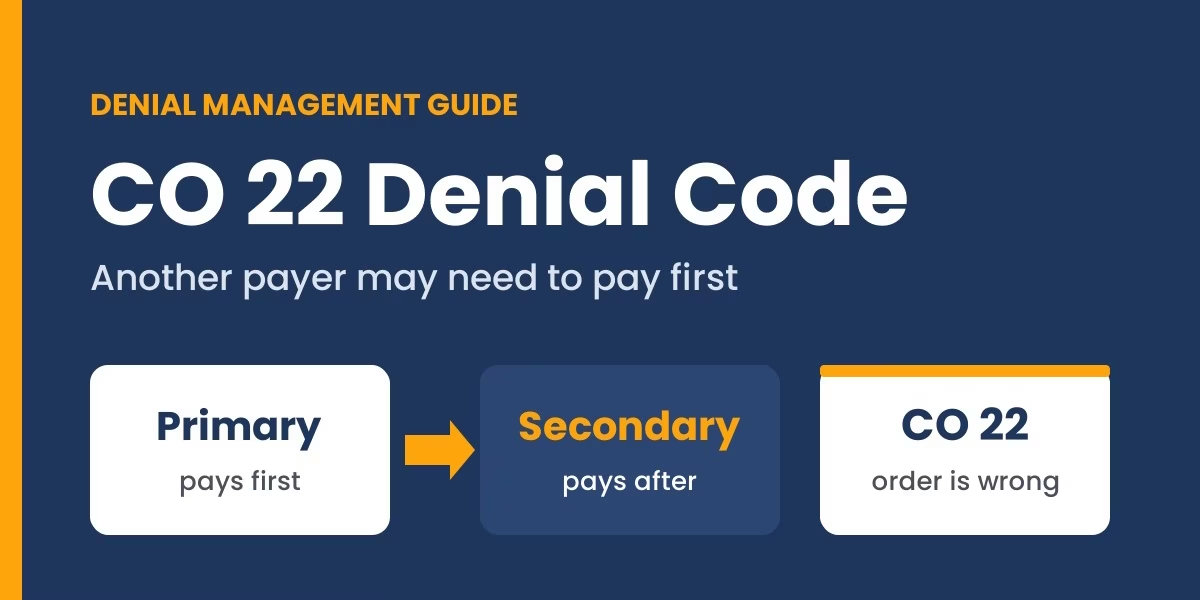
The CO 22 denial code means the payer believes another plan should pay first under coordination of benefits. The fix is to confirm which payer is primary, bill that payer, then send the secondary claim with the primary payer’s payment information. This guide explains what the code means, why it appears on Medicare and commercial claims, a five-step fix, how to correct wrong Medicare records and how to stop it at registration.
| Key takeaways Reason code 22 means the payer thinks another plan should pay first under coordination of benefits (COB).Medicare reports it when its records show a Medicare Secondary Payer (MSP) situation.Fix it by confirming the true primary payer, billing that payer first, then sending the secondary claim with the primary’s payment data.If Medicare’s records are wrong, the patient updates them through the Benefits Coordination & Recovery Center (BCRC). |
What the CO 22 Denial Code Means
Claim adjustment reason code (CARC) 22 reads, in short, that the care may be covered by another payer per coordination of benefits. The group code in front of it shows who owns the balance for now: CO (contractual obligation) points to the provider and PR (patient responsibility) points to the patient. For how this code fits among other frequent denials, see our guide to the most common denial codes.
Payers do not report it the same way. First Coast Service Options lists it as CO 22, while CGS shows the same Medicare Secondary Payer denial as PR-22. Either way, the balance is rarely what anyone owes yet; it is a signal that the claim went to the wrong payer first. It also differs from a contractual write-off such as the CO 45 denial code, which closes a balance rather than redirecting it.
Why Payers Return Reason Code 22
Coordination of benefits decides the order in which plans pay when a patient has more than one. If you need the basics of payer order, our explainer on coordination of benefits in medical billing covers them. Reason code 22 usually comes from one of these situations:
- The patient has a second plan, such as a spouse’s employer plan, that the practice never recorded.
- Coverage changed after the intake form was completed, for example a new job or retirement.
- The injury is tied to an auto accident, liability claim or workers’ compensation case.
- The payer’s own records list other coverage that has ended or was never valid.
- The primary and secondary payers were entered in the wrong order in the practice management system.
Commercial plans set their order-of-benefit rules in the plan contract. A common one is the birthday rule for a child covered by both parents: the plan of the parent whose birthday falls earlier in the calendar year usually pays first. Check the payer’s provider manual for its rules.
CO 22 on Medicare Claims
On Medicare claims, reason code 22 appears when Medicare’s records show it is the secondary payer for that date of service. The CGS guide to Medicare Secondary Payer denials lists the situations where Medicare usually pays second.
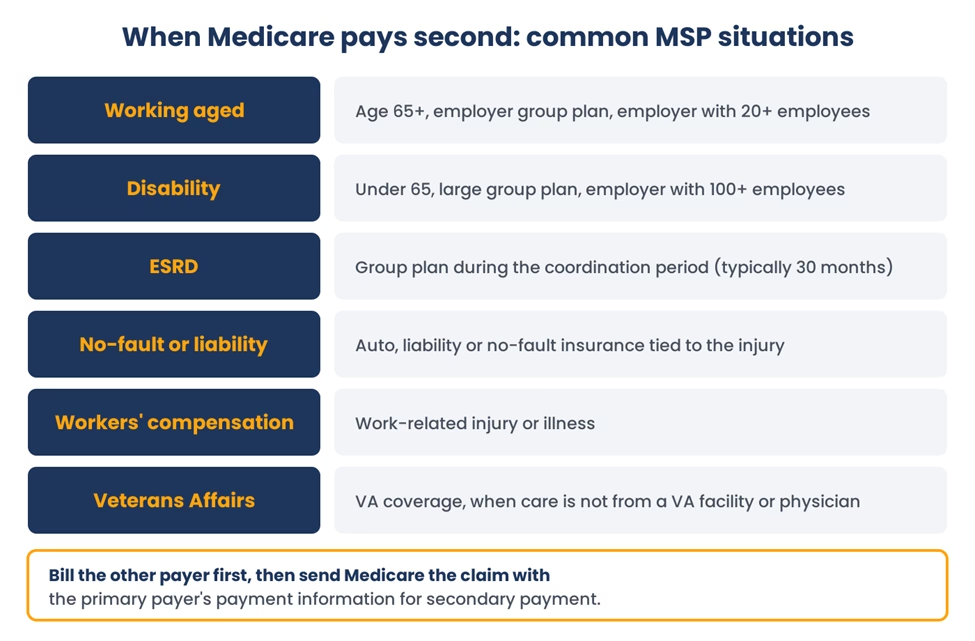
In short, Medicare is usually secondary for working-aged patients with a large employer plan, disabled patients with a large group plan, patients in the end-stage renal disease (ESRD) coordination period, and injuries covered by no-fault, liability or workers’ compensation insurance.
When Medicare is the secondary payer, the claim must carry the primary payer’s payment information. If it does not, Medicare contractors pair reason 22 with remark code MA04, which says secondary payment cannot be considered without the identity of or payment information from the primary payer.
How to Fix a CO 22 Denial
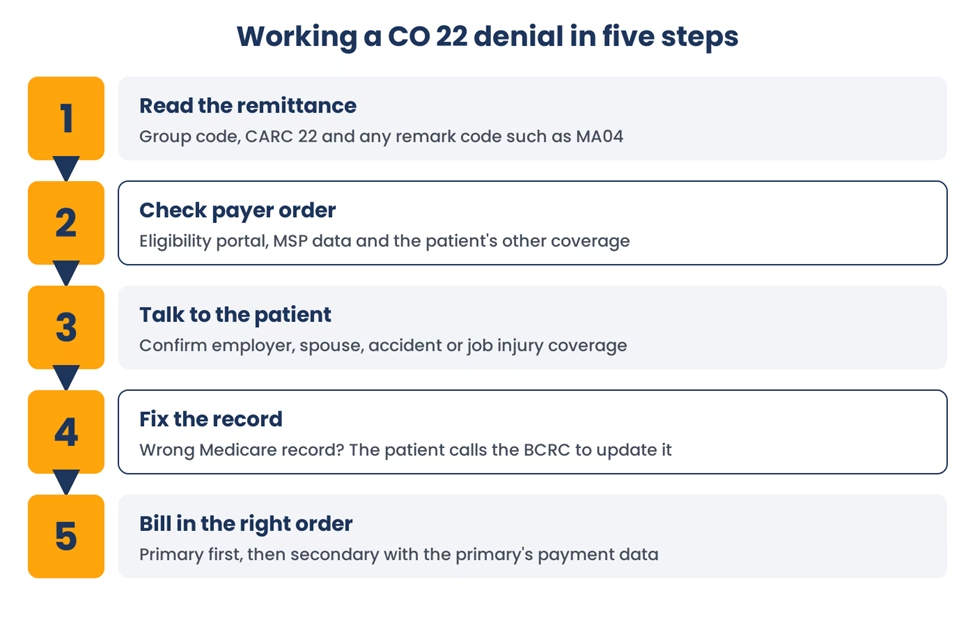
The diagram shows the five steps in order: read the remittance, check payer order, talk to the patient, fix the record, then bill in the right order.
- Read the remittance. Note the group code, CARC 22 and any remittance advice remark code (RARC) such as MA04. The remark code tells you whether the payer wants a different primary or just the missing primary payment data.
- Check payer order. Look up eligibility in the payer portal and, for Medicare, the MSP information your Medicare Administrative Contractor (MAC) shows. Compare it with your registration data.
- Talk to the patient. Ask about employer coverage for the patient or spouse, recent job changes, accidents and work injuries. The First Coast tips to prevent CO 22 recommend having the patient complete the MSP questionnaire again when coverage may have changed.
- Fix the record. If your system is wrong, update the payer order. If Medicare’s record is wrong, the patient or a representative contacts the BCRC at 1-855-798-2627 to correct it.
- Bill in the right order. Send the claim to the primary payer. After it pays or denies, send the secondary claim with the primary payer’s paid amount and adjustments in the other-payer sections of the electronic claim.
The CMS provider services page for coordination of benefits draws a clear line: the BCRC handles questions and record updates about other coverage, while your MAC handles claim denials, billing questions and secondary claim processing. Commercial payers set their own resubmission and timely filing limits for COB claims in the contract and provider manual, so check those before you resend. When the volume of these denials grows, a denial management and appeals service can track each one to closure.
Sample work note
Sample (fictional data). “Medicare CO-22 on DOS June 3. Portal shows working-aged MSP record. Patient, age 66, confirms she still works full time with employer plan coverage through a company of about 300 staff. Updated payer order, billed employer plan as primary June 20. Will bill Medicare secondary with the primary payment data once the employer plan pays.” Swap in your own dates, payers and patient details when you use it.
Preventing CO 22 Denials
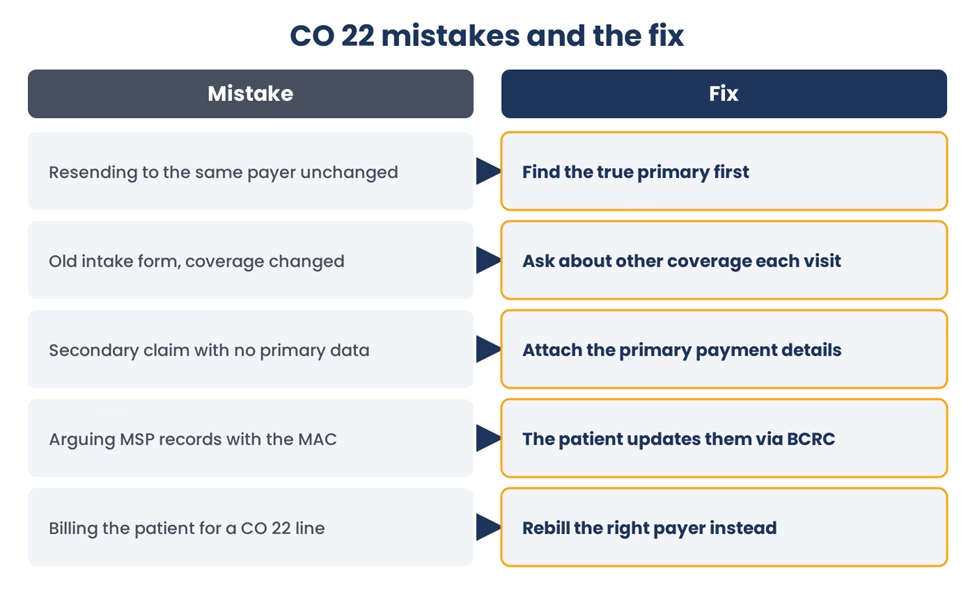
The chart pairs each habit with its fix: find the true primary before resending, ask about other coverage at every visit, attach primary payment data to secondary claims, send Medicare record problems to the BCRC, and rebill the right payer instead of the patient.
Prevention starts at the front desk. CMS relies on providers to ask Medicare patients about other primary coverage, so build that question into every check-in, not just the first visit. Real-time eligibility checks catch many changes before the claim goes out; our guide to the value of eligibility verification in the revenue cycle explains how to set them up.
CO 22 Denial Code FAQs
What does the CO 22 denial code mean?
CO 22 means the payer believes another plan may be responsible for the care under coordination of benefits, so it will not pay as primary. The fix is to identify the correct primary payer, bill it first, then send the secondary claim with the primary payer’s payment details.
What is the difference between CO 22 and PR 22?
Both use reason code 22 for coordination of benefits. The group code shows who owns the balance on that remittance: CO points to the provider and PR to the patient. Payers differ in which they use for the same situation, and in both cases the real next step is to bill the correct primary payer.
Can I bill the patient for a CO 22 denial?
Not as a first step. The denial says another payer may owe the claim, so the practice should find and bill that payer. The patient’s share is known only after the primary and secondary payers process the claim, unless the patient has no other coverage and the payer’s record is simply wrong.
How do I fix a Medicare CO 22 denial?
Check Medicare’s MSP information in your MAC’s portal and confirm the patient’s other coverage. If another plan is primary, bill it first and send Medicare the claim with the primary payment information. If Medicare should be primary, the patient contacts the BCRC to correct the record, then you resubmit.
What does MA04 mean with reason code 22?
MA04 says secondary payment cannot be considered without the identity of or payment information from the primary payer. It usually means Medicare is correctly secondary but the claim lacked the primary payer’s details. Correct the claim with that information and resubmit it under your MAC’s rules.
Get Help With Coordination of Benefits Denials
Resolving the CO 22 denial code comes down to finding the true primary payer, keeping coverage data current and billing in the right order every time. If your team wants help applying that workflow, Zmed Solutions offers revenue cycle management services, and you can reach the team through the Zmed Solutions contact page.
Sources: X12 claim adjustment reason code list (CARC 22); First Coast Service Options, tips to prevent CARC CO 22; CGS Medicare Part B, Medicare Secondary Payer denials; Noridian, reason code 22 with remark code MA04; CMS Coordination of Benefits & Recovery provider services. This article is educational and is not legal advice; payer policies change, so follow the rules in your current contracts.
Ready to optimize your medical billing and boost your revenue? Look no further. Zmed Solutions LLC is your trusted partner in professional Medical Billing Services.
Join our growing network of healthcare providers who have already elevated their revenue with our expert services. Don't miss out on what could be your practice's most profitable decision.
Schedule a Consultation Today!
Contact Us Now, and experience the difference. Your financial success starts here!