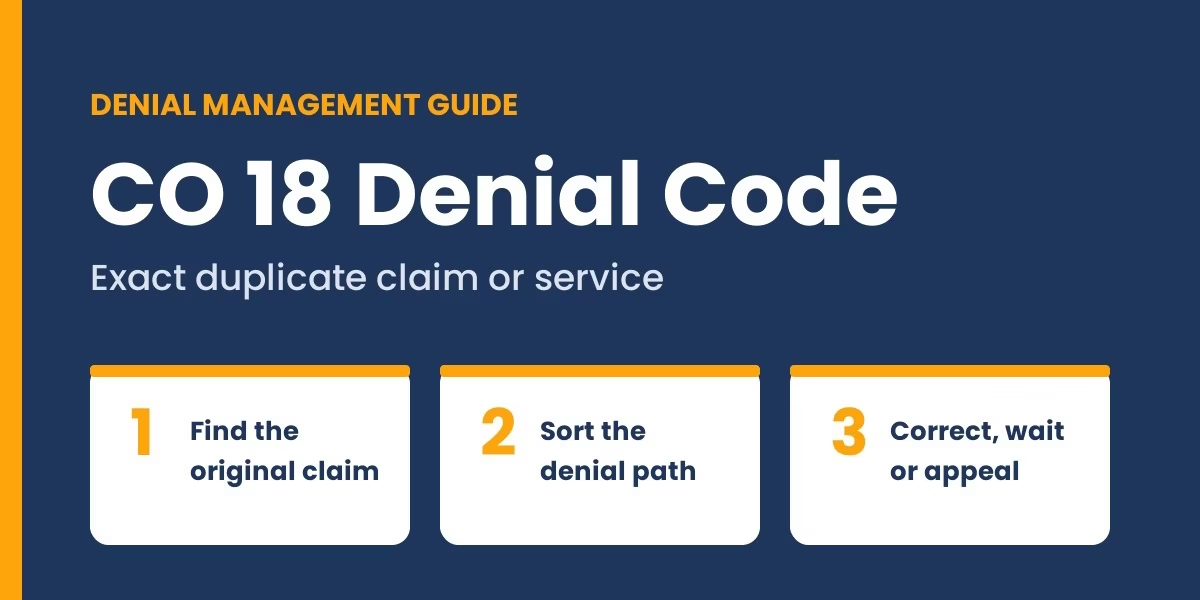
The CO 18 denial code means the payer decided a claim or service line is an exact duplicate of one it has already received. The fix is never to resend the claim blindly: find the original, decide whether the service was truly billed twice, then correct, wait or appeal. This guide explains what the code means, how it differs from OA 18, why payers flag duplicates, the three resolution paths and how to prevent repeats.
| Key takeaways Reason code 18 means the payer matched the line to a claim or service it already received.Medicare contractors report it as OA 18 or CO 18; either way, find the original claim first.A true duplicate needs no action beyond working the original claim; a separate service needs a correction.Status checks, one claim per date of service and the right repeat-service modifiers prevent most cases. |
What the CO 18 Denial Code Means
A remittance line has two parts. The group code shows who owns the balance: CO (contractual obligation) puts it on the provider, OA (other adjustment) covers adjustments that fit neither the provider nor the patient, and PR (patient responsibility) moves it to the patient. The claim adjustment reason code (CARC) explains why. CARC 18 reads “exact duplicate claim/service.” For how this code sits alongside other frequent denials, see our guide to the most common denial codes.
The X12 code list says reason code 18 is meant for group code OA, except where state workers’ compensation rules require CO. In practice, payers differ. First Coast Service Options reports Medicare duplicates as OA18, while CGS lists CO-18 for duplicate services. Billers search for “CO 18” either way, and the workflow is the same. A duplicate denial also differs from fee-schedule write-offs such as the CO 45 denial code, which reduce a payment rather than refuse a repeat line.
Why Payers Flag a Claim as a Duplicate
Payer systems compare each new line with claims already on file. The First Coast tips to prevent OA18 list the fields Medicare matches for an exact duplicate: the beneficiary’s Medicare ID, provider number, from and through dates, type of service, procedure code, place of service and billed amount. Closely matching claims can also deny as suspect duplicates.
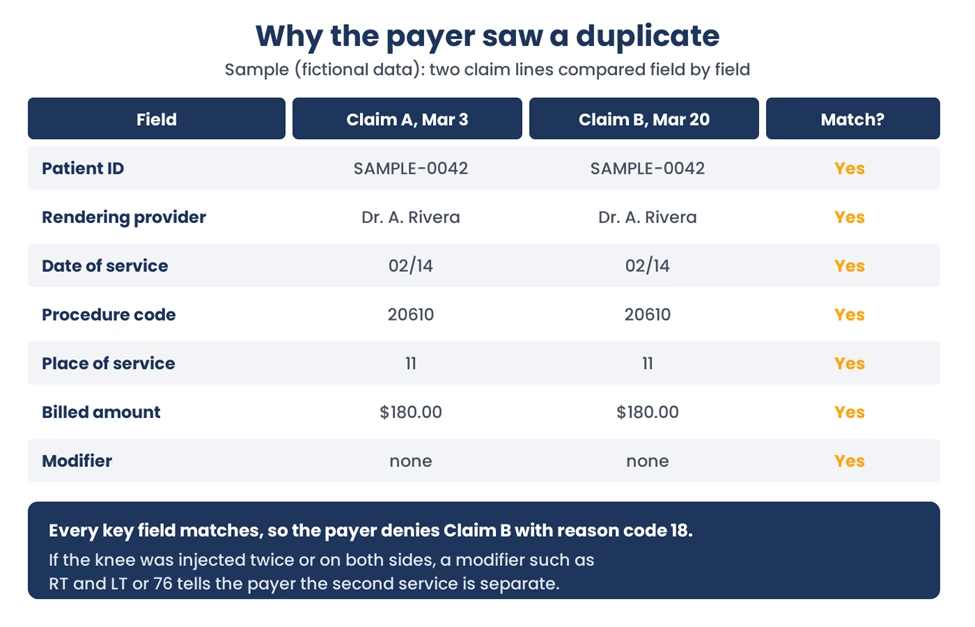
The sample shows two claims for the same knee injection with every key field identical, so the second one denies. Common causes in real billing work include:
- Resubmitting a claim that is still pending or in review instead of checking its status.
- Sending a corrected claim as a new original, so the payer sees two first-time claims.
- Billing a repeat or bilateral service without the modifier that shows it was separate.
- Splitting services from one date of service across two claims.
- Rebilling the secondary payer after Medicare already crossed the claim over automatically.
- A clearinghouse or practice management system sending the same batch twice.
Batch problems often start upstream, so it helps to know how clearinghouse claim submission works before blaming the payer.
How to Fix a CO 18 Denial
Start every CO 18 the same way: look up the original claim in the payer portal or interactive voice response (IVR) system and note its status, payment and any amount applied to the deductible. Then sort the denial into one of three paths.
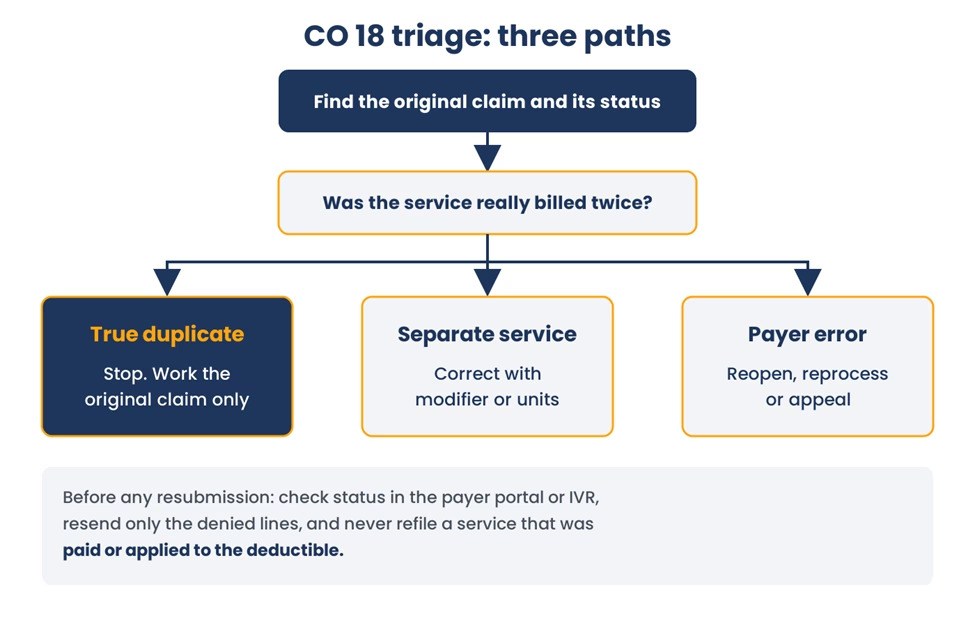
The diagram summarizes the decision: a true duplicate needs no new claim, a separate service needs a correction, and a payer error needs a reopening, reprocessing request or appeal.
Path 1: True duplicate
If the original paid, denied for another reason or is still pending, the CO 18 line needs no new claim. Close it in your system with a note and work the original. If the patient’s balance was posted twice, reverse the extra charge so the patient is not billed for it.
Path 2: Separate service that looked like a duplicate
When the service really happened twice, the claim must show why. The Noridian duplicate claim guidance for JE Part B points to modifier 76 for a repeat procedure by the same physician, 77 for a repeat by another physician and 91 for a repeat clinical lab test, and it asks billers to wait 30 days from the first submission before resending.
The CGS duplicate denial guidance adds RT or LT for one side of the body and 50 for bilateral services, and it recommends billing all services from one date of service on a single claim.
Resend only the denied lines, not the lines that already paid. For commercial payers, a corrected claim usually goes as a replacement using claim frequency code 7 rather than as a new original; for Medicare Part B, check whether your Medicare Administrative Contractor (MAC) wants a reopening instead. Commercial payers set their own correction and appeal rules in the contract and provider manual, so check your payer’s manual.
Path 3: Payer error
If the service was not a duplicate and the claim was already correct, ask the payer to reprocess or file an appeal with documentation, such as two procedure notes with different times or sites. Medicare contractors allow appeals of duplicate denials when the services were distinct. A denial management and appeals service can track these deadlines when the volume grows.
Preventing CO 18 Denials
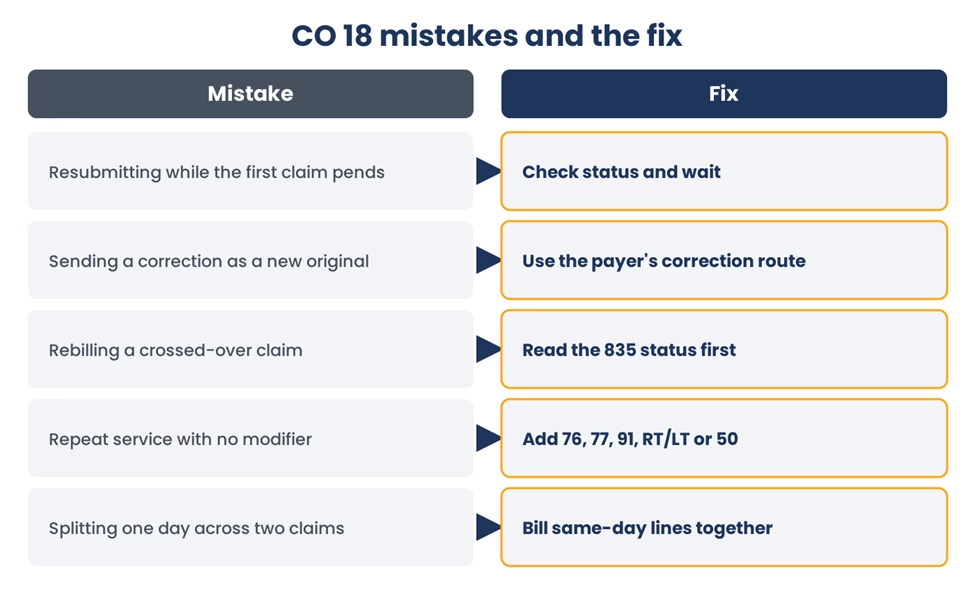
The chart pairs each habit with its fix: check status before resending, route corrections properly, read the 835 before rebilling a secondary payer, add repeat-service modifiers, and keep same-day lines on one claim.
On the electronic remittance advice (ERA), an 835 claim status of 19 means Medicare processed the claim as primary and forwarded it to the secondary payer, so do not bill that payer again. Claim scrubber rules can block a new original claim that matches one already on file; our overview of claim scrubbing in medical billing explains how those edits work. Bundling denials are a different problem with a different fix, covered in our CO 97 denial code guide.
Sample work note
Sample (fictional data). “CO-18 from a commercial plan on line 2, knee injection 20610, date of service Feb 14. Portal shows original claim paid Mar 10 for left knee. Chart confirms second injection, right knee, same day. Corrected line 2 with RT and line 1 with LT, resent line 2 only as a replacement claim. Follow up Apr 12.” Replace the dates, codes and payer steps with your own case details when you use it.
CO 18 Denial Code FAQs
What does the CO 18 denial code mean?
CO 18 means the payer treated the claim or service line as an exact duplicate of one it already received. CO assigns the adjustment to the provider, and reason code 18 names the duplicate. Look up the original claim before acting, because the right next step depends on what happened to that first submission.
What is the difference between CO 18 and OA 18?
Both use reason code 18 for an exact duplicate. The group code differs: the X12 code list intends reason 18 for group code OA except where state workers’ compensation rules require CO, yet some payers still report CO-18. Medicare contractors use both forms. The resolution steps are the same for either version.
Should I resubmit a claim denied with CO 18?
Not until you check the original claim. If it paid, is pending or denied for another reason, a new submission only creates another duplicate. Resend only when the service was truly separate, and then send just the denied lines with the modifiers or correction method your payer requires, after any waiting period the payer sets.
Can a CO 18 denial be appealed?
Yes, when the payer was wrong and the services were distinct. Submit an appeal or reprocessing request with documentation showing separate times, sites or providers. If the service was a true duplicate, there is nothing to appeal, because the original claim is the one that counts.
Can the patient be billed for a CO 18 line?
No. A duplicate line is not a new charge, and the CO group code assigns the adjustment to the provider. Any patient balance comes from how the original claim was processed, such as a deductible or coinsurance shown on that claim’s remittance.
Get Help With Duplicate Denials
Resolving the CO 18 denial code comes down to finding the original claim, sorting the denial into the right path and fixing the habits that cause repeats. If your team wants help applying that workflow every week, Zmed Solutions offers revenue cycle management services, and you can reach the team through the Zmed Solutions contact page.
Sources: X12 claim adjustment reason code list (CARC 18); First Coast Service Options, tips to prevent claim adjustment reason code OA18; CGS Medicare Part B, duplicate denials; Noridian JE Part B, duplicate claim/service guidance. This article is educational and is not legal advice; payer policies change, so follow the rules in your current contracts.
Ready to optimize your medical billing and boost your revenue? Look no further. Zmed Solutions LLC is your trusted partner in professional Medical Billing Services.
Join our growing network of healthcare providers who have already elevated their revenue with our expert services. Don't miss out on what could be your practice's most profitable decision.
Schedule a Consultation Today!
Contact Us Now, and experience the difference. Your financial success starts here!