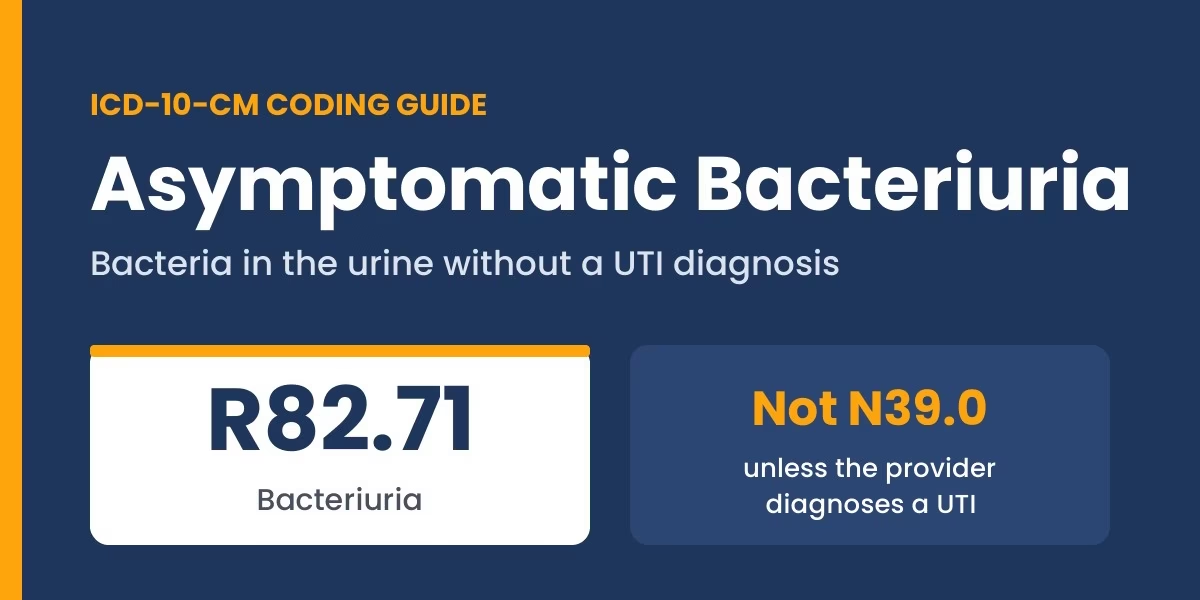
The asymptomatic bacteriuria ICD-10 code is R82.71, Bacteriuria, used when a urine test shows bacteria and the provider has not diagnosed a urinary tract infection (UTI). It is a billable finding code, so it does not imply infection. This guide compares R82.71 with UTI codes such as N39.0, explains the pregnancy and colonization rules that send these cases elsewhere, covers urine test billing and Medicare limits, and walks through a sample claim.
| Key takeaways Asymptomatic bacteriuria codes to R82.71, Bacteriuria, a finding code with no infection implied.Use N39.0 or a site-specific code only when the provider diagnoses a urinary tract infection.In pregnancy, Chapter 15 codes apply, and R82.71 is not used for an abnormal prenatal screen.Medicare treats prenatal screening cultures for bacteriuria as screening, and bacterial urine cultures carry a high improper payment rate. |
Asymptomatic Bacteriuria ICD-10 Code at a Glance
R82.71 sits in the R80 to R82 block, abnormal findings on examination of urine without a diagnosis. Most bacteriuria searches land on UTI coding, so if the provider did diagnose an infection, our ICD-10 code for UTI guide covers N39.0 and the site-specific codes in depth.
| What the provider documents | Code | Title |
| Bacteria in the urine, no UTI diagnosed | R82.71 | Bacteriuria |
| Another abnormal microbiological urine finding | R82.79 | Other abnormal findings on microbiological examination of urine |
| UTI with no site stated | N39.0 | Urinary tract infection, site not specified |
| Abnormal finding on antenatal screening of a pregnant patient | O28.- | Abnormal findings on antenatal screening of mother |
| UTI in a pregnant patient, site not specified | O23.40–O23.43 | Unspecified infection of urinary tract in pregnancy, by trimester |
R82.71 is valid in the FY 2027 code set that took effect on October 1, 2026, and it has no laterality and no seventh character.
R82.71 vs N39.0: What Decides the Code
The lab result does not choose the code; the provider’s conclusion does. Section I.B.4 of the FY 2027 ICD-10-CM Official Guidelines for Coding and Reporting allows sign, symptom and finding codes when no related definitive diagnosis has been established. A positive culture in a patient without symptoms, which the provider records as asymptomatic bacteriuria, stays at R82.71.
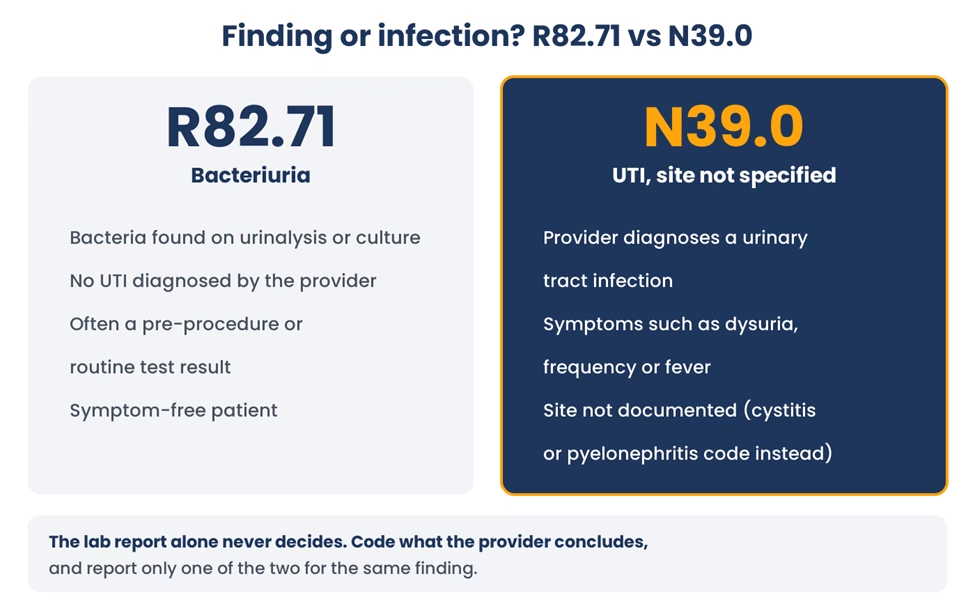
In short, R82.71 is a finding and N39.0 is a diagnosis. If the provider diagnoses a UTI, report the UTI code and drop R82.71, because bacteria in the urine is part of that infection. Never assign a UTI code from a culture report the provider has not interpreted.
Excludes1 notes to know
- R82.7, the subcategory above R82.71, has an Excludes1 note for colonization status (Z22.-). Do not report a carrier code and R82.71 together.
- The R80 to R82 block has an Excludes1 note for abnormal findings on antenatal screening of the mother (O28.-), which matters for prenatal visits.
Asymptomatic Bacteriuria in Pregnancy
Pregnancy is the main reason providers test symptom-free patients, and it changes the code family. ICD-10-CM treats a condition in a pregnant patient as affecting the pregnancy unless the provider documents otherwise, so a Chapter 15 code comes first.
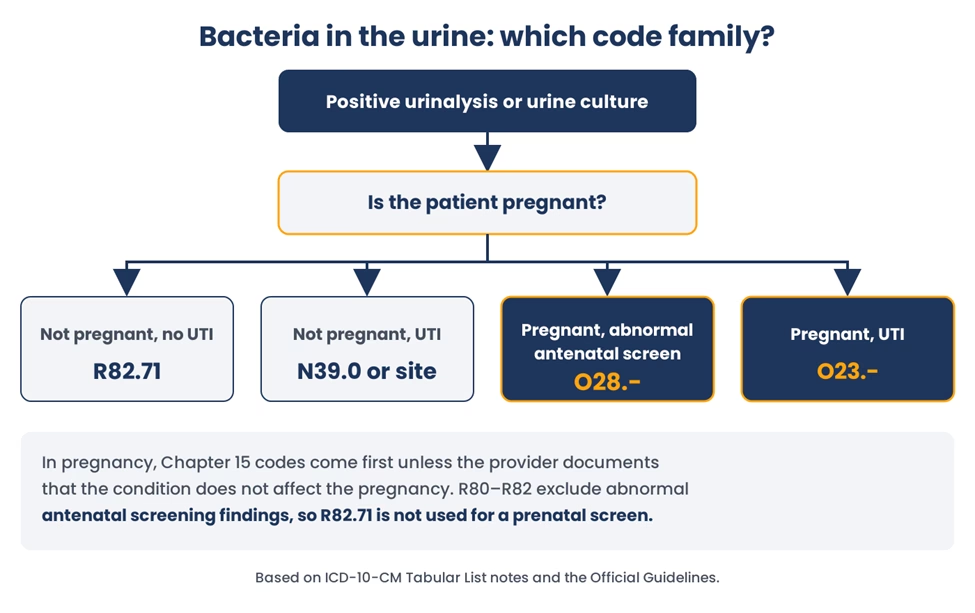
The flowchart reads top to bottom: outside pregnancy, R82.71 or a UTI code; in pregnancy, an abnormal screening result points to O28.- and a diagnosed UTI points to the O23 codes.
When the provider diagnoses a UTI in pregnancy without naming the site, O23.40 to O23.43 apply by trimester, and category O23 instructs coders to add a code for the organism from B95 to B96. When the documentation is unclear about whether the finding is a screening abnormality or an infection, query the provider rather than choosing on your own. Practices that handle many prenatal claims can see how our OB-GYN medical billing and coding team approaches these visits.
Billing Urine Tests Linked to Bacteriuria
The diagnosis code on a urine test has to support why the test was ordered. Typical procedure codes are 81001 or 81003 for urinalysis, 87086 for a quantitative urine culture, 87088 for isolation and presumptive identification of each organism, and 87184 or 87186 for susceptibility testing.
For Medicare, National Coverage Determination (NCD) 190.12, Urine Culture, Bacterial, sets the rules. It allows 87086 once per encounter, allows 87088, 87184 and 87186 more than once because infections can involve several organisms, and treats testing for asymptomatic bacteriuria during a prenatal evaluation as screening, which Medicare does not cover.
These claims draw scrutiny. The CMS compliance tips for bacterial urine culture lab tests report a 16.2% improper payment rate for these tests in the 2024 reporting period, with insufficient documentation behind all of it. Commercial payers set their own limits in the contract and provider manual, so check your payer’s policy. Labs can see how culture claims are handled in our guide to billing for labs and diagnostic centers.
Sample claim sequence
Sample (fictional data). A 68-year-old Medicare patient with benign prostatic hyperplasia (BPH) is scheduled for a prostate procedure at a fictional urology clinic.
| Visit | Provider documentation | Diagnosis codes | Procedures billed |
| Visit 1, April 4 | Pre-procedure urine testing; culture grows E. coli; patient has no urinary symptoms; assessment: asymptomatic bacteriuria before planned procedure | N40.1, R82.71 | 81003, 87086, 87088 |
| Visit 2, April 18 | Burning on urination and fever; provider diagnoses UTI caused by E. coli | N39.0, B96.20 | Office visit |
To reuse this sample, swap in your own dates, results and the provider’s exact assessment. Coding the underlying prostate condition correctly matters too; our guide to the ICD-10 code for BPH with lower urinary tract symptoms covers N40.1.
Common Bacteriuria Coding Mistakes
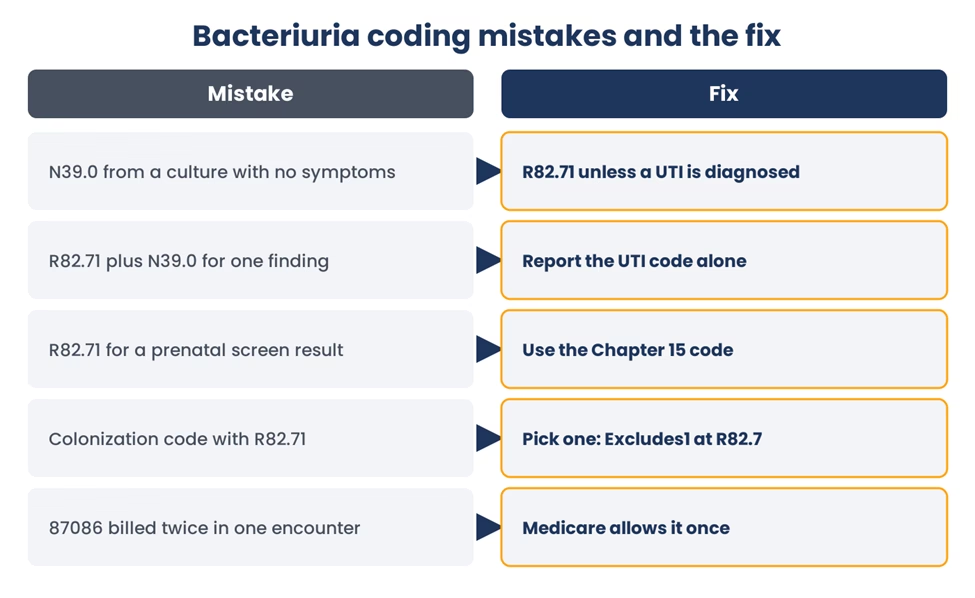
The chart pairs each error with its fix: keep R82.71 until the provider diagnoses a UTI, report only the UTI code once it is diagnosed, use Chapter 15 codes in pregnancy, never pair a colonization code with R82.71, and bill 87086 once per encounter for Medicare.
Most of these errors can be caught by scrubber edits that flag N39.0 with no symptom or provider assessment documented, R82.71 with any O-code, and duplicate 87086 lines. When urine test claims still deny, our guide to preventing medical necessity denials covers the follow-up and appeal steps.
Asymptomatic Bacteriuria ICD-10 Code FAQs
What is the ICD-10 code for asymptomatic bacteriuria?
Use R82.71, Bacteriuria, when a urine test shows bacteria and the provider has not diagnosed a urinary tract infection. It is a billable code with no laterality or seventh character. If the provider later diagnoses a UTI, switch to N39.0 or the code for the documented site, and stop reporting R82.71 for that finding.
Is bacteriuria the same as a UTI for coding?
No. Bacteriuria is a lab finding, while a UTI is a diagnosis the provider makes, usually based on symptoms as well as test results. R82.71 reports the finding and N39.0 reports the infection. Coders should never convert a positive culture into a UTI code unless the provider documents that diagnosis.
Can R82.71 and N39.0 be billed together?
Not for the same finding. Once the provider diagnoses a UTI, the bacteria in the urine are part of that infection, and signs that are integral to a confirmed diagnosis are not coded separately. Report N39.0 or the site-specific code alone, and add an organism code from B95 to B96 when the culture identifies one.
How do you code asymptomatic bacteriuria in pregnancy?
Pregnancy codes come from Chapter 15. An abnormal result on a prenatal screen points to O28.-, because the R80 to R82 block excludes abnormal antenatal screening findings. A diagnosed UTI in pregnancy uses the O23 codes by trimester, such as O23.40 to O23.43 when no site is named. Query the provider when the documentation is unclear.
Does Medicare cover urine cultures for asymptomatic bacteriuria?
Medicare covers bacterial urine cultures under NCD 190.12. When the order meets its indications, such as abnormal urinalysis or signs of infection. The NCD treats testing for asymptomatic bacteriuria during a prenatal evaluation as screening, which is not cover. It also limits 87086 to once per encounter, so check documentation before billing.
Get Help With Urology and Lab Claims
Choosing the right asymptomatic bacteriuria ICD-10 code comes down to the provider’s conclusion. The patient’s pregnancy status and a test order that meets payer rules. If your team wants help applying those checks on every claim. Zmed Solutions offers revenue cycle management services, and you can reach the team through the Zmed Solutions contact page.
Sources: ICD-10-CM Official Guidelines for Coding and Reporting FY 2027 (CDC, NCHS); ICD-10-CM Tabular List, block R80 to R82 and codes R82.71, R82.79, N39.0, O23.4- and O28.-; CMS NCD 190.12, Urine Culture, Bacterial; CMS Medicare provider compliance tips for bacterial urine culture lab tests. This article is educational and is not legal or medical advice; payer policies change, so follow the rules in your current contracts.
Ready to optimize your medical billing and boost your revenue? Look no further. Zmed Solutions LLC is your trusted partner in professional Medical Billing Services.
Join our growing network of healthcare providers who have already elevated their revenue with our expert services. Don't miss out on what could be your practice's most profitable decision.
Schedule a Consultation Today!
Contact Us Now, and experience the difference. Your financial success starts here!