The CO 50 denial code means the payer decided the service was not medically necessary under its coverage rules, so it paid nothing for that line. Because the group code is CO, the practice absorbs the amount unless a valid Advance Beneficiary Notice (ABN) shifted liability to the patient. This guide covers how to read the denial, why it happens, how to fix or appeal it, how ABN modifiers change who pays and how to prevent repeat denials.
| Key takeaways CO 50 means the payer judged the service not medically necessary for this patient.Many CO 50 denials are coding problems, such as a diagnosis that does not meet the policy.If the record supports the service, appeal with the notes and the policy that applies.Without a valid ABN, a Medicare CO 50 balance stays with the provider. |
What Does Denial Code CO 50 Mean?
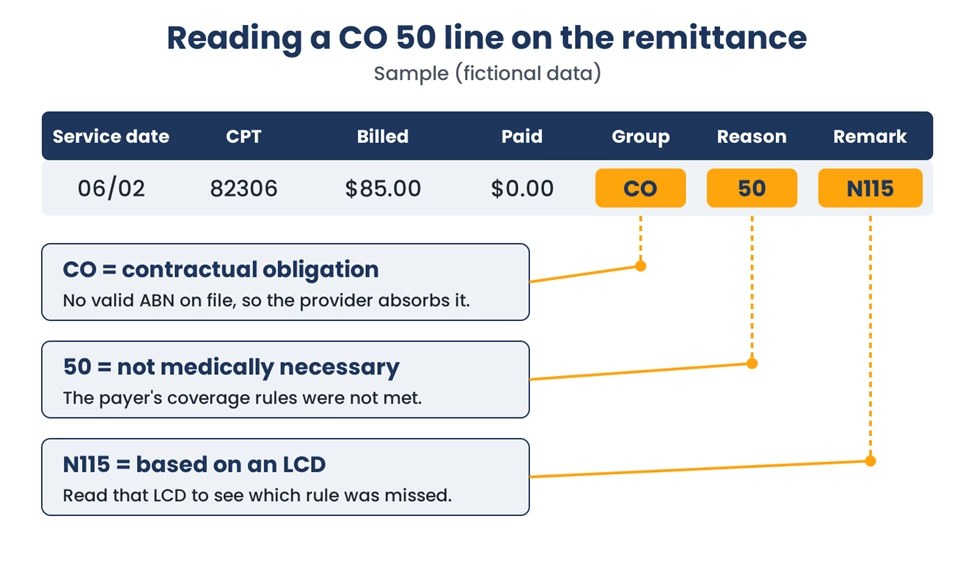
CO 50 is a Claim Adjustment Reason Code (CARC) shown on the electronic remittance advice (ERA) or explanation of benefits (EOB). Its description says the services are non-covered because the payer does not deem them a medical necessity. The service may be valid and well documented; it simply did not meet the payer’s coverage criteria as billed.
CO, the group code, means contractual obligation, so the payer is applying your contract and the provider carries the loss. Our guide to the CO 45 denial code and contractual adjustments explains how CO amounts post. Medical necessity denials are among the costliest that denial management and appeals services work, because each one needs a record review.
The remark code is your best clue. For Medicare, remark code N115 means the decision was based on a Local Coverage Determination (LCD). The Noridian JA DME denial resolution guidance for reason code 50 lists typical triggers, such as a missing order, a missing required modifier or a diagnosis the LCD does not accept.
Common Causes of CO 50 Denials
- The diagnosis does not meet the policy. The ICD-10-CM code billed is not on the payer’s list of covered diagnoses for that service.
- The documentation is thin. The note does not show the symptoms, prior treatment or test results the policy requires.
- A required modifier is missing, such as a modifier the LCD requires to show criteria were met.
- Frequency limits were passed, for example a screening test repeated sooner than the policy allows.
- The service needs criteria the plan applies to everyone, such as a trial of conservative care before imaging.
How Payers Decide Medical Necessity
Original Medicare uses National Coverage Determinations (NCDs) and LCDs, published in the Medicare Coverage Database. The CMS guide to searching the Medicare Coverage Database explains how to find a policy by CPT, HCPCS or ICD-10-CM code and filter by your state and contractor. Other payers publish their own medical policies:
| Payer type | Where medical necessity rules live |
| Original Medicare | NCDs, plus LCDs and billing articles from your MAC |
| Medicare Advantage | The plan’s coverage policies and provider manual |
| Medicaid | The state provider manual or managed care plan policies |
| Commercial plans | Medical or clinical policy bulletins and your contract |
How to Fix a CO 50 Denial
Start by comparing three things: the claim, the medical record and the policy the payer applied.
- Find the policy. Use the remark code or the policy reference on the remittance to pull the exact LCD, NCD or payer policy.
- Check the coding. If the record supports a covered diagnosis or a required modifier that was left off, request a reopening or send a corrected claim.
- Check the documentation. If the record meets the criteria but the payer did not see it, appeal with the notes, test results and the policy section you rely on.
- Check liability. If the criteria truly were not met, confirm whether a valid ABN was signed. With one, the patient can be billed; without one, adjust the line off.
- Watch the deadline. Original Medicare allows 120 days from receipt of the initial determination to request a redetermination. Other payers set limits in their contracts and manuals.
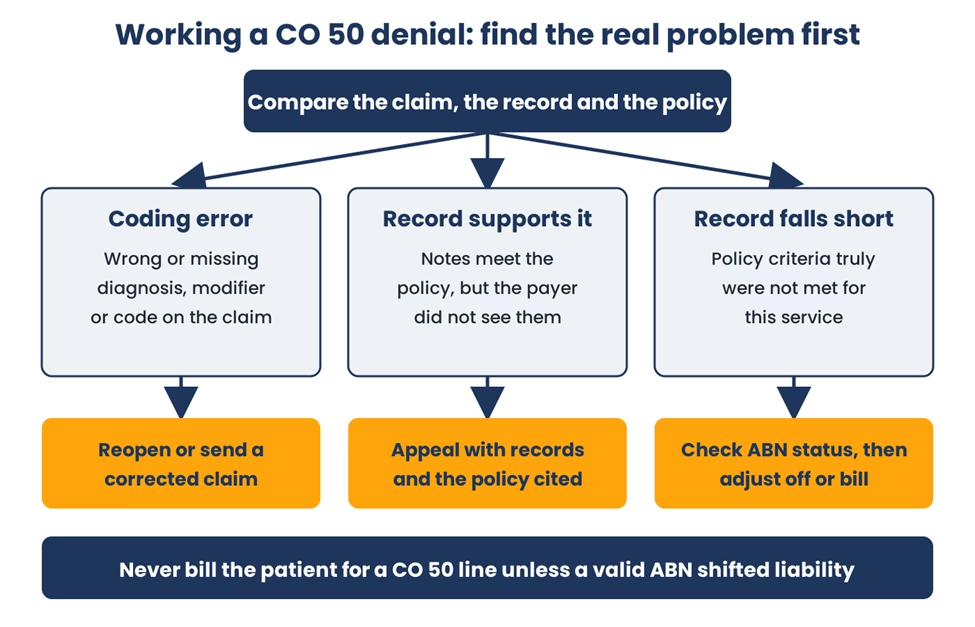
In short: fix coding errors with a correction, appeal when the record supports the service, and adjust off when it does not and no valid ABN exists.
Sample CO 50 Appeal Letter
Sample (fictional data). Replace the names, numbers, dates and clinical details with those from your own claim and record.
July 8, 2026
Appeals Unit, Pinecrest Health Plan, PO Box 2210, Columbus, OH 43215
Re: CO 50 denial. Patient Maria Lopez, member ID PHP771034, claim 2026060300218, June 2, 2026, CPT 82306.
Riverbend Family Medicine requests reconsideration. Dr. Sam Patel ordered the vitamin D test because the patient has documented chronic kidney disease, a condition your laboratory policy lists as covered. The diagnosis was documented but not coded on the original claim. Enclosed are the visit note, the lab order and the policy excerpt. Please reprocess the claim.
Sincerely, Lee Carter, Billing Supervisor, Riverbend Family Medicine, (555) 017-4420
CO 50, the ABN and Patient Liability
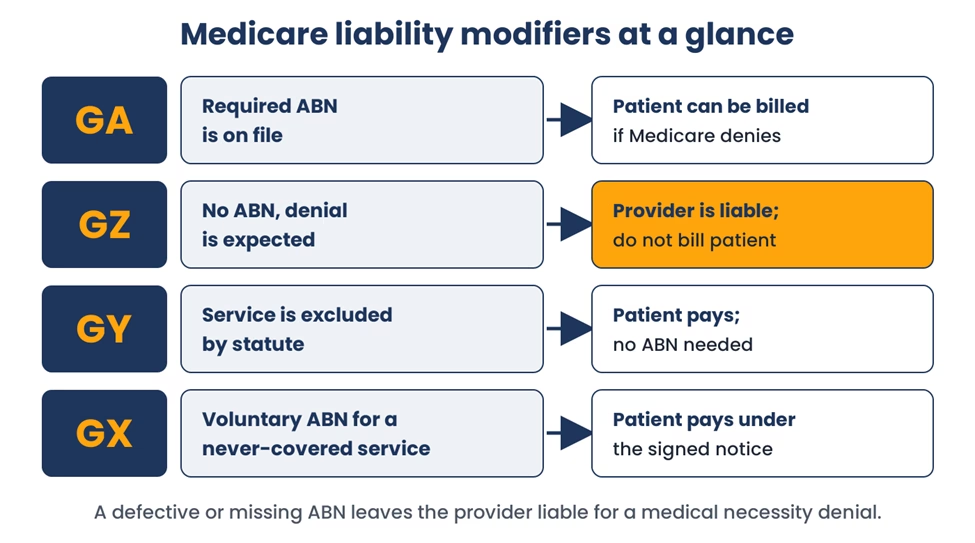
Under Original Medicare, an ABN signed before the service is what lets you bill the patient if Medicare denies for medical necessity. Modifiers tell Medicare which situation applies. The CGS guidance on ABN claim reporting modifiers defines them:
| Modifier | When it is used | Usual result on a denial |
| GA | A required ABN was issued and is on file | The patient can be held liable |
| GZ | Denial expected and no ABN was issued | Provider liable; do not bill the patient |
| GY | Medicare excludes the service by statute | Patient liable; no ABN needed |
| GX | Voluntary ABN for a service Medicare never covers | Patient liable under the notice |
If the ABN is missing, unsigned or too vague, the provider stays liable. Our guide to how the ABN works in medical billing covers form and timing rules, and our article on using coding modifiers accurately explains modifier placement.
CO 50 vs CO 11, CO 151 and PR 204
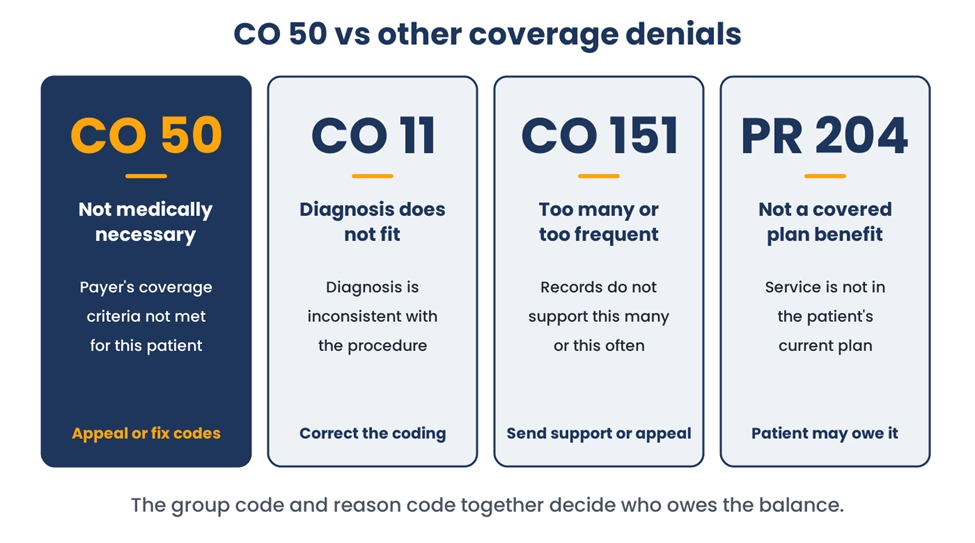
| Code | What it means | Typical fix |
| CO 50 | Not deemed a medical necessity by the payer | Correct coding or appeal with records |
| CO 11 | Diagnosis is inconsistent with the procedure | Correct the diagnosis or its pointer |
| CO 151 | Information does not support this many or this frequent services | Send support for the frequency or appeal |
| PR 204 | Not covered under the patient’s current benefit plan | Patient responsibility per plan terms |
How to Prevent CO 50 Denials
- Build edits that match CPT codes to the covered diagnoses in the LCD or payer policy.
- Give providers short documentation prompts for high-risk services such as imaging, labs and therapy.
- Track frequency limits for screenings and repeat tests before scheduling.
- Issue an ABN whenever Medicare may deny for medical necessity, and add the right modifier.
- Review denial trends monthly by CPT code, payer and provider.
For a deeper playbook, see our guide to preventing medical necessity denials.
CO 50 Denial Code FAQs
Can I bill the patient for a CO 50 denial?
Not when the group code is CO. That code means the provider is responsible under the contract. For Original Medicare, you can bill the patient only if a valid ABN was signed before the service and the claim carried modifier GA. For other payers, follow your contract and the plan’s patient notice rules.
Is CO 50 the same as CO 11?
No. CO 11 means the diagnosis does not match the procedure, which is usually a coding fix. CO 50 means the payer applied its coverage criteria and found the service not medically necessary. A CO 50 can still come from a coding gap, but it often needs a record review and an appeal.
What does remark code N115 mean with CO 50?
N115 tells you the Medicare decision was based on a Local Coverage Determination. Pull the LCD and its billing article, then check whether the claim carried a covered diagnosis, any required modifiers and documentation that meets the criteria. That comparison tells you whether to correct the claim or appeal.
How long do I have to appeal a CO 50 denial?
For Original Medicare, you have 120 days from receipt of the initial determination to request a redetermination. Medicare Advantage, Medicaid and commercial plans set their own limits in the contract and provider manual, so check the payer’s manual and start the review as soon as the denial posts.
Get Help Resolving CO 50 Denials
The CO 50 denial code is often recoverable when the record supports the service and the appeal cites the right policy. If medical necessity denials keep growing, Zmed Solutions offers revenue cycle management services covering coding review, claims and denial follow-up, and you can reach the team through the Zmed Solutions contact page.
Sources and note: X12 claim adjustment reason code descriptions as published by Noridian and the Louisiana Department of Health; Noridian JA DME denial resolution guidance; CGS ABN claim reporting modifiers; CMS Medicare Coverage Database guide; CMS guidance on Medicare redeterminations. This article is general billing education, not legal or medical advice. Payer rules vary, so check each payer’s contract and provider manual.
Ready to optimize your medical billing and boost your revenue? Look no further. Zmed Solutions LLC is your trusted partner in professional Medical Billing Services.
Join our growing network of healthcare providers who have already elevated their revenue with our expert services. Don't miss out on what could be your practice's most profitable decision.
Schedule a Consultation Today!
Contact Us Now, and experience the difference. Your financial success starts here!