The CO 4 denial code means the payer found a modifier that does not fit the procedure code on the line, or found that a modifier the payer requires is missing. It is usually a fixable coding error rather than a coverage dispute. This guide explains what the code means, the most common modifier problems behind it, how to correct or appeal it, how it differs from related codes and how to prevent it.
| Key takeaways CO 4 flags a code-modifier pair the payer will not accept as billed.Common triggers are 26 or TC on codes that cannot be split, missing side modifiers and outdated modifiers.Most CO 4 denials are fixed with a corrected claim, not an appeal.Add a modifier only when the record supports it, never just to pass an edit. |
What Does Denial Code CO 4 Mean?
CO 4 is a Claim Adjustment Reason Code (CARC) on the electronic remittance advice (ERA) or explanation of benefits (EOB). Medicare contractors show it as the procedure code is inconsistent with the modifier used. Many payer code lists still show an older, longer version that adds or a required modifier is missing, and payers use the code for both problems.
CO means contractual obligation, so the provider absorbs the amount until the line is fixed. Our guide to the CO 45 denial code and contractual adjustments explains how CO amounts post. Because CO 4 lines are usually recoverable, they are quick wins for denial management and appeals services.
A remark code often narrows the problem. On Medicare equipment claims, the Noridian JA DME denial resolution guidance for reason code 4 pairs it with remark code N519, an invalid combination of HCPCS modifiers, and tells suppliers to correct the line and resubmit.
Why CO 4 Denials Happen
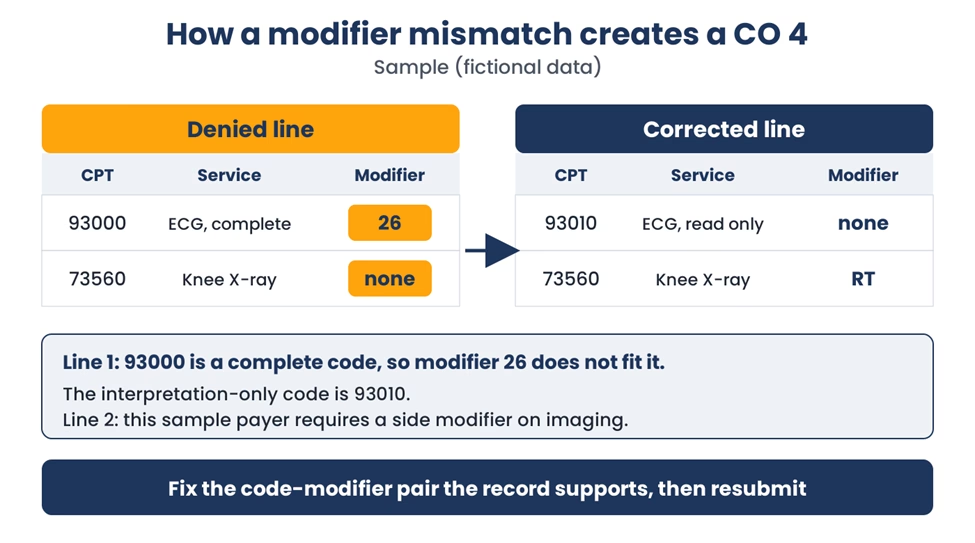
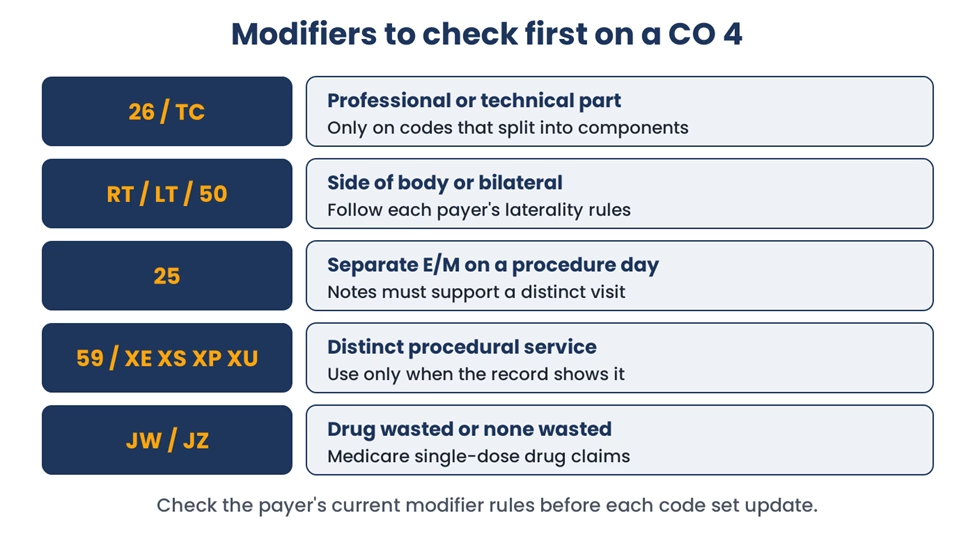
- A component modifier on a code that cannot be split. Modifier 26 (professional component) or TC (technical component) on a complete code such as 93000, a full ECG, which has its own interpretation-only code, 93010.
- A missing side or bilateral modifier. The payer expects RT, LT or 50 on imaging, injections or surgery and the line has none.
- A modifier not valid on that date, such as one retired or added at an annual code update.
- A modifier the code does not need, added by a template or charge default.
- A drug-waste modifier problem. Medicare requires JW for discarded drug amounts and, since July 1, 2023, JZ when no drug from a single-dose container was discarded, per the Noridian guidance on the JZ modifier.
How to Fix a CO 4 Denial
Compare the denied line with the medical record and the payer’s modifier rules.
- Read the full line, including the remark code and any policy reference on the remittance.
- Check the code-modifier pair. Confirm the modifier is valid for that CPT or HCPCS code on the date of service.
- If the modifier is wrong, correct the line. Replace or remove it, or switch to the code that matches the service, then send a corrected claim.
- If a required modifier is missing, add it only when the record supports it, such as the documented side of the body.
- If the pair is valid, appeal. Send the note and the coding rule or payer policy that supports it.
- Track the deadline. Original Medicare allows 120 days from receipt of the initial determination for a redetermination; other payers set corrected-claim and appeal limits in their contracts.
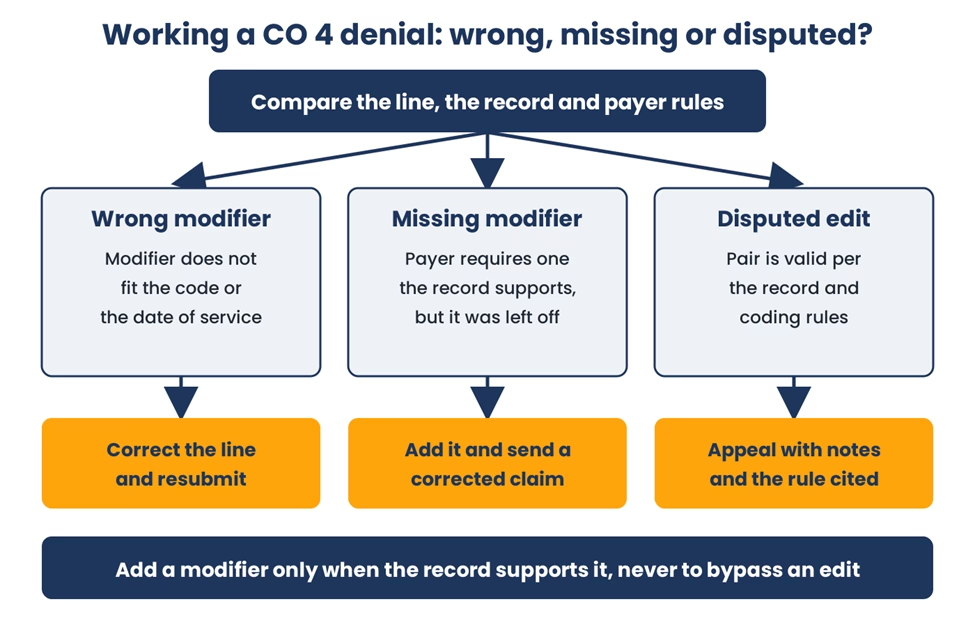
In short: correct wrong modifiers, add missing ones the record supports, and appeal only when the pair is valid.
Sample CO 4 Corrected Claim Note
Sample (fictional data). Many payers ask for a short note or claim frequency code with a corrected claim. Replace the details with your own.
Corrected claim for claim 2026090400731, patient Noah Grant, date of service September 4, 2026.
Line 1 originally billed 93000 with modifier 26. The physician only interpreted the ECG performed at the hospital, so the line is corrected to 93010 with no modifier.
Line 2, 73560, now carries modifier RT, matching the right-knee X-ray documented in the order and report.
Submitted by Ava Reed, Billing Specialist, Summit Internal Medicine, (555) 013-7742.
CO 4 vs CO 182, CO 236 and CO 97
| Code | What it means | Typical fix |
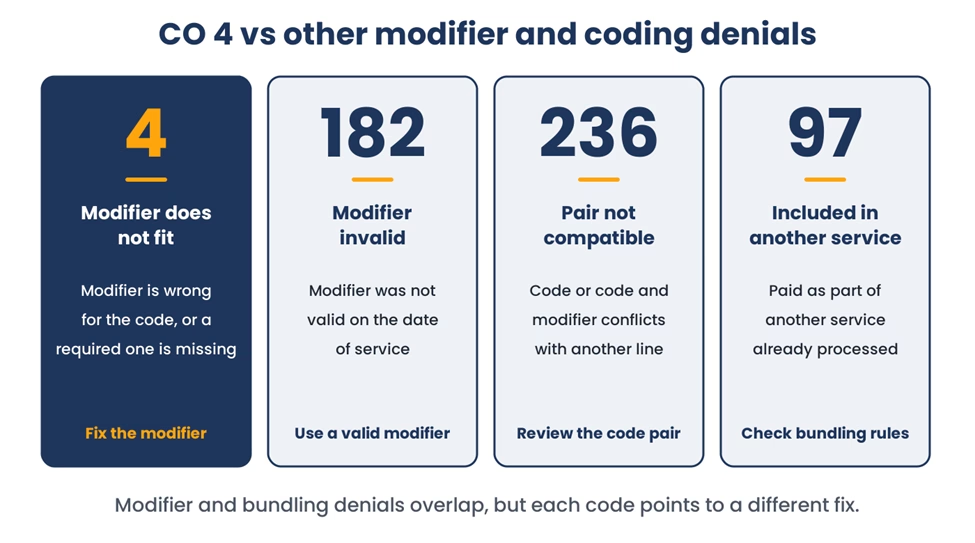
| CO 4 | Procedure code is inconsistent with the modifier, or a required modifier is missing | Correct or add the modifier |
| CO 182 | Procedure modifier was invalid on the date of service | Use a modifier valid on that date |
| CO 236 | Procedure or procedure-modifier pair is not compatible with another one on the claim | Review the code pair and modifier use |
| CO 97 | Service is included in another service already processed | Check bundling rules |
Bundling denials need a different review. Our guide to the CO 97 denial code covers that side, and the CMS procedure-to-procedure edit page explains when a modifier can allow two codes that are normally bundled.
How to Prevent CO 4 Denials
- Keep a payer-by-payer modifier reference for imaging, injections, surgery and drugs.
- Review charge templates after every January and October code update.
- Load modifier validity edits into your claim scrubber.
- Train coders on when distinct-service modifiers apply; our article on correct use of modifier 59 covers the main rules.
- Audit CO 4 trends monthly by code, provider and payer.
For a broader refresher, see our guide to coding modifiers for accurate billing.
CO 4 Denial Code FAQs
Can I bill the patient for a CO 4 denial?
No. Group code CO means the provider is responsible under the contract, and a CO 4 is a coding issue the practice controls. Correct the modifier and resubmit, or appeal if the original pairing was valid. If neither applies, adjust the line off rather than billing the patient for it.
Should I send a corrected claim or an appeal for CO 4?
Send a corrected claim when the modifier was wrong or missing, because the fix is on the claim itself. Choose an appeal only when the original modifier was valid and the payer’s edit is wrong. For Original Medicare, simple clerical fixes usually go through a reopening rather than the appeals process.
Is CO 4 the same as CO 97?
No. CO 4 says the modifier and code do not fit together. CO 97 says the service was included in payment for another service on the claim or an earlier claim. A missing distinct-service modifier can play a part in both, but CO 97 needs a bundling review rather than a simple modifier fix.
How long do I have to fix a CO 4 denial?
For Original Medicare, you have 120 days from receipt of the initial determination to request a redetermination. Corrected-claim and appeal limits for Medicare Advantage, Medicaid and commercial plans are set in the contract and provider manual, so check them as soon as the denial posts.
Get Help Clearing CO 4 Denials
The CO 4 denial code is among the easiest denials to recover when modifiers are reviewed line by line before claims go out. If modifier errors keep reaching your denial queue, Zmed Solutions offers revenue cycle management services covering coding review, claims and denial follow-up, and you can reach the team through the Zmed Solutions contact page.
Sources and note: X12 claim adjustment reason code descriptions as published by Noridian and the Louisiana Department of Health; Noridian JA DME and JE Part B guidance; CMS NCCI procedure-to-procedure edit page; CMS guidance on Medicare redeterminations. CPT codes are from the AMA CPT code set. This article is general billing education, not legal or medical advice. Payer rules vary, so check each payer’s contract and provider manual.
Ready to optimize your medical billing and boost your revenue? Look no further. Zmed Solutions LLC is your trusted partner in professional Medical Billing Services.
Join our growing network of healthcare providers who have already elevated their revenue with our expert services. Don't miss out on what could be your practice's most profitable decision.
Schedule a Consultation Today!
Contact Us Now, and experience the difference. Your financial success starts here!