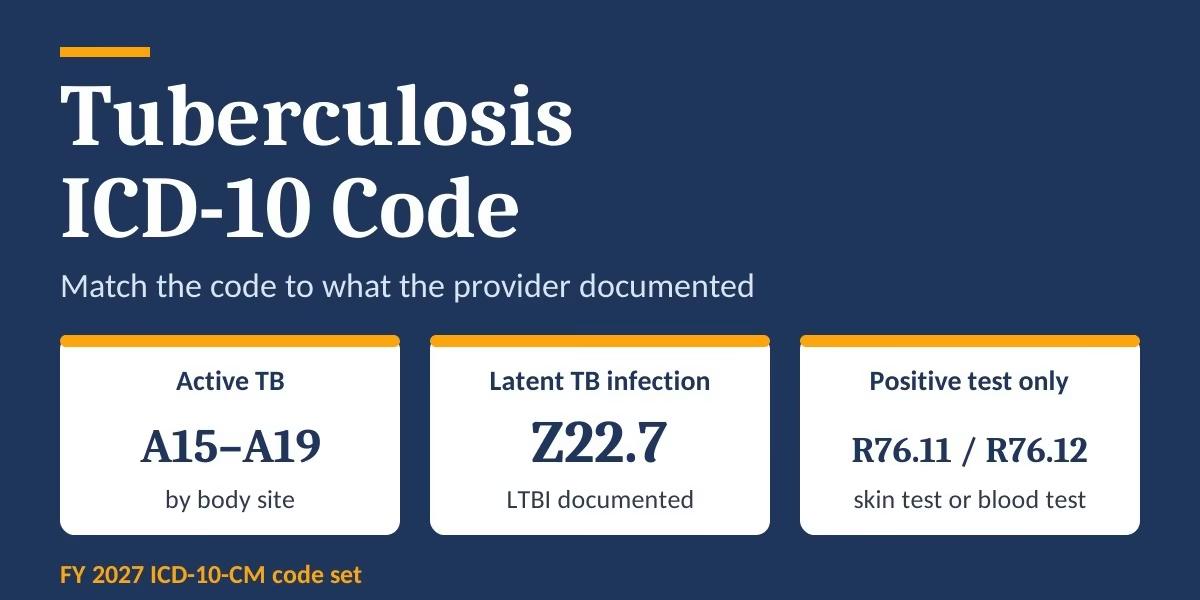
The right tuberculosis ICD-10 code depends on what the provider documented, not on a lab result alone. Active disease uses A15 through A19, latent infection uses Z22.7, and a positive skin or blood test with no diagnosis uses R76.11 or R76.12.
This guide shows how to choose between them, which codes cannot appear together, and how to handle suspected TB. It uses the FY 2027 code set, in effect for dates of service from October 1, 2026, and supports the coding step of a clean revenue cycle management workflow.
| Key takeaways Active TB uses A15 through A19, chosen by body site. A15.0 is tuberculosis of the lung.Z22.7 is for a documented latent TB infection. R76.11 and R76.12 are for a positive test with no diagnosis.Z22.7, R76.11 and R76.12 are never reported together.Outpatient claims do not use “suspected” or “rule out” TB. Code the symptoms or findings instead. |
Tuberculosis ICD-10 Codes by Scenario
Start with the provider’s assessment. The lab result shows what the test found; the assessment tells you what to bill.
| What the provider documented | Code | Code title |
| Tuberculosis of the lung | A15.0 | Tuberculosis of lung |
| Respiratory TB outside the lung, site named | A15.4 to A15.8 | Lymph nodes (A15.4), airway (A15.5), pleurisy (A15.6), primary (A15.7), other (A15.8) |
| TB outside the respiratory system | A17.-, A18.-, A19.- | Nervous system, other organs and miliary tuberculosis |
| Latent TB infection | Z22.7 | Latent tuberculosis |
| Positive skin test, no diagnosis | R76.11 | Nonspecific reaction to tuberculin skin test, no active TB |
| Positive blood test, no diagnosis | R76.12 | Nonspecific reaction to gamma interferon antigen response, no active TB |
| Contact with a person who has TB | Z20.1 | Contact with and (suspected) exposure to TB |
| Past TB or past latent infection | Z86.11, Z86.15 | Personal history of TB; personal history of latent TB infection |
| Late effects of TB | B90.- | Sequelae of tuberculosis, by site |
| Test visit, no symptoms | Z11.7 or Z11.1 | Testing for latent TB infection; screening for respiratory TB |
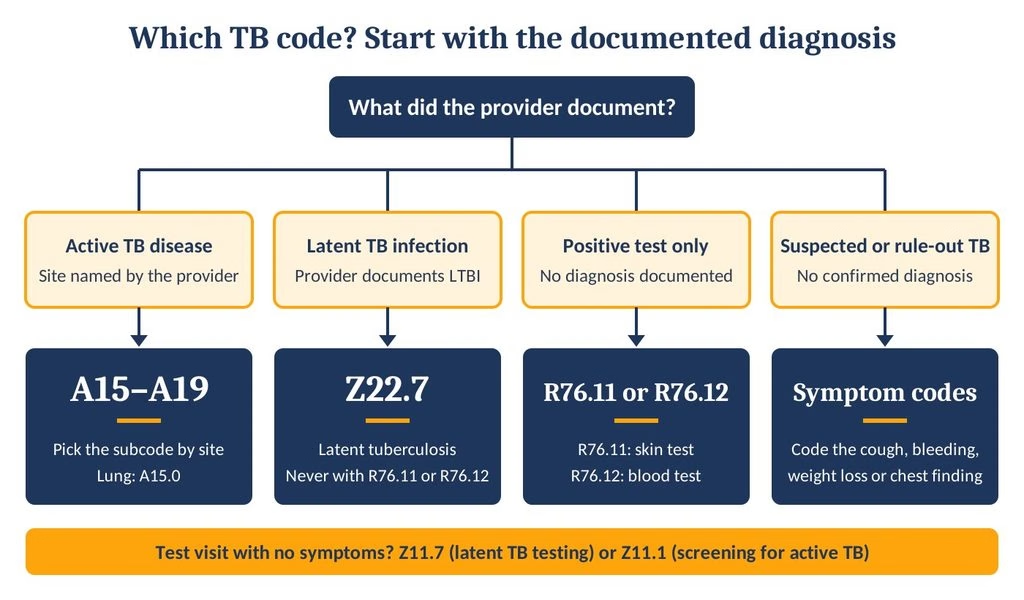
Summary: active TB to A15 through A19, latent infection to Z22.7, a positive test only to R76.11 or R76.12, and suspected TB to symptom codes.
Active TB Codes: A15 to A19 by Body Site
A15 is a category header, so it cannot be billed on its own. Choose the subcode for the site the provider names: A15.0 for the lung, A15.4 through A15.8 for other respiratory sites, and A15.9 only when no detail is given.
TB outside the respiratory system moves to other categories. Nervous system disease uses A17 (A17.0 is tuberculous meningitis). Other organs use A18, such as A18.01 for the spine, A18.2 for peripheral lymph nodes and A18.11 for the kidney and ureter. Miliary TB uses A19.
Add a Z16 code when the record shows drug resistance. If the patient also has HIV disease, follow Section I.C.1.a of the official guidelines for sequencing. Older cheat sheets may still show A15.1 to A15.3 and A16 codes, which are not in the current A15 to A19 range.
Latent TB, Positive Tests and Exposure
A positive TB test shows infection, not disease. CDC’s clinical overview of latent TB infection says a positive skin or blood test calls for more testing, such as a chest radiograph, and that TB disease must be excluded before latent infection is treated.
That is why three code paths exist. A documented latent tuberculosis infection (LTBI) is Z22.7. A positive PPD or Mantoux skin test with no diagnosis is R76.11. A positive interferon-gamma blood test such as QuantiFERON with no diagnosis is R76.12.
The visit that places or reads the test uses a testing code: Z11.7 for latent TB testing and Z11.1 for screening for respiratory TB. CDC lists the newer TB codes, and our guide to TB screening ICD-10 codes explains how to choose between Z11.1 and Z11.7 and why Z11.51 is not a TB code.
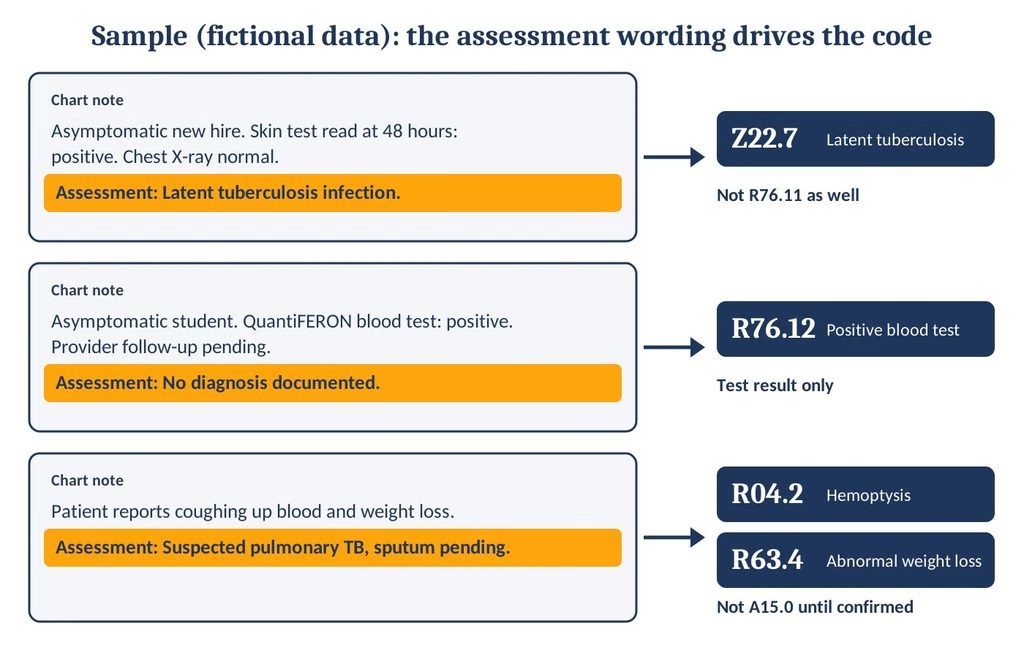
Sample Chart Notes and the Codes They Support
Suspected TB: Code the Symptoms, Not the Rule-Out
In outpatient settings, Section IV.H of the FY 2027 ICD-10-CM Official Guidelines says not to code a diagnosis documented as probable, suspected, questionable or rule out. Code the condition to the highest degree of certainty, such as symptoms, signs or abnormal findings. Hospital inpatient stays follow a different rule.
For a TB work-up, that usually means cough (R05.- codes), coughing up blood (R04.2), abnormal weight loss (R63.4), generalized sweating (R61), fever (R50.9) or an abnormal chest imaging finding (R91.8). If TB is evaluated and ruled out in a patient with no symptoms, Z03.89 may fit. Once a test confirms disease, code the confirmed TB.
Codes That Cannot Be Reported Together
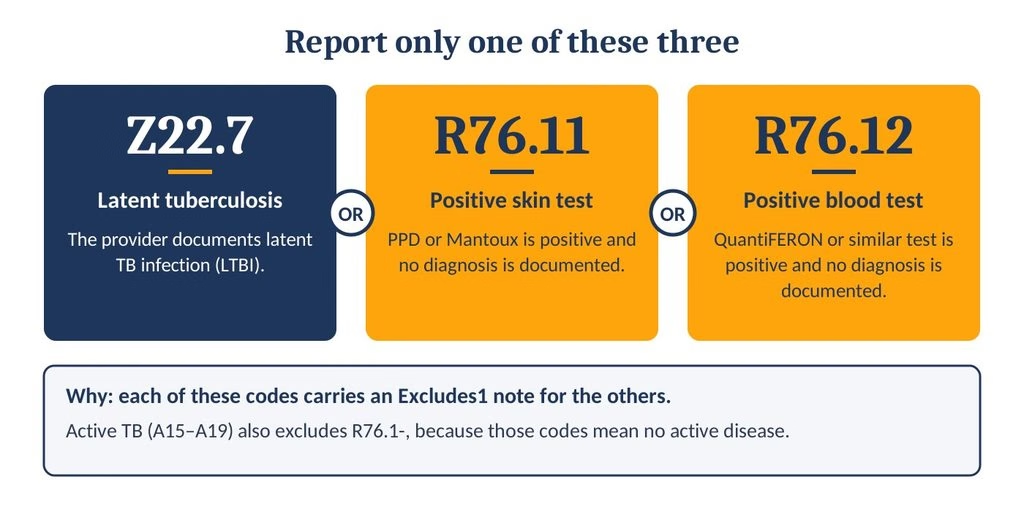
An Excludes1 note means two conditions are not coded together.
| Code pair | Together? | Reason |
| Z22.7 and R76.11 | No | Z22.7 excludes R76.11, a positive skin test without active TB. |
| Z22.7 and R76.12 | No | Z22.7 also excludes R76.12, the positive blood test code. |
| R76.11 and R76.12 | No | Each code excludes the other, so pick one. |
| A15 to A19 and R76.1- | No | R76.1- applies only when there is no active tuberculosis. |
| Z20.1 and diagnosed TB | No | Z20 excludes a diagnosed current infectious disease. |
Common TB Coding Mistakes and How to Prevent Them
- Reporting two exclusive codes. Choose Z22.7, R76.11 or R76.12 based on what the provider documented, and add a claim edit that flags the pairs above.
- Using Z11.51 for TB screening. Z11.51 is HPV screening. Use Z11.1 or Z11.7.
- Coding from a lab value alone. A result is not a diagnosis. Send a query to the provider.
Update superbills and encoders every October 1; our summary of the FY 2027 ICD-10-CM code changes shows what to review. These slips also appear on lists of common medical coding errors.
What the Provider Should Document
- The test type, date and result, and whether TB disease was evaluated, such as chest radiograph findings.
- The assessment in words: active TB, latent TB infection, positive test only, or symptoms under evaluation.
- For active disease, the body site and any drug resistance.
- The reason for the visit: testing, treatment, follow-up or exposure.
Diagnosis codes must also support the test or service billed, so review how to prevent medical necessity denials and how ICD-10 and CPT codes work together on one claim. Payers use ICD-10-CM, but each sets its own coverage rules for TB tests and treatment, so check the payer’s provider manual.
Frequently Asked Questions
What is the ICD-10 code for tuberculosis?
There is no single code. Tuberculosis of the lung uses A15.0, other respiratory sites use A15.4 through A15.9, and other organs use A17 through A19. Latent infection uses Z22.7, and a positive test with no diagnosis uses R76.11 or R76.12. The provider’s documented diagnosis decides.
What is the ICD-10 code for a positive TB test?
A positive tuberculin skin test with no diagnosis uses R76.11. A positive interferon-gamma blood test such as QuantiFERON uses R76.12. If the provider documents latent tuberculosis infection, use Z22.7 instead, because it cannot be reported with either R76 code. Check the assessment before choosing.
What is the ICD-10 code for latent TB?
Latent tuberculosis infection (LTBI) is coded Z22.7. Use Z86.15 when the provider documents a personal history of latent TB infection rather than a current one. If the patient has active disease, use the A15 through A19 range instead. Do not add R76.11 or R76.12 to Z22.7.
Can you code suspected TB on an outpatient claim?
No. Outpatient guidelines do not allow probable, suspect or rule-out diagnoses to be code. Report the symptoms, signs or abnormal findings that prompted the visit, such as cough or an abnormal chest image. Hospital inpatient stays follow a different rule. The diagnosis can be code once it is confirm.
Final Thoughts
Choosing a tuberculosis ICD-10 code comes down to one question: what did the provider document? Active disease, latent infection, a positive test and suspected TB each have their own path, and the Excludes1 notes keep them separate.
Need Help With TB Claims?
If TB-related claims keep returning with edits or denials, a coding review can show where documentation and codes drift apart. Zmed Solutions supports practices through its infectious disease billing and credentialing support, and its revenue cycle team handles denial management and appeals. You can reach the team through the contact page.
Sources and note: CDC (ICD-10-CM Codes for Tuberculosis; Clinical Overview of Latent Tuberculosis Infection) and CMS (FY 2027 ICD-10-CM Official Guidelines). Educational information only, not legal or medical advice.
Ready to optimize your medical billing and boost your revenue? Look no further. Zmed Solutions LLC is your trusted partner in professional Medical Billing Services.
Join our growing network of healthcare providers who have already elevated their revenue with our expert services. Don't miss out on what could be your practice's most profitable decision.
Schedule a Consultation Today!
Contact Us Now, and experience the difference. Your financial success starts here!