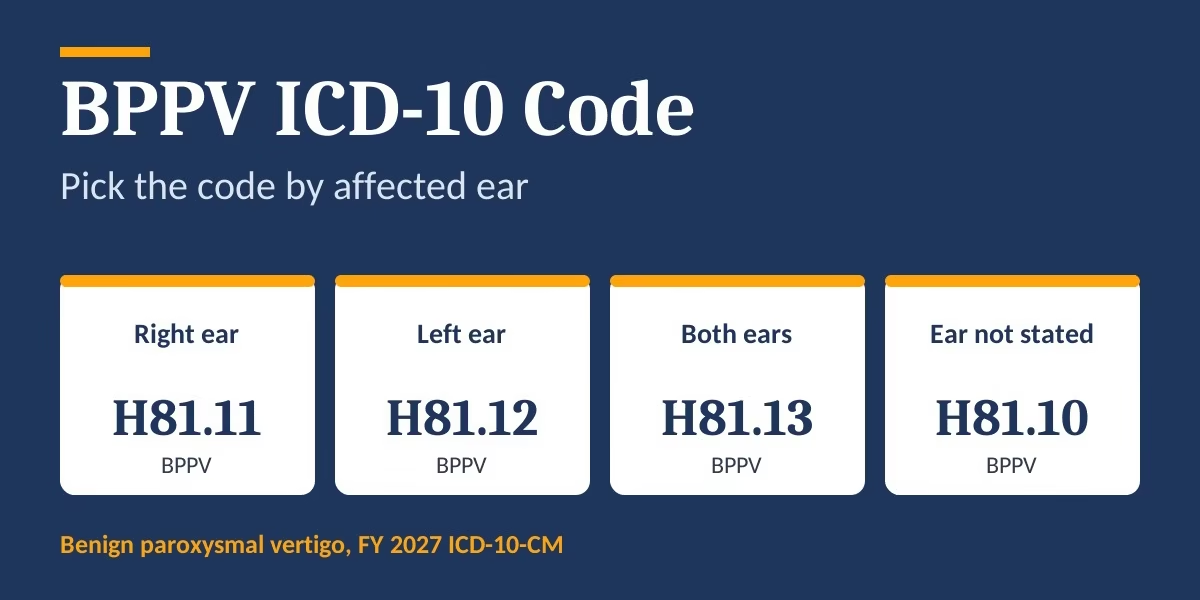
The BPPV ICD-10 code is H81.1-, benign paroxysmal vertigo, and the fifth character names the affected ear: H81.10 unspecified, H81.11 right, H81.12 left and H81.13 bilateral. Use R42 only when vertigo has no diagnosis behind it.
This guide explains how to select the correct code based on the documented ear, why R42 and H81 should not be reported together for the same condition, how to link the canalith repositioning maneuver, and what documentation is require. It is a narrower companion to our guide to ICD-10 codes for dizziness.
| Key takeaways BPPV is coded H81.1-: H81.11 right ear, H81.12 left ear, H81.13 both ears and H81.10 ear not stated.Use the documented ear. H81.10 is a last resort, because unspecified-side codes should rarely be used.R42 is for vertigo with no diagnosis. Once BPPV is documented, H81.1- replaces it.Link CPT 95992, the canalith repositioning maneuver, to the BPPV code. |
BPPV ICD-10 Code by Affected Ear
Benign paroxysmal positional vertigo is indexed to the H81.1 category. Start with the ear the provider documents, then match it to the table. All four codes are billable. The CDC FY 2027 ICD-10-CM release took effect October 1, 2026, and these codes show no change.
| What the provider documented | Code | Code title |
| BPPV, right ear | H81.11 | Benign paroxysmal vertigo, right ear |
| BPPV, left ear | H81.12 | Benign paroxysmal vertigo, left ear |
| BPPV, both ears | H81.13 | Benign paroxysmal vertigo, bilateral |
| BPPV, ear not stated | H81.10 | Benign paroxysmal vertigo, unspecified ear |
H81.1 on its own is a category, not a full code, so a claim needs the fifth character.
Right, Left, Bilateral and Unspecified Ear
Section I.B.13 of the FY 2027 ICD-10-CM Official Guidelines says that when the side is not identified in the record, you assign the unspecified-side code, and that unspecified-side codes should rarely be used. For BPPV, that means H81.10 is a last resort, not a default.
Laterality is an exception to the rule that the treating provider must document the diagnosis. If the provider did not name the ear, documentation from another clinician, such as a therapist who performed the maneuver, can support the side. If records conflict, query the provider.
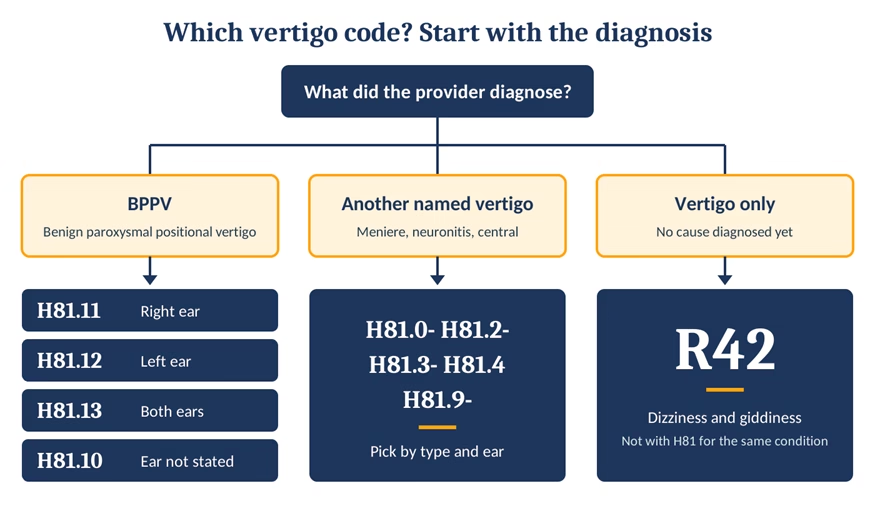
Summary: BPPV is H81.10 to H81.13 by ear, other named vertigo types are in H81.0, H81.2, H81.3, H81.4 and H81.9, and vertigo with no diagnosis is R42.
BPPV vs R42 and Other Vertigo Codes
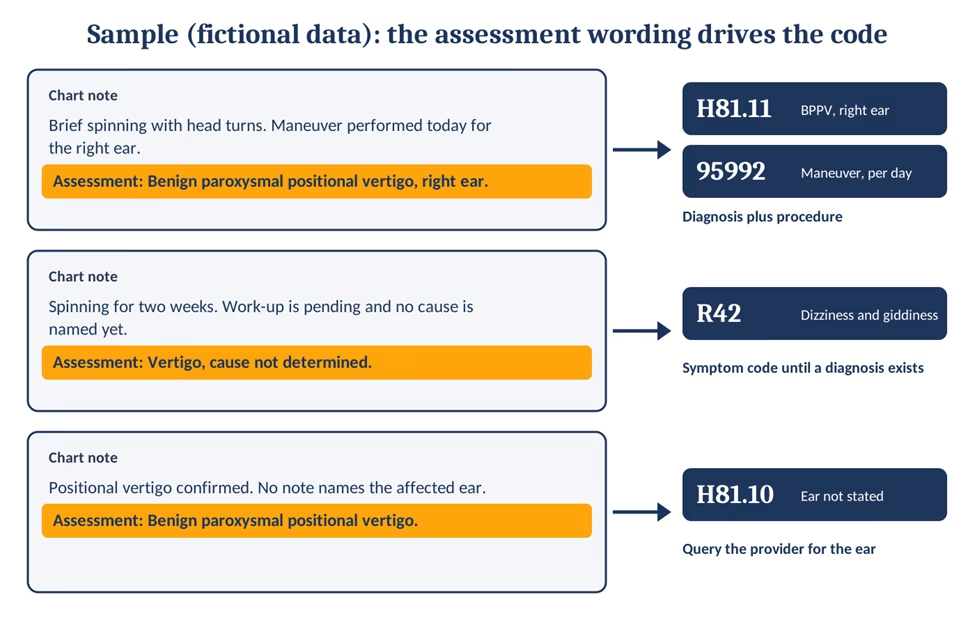
R42, dizziness and giddiness, includes vertigo not otherwise specified.
It includes an Excludes1 note for H81 vertiginous syndromes, meaning the two codes must not be report together for the same condition. Once the provider documents BPPV, H81.1- replaces R42.
| Documented diagnosis | Code range | Note |
| Vertigo, cause not determined | R42 | Symptom code until a diagnosis exists |
| Ménière’s disease | H81.0- | Choose the ear in the fifth character |
| Vestibular neuronitis | H81.2- | Choose the ear in the fifth character |
| Other peripheral vertigo | H81.3- | Includes aural vertigo (H81.31-) |
| Vertigo of central origin | H81.4 | No ear character |
| Vestibular disorder, unspecified | H81.9- | Choose the ear in the fifth character |
Lightheadedness that is not vertigo stays with R42 and the wider dizziness codes.
Sample Chart Notes and the Codes They Support
Billing the Canalith Repositioning Maneuver
CPT 95992 describes canalith repositioning procedures, such as the Epley or Semont maneuver, reported per day.
Report it once per day, even when multiple maneuvers are perform. Link it to the BPPV code, with the ear documented, so the diagnosis supports the procedure.
Which clinicians may bill the code, and how often, depends on the payer, so check each payer’s policy. Our article on medical necessity denials explains why the diagnosis on the claim matters.
Common BPPV Coding Mistakes and How to Prevent Them
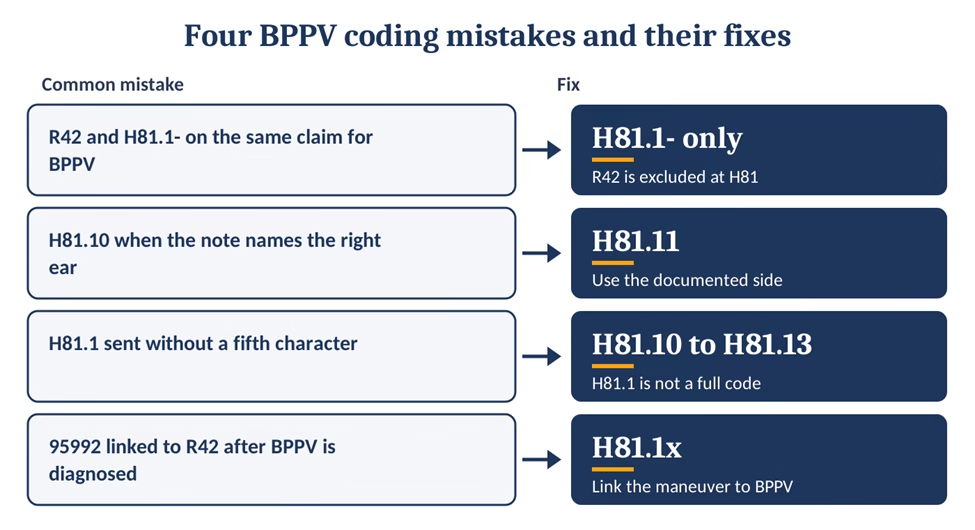
- Ask for the ear. Add a side field to the vertigo template so notes name right, left or both.
- Review every October 1. Our summary of the FY 2027 ICD-10-CM code changes lists what to check each year.
- Drop R42 once BPPV is confirm. Report the H81.1- code instead.
What the Provider Should Document
- The diagnosis in words: benign paroxysmal positional vertigo, not only “dizzy.”
- The affected ear: right, left or both.
Document the maneuver performed and the date of service when billing for it.- The plan: repeat treatment, home exercises or referral.
Frequently Asked Questions
What is the ICD-10 code for BPPV?
Code BPPV in category H81.1, benign paroxysmal vertigo.
Use H81.11 for BPPV affecting the right ear, H81.12 for the left ear, H81.13 for both ears, and H81.10 when documentation does not specify the affected ear. Require the fifth character, as H81.1 alone is not a billable code.
What is the ICD-10 code for vertigo?
Vertigo not otherwise specified is R42, dizziness and giddiness. When the provider documents a specific type, such as BPPV, Ménière’s disease or vestibular neuronitis, use the matching H81 code instead of the symptom code. R42 has an Excludes1 note for the H81 vertiginous syndromes.
Can I report R42 with H81.10?
Not for the same condition. R42 has an Excludes1 note that bars it with H81 vertiginous syndromes, so once BPPV is documented, H81.1- replaces the symptom code. R42 is for vertigo that has no diagnosis yet. Check the tabular list in your encoder for the current note before you submit the claim.
Which code is used for right ear BPPV?
H81.11, benign paroxysmal vertigo, right ear. Use it when the provider documents BPPV on the right side. If the note names the left ear, use H81.12. Both ears are involved, use H81.13. If no side is documented, query the provider before settling for H81.10.
Did the BPPV codes change in FY 2027?
The H81.1 codes carry into FY 2027, effective October 1, 2026, and H81.10 lists no change for that year. Codes still change every October, so review the new code set each year before you update your templates, superbills and charge masters.
Final Thoughts
Choosing the BPPV ICD-10 code comes down to two details: the provider’s diagnosis and the documented ear. Use H81.11, H81.12 or H81.13 when the side is known, H81.10 only when it cannot be found, and R42 only while vertigo has no diagnosis.
Need Help With Neurology and ENT Claims?
If vertigo claims keep returning with diagnosis edits or denials, a coding review can show where documentation and codes drift apart. The Zmed Solutions team handles coding, claim scrubbing and denial follow-up as part of revenue cycle management. You can reach the team through the contact page.
Sources and note: CMS (FY 2027 ICD-10-CM Official Guidelines), the FY 2027 ICD-10-CM code set and AMA CPT (code 95992). Educational information only, not medical or legal advice.
Ready to optimize your medical billing and boost your revenue? Look no further. Zmed Solutions LLC is your trusted partner in professional Medical Billing Services.
Join our growing network of healthcare providers who have already elevated their revenue with our expert services. Don't miss out on what could be your practice's most profitable decision.
Schedule a Consultation Today!
Contact Us Now, and experience the difference. Your financial success starts here!