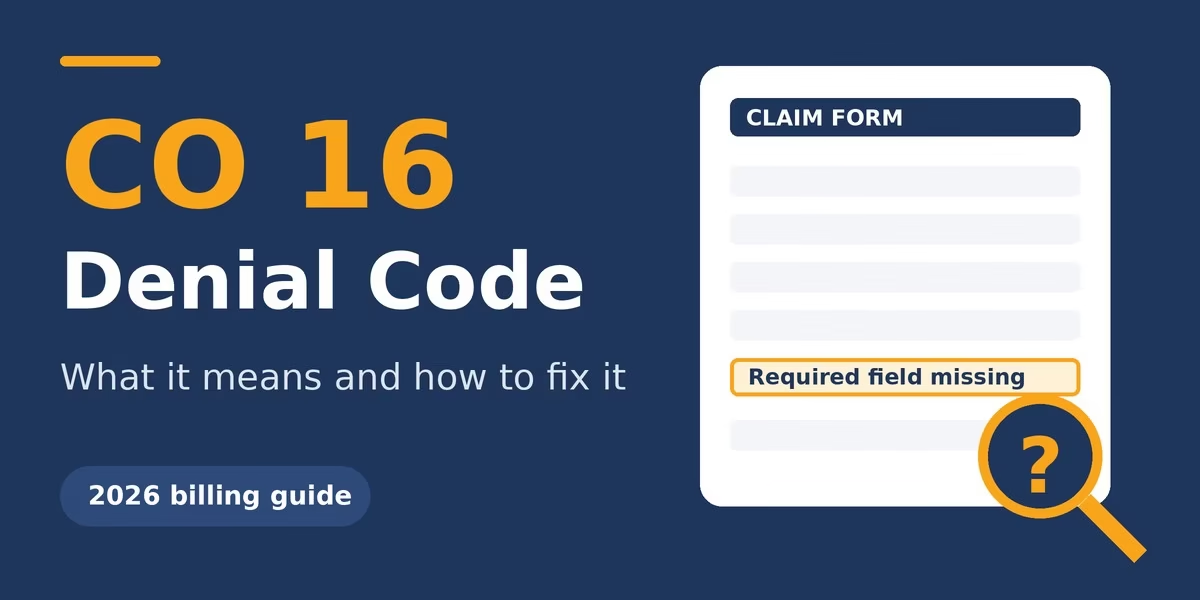
The CO 16 denial code means a payer could not process a claim because the claim lacks required information or has a submission or billing error. CO marks the provider as financially responsible, and the payer must attach a remittance advice remark code (RARC) naming the missing or invalid item.
A CO 16 denial code stops a claim before the payer looks at the care itself. The fix usually sits in a single data field. The difficulty is that the right response depends on the payer. Medicare often returns these claims as unprocessable with no appeal rights, while commercial plans and Medicaid may expect a corrected claim. This guide explains how to read the remark code, repair the claim, protect the filing deadline and reduce repeats. A 10-question self-assessment checklist near the end lets you score your own process.
CO 16 numbers worth keeping on hand
Six numbers cover most CO 16 decisions: one published filing standard, one survey figure and four practical targets. Review them on the schedule shown. Treat the practical targets as starting points to adjust for your specialty and payer mix, since no standards body mandates them.
| Metric | Practical target or range | Review frequency | Source type |
| Medicare timely filing limit | 12 months from the date of service | Every returned claim | A |
| Overall initial denial rate | 5% to 10% is commonly cited | Monthly | C |
| Clean claim rate | 95% or higher as a practical target | Weekly | C |
| Providers reporting denial rates of 10% or higher | 41% of surveyed providers (2025) | Annual reference | B |
| Corrected-claim turnaround after a CO 16 | About 5 business days (illustrative internal target) | Weekly | C |
| CO 16 share of all denials | No published benchmark; track your own trend | Monthly, by payer | C |
Source types: A = published standard or definition from a named body (CMS and its contractors). B = named survey (Experian Health, State of Claims 2025). C = practical or illustrative target commonly reported across industry sources. Actual figures vary by payer, specialty and contract.
What does the CO 16 denial code actually say?
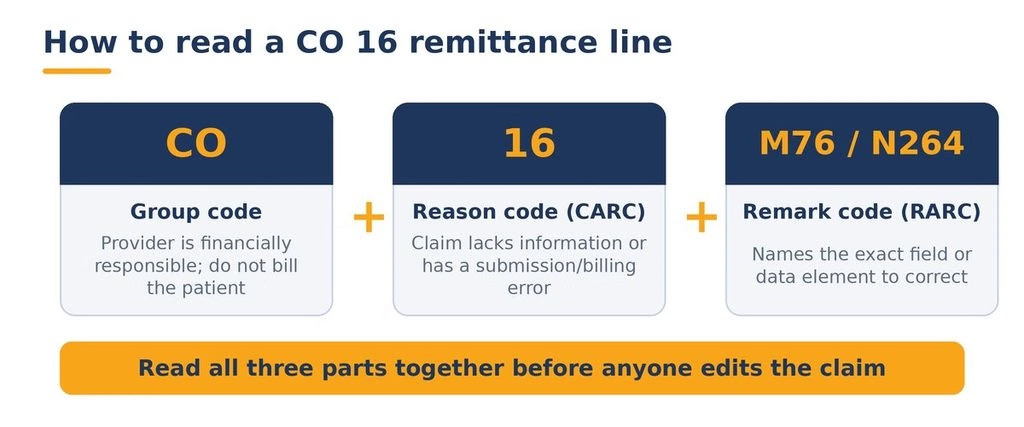
The CO 16 denial code joins a group code (CO) to a claim adjustment reason code (CARC), CARC 16. The standards body X12 describes CARC 16 as a claim that lacks information or has submission or billing errors. Its published code list is the reference payers use. Three parts of the remittance line work together, and reading them in order saves rework.
- Group code CO (contractual obligation): the provider carries the financial responsibility, so the balance cannot be moved to the patient.
- CARC 16: the reason category, meaning the claim lacks information or contains a submission or billing error.
- RARC: the specific element at fault, such as a diagnosis code, a procedure code or an ordering provider.
X12’s usage note adds two rules. CARC 16 is not meant for missing attachments or other documentation, and at least one remark code must accompany it. A CO 16 with no remark code is therefore incomplete remittance data. Call provider relations and ask which field failed.
Why the CO group code matters for patient balances
Group code CO tells the practice to absorb the balance unless the claim is corrected and paid. Group code PR would assign patient responsibility. In billing audits, a common pattern is staff moving a CO 16 balance to the patient to clear an aging report. That creates a compliance problem and an unhappy patient. Hold the balance in the payer queue whenever the remittance shows CO.
Is a CO 16 a rejection, an unprocessable claim or a true denial?
A CO 16 usually means the payer refused to adjudicate the claim, which differs from a clinical or coverage judgment. Where the message appears varies. Before adjudication, a payer or clearinghouse can send a 277CA acknowledgment that rejects the claim. A true denial appears only on the 835 electronic remittance advice (ERA) after adjudication. Check the 277CA report first and the 835 second.
Medicare adds a third category. When a Medicare contractor returns a claim as unprocessable, the remittance usually carries CARC 16 with remark code MA130. The claim has no appeal rights. Noridian’s reason code guidance says the fix is a new claim with corrected or complete information. The distinction matters because an appeal only delays the correction.
| Payer type | What CO 16 usually means | Typical correction route | Deadline reference |
| Medicare fee-for-service | Unprocessable claim, often paired with MA130 | New claim with corrected data; no appeal | 12 months from date of service |
| Medicare Advantage | Plan-level edit or missing data | Follow the plan’s provider manual: corrected or new claim | Per plan contract |
| Medicaid (state or managed care) | Missing or invalid data under state rules | State Medicaid manual or MCO corrected-claim policy | Varies by state and plan |
| Commercial | Payer edit; may be a 277CA rejection or 835 denial | Corrected claim or new claim, per payer policy | Per contract |
General guidance, not a substitute for your contracts. Payer contracts and state rules govern the exact route and deadline.
Payers differ even on the mechanics of a correction. VA Community Care, for example, reserves frequency code 7 for claims already processed. It says rejected or denied claims should not use it. That example shows why one rule cannot be copied across payers. Confirm the payer’s rule before choosing between a corrected claim and a new claim.
What triggers a CO 16, and which remark code points to the fix?
Missing or invalid claim data triggers most CO 16 returns, and the remark code names the field. In Experian Health’s 2025 State of Claims survey, 50% of providers cited missing or inaccurate data as a leading denial cause. Authorizations followed at 35% and incomplete patient registration data at 32%. Those figures describe denials broadly, not CO 16 alone, but they show where front-end effort pays off.
| Trigger | Remark codes often paired | Typical fix |
| Invalid or truncated diagnosis code | M76 | Re-code to the highest valid specificity for the date of service, then resubmit |
| Missing or invalid procedure code | M51 | Correct the CPT or HCPCS code; use an unlisted code only when no listed code fits |
| Procedure code not valid for the service or date | N56 | Validate the code against the code set in effect on the date of service |
| Missing or invalid ordering/referring provider name | N264 | Enter the individual’s name without nicknames or credentials; on paper, first name then last name in Item 17 |
| Ordering/referring identifier invalid, or name not matching payer records | N265, N575 | Report the individual’s NPI, confirm the name matches enrollment records, and check PECOS status for Medicare |
| Other-insurance (Medicare secondary payer) data incomplete | N245 | Correct the other-payer details and send a new claim |
| Accident date missing or invalid | N305 | Add the accident date and send a new claim |
| Certificate of medical necessity not linked (DME) | M60 | Link the certificate to the claim in your billing software |
| Claim returned as unprocessable (Medicare) | MA130 | Correct every error the accompanying remark code names and send a new claim |
Remark codes shown are examples, drawn from CMS and Medicare contractor guidance and published vendor explainers. The 835 or payer portal shows the exact RARC your payer sent.
Why October 2026 raises the risk
The FY 2027 ICD-10-CM update took effect October 1, 2026, with 238 new codes, four revisions and 21 deletions, according to Physicians Practice. Claims that still use a parent code that was expanded, such as I42.0 for dilated cardiomyopathy, are rejected after the switchover. For dates of service on or after January 1, 2014, CMS directs Medicare contractors to return a CMS-1500 as unprocessable when the header holds an invalid diagnosis code. That applies even if no service line points to it.
In billing audits, a common pattern is an early-October CO 16 spike that traces to stale EHR diagnosis shortcuts, not coder error. Refresh superbills, favorites lists and charge-capture pick lists whenever an annual code-set update takes effect. Review them again for the January 1 CPT and HCPCS changes.
How is CO 16 different from CO 4, CO 11, CO 22, CO 45 and CO 97?
CO 16 flags missing or invalid claim data, while its look-alikes flag a specific coding, coverage or payment-policy result. Mixing them up sends staff down the wrong path. Examples include appealing a CO 16 or rebuilding a clean claim to chase a CO 45 adjustment, which is normally a contractual write-off.
| Code | Plain meaning | First move |
| CO 16 | Claim lacks information or has a submission or billing error | Read the RARC, correct the data, resubmit by the payer’s route |
| CO 4 | Procedure code and modifier do not agree | Review modifier rules and send a corrected claim |
| CO 11 | Diagnosis does not fit the procedure billed | Check coding and documentation; correct only if the coding was wrong |
| CO 22 | Another payer may be responsible | Verify the primary payer and update coordination of benefits data |
| CO 45 | Charge exceeds the contracted or allowed amount | Usually a contractual write-off; see the CO 45 guide |
| CO 97 | Payment already included in another service’s allowance | Check bundling rules and modifiers before any follow-up |
Meanings paraphrased from the X12 claim adjustment reason code list.
How do you fix a CO 16 denial step by step?
Fix a CO 16 denial by reading every remark code, correcting the named data element and resubmitting through the route the payer specifies before the filing deadline closes. The sequence below works for most payers, and each step names the condition that triggers it.
- Pull the full remittance line: group code, CARC and every RARC. Use the 835 when the claim was adjudicated, and the 277CA report when the clearinghouse or payer rejected it.
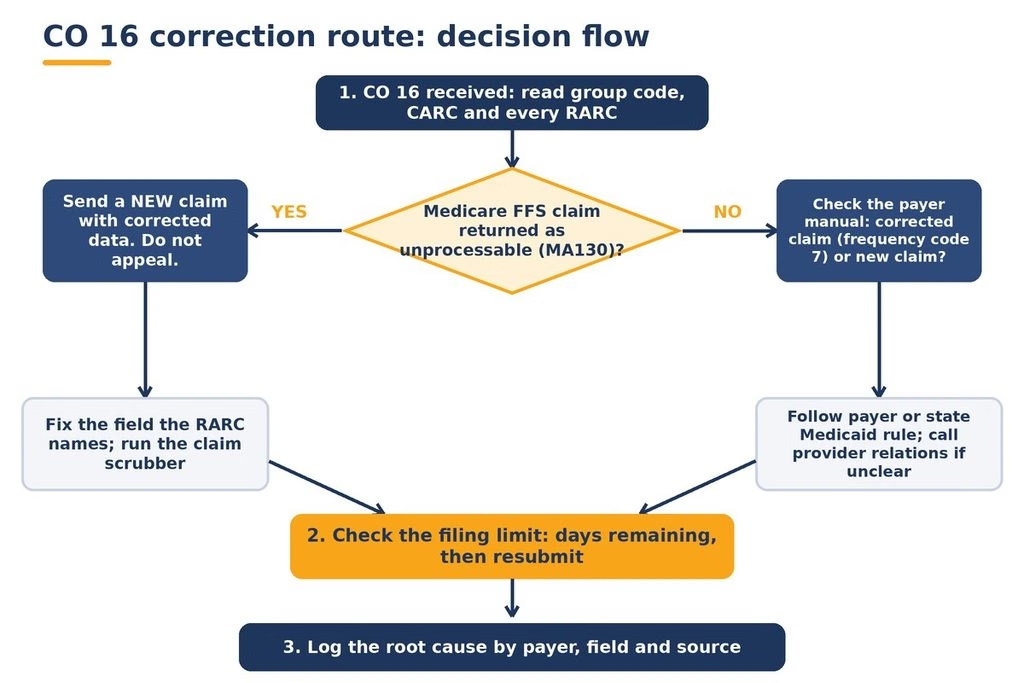
- Classify the return as a front-end rejection, a Medicare unprocessable claim with MA130, or an adjudicated CO 16 denial, because the route differs for each.
- Match each RARC to a claim element using the trigger table above, then open the claim in the practice management system.
- Compare the claim to source documents when the RARC points to demographics, insurance or provider data: the insurance card, the referral or order, and the encounter note.
- Correct the claim and scrub it. A claim scrubber applies claim scrubbing rules that catch missing fields and invalid code pairs before release.
- Choose the route. Send a new claim for Medicare unprocessable returns, follow the payer’s corrected-claim policy for commercial, Medicare Advantage and Medicaid, and call provider relations when the remark code is missing or unclear.
- Resubmit and log it. Record the date and the root cause by payer, field and source, so repeat causes show up in monthly reporting.
Medicare secondary payer claims
Medicare secondary payer (MSP) claims follow a specific pattern. Noridian’s May 2025 guidance says MSP claims rejected with CARC 16 cannot be appealed and need a new claim. Remark code N245 points to incomplete or invalid other-insurance information. N305 flags a missing or invalid accident date, and N704 confirms that no appeal is allowed. Paper, fax and portal appeals are not accepted for these rejections.
Medicare Advantage, Medicaid and commercial plans
Outside Medicare fee-for-service, the plan’s provider manual and contract control the correction route. Check whether the plan wants a replacement claim with a frequency code and the original claim number, a brand-new claim, or a portal-based correction. State Medicaid rules and managed care plans can differ within the same state, so verify before the first resubmission, not after the second rejection.
In denial work queues, a common pattern is that teams file an appeal on a CO 16 because the remittance says the claim was denied. FCSO’s guidance says appeals of unprocessable claims are returned with instructions to refile, which can add roughly 60 days and risk a timely filing denial. Send the corrected claim instead, and keep the appeal path for adjudicated denials that carry appeal rights.
How long do you have to correct and resubmit a CO 16 claim?
Medicare allows 12 months from the date of service, and a claim returned as unprocessable does not count as filed within that window. Noridian’s timely filing guidance cites 42 CFR 424.44 and states that rejected claims must be corrected and resubmitted within the same one-year period. Narrow exceptions exist, such as a Medicare program error, but they should not be part of a plan.
Other payers set their own limits by contract or state rule, and these often differ from Medicare’s. Confirm each payer’s filing limit and whether a returned claim stops the clock. Pair that with a timely claims submission routine that flags every CO 16 return by the days remaining.
Illustrative scenario (not an actual client record): a commercial contract sets a 90-day filing limit from the date of service. The payer does not count a returned claim as filed. The practice submits on day 30 and receives a CO 16 on day 45, so 90 minus 45 leaves 45 days. A fix sent on day 55 leaves a 35-day margin, while leaving the return untouched until day 85 leaves only 5.
Formula: days remaining = filing limit minus days elapsed since the date of service.
How do you measure CO 16 and spot a problem hiding in the average?
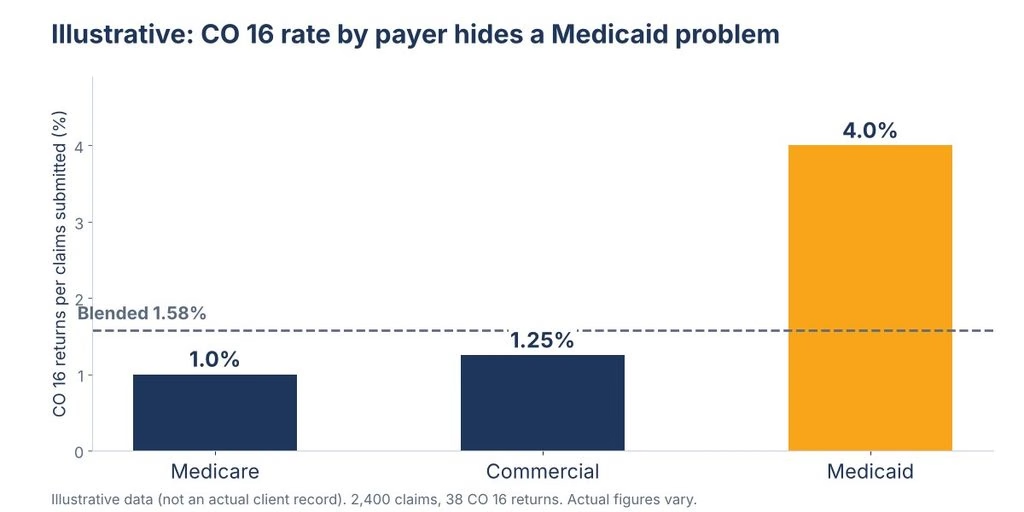
Measure CO 16 as a rate by payer rather than as one blended number, because a single payer or data source can hide inside an acceptable average. The formula is CO 16 returns divided by claims submitted, tracked monthly by payer and by billing provider.
| Payer (Illustrative) | Claims submitted | CO 16 returns | CO 16 rate |
| Medicare | 1,200 | 12 | 1.0% |
| Commercial | 800 | 10 | 1.25% |
| Medicaid | 400 | 16 | 4.0% |
| Total (blended) | 2,400 | 38 | 1.58% |
Illustrative scenario (not an actual client record). Actual figures vary by payer, specialty and location.
In this illustrative example, the blended rate of 1.58% looks tolerable, but Medicaid runs at 4.0%, about 2.5 times the blended figure. The next step is to read the Medicaid remark codes. One recurring RARC often points to a single cause, such as a missing ordering provider field.
Two companion metrics sharpen the picture. Clean claim rate equals claims accepted on the first pass divided by claims submitted. Here, 2,150 of 2,400 gives 89.6%, about 130 claims short of the 95% practical target. CO 16 share of denials equals CO 16 returns divided by all denied claims, so 38 of 210 denials is 18.1%. Review the metrics every practice should track for wider context.
Rework time matters too. Multiplying 38 returns by an assumed 20 minutes each, then dividing by 60, gives about 12.7 staff hours in that month. The 20-minute figure is an illustrative assumption, so replace it with your own timed average. These clean claim submission tips cover the upstream fixes.
How to use these numbers correctly
Compare like for like: the same payer, specialty and month. One missed benchmark is a signal to investigate, not a verdict. A rate that spikes after an EHR change or code update points to a process cause. A rate that stays high for one provider points to enrollment or data-entry habits. A payer-specific pattern that staff cannot resolve may justify denial management and appeals support.
How do you prevent CO 16 denials before submission?
Prevent CO 16 denials by validating data at registration, charge entry and scrubbing, because each stage catches different missing or invalid elements. Assign an owner to each stage when repeat denials come from several sources, so correction does not fall on the billing desk alone.
- Registration: verify coverage and demographics at scheduling and check-in, especially when the patient is new or the plan changed. See the value of eligibility verification.
- Charge entry: make the referring or ordering provider field mandatory when the payer requires it. For Medicare, PECOS enrollment and specialty must support the order, and the individual’s NPI and name must be reported.
- Provider enrollment: confirm payer enrollment, NPI and taxonomy whenever a provider joins or billing details change, with credentialing and contracting support if enrollment lags.
- Scrubber and clearinghouse edits: add a rule when the same RARC returns twice, so the error is blocked before release.
- Code-set updates: review pick lists and charge masters on October 1 and January 1 each year.
- 277CA review: work rejections the day they arrive, because a rejected claim still runs against the filing clock.
How long does improvement take?
Fixing the top two or three recurring causes often produces a partial drop in CO 16 volume within roughly 30 to 60 days. Fuller results typically take 90 to 180 days, because payer-specific edits and registration habits change slowly. These are general planning ranges, not guarantees, and results vary by practice size, payer mix and system setup. A documented denial management workflow keeps the work moving.
What mistakes keep CO 16 denials coming back?
Repeat CO 16 returns usually trace to process habits rather than payer behavior. Each fix below is conditional, so apply it only when its trigger appears. Log the outcome each time, so the next monthly review shows whether the habit actually changed or only moved to another team.
- Appealing an unprocessable claim. When the remittance shows MA130 or remark code N704, send a new claim instead.
- Fixing the claim but not the cause. When the same RARC appears twice in a month, change the registration, charge-entry or scrubber rule that allowed it.
- Moving the balance to the patient. When the group code is CO, hold the balance until the claim is corrected or written off under your policy.
- Defaulting to frequency code 7. When the original claim was rejected or never adjudicated, check whether the payer wants a new claim.
- Reading the CARC and skipping the RARC. When the remark code is unclear, look it up or call provider relations before editing anything.
- Letting returned claims age. When a return arrives, record the days remaining against the filing limit that same day.
Quick summary
- CO 16 means a payer could not process the claim because data was missing or invalid, and the RARC names the field.
- Group code CO keeps the balance with the practice, not the patient.
- Medicare unprocessable claims with MA130 carry no appeal rights; send a new claim.
- Medicare timely filing is 12 months from the date of service (published standard); other payers follow their contracts.
- A 95% clean claim rate and a 5% to 10% overall denial rate are commonly cited practical targets, not mandates.
- Track CO 16 by payer, because a blended rate can hide one payer’s problem.
- Review diagnosis and procedure pick lists each October 1 and January 1.
Self-assessment: how ready is your CO 16 process?
Answer yes or no to each question, then count your yes answers and match the total to the scoring guide below. Questions tied to practical targets use the commonly cited ranges from this guide, so adjust them for your specialty and payer mix before drawing conclusions.
- Does staff read the RARC before editing any CO 16 claim?
- Do you track CO 16 returns by payer every month?
- Is your clean claim rate at or above the 95% practical target?
- Is your overall initial denial rate within the commonly cited 5% to 10% range?
- Do you know each payer’s filing limit and its rule on returned claims?
- Are Medicare unprocessable (MA130) claims resubmitted as new claims instead of appealed?
- Are ordering/referring NPIs and PECOS status checked before submission when required?
- Were diagnosis pick lists refreshed after the October 1, 2026 ICD-10-CM update?
- Are 277CA rejections worked within one business day?
- Is the root cause logged for each CO 16, so a repeat cause triggers a rule change?
| Yes answers | What it suggests |
| 9 to 10 | Strong process. Keep monthly payer-level tracking and refresh rules after each code-set update. |
| 6 to 8 | Gaps exist. Start with any “no” on filing limits, RARC logging or Medicare resubmission rules. |
| 0 to 5 | High risk of repeat CO 16 returns and missed filing limits. Fix the registration and rejection-review steps first, then consider outside support. |
When should a practice consider outside billing support?
Outside support makes sense when internal effort has stopped moving the numbers. A repeating CO 16 usually means the cause sits upstream of the billing desk, in registration, enrollment or coding. Five concrete signals suggest the in-house approach has reached its limit:
- CO 16 stays among your top denial reasons for three straight months after internal fixes.
- Returned claims regularly come within days of a filing limit.
- One payer’s CO 16 rate stays several times your blended rate and staff cannot find the cause.
- Turnover or workload leaves 277CA rejections unworked for more than a day or two.
- Provider enrollment, ordering/referring data and code-set updates sit with different people and no shared checklist.
When comparing partners, look for denial reporting by payer and remark code, clear ownership of rejection work and credentialing support. Also look for documented compliance practices and a written corrected-claim workflow. Ask how the vendor records root causes, not only how many claims it resubmits.
Zmed Solutions is one example of this model, providing end-to-end billing, credentialing, coding, denial management and compliance support. A practice evaluating any partner, Zmed included, can request a sample remark-code report and the escalation path for returned claims. Results vary by practice, so review how Zmed’s revenue cycle management services fit your payer mix.
Final thoughts
A CO 16 denial code is a data problem with a short list of causes. The remark code names the field, the group code keeps the balance with the practice, and the payer type decides the correction route. Fast, accurate correction depends on knowing which of those three facts applies before anyone touches the claim.
The firm published standards in this guide are the CARC 16 definition and usage note from X12 and Medicare’s 12-month timely filing rule. CMS direction to return claims with invalid header diagnosis codes as unprocessable is also a published standard. The 95% clean claim rate, the 5% to 10% denial range, the five-day turnaround, the 30-to-180-day improvement ranges and every payer table figure are practical or illustrative targets.
The natural next question is which denial codes to fix after this one. Start with the top three on your remittance report by dollar value. Then see how Zmed Solutions’ end-to-end revenue cycle management can support the denial and enrollment work behind them.
Frequently asked questions
What does CO 16 mean in medical billing?
CO 16 means the payer could not process a claim because required information is missing or invalid, or the claim contains a submission or billing error. CO is the contractual obligation group code, so the provider is responsible for the balance, and a remark code identifies the specific field that needs correction before resubmission.
Can you appeal a CO 16 denial?
Usually not. Medicare treats claims returned with CARC 16 and remark code MA130 as unprocessable, which carries no appeal rights, so the practice submits a new claim with corrected information. Other payers may allow a corrected claim or reconsideration, so check the payer’s provider manual before choosing a route.
Can you bill the patient for a CO 16 denial?
In general, no. The CO group code assigns responsibility to the provider, so the practice corrects and resubmits the claim or follows its write-off policy. Billing the patient for a balance caused by a claim error can conflict with payer contracts, so confirm the contract language when unsure.
What is a good clean claim rate?
Many industry sources cite a clean claim rate of 95% or higher as a practical target, and no federal agency mandates it. Measure claims accepted on the first pass divided by claims submitted, compare like for like by payer and specialty, and treat a miss as a prompt to investigate.
What is a good denial rate for a medical practice?
An initial denial rate of 5% to 10% is commonly cited as an industry standard. A 2025 Experian Health survey, however, found 41% of providers reporting rates of 10% or higher. Targets vary by specialty and payer mix, so benchmark against your own trend first.
What is a good CO 16 denial rate?
No published benchmark exists for CO 16 alone. A practical approach is tracking CO 16 returns divided by claims submitted for each payer monthly, then investigating when the rate rises or one payer runs well above the blended figure. A falling trend matters more than a universal number.
Sources and methodology
This guide draws on web research completed October 16, 2026. Figures reflect information available at that time. Results vary by payer and practice, and annual changes to ICD-10-CM, CPT, HCPCS, fee schedules and payer policies can alter details. Sources are grouped by type.
(a) Published standards and definitions from named bodies
- X12, Claim Adjustment Reason Codes (CARC 16 description and usage note): x12.org
- Noridian Medicare, Missing/Incorrect Required Claim Information (CARC 16, no appeal rights): Noridian JE Part B
- Noridian Medicare, Claim Submission Timeliness (12 months; 42 CFR 424.44): Noridian JF Part B
- Noridian Medicare, PECOS and ordering/referring N264/N265 denials: Noridian JE Part B
- Noridian Medicare, new process for MSP claims rejected with CARC 16 (updated May 30, 2025): Noridian JF Part B
- Noridian Medicare, incomplete or invalid claims terminology (MA130, unprocessable claims): Noridian JA DME
- CMS Transmittal 2746, invalid diagnosis codes on CMS-1500 claims (CARC 16, M76, MA130): cms.gov
- FCSO Medicare, what to do with claims returned as unprocessable: medicare.fcso.com
- VA Community Care, claims corrections and voids (frequency codes 7 and 8): department.va.gov
(b) Named benchmarking data providers
No proprietary benchmarking data, such as MGMA DataDive or payer-specific data sets, was used or cited. Every target in this guide is either a published standard listed in group (a) or a practical target in group (c). None should be read as a benchmark from a named data provider.
(c) Practical or illustrative targets from general industry sources
- The 5% to 10% overall denial range, as reported by TechTarget RevCycleManagement (March 2025): techtarget.com
- The 95% clean claim rate, the five-day turnaround, the 30-to-180-day improvement ranges, all worked examples and the payer table: commonly reported across industry sources or illustrative, with no single named benchmark.
- Remark code examples from vendor explainers (M60, N575): Etactics
- Acknowledgment versus denial distinction (277CA and 835): Stedi documentation
(d) Survey or study data with its named source
- Experian Health, State of Claims 2025, 3rd annual survey (published September 22, 2025): experianplc.com
- Physicians Practice, FY 2027 ICD-10-CM code counts and example (July 14, 2026): physicianspractice.com
Ready to optimize your medical billing and boost your revenue? Look no further. Zmed Solutions LLC is your trusted partner in professional Medical Billing Services.
Join our growing network of healthcare providers who have already elevated their revenue with our expert services. Don't miss out on what could be your practice's most profitable decision.
Schedule a Consultation Today!
Contact Us Now, and experience the difference. Your financial success starts here!