THE 30-SECOND ANSWER
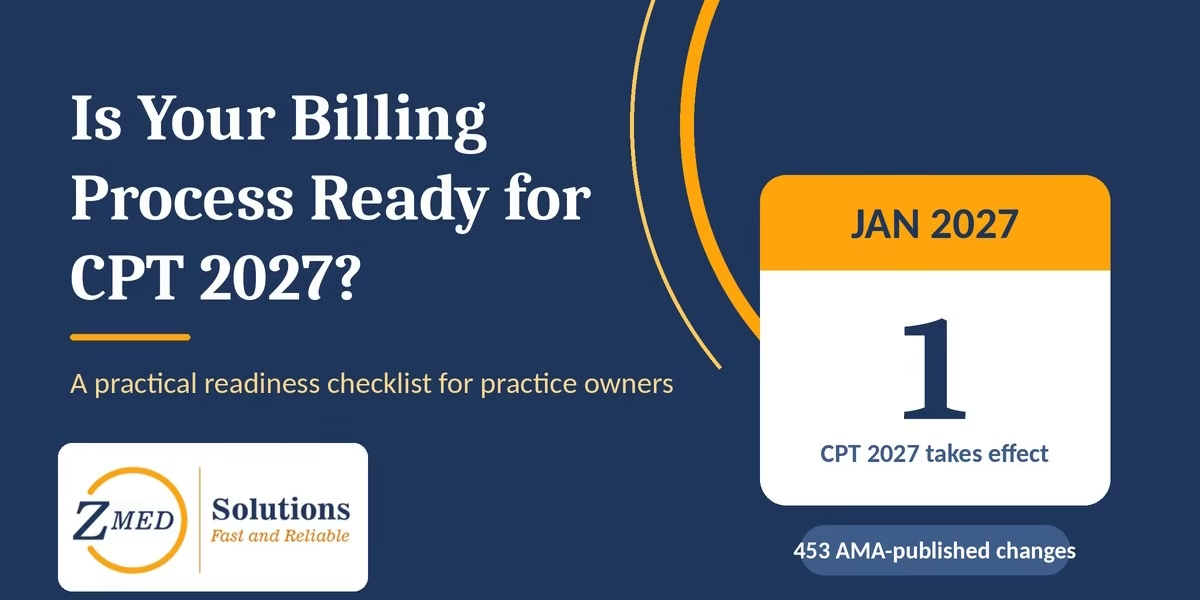
Is your billing process ready for CPT 2027? It is once new codes, documentation templates, EHR mappings, and claim edits are tested before January 1, 2027. Most teams also watch their clean claim rate, where about 95% is a commonly cited practical target.
Why January 1 Is Closer Than It Feels?
If your team learns about a coding change from its first denial, you are already behind. This guide explains what changes, which code families are most exposed, where claim denials are likeliest, and what to do if a payer lags. It also includes a 15-week plan and a ten-question self-assessment. The AMA released the CPT 2027 code set on September 9, 2026, with 453 editorial changes. So, is your billing process ready for CPT 2027? Use the numbers and steps below to find out before payers do it for you.
CPT 2027 Numbers at a Glance
Key numbers for CPT 2027 readiness
| Metric | Practical Target / Range | Review Frequency | Primary Source |
| CPT 2027 effective date | January 1, 2027 | Monthly countdown | AMA published |
| Total editorial changes | 453 (299 new, 74 revised, 80 deleted) | Once, then by specialty | AMA published |
| Maternity code changes | 17 deleted, 12 new, 6 revised | Weekly for OB/GYN teams | AMA published (maternity page) |
| Clean claim rate | About 95% or higher | Weekly | Commonly reported range |
| Denial rate | Under about 10%; many aim below 5% | Monthly | Commonly reported range |
| Days in A/R | Roughly 30–45 days | Monthly | Commonly reported range |
| Charge entry lag | 1–3 business days | Weekly | Illustrative target |
Source labels: “AMA published” means the figure appears in the AMA’s CPT 2027 announcement or maternity page. “Commonly reported range” reflects figures repeated across industry sources, not a mandate. “Illustrative target” is a planning goal; verify against your own data.
What Actually Changes on January 1, 2027?
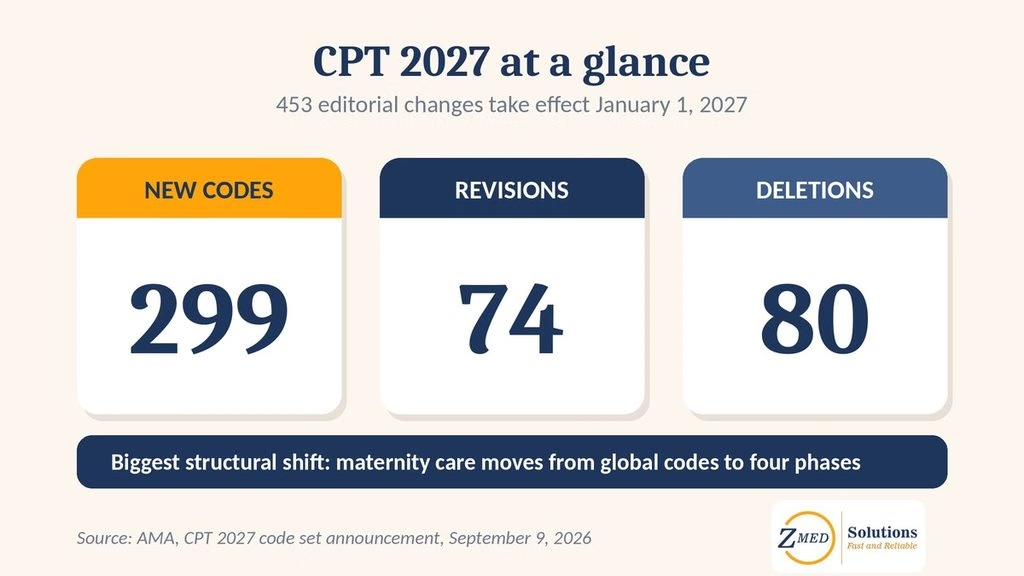
The AMA’s release lists 453 editorial changes: 299 new codes, 74 revisions, and 80 deletions. Most practices will touch only a small slice of them. Maternity care is the largest structural shift, because the global obstetric package is being retired. It is replaced by separate reporting for antepartum care, labor management, delivery, and postpartum care, with the AMA’s maternity page listing the 17 deleted, 12 new, and six revised codes. Other updates reach cardiology, urology, radiology, sleep medicine, biofeedback, and AI-related services. The key-update list does not name the office visit family, 99202–99215. Confirm details in the codebook.
Selected AMA-announced changes and where they land
| Family | AMA-Announced Change | Most Exposed | Priority (our illustrative view) |
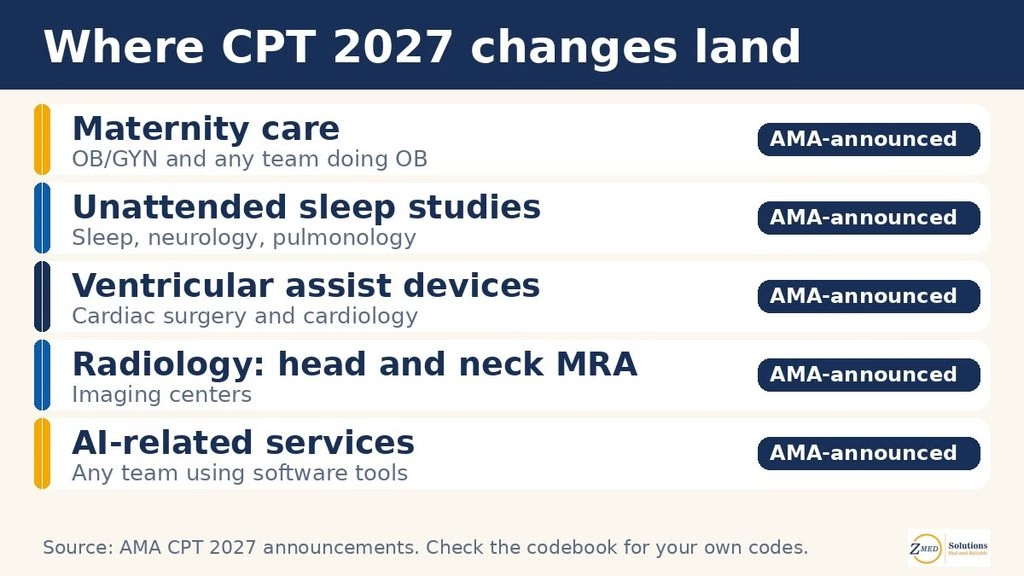
| Maternity care | Global codes replaced by phase-based codes | OB/GYN and any team doing obstetrics | High |
| Unattended sleep studies | Six new codes | Sleep, neurology, and pulmonology teams | High if you bill them |
| Ventricular assist devices | Three new left ventricular assist device codes | Cardiac surgery and cardiology | High for those programs |
| Radiology | New and revised codes; new head and neck MRA table | Imaging centers | Medium |
| Biofeedback | New time-based code structure | Behavioral health and rehabilitation | Medium |
| AI-related services | 10 new codes, 43 in total (AMA-published) | Teams using software tools; payer coverage uneven | Watch |
Priority reflects our judgment about likely billing impact, not an AMA rating. Trade sources also report six new adaptive behavior codes; confirm in the codebook.
How to Prioritize Your Crosswalk?
A crosswalk maps every retired code to its replacement. You cannot fix everything at once, so rank by money at risk. Pull 12 months of claims by code. Flag every code the AMA deleted or revised. Then rank the flagged codes by revenue at risk, and work down the list. Add a second pass for payers with tricky policies and for codes with denial history. Most practices find that a short list of codes carries most of the exposure.
- Volume: annual claims per flagged code.
- Revenue: volume × average allowed amount.
- Payer exposure: which payers have the strictest edits or authorization rules.
- Specialty mix: OB/GYN faces the largest structural change; sleep, cardiac surgery, and imaging teams have narrower ones; many other specialties see few.
Prioritization example (illustrative): revenue at risk = annual claims × average allowed amount. A flagged code with 900 annual claims at $150 carries $135,000. A flagged code with 60 claims at $400 carries $24,000. Start with the first.
Where CPT Changes Break a Billing Workflow?
Documentation and Coding
New codes only get paid when the clinical note supports them. Providers may need updated templates, especially for per-encounter and time-based services. Coders need a crosswalk that maps every retired code to its replacement. Without one, staff drift back to familiar codes, and denials follow. Run a short medical coding audit on early January charts, then share findings with providers within a week. For obstetric teams, our OB/GYN billing guide covers the specialty’s coding basics.
Charge Capture, EHR, and Claim Edits
Perfect coding still fails if your software offers retired codes. Confirm that charge capture lists, fee schedules, and your EHR setup all carry the 2027 changes. Then test your claim scrubber with real sample claims before go-live. Many clearinghouses update edits on their own timeline, so ask each vendor for a date. Our explainer on claim scrubbing shows what these edits catch. Finding a broken mapping in December costs a phone call. Finding it in February can cost weeks of delayed payments.
Payer Rules, Contracts, and Fee Schedules
CPT publishes the codes, but each payer decides how, when, and whether to pay them. Ask every major payer for its 2027 policies, including prior authorization rules and effective dates. Then check that your contract fee schedules list the new codes at all. A missing rate can quietly turn a paid claim into an underpayment. Keep a simple tracker with payer name, policy date, and open questions, and review it weekly through the end of March.
The Medicare Wildcard: G-Codes and the Final Rule
For maternity billing, one important question about Medicare payment remains open. In its CY 2027 proposed rule (91 FR 43842), CMS proposed values for the new maternity CPT codes and also asked for comment on creating HCPCS G-codes to maintain current coding. Comments closed September 14. CMS is expected to finalize values in November 2026, according to AMA-derived summaries and trade coverage, so confirm the date against CMS. Commercial payers and state Medicaid programs may choose differently, so you could run two workflows side by side. Prepare your systems now so either outcome can be handled. Review the AMA’s maternity resources for any patient whose dates of service cross January 1.
If a Payer Has Not Loaded the New Codes by January 1
CPT is the standard code set for electronic transactions under HIPAA, and codes must be valid for the date of service (see the AMA’s HIPAA overview). Payer systems and fee schedules still lag. Do not wait for the first denial. In December, ask each major payer in writing when it will load the 2027 codes and how to bill until then. Send a small batch of test claims. After January 1, never bill a deleted code for a 2027 service date, even if the payer’s system still accepts it. If a payer instructs an interim method, get it in writing and keep it with the claim. Log every answer, and watch timely filing limits so late payer fixes never cost you the claim.
Payer-lag symptoms and first moves (triggers are commonly reported)
| Symptom | Likely Cause | First Move |
| Claim rejected: code invalid | Deleted code still in your favorites | Remove it; resubmit with the new code |
| New code denied as not covered | Payer has not loaded the code | Request written guidance; log the reply |
| Payment lower than contract | Rate missing for the new code | Ask the payer to load the fee schedule |
| Claims stuck in pending | Edits not updated | Ask for a status and escalation contact |
Is Your Billing Process Ready for CPT 2027? Four Worked Examples
Formulas You Can Run This Week
Worked Example 1: Clean Claim Rate
Formula: claims accepted on first submission ÷ total claims submitted × 100. Example: in January, 1,000 claims go out and 940 pass first review. 940 ÷ 1,000 = 94%, just under the commonly cited 95% target. If the gap persists, check your electronic claims setup.
Worked Example 2: Denial Rate
Formula: denied claims ÷ total claims submitted × 100. Example: 80 of 1,000 claims are denied. 80 ÷ 1,000 = 8%, within the commonly reported under-10% range.
Worked Example 3: Days in A/R
Formula: total accounts receivable ÷ average daily charges. Example: A/R is $420,000 and charges average $10,000 per day. $420,000 ÷ $10,000 = 42 days, inside the commonly reported 30–45 day range.
Worked Example 4: Cash Delayed by Extra Denials (Illustrative)
Formula: monthly claims × added denial rate × average allowed amount. Example: 1,000 claims × 0.04 × $150 = $6,000 in payments delayed each month. Actual amounts vary by practice.
Reading Benchmarks Without Fooling Yourself
A benchmark only helps when you compare like with like. Match specialty, payer mix, practice size, and reporting period before drawing conclusions. A primary care group and an orthopedic office should not share identical targets. Treat every figure in this guide as a starting point, not a verdict. One missed benchmark is a signal to investigate. Ask whether the gap traces to one payer, one code family, or one workflow step. Our list of billing metrics worth tracking can help you choose what to measure.
Getting Your Billing Process Ready for CPT 2027: A 15-Week Plan
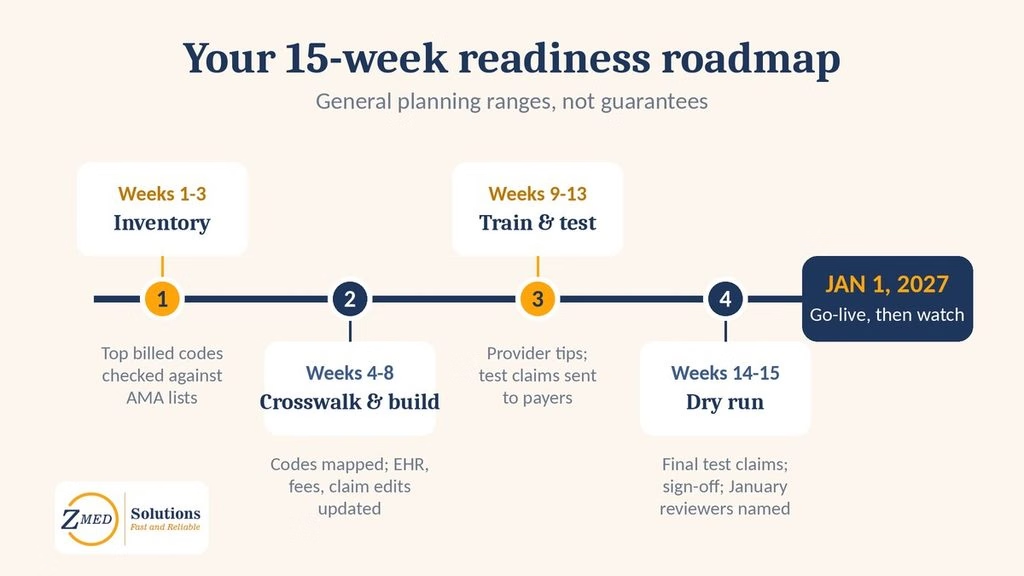
As of mid-September 2026, roughly 15 weeks remain. The table below offers general planning ranges, not guarantees, because every practice starts from a different place. After January 1, expect a stabilization period while payers adjust their systems. Treat the first 90 days as a monitoring window, with daily claim reviews at first, and bring providers into them, since denial reasons often reveal documentation gaps.
| Phase | Timing | Key actions | Typical planning range |
| Inventory | Weeks 1–3 | List top billed codes; rank by revenue at risk | 2 weeks partial; 3–4 complete |
| Crosswalk and build | Weeks 4–8 | Map codes; update EHR, fees, edits | 4–6 weeks partial; 8–10 complete |
| Train and test | Weeks 9–13 | Brief providers; ask payers in writing; send test claims | 2–3 weeks partial; 2–3 months to habit |
| Dry run | Weeks 14–15 | Final test claims; name reviewers | 1 week partial; 2 complete |
| Monitor | After Jan. 1 | Daily claim and payer tracking | 30–60 days partial; 90–180 stable |
Key Takeaways in Brief
- Maternity billing shifts most; Medicare’s final rule is expected in November.
- Rank flagged codes by revenue at risk, and crosswalk those first.
- Test codes, EHR mappings, and claim edits together, not one by one.
- Ask payers in writing about their load dates, and never bill a deleted code for a 2027 service date.
- Ask “is your billing process ready for CPT 2027?” at every monthly review through March.
Is Your Billing Process Ready for CPT 2027? Ten Yes-or-No Checks
Answer each question with yes or no, then count your yeses.
- Have you checked your top 50 billed codes against AMA deletions and revisions?
- Does every retired code have a documented replacement?
- Are EHR charge lists and fee schedules updated for 2027?
- Have you sent test claims through your claim scrubber?
- Is your clean claim rate at or near 95% today?
- Is your denial rate under about 10% today?
- Are your days in A/R within roughly 30–45 days?
- Have you asked your top five payers, in writing, for 2027 policies and code-load dates?
- Have providers received documentation guidance for changed services?
- Does someone own daily review of the first January claims?
| Yes answers | Meaning | Next step |
| 8–10 | On track | Keep testing and monitor payers monthly. |
| 5–7 | Needs attention | Fix your “no” answers this month, starting with claim edits. |
| 0–4 | At risk | Prioritize the crosswalk and claim testing now; consider outside help. |
Final Thoughts
CPT 2027 is not a rumor, and its core facts come directly from the AMA. The January 1, 2027 date, the 453 editorial changes, and the maternity restructure are firm published facts. Medicare’s treatment of maternity codes stays proposed until the final rule arrives. Every other figure here is a commonly reported or illustrative target, not a mandate. That includes the 95% clean claim rate, the under-10% denial rate, and the 30–45 day A/R range.
Readiness is a habit that your whole team builds, not a single project. Use your checklist score to decide where to start. Update the crosswalk, test the systems, train providers, and watch the first 90 days closely. Small, steady steps beat a last-minute scramble in the final week of December. Assign one owner to each step, and review progress in a short weekly meeting.
Frequently Asked Questions
When does CPT 2027 take effect?
CPT 2027 takes effect on January 1, 2027. The AMA released the full code set on September 9, 2026.
Is your billing process ready for CPT 2027 if your software updates automatically?
Not necessarily. Vendors update on their own schedules, so send test claims yourself before January.
What if a payer has not loaded the new codes?
Ask in writing how to bill until it does, and never use a deleted code for a 2027 service date. Log the answer and watch timely filing limits.
What is a good clean claim rate?
About 95% or higher is a commonly cited goal for many practices. Treat it as a practical target, not a mandate, and compare it with your own payer mix.
What is a good denial rate for a medical practice?
A commonly reported goal is under about 10%, and many practices aim below 5%. Track it by payer, because blended figures can hide problem accounts.
What is a good number of days in A/R?
Roughly 30 to 45 days is a commonly reported range. Specialty and payer mix can move it, so trend it monthly.
Are CPT updates required by law?
Under HIPAA, HHS adopted CPT as the standard code set for outpatient services in electronic transactions. Use codes valid for each date of service.
Will every payer adopt the new maternity codes on January 1?
Not necessarily. CMS has not finalized its approach, and commercial payers and Medicaid programs set their own policies. Ask each payer for written guidance.
What should a small practice do first?
Compare your top billed codes with the AMA’s deleted and revised lists, and rank them by revenue at risk. Then update your crosswalk and test claims through your EHR.
When Your In-House Team Needs Backup?
Is your billing process ready for CPT 2027 if several of these signals sound familiar?
- Denials rise after each code change, and nobody can name the top three causes.
- Clean claim rates keep missing your own targets.
- Coding knowledge sits with one or two people.
- Payer policy updates pile up faster than your team can read them.
If several signals sound familiar, outside support may be worth a look, and so may training your current team. Look for a partner that documents its process, not just its promises. Ask how it handles code updates, claim edit testing, denial tracking, and payer policy monitoring. Confirm that credentialing, coding, billing, and compliance work together instead of in silos. Request reporting by payer and code family, plus a named contact. Check how the partner protects patient data. Results vary by practice, payer mix, and starting point.
Zmed Solutions is one example of a partner built around this kind of structure. It provides revenue cycle management, including billing, credentialing, coding, denial management, and compliance support, so code updates, claim edits, and payer follow-up run through one process. You can use this checklist on your own or with any partner. If you want a second opinion on your answers, you can reach the team through the Zmed Solutions contact page. No outcome is guaranteed.
Where These Figures Come From?
- (a) Published standards and definitions: the AMA’s CPT 2027 announcement (September 9, 2026) and maternity page supply the dates and counts (453 changes; 17 deleted, 12 new, and six revised maternity codes; three new left ventricular assist device codes; ten new AI-related codes, 43 in total). The AMA’s HIPAA overview covers CPT as a standard code set.
- (b) Named benchmarking data providers: none. No figure here comes from a named benchmarking dataset.
- (c) Practical and illustrative targets: the 95% clean claim rate, under-10% denial rate, 30–45 day A/R range, charge entry lag, and priority ratings are rounded from general industry sources or are our judgment. Worked examples are illustrative.
- (d) Proposed rule and timing: the CMS CY 2027 proposed rule (CMS-1848-P, 91 FR 43842, published July 16, 2026) for the maternity valuation proposal and G-code comment solicitation. The expected November final rule comes from AMA-derived summaries and trade coverage; confirm against CMS. No survey data was used.
Actual results vary by practice and situation. Figures reflect information available in September 2026.
Key Market Player
Ready to optimize your medical billing and boost your revenue? Look no further. Zmed Solutions LLC is your trusted partner in professional Medical Billing Services.
Join hundreds of satisfied healthcare providers who have already elevated their revenue with our expert services. Don't miss out on what could be your practice's most profitable decision.
Schedule a Consultation Today!
Contact Us Now, and experience the difference. Your financial success starts here!