ICANotes billing is the process of converting behavioral health documentation created inside the ICANotes EHR into accurate, submission-ready insurance claims. It covers charge capture, CPT and ICD-10 coding, claim scrubbing, and denial follow-up so psychiatric and therapy practices get paid correctly and on time. Done well, it closes the gap between clinical notes and clean reimbursement.
A psychiatrist finishes a full day of medication management visits, closes out every note in ICANotes, and still waits six weeks for a check that never quite matches what was billed. This scenario plays out in behavioral health practices across the country every month. ICANotes is a strong clinical documentation tool, but documentation and billing are not the same discipline, and a gap between the two quietly drains revenue from otherwise healthy practices.
This guide walks through what ICANotes billing actually involves, the coding and workflow challenges unique to psychiatric and therapy practices, and a benchmark comparison of in-house versus outsourced approaches. Practice owners, office managers, and billing decision-makers will find practical best practices for closing claims faster, along with a clear picture of when it makes sense to bring in a dedicated billing partner such as Zmed Solutions.
What Is ICANotes Billing?
ICANotes billing describes everything that happens after a clinician finishes a note inside the ICANotes EHR and before a payer sends payment. The system’s structured templates are built for psychiatric evaluations, therapy sessions, and medication management, and they generate suggested CPT and ICD-10 codes automatically. Automatic code suggestions are a starting point, not a finished claim. Someone still has to confirm code accuracy, apply modifiers, check payer-specific rules, and submit the claim through a clearinghouse. When that step is treated as an afterthought, practices see mismatched codes, rejected claims, and slower reimbursement than the underlying clinical work deserves.
How ICANotes Handles Documentation?
ICANotes was designed by a psychiatrist, so its templates map closely to real behavioral health workflows, including psychotherapy notes, treatment plans, and medication logs. Built-in evaluation and management calculators estimate visit levels based on documented time and complexity. This is genuinely useful for psychiatric medical billing, since coding for mental health visits carries specific documentation requirements. Still, the software cannot verify a patient’s active insurance, confirm prior authorization, or catch a payer’s unique billing quirks. Those steps sit outside the EHR and require a dedicated billing process layered on top of it.
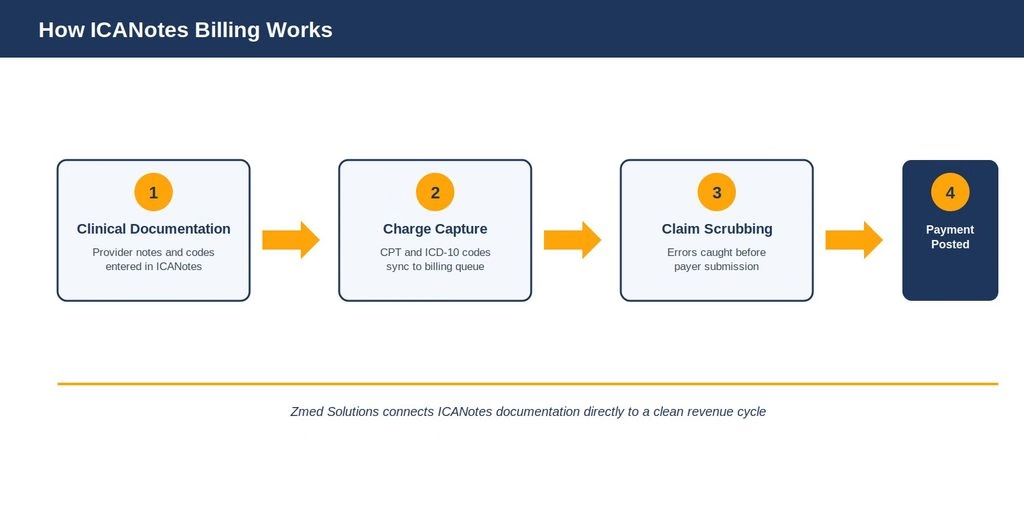
From Note to Claim in ICANotes
The path from a finished note to a paid claim involves several handoffs. A clinician documents the encounter, the system suggests a code, a biller reviews and corrects that code if needed, the claim is scrubbed for errors, and it is transmitted electronically to the payer. Any weak link in that chain, such as an outdated fee schedule or a missing modifier, can bounce the claim back. That is why EHR-integrated billing works best when it is actively managed rather than left to run on default settings.
Common Billing Challenges with ICANotes
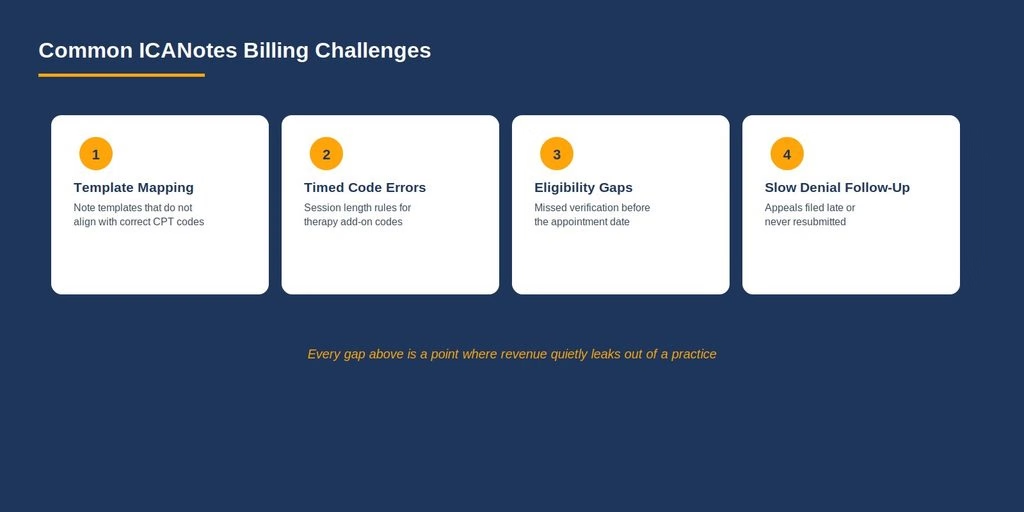
Most behavioral health practices using ICANotes run into a recurring set of billing obstacles. These problems are rarely about the software itself; they surface when clinical documentation habits, payer requirements, and billing follow-up are not tightly coordinated. Understanding where things typically break down is the first step toward fixing them. The four challenges below account for the majority of denied and delayed claims that billing teams encounter during onboarding reviews of ICANotes-based practices.
Template-to-Code Mismatches
ICANotes templates are flexible, which means two clinicians can document a similar session differently enough to trigger different code suggestions. If a template defaults to a generic code instead of the specific service rendered, the claim may underbill or overbill the payer. Regular chart audits catch these mismatches before they become a pattern. Standardizing templates across a practice, and reviewing them whenever payer policies change, keeps documentation and coding aligned instead of drifting apart over time.
Timed CPT Code Errors
Add-on psychotherapy codes and interactive complexity codes depend on exact session length, and ICANotes will only calculate this correctly when start and stop times are entered consistently. A few minutes of rounding can shift a claim from a covered code to one a payer rejects outright. This is a common source of denials in behavioral health billing services, particularly for practices offering extended sessions or family therapy. Training staff to log precise times prevents an easily avoidable rejection.
Eligibility and Authorization Gaps
Behavioral health benefits are frequently carved out to a separate payer or require prior authorization after a set number of visits. ICANotes does not automatically flag when a patient’s mental health benefit has changed or when authorized visits are running low. Without a real-time eligibility check before each appointment, practices discover the problem only after a claim is denied. Building eligibility verification into the front-desk workflow, rather than relying on the EHR alone, closes this gap for good.
Slow Denial Follow-Up
Denied claims need a fast, organized response, but many practices let them sit in a queue while staff focus on new patients. ICANotes does not include a built-in appeals workflow, so denial tracking has to happen elsewhere, often in spreadsheets that are easy to lose track of. Effective claims denial management requires a dedicated process: categorizing denial reasons, correcting the root cause, and resubmitting within payer deadlines before timely filing limits expire.
ICANotes Billing vs Outsourced Revenue Cycle Management
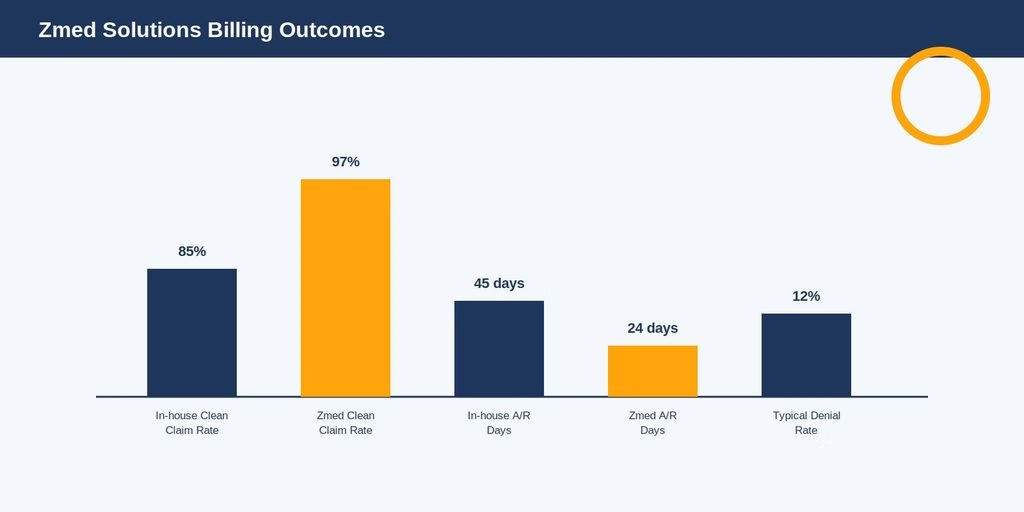
Practices weighing their options usually compare two paths: keeping billing in-house using ICANotes’ built-in tools, or partnering with a specialized revenue cycle team that works alongside the EHR. Both can technically get claims out the door, but the difference shows up in clean claim rates, days in accounts receivable, and how quickly problems get caught. The table below benchmarks typical performance for each approach, based on patterns observed across behavioral health and psychiatric practices.
| Metric | In-House ICANotes Billing | Outsourced RCM Partner |
| Clean claim rate | 80% – 88% | 95% – 98% |
| Average days in A/R | 40 – 50 days | 20 – 28 days |
| Denial follow-up time | 2 – 4 weeks | 48 – 72 hours |
| Coding review | Occasional spot checks | Every claim reviewed pre-submission |
| Eligibility verification | Manual, inconsistent | Automated, real-time |
| Staff time required | High (dedicated biller needed) | Minimal (practice reviews reports) |
What the Numbers Mean for Small Practices?
A ten to fifteen point gap in clean claim rate translates directly into cash flow. Every claim that bounces back adds administrative time and pushes payment further out, sometimes by a full billing cycle. For a solo psychiatrist or a small group practice, that gap can mean the difference between predictable revenue and constant cash flow stress. Mental health revenue cycle management handled by a specialized partner does not just submit claims faster; it catches the errors that create denials in the first place, which compounds over months into meaningfully higher collections.
Best Practices to Optimize ICANotes Billing
Practices that keep billing in-house can still significantly improve their numbers by tightening a few specific habits. None of these require replacing ICANotes; they require treating billing as an active, monitored process rather than a background task. The five practices below consistently reduce denials and speed up reimbursement for behavioral health and psychiatric groups of any size.
Standardize Documentation Templates
Build one approved template per visit type and require every clinician to use it. Consistency at the documentation stage prevents the coding drift that leads to inconsistent claims and confused payers down the line.
Verify Eligibility Before Every Visit
Run an eligibility check the day before each appointment, not just at intake. Behavioral health benefits change more often than medical benefits, and catching a lapse early avoids a denied claim after the session has already happened.
Scrub Claims Before Submission
Use a claim scrubbing tool or a second set of eyes to catch missing modifiers, mismatched diagnosis pointers, and incomplete fields before the claim leaves the building. Prevention is far cheaper than an appeal.
Track Denials by Root Cause
Log every denial with its reason code and resolution. Patterns emerge quickly, whether it is a specific payer, a specific code, or a specific clinician’s documentation style, and patterns are what actually get fixed.
Review Reports Monthly
Set aside time each month to review clean claim rate, days in accounts receivable, and top denial reasons. A short recurring review keeps small problems from becoming expensive ones.
Why Practices Outsource ICANotes Billing?
Many behavioral health practices eventually decide their time is better spent with patients than with claim queues. Zmed Solutions provides end-to-end revenue cycle management built around the way ICANotes practices actually document care, pairing coding review with fast denial resolution. The team also supports credentialing and payer enrollment, which prevents claims from being denied for reasons that have nothing to do with coding at all. For practices setting up or switching systems, EHR setup services ensure ICANotes is configured correctly from day one, which prevents many billing headaches before they start.
Practices comparing behavioral health platforms more broadly may also find it useful to review this mental health EHR systems guide or this overview of EHR options built for psychiatrists, both of which cover how documentation choices ripple into billing outcomes.
Industry data backs up the stakes here. According to MGMA’s revenue cycle research, first-pass denial rates and days in A/R are among the strongest predictors of a practice’s financial health, which lines up with the benchmark gap shown earlier in this guide. Procedure coding itself is governed by the CMS coding and billing standards, so any billing workflow, whether in-house or outsourced, has to stay current with those national rules.
Quick Summary
- ICANotes billing turns behavioral health documentation into clean, submission-ready claims.
- Template mismatches, timed-code errors, and eligibility gaps cause most ICANotes claim denials.
- Outsourced RCM partners typically post 95%+ clean claim rates versus 80–88% in-house.
- Standardized templates, real-time eligibility checks, and monthly reporting cut denials fast.
- Zmed Solutions pairs psychiatric coding expertise with credentialing and EHR setup support.
Final Thoughts
ICANotes gives behavioral health practices a documentation system built specifically for the way psychiatric and therapy care actually happens. But documentation quality and billing performance are two different jobs, and treating them as one is where most revenue gets lost. Closing that gap does not require replacing the EHR; it requires a billing workflow that reviews every code, checks eligibility before every visit, and follows up on every denial without delay.
Whether a practice keeps billing in-house or brings in a dedicated partner. The benchmarks in this guide offer a clear way to measure performance. A clean claim rate in the mid-90s and an A/R cycle under thirty days are realistic goals for ICANotes-based practices. Not aspirational ones. The practices that hit those numbers consistently are the ones that treat billing as a daily discipline rather than a monthly cleanup task.
For practices ready to see what dedicated ICANotes billing support looks like in practice. Zmed Solutions offers a review of current claim performance. A clear plan for closing the gaps identified in that review.
Frequently Asked Questions
Does ICANotes submit insurance claims automatically?
ICANotes can generate claims and suggest codes based on documentation. But it does not independently verify eligibility, catch payer-specific errors, or manage denials. A billing team or software still needs to review each claim before submission.
What CPT codes are most affected by ICANotes documentation errors?
Timed psychotherapy add-on codes and interactive complexity codes are the most sensitive to documentation gaps. Since they depend on exact session length and specific clinical criteria being noted correctly.
Can Zmed Solutions work directly inside a practice’s existing ICANotes account?
Yes. Billing specialists can review notes and codes directly within a practice’s existing ICANotes setup. So no data migration or system change is required to improve billing performance.
How long does it take to see improved collections after switching billing approaches?
Most practices see measurable improvement in clean claim rate within the first 60 to 90 days. As coding patterns are corrected and outstanding denials from the prior workflow are resolved.
Is outsourced billing more expensive than an in-house biller for a small practice?
When factoring in salary, benefits, software, and the cost of denied claims. Most small practices find outsourced billing comparable or lower in total cost. While also recovering more of the revenue they are already owed.
Does outsourcing ICANotes billing affect credentialing or payer contracts?
No. Credentialing and payer contracts remain with the practice and its providers. A billing partner works within those existing agreements and can also assist with new credentialing or re-credentialing as needed.
Key Market Player
Ready to optimize your medical billing and boost your revenue? Look no further. Zmed Solutions LLC is your trusted partner in professional Medical Billing Services.
Join our growing network of healthcare providers who have already elevated their revenue with our expert services. Don't miss out on what could be your practice's most profitable decision.
Schedule a Consultation Today!
Contact Us Now, and experience the difference. Your financial success starts here!