


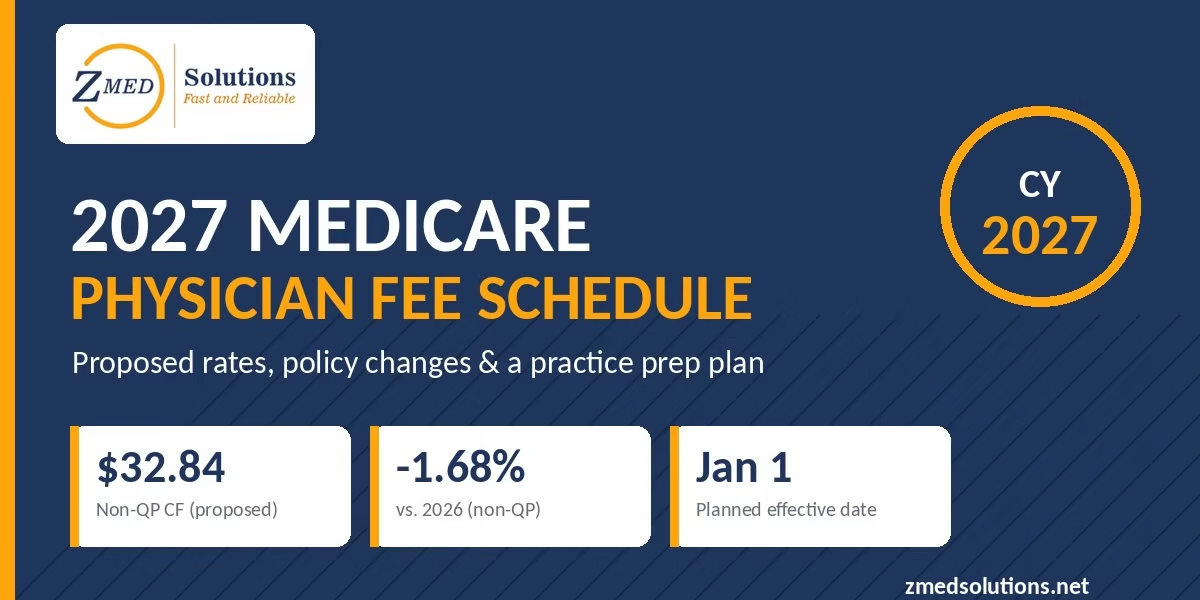
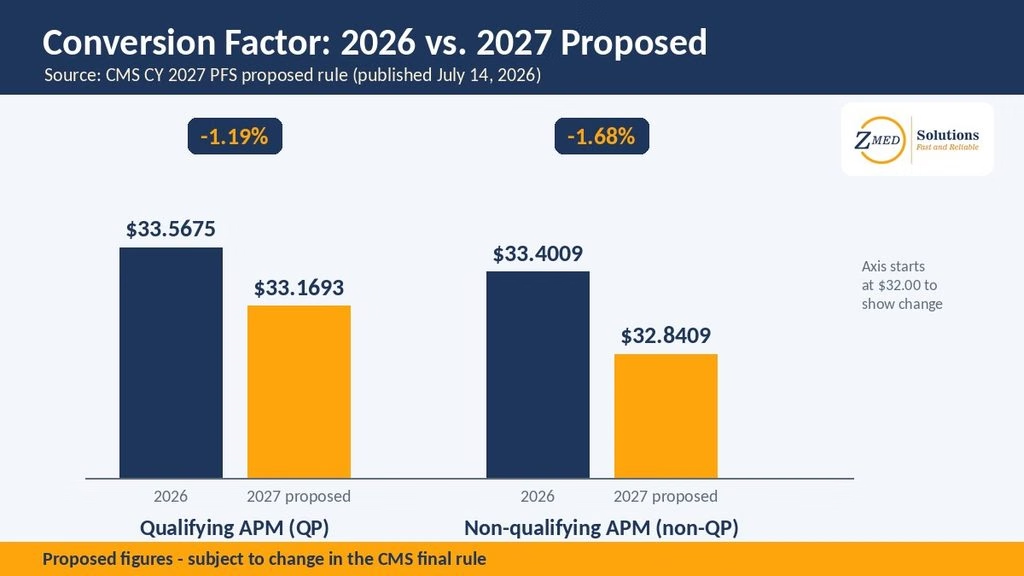
The 2027 Medicare physician fee schedule is the CMS payment framework that sets Part B rates for physician services starting January 1, 2027. Under the July 2026 proposed rule, the conversion factor would fall to $33.1693 for qualifying APM participants (−1.19%) and $32.8409 for all other clinicians (−1.68%). These are proposed figures, and the final rule could change them.
If Medicare makes up a large share of your revenue, a small rate change becomes real money by spring. The 2027 Medicare physician fee schedule proposes lower base rates, a payment cut for same-day visits and procedures, and tighter rules for remote monitoring. This guide explains what CMS actually proposed and separates published figures from planning estimates. You will find worked examples, a specialty impact table, and a realistic timeline for adjusting your billing workflow. Near the end, a 10-point readiness checklist lets you score how prepared your practice is for January. Everything here reflects the proposed rule, so treat it as a preparation guide until CMS publishes the final version.
2027 Medicare Physician Fee Schedule Figures at a Glance
| Figure | Proposed Value / Practical Target | Review Frequency | Primary Source |
| Non-QP conversion factor | $32.8409 (−1.68% vs. $33.4009) | At final rule, then yearly | CMS proposed rule |
| QP conversion factor | $33.1693 (−1.19% vs. $33.5675) | At final rule, then yearly | CMS proposed rule |
| Statutory base update | +0.25% non-QP / +0.75% QP | Yearly | CMS proposed rule (statutory) |
| Expiring one-year boost | 2.5% (applied to 2026 only) | Watch Congress | CMS proposed rule |
| Same-day E/M + global procedure | Highest-paid service 100%; others 50% | Monthly after Jan 1 | CMS proposed rule |
| G2211 replacement modifier | +16% of E/M payment (+32% ACO modifier) | Monthly | CMS proposed rule |
| Efficiency adjustment | −2.5% work RVUs, non-time-based codes | Yearly | CMS CY 2026 final rule; retained per ACC |
| MIPS penalty threshold | 75 points through performance year 2028 | Yearly | CMS final policy, reported by AMA |
| Fee schedule loaded in PM system | Before first January claims go out | Once, early January | Illustrative target |
| Medicare payment variance | Investigate any line paid below expected | Monthly | Illustrative target |
Source labels: “CMS proposed rule” means CMS published the figure in its CY 2027 proposed rule or fact sheet; it may change in the final rule. “Reported by [organization]” means a CMS figure or policy as summarized by that named body. “Illustrative target” means a practical planning target compiled from general revenue cycle practice, not a CMS requirement.
How the 2027 Medicare Physician Fee Schedule Sets Rates?
Every Part B payment starts with relative value units (RVUs) for physician work, practice expense, and malpractice. Each component is adjusted by geographic practice cost indices (GPCIs), then multiplied by the conversion factor. Since 2026, the law requires two conversion factors: one for qualifying participants in an Advanced Alternative Payment Model and one for everyone else. According to the CMS fact sheet on the CY 2027 proposed rule, statutory updates add 0.75% and 0.25%, plus 0.53% tied to work RVU changes. However, the one-time 2.5% increase Congress provided for 2026 expires. That expiration outweighs the updates, so Medicare reimbursement declines for most practices. If you followed earlier fee schedule cut debates, the pattern will feel familiar.
Worked Example 1: Payment for a Single Service
Formula: Payment = [(Work RVU × Work GPCI) + (PE RVU × PE GPCI) + (MP RVU × MP GPCI)] × Conversion Factor
Example: A service with 1.92 work, 1.52 practice expense, and 0.13 malpractice RVUs (GPCIs of 1.0) totals 3.57 RVUs. In 2026: 3.57 × $33.4009 = $119.24. Proposed 2027: 3.57 × $32.8409 = $117.24. That is $2.00 less per service (−1.68%). These RVUs are illustrative; confirm real values for your codes once CMS posts final rates.
Worked Example 2: Estimating the Annual Impact
Formula: Annual impact = Annual Medicare allowed amount × Conversion factor change (%)
Illustrative scenario (not an actual client record): a four-provider internal medicine group with $900,000 in annual Medicare allowed amounts and no qualifying APM participants. $900,000 × −1.68% = about −$15,120 for 2027. This captures only the conversion factor effect; code-level RVU and policy changes can move the real figure either way.
Policy Proposals That Could Matter More Than the Rate Cut
Same-Day E/M Visits and Global Procedures
CMS proposes a new reduction when the same physician, or one in the same group, bills a separately identifiable office evaluation and management (E/M) visit on the same day as a 0-, 10-, or 90-day global surgery procedure. The highest-paid service would be paid at 100%, and every other same-day service at 50%. CMS floated a similar idea in 2019 but never finalized it. The AMA has flagged this 50% cut as a major concern for physicians. Practices that frequently bill modifier 25 with minor procedures face the largest exposure. If those claims already trigger rework, strong denial management and appeals support becomes even more important in 2027.
Worked Example 3: Same-Day Payment Reduction
Formula: Same-day payment = Highest-paid service × 100% + Each additional service × 50%
Example: A minor procedure pays $160 and a same-day E/M visit pays $120, totaling $280 today. Under the proposal: $160 + ($120 × 50%) = $220, a $60 loss per encounter (about 21%). At 40 encounters a month, that is $28,800 a year. Prices are illustrative, but the gap can easily outweigh the conversion factor cut.
G2211 Moves From Add-On Code to Modifier
The G2211 complexity add-on code would become a modifier appended to the E/M base code. Instead of a flat payment, it would raise the visit payment by 16% at every E/M level. A second modifier would add 32%, but only for clinicians in a Shared Savings Program ACO or the LEAD Model. CMS is using placeholder names, so final modifier codes will arrive with the final rule. Your EHR templates, charge entry rules, and claim edits will need updating before the first January visits. Verify each clinician’s ACO participation status and payer enrollment records through your credentialing and contracting process.
Worked Example 4: What the Modifier Adds by Visit Level
Formula: Modifier value = E/M payment × 16% (or × 32% for eligible ACO clinicians)
Example: A $90 visit gains $14.40; a $130 visit gains $20.80. An eligible ACO clinician billing the same $130 visit gains $41.60. Because the increase is a percentage, higher-level visits benefit more than under a flat add-on. Visit amounts are illustrative.
Remote Monitoring, Telehealth, and Practice Expense
Remote patient monitoring would require an initiating visit, and remote therapeutic monitoring would be limited to established patients. Payment would apply only when employed clinical staff, not contractors, perform the work. If a vendor runs your program, schedule a compliance review now. On telehealth, CMS proposes five new list services and a $32.65 originating site fee; see our telehealth codes guide. CMS would also phase out 2007-era practice expense survey data. The American College of Cardiology reports the −2.5% efficiency adjustment stays in place. Details appear in the proposed rule in the Federal Register. Traditional MIPS would sunset in 2029, favoring MIPS Value Pathways.
Specialty Winners and Losers Under the Proposal
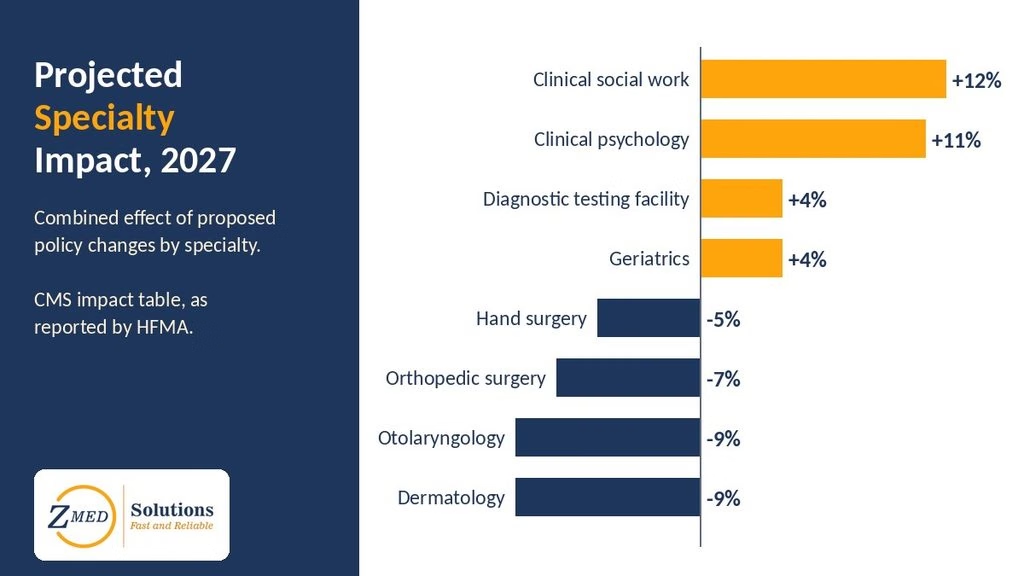
National averages hide wide differences between specialties. CMS publishes a specialty impact table combining the conversion factor, RVU changes, and policy proposals into one estimated change. HFMA’s summary of that table shows double-digit gains for behavioral health and losses for several procedural specialties. Because these figures come from one named source, they are not illustrative estimates. Still, they are nationwide averages. Your result depends on code mix, setting, locality, and same-day procedure volume. Use the table to set expectations, then confirm against your own claims.
| Specialty | Projected 2027 Change | Source |
| Clinical social work | +12% | CMS impact table, via HFMA |
| Clinical psychology | +11% | CMS impact table, via HFMA |
| Diagnostic testing facilities | +4% | CMS impact table, via HFMA |
| Geriatrics | +4% | CMS impact table, via HFMA |
| Hand surgery | −5% | CMS impact table, via HFMA |
| Orthopedic surgery | −7% | CMS impact table, via HFMA |
| Otolaryngology | −9% | CMS impact table, via HFMA |
| Dermatology | −9% | CMS impact table, via HFMA |
How a Blended Average Can Hide a Problem?
Illustrative scenario (not an actual client record): a multispecialty group earns 60% of Medicare revenue from primary care and 40% from dermatology. Assume an illustrative +1% for primary care and the −9% CMS projection for dermatology. The blend is (0.60 × 1%) + (0.40 × −9%) = −3.0%. A 3% group decline looks manageable, yet dermatology alone drops 9%, which could strain its staffing budget. Always break results down by specialty, location, or service line.
Reading the 2027 Figures Against Your Own Practice
A benchmark only helps when you compare like with like. Specialty impacts are national averages, so compare them with practices of similar specialty, payer mix, size, and site of service. Match reporting periods too, using full-year data rather than mixed quarters. Locality GPCIs and QP status also shift results. If your modeled decline looks worse than your specialty average, treat it as a signal to investigate, not a verdict. Tracking a few core billing metrics monthly makes these comparisons faster and more reliable.
How Long Adjustments Take to Show Up?
Some fixes show results within one billing cycle, while others take several months. The ranges below are general planning ranges, not guarantees for any specific practice.
| Adjustment | Partial Results | Full Results |
| Load final fee schedule and expected-payment tables | 1–2 weeks | About 30 days (first full remit cycle) |
| Replace G2211 with the new modifier in EHR and charge entry | 2–4 weeks | About 60 days |
| Rework same-day E/M and procedure documentation | 30–60 days | 90–120 days |
| Move RPM/RTM to employed staff with initiating visits | 30–60 days | About 90 days |
| Renegotiate commercial contracts priced off Medicare | 3–6 months | 6–12 months |
The Short Version
- Proposed conversion factors: $32.8409 (non-QP, −1.68%) and $33.1693 (QP, −1.19%), not yet final.
- Same-day E/M plus global procedures: highest service 100%, others 50%.
- G2211 would become a modifier worth 16% of the E/M payment, or 32% for eligible ACO clinicians.
- Remote monitoring would require an initiating visit and practice-employed clinical staff.
- CMS impact estimates range from +12% (clinical social work) to −9% (dermatology, otolaryngology).
- Loading the final 2027 Medicare physician fee schedule before January claims is an illustrative target, not a CMS rule.
Is Your Practice Ready for January 2027? A 10-Point Check?
Answer each question yes or no, then total your yes answers.
- Have you modeled your top 20 Medicare codes at the proposed conversion factor?
- Do you know whether any clinicians qualify as QPs in an Advanced APM?
- Have you counted same-day E/M visits billed with global procedures?
- Is there a plan to replace G2211 with the new modifier in your EHR?
- Do employed clinical staff deliver your RPM or RTM services?
- Will the final 2027 fee schedule load before your first January claims?
- Do you compare Medicare payments against expected allowables every month?
- Have you identified commercial contracts priced as a percentage of Medicare?
- Is your projected MIPS score comfortably above the 75-point threshold?
- Does one person own tracking the final rule and Congress?
Scoring: 8–10 yes answers means you are well prepared, so focus on monitoring early 2027 payments. A score of 5–7 means partial readiness; close gaps affecting your highest Medicare volume first. A score of 0–4 signals real risk, so start with questions 1, 3, and 6 this month.
Final Thoughts
The 2027 Medicare physician fee schedule pairs a modest headline cut with policy changes that could hit some practices harder. Same-day procedure reductions, the G2211 shift, and remote monitoring rules reward practices that prepare early.
Know which numbers are firm. The conversion factors, the 100%/50% rule, the 16% and 32% modifiers, and specialty impacts are CMS-published proposals that may still change. The 75-point MIPS threshold is finalized policy. Example RVUs, scenarios, and targets like early fee schedule loading are illustrative. Model your codes now, then refresh once the final rule arrives.
Frequently Asked Questions
When will the 2027 Medicare physician fee schedule final rule be released?
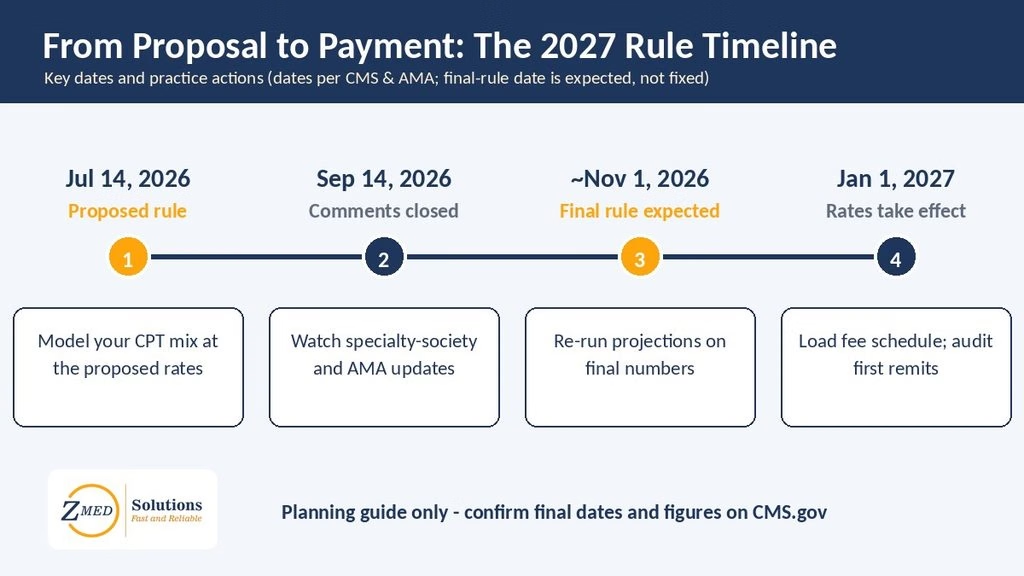
The AMA expects the final rule by November 1, 2026, with most changes effective January 1, 2027.
What is the proposed 2027 Medicare conversion factor?
CMS proposed $32.8409 for non-qualifying clinicians and $33.1693 for qualifying APM participants. Both may change in the final rule.
Why are Medicare physician payments going down in 2027?
The one-year 2.5% increase Congress provided for 2026 expires, and small statutory updates do not fully offset it.
Can Congress still stop the 2027 Medicare cuts?
Legislation could change the outcome. The Patients First Act (H.R. 9693) would add an inflation-based update, but it has not become law.
How would the same-day E/M proposal affect modifier 25 claims?
The lower-paid same-day service would be paid at 50%. Practices billing modifier 25 often should model this now.
What happens to G2211 in 2027?
CMS proposes replacing it with a modifier worth 16% of the E/M payment, or 32% for eligible ACO clinicians.
What is a good MIPS score to target for 2027?
At least 75 points avoids a penalty through performance year 2028. A buffer of several points above that is a sensible illustrative target, not a CMS rule.
What is a good Medicare underpayment rate for a practice?
CMS publishes no underpayment benchmark. As an illustrative target, aim for near zero and investigate any code repeatedly paid below expected.
What is a good first step for a small practice preparing for 2027?
Price your top 20 Medicare codes at the proposed rates. That one exercise reveals most of your exposure.
Signs Your Practice Needs Outside Billing Help for 2027
- No one on staff has time to model the proposed rates against your code mix.
- Same-day E/M and procedure claims already come back denied or need rework.
- Medicare payments are not reconciled against expected allowables each month.
- Telehealth, remote monitoring, or ACO billing rules change faster than your workflows.
- Credentialing or enrollment gaps delay payment when providers join or change status.
If several sound familiar, look for outside support with a clear structure. A strong partner loads fee schedules promptly and reports payment variances by payer and code. It audits coding against new rules, works denials to their root cause, and keeps credentialing current. Transparent monthly reporting matters just as much. Ask how a prospective partner handled the 2026 rule changes; the answer shows whether they plan ahead or react late.
Zmed Solutions is one example of this end-to-end structure. Its team handles billing, credentialing, coding, denial management, and compliance support within one coordinated revenue cycle management workflow. For the 2027 Medicare physician fee schedule, that means updating rate tables, reviewing modifier logic, and monitoring early remittances for variances. Results vary by practice, specialty, and payer mix, so no specific outcome is promised.
Where These Figures Come From?
- (a) Published standards and definitions: conversion factors, updates, same-day E/M, G2211, remote monitoring, and telehealth proposals come from the CMS CY 2027 proposed rule and fact sheet. The payment formula follows CMS methodology. The 75-point MIPS threshold is finalized CMS policy, as reported by the AMA.
- (b) Named benchmarking sources: specialty impacts from CMS’s impact table as summarized by HFMA; efficiency adjustment status from the American College of Cardiology.
- (c) Practical and illustrative targets: example RVUs and prices, scenarios, timeframe ranges, and fee schedule load timing reflect general revenue cycle practice.
- (d) Survey data: none used.
Actual results vary by practice and situation. All figures reflect information available on September 25, 2026, and the final rule may change them.
Ready to optimize your medical billing and boost your revenue? Look no further. Zmed Solutions LLC is your trusted partner in professional Medical Billing Services.
Join our growing network of healthcare providers who have already elevated their revenue with our expert services. Don't miss out on what could be your practice's most profitable decision.
Schedule a Consultation Today!
Contact Us Now, and experience the difference. Your financial success starts here!
