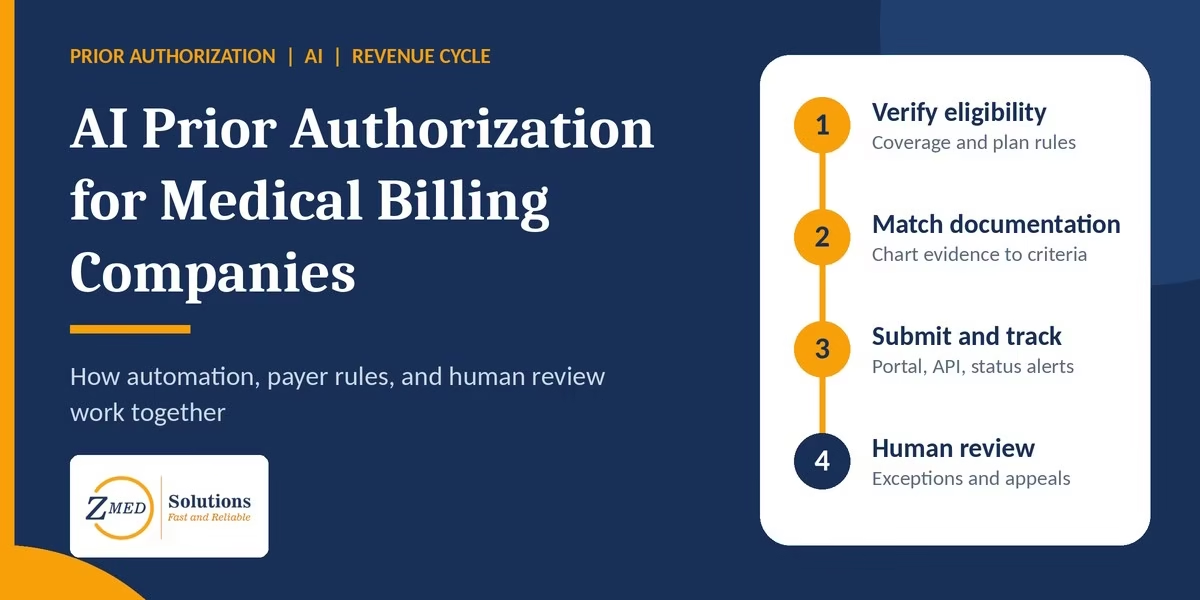
AI prior authorization for medical billing companies automates repetitive approval steps. Software checks payer rules, gathers chart evidence, submits requests, and tracks decisions while staff review exceptions. Independent data supports electronic authorization saving about 14 minutes per request (CAQH, 2024). We found no independent measurement of AI-specific savings, so measure your own baseline first.
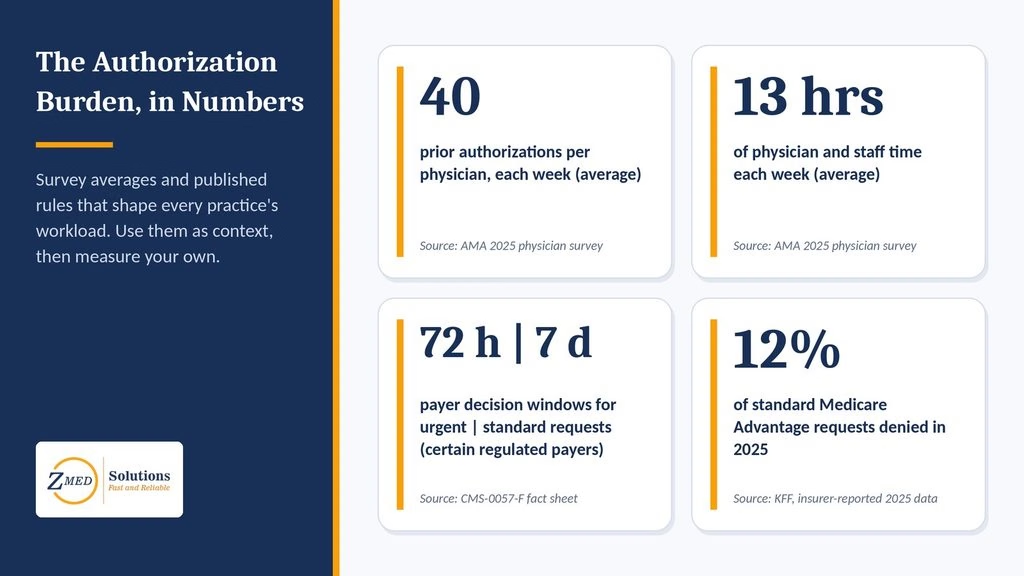
Physicians complete about 40 prior authorizations every week, according to the AMA’s 2025 survey. Practice staff absorb much of that work, and each missed approval can become a denied claim. This guide explains how AI prior authorization for medical billing companies works. It covers the numbers to track, the evidence on time savings, likely costs, and where human review must stay. You will also find worked formulas and a ten-question readiness check. Use it to judge whether your process can keep pace, and when outside revenue cycle management support may beat extra hiring.
Prior Authorization Numbers at a Glance
Key numbers for authorization workflows
| Metric | Practical Target/Range | Review Frequency | Primary Source |
| Requests per physician, weekly | 40 on average (a survey average, not a target) | Quarterly | Named survey (AMA, 2025) |
| Physician and staff time, weekly | 13 hours on average (survey average) | Quarterly | Named survey (AMA, 2025) |
| Provider time saved, electronic standard | About 14 minutes per authorization | Annually | Named data analysis (CAQH, 2024) |
| Payer decision windows | 72 hours urgent; 7 calendar days standard | Monthly, by payer | Published standard (CMS-0057-F) |
| Payer denials of standard requests | Medicare Advantage 12%; Medicaid managed care 14%; ACA Marketplace 18% | Annually | Named data analysis (KFF, 2025) |
| Denials overturned on appeal | Medicare Advantage 67%; Medicaid managed care 47%; Marketplace 43% | Annually | Named data analysis (KFF, 2025) |
| Chart-to-submission time | 1 business day | Weekly | Illustrative target |
| Authorization-related claim denials | Under 2% of claims | Monthly | Illustrative target |
| First-pass approval rate, by payer | 90% or higher | Monthly | Illustrative target |
Source labels: Named survey is a figure from a specific survey. Named data analysis is a review of reported figures. Published standard is a federal rule. Illustrative target is a planning figure, not a mandate. CMS-0057-F covers certain federally regulated payers and excludes drugs.
Why Manual Authorization Work Stopped Scaling?
Prior authorization began as a cost-control checkpoint. It now works as a daily bottleneck for many practices. The AMA survey found physicians and staff spend about 13 hours weekly on requests, and two in five physicians (40%) employ staff who handle nothing else. About three-quarters (74%) report that denials have increased over five years. When approval slips, the claim fails later, and billers rework avoidable claim denials by hand. For a refresher on why insurers require approvals, read this explainer on prior authorization.
Under CMS-0057-F, impacted payers must decide urgent requests within 72 hours and standard requests within seven calendar days, per the CMS fact sheet. Electronic prior authorization APIs follow in January 2027. However, the rule covers certain federally regulated plans, not every commercial payer, and it excludes drugs. KFF’s review of insurer-reported 2025 data from 14 large insurers found average standard denial rates of 12% in Medicare Advantage, 14% in Medicaid managed care, and 18% in ACA Marketplace plans. Individual insurers ranged from 2% to 25%. Appeals are rare, yet 67% of appealed Medicare Advantage denials were overturned. So documentation quality matters as much as speed.
What the Evidence Says About Time Savings?
Independent evidence is real but narrower than vendor marketing suggests. CAQH’s 2024 Index estimated that adopting the electronic standard could save medical providers and staff about 14 minutes per authorization. CAQH’s 2025 Index reported that more than 25% of provider organizations already use AI tools in administrative workflows. But those studies measure electronic transactions, not AI itself. We found no independent, peer-reviewed measurement of AI-specific time savings. Vendor guides cite larger gains, but those are self-reported. Treat any percentage as a claim to test. Time-savings depend on payer mix, chart quality, and implementation, so record your own baseline before you buy.
How AI Prior Authorization for Medical Billing Companies Works?
Step 1: Catch the Requirement Before the Visit
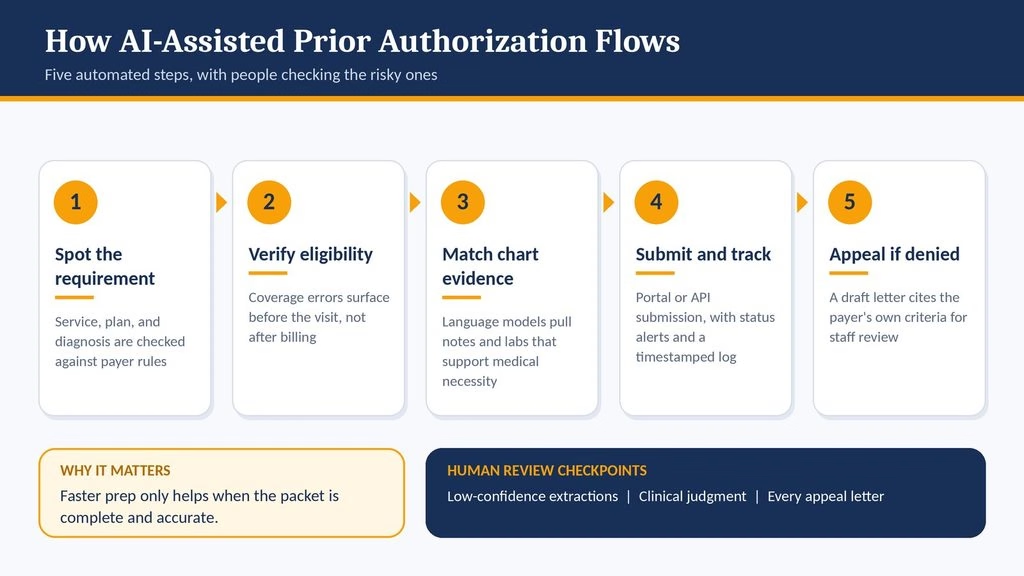
The workflow starts before the appointment. Software reads the scheduled service, plan type, and diagnosis, then flags whether approval is required. It pairs with eligibility verification, so coverage errors surface early instead of at billing. Because payer rules change often, the rule library must refresh continuously. A stale library creates the same errors as a stale spreadsheet. Teams that want more detail can review eligibility verification technology in practice.
Step 2: Match Chart Evidence to Payer Criteria
Next, natural language processing reads visit notes, lab results, and imaging reports. It extracts the evidence that supports medical necessity and compares it with the payer’s written policy. Missing items get flagged before submission, so staff can request them from the clinic. This step often decides whether a request clears on the first pass. However, it works only as well as the clinical documentation. Sparse or copied notes produce weak packets, no matter how capable the software is.
Step 3: Submit, Track, and Draft Appeals
Once the packet is complete, the system submits it by portal, electronic prior authorization transaction, or API. It monitors status and alerts staff when a payer requests more information. If a denial arrives, the software can draft an appeal citing the payer’s own criteria. A person reviews and signs that letter. Every action leaves a timestamped audit trail, which supports denial management. For deeper reading, see these AI-driven denial reduction strategies.
Human review checkpoints: low-confidence extractions from unclear notes; clinical judgment calls and peer-to-peer conversations; and every appeal letter, before it leaves your office.
Compliance Guardrails
An AI vendor handling patient data for you is usually a business associate, so a signed business associate agreement comes first. Ask where data lives, whether it trains public models, and how each automated action is logged. Physicians have reason for caution. In the AMA survey, six in ten said they worry that insurers’ use of AI may increase denial rates. That concern is about payers, but it shows why licensed staff should make every clinical call on your side too. Train your team to challenge outputs with this guide to training staff for AI and automation. Finally, confirm that safeguards are documented, not just promised. Zmed Solutions describes its server, backup, and email safeguards on its compliance page. That page does not address AI-specific questions such as model training, so ask any vendor, including Zmed, those directly.
What Implementation Costs and How Long It Takes?
Cost and timing are where AI claims meet reality, and independent benchmarks are scarce. Vendor-published buyer’s guides report per-request fees of roughly $5 to $15, monthly subscriptions of roughly $500 to $5,000 or more, and go-live in roughly 4 to 12 weeks. These are commonly reported vendor ranges, not standards, and your quote may differ. When a billing company runs the tools for you, the cost is usually folded into its service fee. Ask exactly what is included.
- Setup time: who configures payer rules, and how long until the first live request?
- Integration: which EHR and practice management systems connect, and by what method?
- Pricing model: per request, subscription, per provider, or bundled? What triggers extra charges?
- Training: how many staff hours does onboarding need, and who owns exceptions afterward?
Measuring the Payoff
Numbers turn a vendor pitch into a decision. Use these formulas with your own data.
| Metric | Formula | Worked example (illustrative) |
| Annual authorization labor cost | Weekly hours × hourly cost × 52 | 30 hours × $25 × 52 = $39,000 |
| First-pass approval rate | Approved at first submission ÷ total submitted × 100 | 180 ÷ 200 × 100 = 90% |
| Authorization-related denial rate | Authorization denials ÷ total claims × 100 | 38 ÷ 1,900 × 100 = 2% |
| Recoverable appeal revenue | Denials appealed × overturn rate × average payment | 40 × 0.67 × $350 = $9,380 |
| Net annual benefit | Hours saved × hourly cost × 52 − annual cost | 10 × $25 × 52 − $9,000 = $4,000 |
Hourly cost, claim counts, payment amounts, and the $9,000 annual cost (setup plus subscription) are illustrative. The 0.67 overturn rate mirrors KFF’s 2025 Medicare Advantage figure and will differ by payer.
If your authorization-related denial rate lands above target, sort denials by payer and reason code first. Repeat patterns usually point to one fixable cause, such as a documentation gap or a policy change. Denial management and appeals support can speed that investigation. Document each fix, then re-measure after two to four weeks.
When One Payer Connection Fails: A Different Hidden Problem?
Illustrative scenario (not an actual client record): a practice sends 500 requests a month. Payer X accounts for 100 of them, and its portal connection breaks for a week. The other 400 requests go out in one business day. The 100 for Payer X sit in a failed-submission queue for six days. The average turnaround is (400 × 1 + 100 × 6) ÷ 500 = 2.0 days, which looks close to a two-day goal. Yet one in five requests waited six days. Averages hide stalls. Watch queue age by payer, set an alert for failed submissions, and review an exceptions list every morning.
Reading Benchmarks Without Misleading Yourself
A benchmark only helps when you compare like with like. Match your specialty, payer mix, practice size, and reporting period. Specialty practices often face heavier authorization loads than primary care, so one shared target rarely fits both. A Medicare Advantage-heavy practice should not judge itself against a commercial-only peer. Treat one missed number as a signal to investigate, not a verdict. Pull denial reasons, check the payer split, and look for one root cause before changing workflows.
How Long Before Results Show Up?
These planning ranges are general, not a guarantee for any practice. Most delays come from data cleanup and staff training, not the software itself.
| Phase | Typical planning range | What you may notice |
| Baseline your numbers | 2 to 4 weeks | A clear view of volume, turnaround, and denials by payer |
| Pilot with one or two payers | 1 to 3 months | Fewer missing documents and faster prep (partial gains) |
| Roll out across payers | 3 to 6 months | Steadier approvals and fewer authorization-related denials |
| Tune and retrain | 6 to 12 months | Fuller results as payer rules and staff habits settle |
Short Recap: What to Remember?
- AI prior authorization for medical billing companies automates rule checks, packet assembly, submission, and tracking. People still own clinical decisions.
- The AMA reports about 40 weekly requests and 13 staff hours. These are survey averages, not targets.
- Independent data supports electronic authorization savings; AI-specific savings are unproven. Build your own baseline.
- CMS-0057-F sets 72-hour and seven-day decision windows for certain payers.
- Split every rate by payer, and watch queue age, because averages hide weak payers and stalls.
Is Your Authorization Workflow Ready? A Ten-Question Check
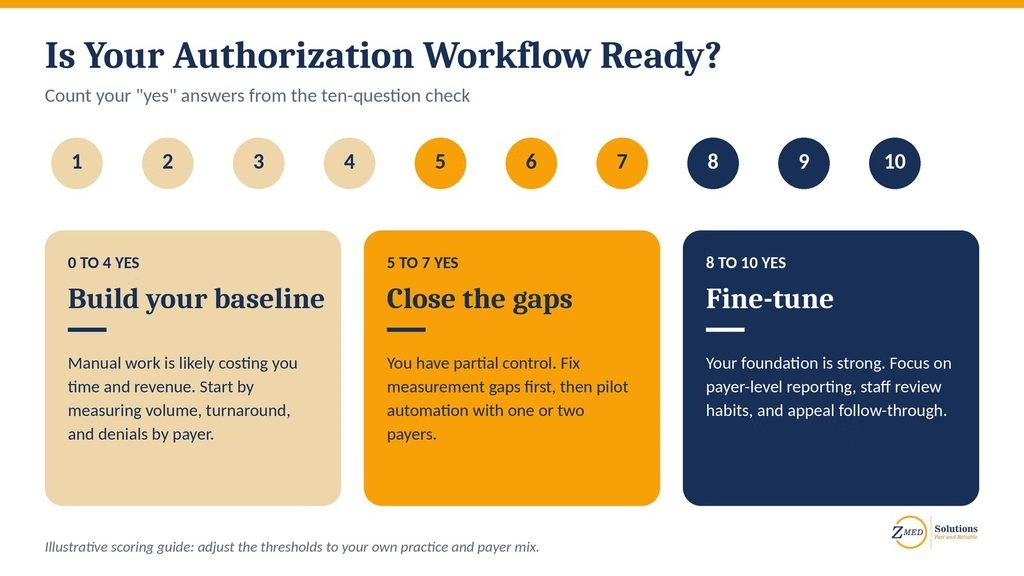
Answer yes or no for each question, then count your yeses.
- Do you know weekly requests per provider? (The AMA survey average is 40; it is a reference point, not a target.)
- Do you track weekly staff hours on authorizations? (The AMA survey average is 13.)
- Can you name each payer’s decision window (72 hours or seven days)?
- Do you check authorization needs before scheduling, not after the visit?
- Do you keep chart-to-submission time near one business day?
- Is first-pass approval at or above 90% for each major payer?
- Are authorization-related denials under 2% of your claims?
- Do you appeal most authorization denials, since many appeals succeed?
- Does every AI vendor sign a business associate agreement and keep audit logs?
- Are staff trained to review automated outputs and handle exceptions?
Scoring guide (illustrative)
| Your score | What it suggests |
| 8 to 10 yes | Strong foundation. Focus on payer-level reporting and fine-tuning. |
| 5 to 7 yes | Partial control. Close measurement gaps, then pilot automation. |
| 0 to 4 yes | Manual work is likely costing you revenue. Begin with a baseline audit. |
Signs Your In-House Team Has Hit a Ceiling
- Requests routinely wait days before anyone submits them.
- The same payer or service keeps producing avoidable denials.
- Staff spend more time on hold than on billing follow-up.
- Nobody can report first-pass approval rates by payer.
- One staff absence stalls the entire queue.
What to Look for in Outside Support?
Look for a partner that connects authorization to the rest of your revenue cycle. Ask how automation is used, where people review it, and how exceptions are handled. Confirm a signed BAA, audit logs, and reporting by payer. Clear escalation paths matter when a payer disputes a request. Prefer transparent scope over bold promises, because outcomes vary by practice, specialty, and payer mix. This is especially true for AI prior authorization for medical billing companies, where tools differ widely.
Where Zmed Solutions Fits?
Zmed Solutions is one example of this structure. Its published service pages describe eligibility checks, charge entry, claim scrubbing, and follow-up and appeals within a revenue cycle management service, plus credentialing, coding, and denial management. Its revenue integrity guidance describes authorization automation tools that connect to EHRs and payer portals, with staff reviewing exceptions. That connected view matters because an authorization gap usually surfaces later as a coding, eligibility, or denial issue.
What the public pages do not show is how a tool behaves on your payers. Illustrative scenario (not an actual client record): a payer requires approval for an advanced imaging order. Software flags the rule at scheduling. A coordinator confirms the order, diagnosis, and prior conservative treatment notes, then submits through the payer portal. A status alert fires when the payer requests records. A person handles the peer-to-peer call. Ask Zmed, or any partner, to walk through one of your payers this way, and to explain three things: which steps are automated, where staff review, and what the software cannot decide. AI prepares and tracks requests. Payers approve or deny them. Results vary by practice and situation, and no partner can promise a specific outcome.
Final Thoughts
AI can lift routine authorization work off your team’s desk. It cannot replace clinical judgment, clean documentation, or payer-level monitoring. The strongest results come from pairing software with disciplined human review and clean data. Neither building in-house nor partnering removes the need for oversight. Start by measuring your baseline, then automate the costliest steps, and revisit the numbers each quarter because payer rules keep shifting.
Remember which numbers are firm. The 72-hour and seven-day windows come from CMS-0057-F. The 40 weekly requests, 13 weekly hours, and physician opinions come from the AMA survey. KFF supplies the payer denial and overturn rates, and CAQH supplies the 14-minute estimate. The one-day turnaround, 2% denial rate, 90% first-pass approval, and vendor cost ranges are illustrative or commonly reported, not official benchmarks. Check each against your own data before setting goals.
Frequently Asked Questions
What is AI prior authorization for medical billing companies?
It uses machine learning and natural language processing to check rules, assemble documentation, submit requests, and track decisions. Billing staff review exceptions and appeals. The goal is fewer delays and fewer avoidable claim denials.
Can AI approve or deny a prior authorization?
No. Payers decide medical necessity and coverage, not billing software. AI prepares, submits, and tracks requests on the provider side, and staff review the results.
Is AI prior authorization for medical billing companies HIPAA compliant?
It can be, when the vendor signs a business associate agreement and follows HIPAA safeguards. Ask about encryption, access controls, audit trails, and whether patient data trains public models. Compliance depends on the setup, not the label.
Does AI really save time on prior authorization?
Independent data shows electronic authorization saves about 14 minutes per request (CAQH, 2024). We found no independent measurement of AI-specific savings, so measure your own baseline.
What does AI prior authorization cost?
Vendor guides report roughly $5 to $15 per request or $500 to $5,000+ monthly, with 4 to 12 weeks to go live. These are commonly reported vendor ranges. Ask for a written quote.
What is a good prior authorization denial rate?
There is no single official target. KFF reported average payer denial rates of 12% to 18% for standard requests in 2025. For your own claims, an authorization-related denial rate under 2% is an illustrative goal.
What is a good first-pass approval rate for prior authorization?
A practical target is around 90% or higher, but that is illustrative, not a published standard. Track it by payer, because a blended average can hide a weak one.
Should small practices outsource prior authorization?
It depends on volume, staffing, and denial patterns. If the ceiling signs above sound familiar, outside support may cost less than more hires. A hybrid model, keeping clinical documentation in-house, is another option.
Where These Figures Come From?
- Published standards: CMS-0057-F decision windows and the January 2027 API date (CMS fact sheet).
- Named benchmarking data: KFF’s analysis of insurer-reported 2025 prior authorization metrics (14 large insurers, about 71 million enrollees); CAQH Index, 2024 and 2025.
- Survey data: AMA 2025 Prior Authorization Physician Survey, 1,000 physicians, released May 2026 (40 requests and 13 hours weekly; 40% with dedicated staff; 74% report rising denials; 60% concerned about insurers’ AI).
- Practical or illustrative targets: the one-day turnaround, 2% denial rate, 90% first-pass approval, vendor-published cost and timeline ranges, and all worked-example inputs. They come from general industry practice, not official benchmarks.
Actual results vary by practice and situation. Figures reflect information available in September 2026.
Key Market Player
Ready to optimize your medical billing and boost your revenue? Look no further. Zmed Solutions LLC is your trusted partner in professional Medical Billing Services.
Join hundreds of satisfied healthcare providers who have already elevated their revenue with our expert services. Don't miss out on what could be your practice's most profitable decision.
Schedule a Consultation Today!
Contact Us Now, and experience the difference. Your financial success starts here!