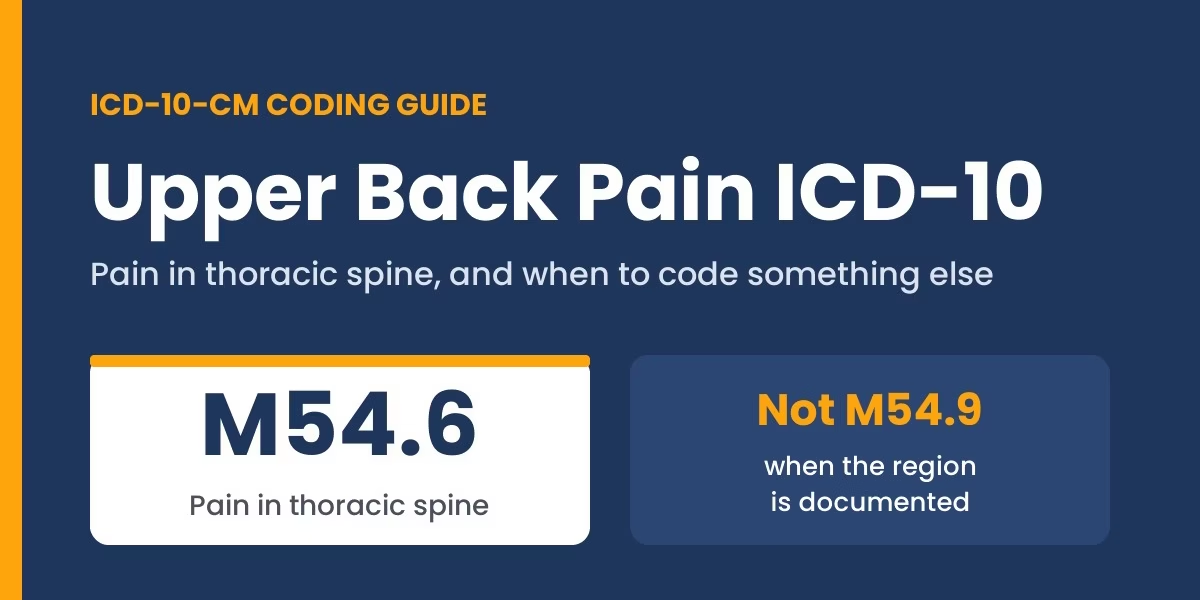
The upper back pain ICD-10 code is M54.6, Pain in thoracic spine, used when the provider documents pain in the upper or mid back and no more specific cause. It is billable, has no laterality or seventh character, and is unchanged in the FY 2027 code set. This guide compares M54.6 with M54.9 and the other back pain codes, shows when a disc, nerve or injury code replaces it, explains Medicare chiropractic sequencing and walks through a sample claim.
| Key takeaways Upper and mid back pain code to M54.6, Pain in thoracic spine.M54.9, Dorsalgia, unspecified, is only for back pain with no region documented.A documented cause replaces M54.6: disc disorders (M51.-), thoracic radiculopathy (M54.14) or a recent strain (S29.012-).On Medicare chiropractic claims, the subluxation code comes first and M54.6 can follow as a secondary diagnosis. |
Upper Back Pain ICD-10 Code at a Glance
Category M54, Dorsalgia, splits back pain by region. Coders often reach for M54.9 because “back pain” sounds generic, but that code is meant for back pain with no region stated. For the full story on the unspecified code, see our guide to back pain ICD-10 code M54.9.
| Documented location | Code | Title |
| Upper back, mid back or thoracic spine | M54.6 | Pain in thoracic spine |
| Neck | M54.2 | Cervicalgia |
| Low back | M54.50, M54.51, M54.59 | Low back pain, unspecified; vertebrogenic low back pain; other low back pain |
| Back, region not stated | M54.9 | Dorsalgia, unspecified (includes back pain NOS) |
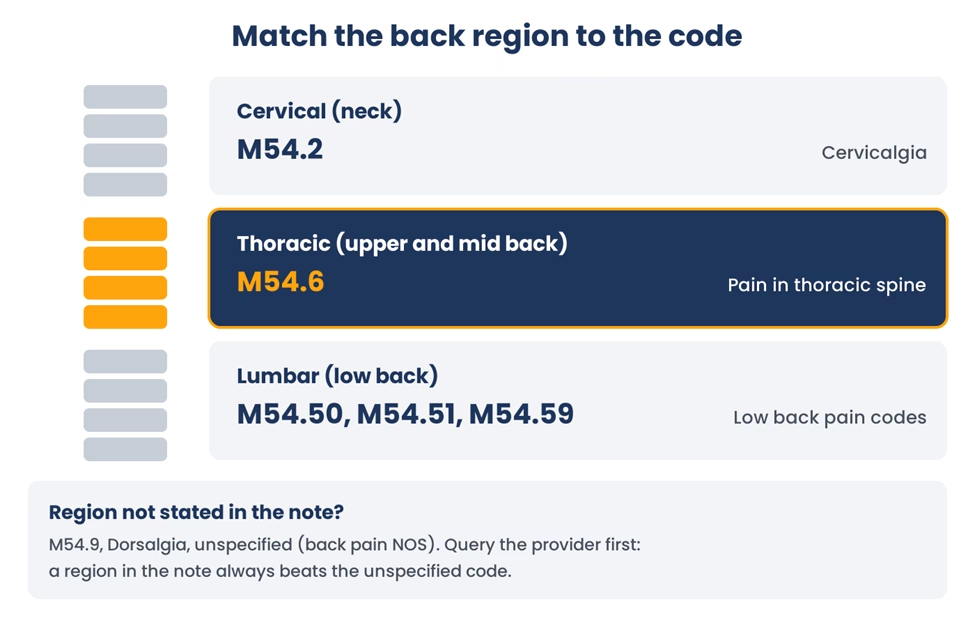
In short, the region in the note picks the code: neck to M54.2, upper or mid back to M54.6, low back to the M54.5- codes, and no region to M54.9. Neck pain has its own rules, covered in our neck pain ICD-10 code guide.
M54.6 has carried the same title since ICD-10-CM took effect in October 2015. Some websites list an “M54.A6” code for thoracic pain; no such code exists in ICD-10-CM, and a claim that carries it will reject as invalid.
When M54.6 Is the Wrong Code
M54.6 is a symptom code. Once the provider documents why the upper back hurts, the specific diagnosis takes over. Section I.B.5 of the FY 2027 ICD-10-CM Official Guidelines for Coding and Reporting says symptoms that are a routine part of a confirmed condition are not coded separately, and the Tabular List adds two Excludes1 notes that point the same way.
| What the provider documents | Code instead of M54.6 | Why |
| Thoracic intervertebral disc disorder | M51.- (thoracic codes) | M54.6 has an Excludes1 note for thoracic pain due to a disc disorder. |
| Thoracic radiculopathy with no disc disorder documented | M54.14 | Radiculopathy, thoracic region, is the more specific diagnosis. |
| Strain of the upper back muscles from a recent injury | S29.012A, then D or S | The M50 to M54 block excludes current injuries, which code to the injury chapter. |
| Back pain documented as psychogenic | F45.41 | Category M54 has an Excludes1 note for psychogenic dorsalgia. |
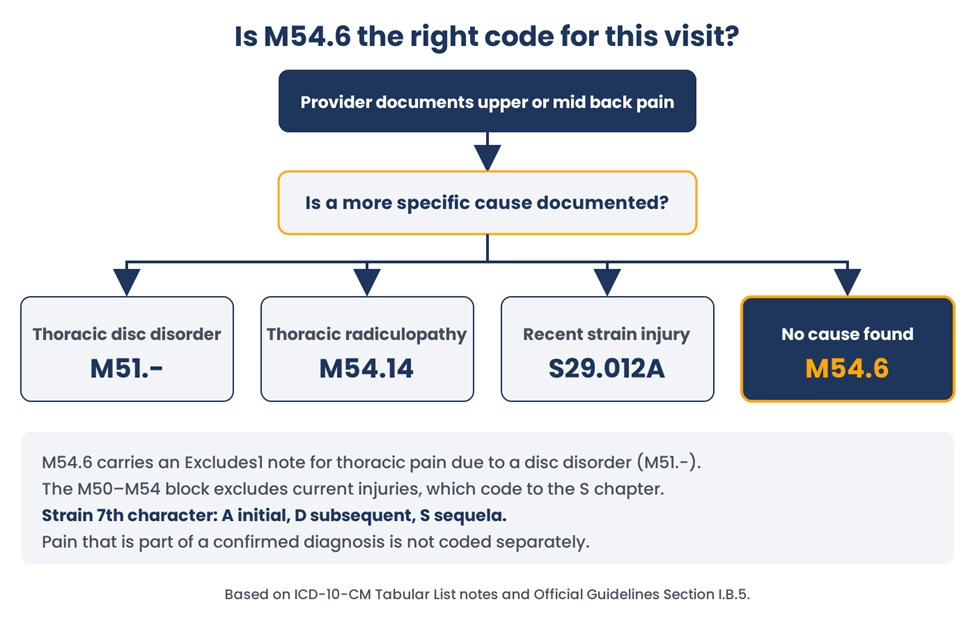
The flowchart reads top to bottom: if the provider documents a disc disorder, radiculopathy or recent strain, use that code; M54.6 is only for upper back pain with no cause found.
For the strain codes, the seventh character tracks the phase of care: A while the patient receives active treatment, D for routine healing and recovery visits, and S for a late effect. Pain practices that move on to injections or other procedures can see how those claims are built in our pain management billing and coding guide.
Documentation That Supports M54.6
M54.6 is easy to code and easy to question. A note that holds up in review usually includes:
- The location in plain words, such as “mid back pain between the shoulder blades,” or the thoracic levels involved.
- Onset, duration and any trigger, which also shows whether an injury code fits better.
- Exam findings such as tenderness, range of motion and a neurologic check.
- The provider’s assessment, including any cause that was ruled in or ruled out.
- The plan, such as therapy, imaging or a follow-up, linked to the diagnosis.
When imaging, injections or therapy are ordered, payers check that the diagnosis supports the service. Our guide to preventing medical necessity denials covers how to keep the diagnosis and the order aligned.
Medicare Chiropractic Claims and Therapy Visits
Chiropractic claims are where M54.6 is most often sequenced wrong. Medicare covers chiropractic manual manipulation only to correct a subluxation, and the CMS chiropractic services compliance tips say the subluxation must be the primary diagnosis and must name the spinal level.
The WPS billing and coding article for chiropractic services puts that into practice: the primary diagnosis comes from M99.00 to M99.05, such as M99.02 for the thoracic region, and the condition being treated goes second. M54.6 appears in its short-term secondary group, and manipulation codes 98940 to 98942 need the AT modifier for active treatment. Other Medicare Administrative Contractors (MACs) publish similar articles, and commercial payers set their own rules in the contract and provider manual, so check your payer’s policy. Practices that want help with these claims can review our chiropractic billing services.
Physical therapy claims use M54.6 as a treatment diagnosis more freely, but the plan of care still needs the region and the functional problem documented. Our guide to CPT codes in physical therapy explains how the therapy codes pair with these diagnoses.
Sample claim sequence
Sample (fictional data). A 47-year-old Medicare patient sees a primary care physician, then a chiropractor, for mid back pain with no injury.
| Visit | Documentation | Diagnosis codes | Procedure billed |
| Physician, June 2 | Mid back pain for three weeks, no trauma, no neurologic deficit; cause not found | M54.6 | Office visit |
| Chiropractor, June 9 | Subluxation at T5 and T6 found on exam (pain, asymmetry, restricted motion); thoracic manipulation | 1: M99.02 2: M54.6 | 98940 with modifier AT |
To reuse this sample, swap in your own dates, exam findings and spinal levels, and apply your own MAC or payer’s diagnosis list and modifier rules.
Common Upper Back Pain Coding Mistakes
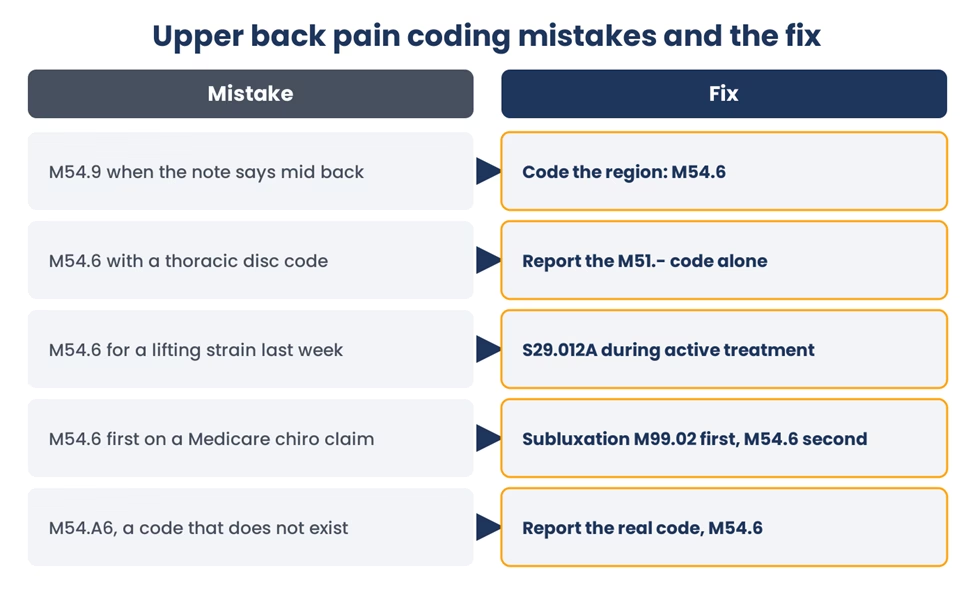
The chart pairs each error with its fix: code the documented region, drop M54.6 when a disc code applies, use the injury code for a recent strain, put the subluxation first on Medicare chiropractic claims, and never use the nonexistent M54.A6.
Most of these errors can be caught by claim scrubber edits: flag M54.9 when the note names a region, M54.6 on the same claim as a thoracic M51 code, and 98940 to 98942 without an M99.0- code in the first position.
Upper Back Pain ICD-10 Code FAQs
What is the ICD-10 code for upper back pain?
Use M54.6, Pain in thoracic spine, when the provider documents upper or mid back pain and no more specific cause. If the provider later documents a disc disorder, thoracic radiculopathy or a recent strain, that diagnosis replaces M54.6. If the note says only “back pain” with no region, M54.9 applies, but querying the provider for the region is better.
Is M54.6 a billable code?
Yes. M54.6 is a complete, billable ICD-10-CM code with no laterality and no seventh character, and it is unchanged in the FY 2027 code set that took effect on October 1, 2026. Payers may still question it when it supports imaging, injections or long courses of therapy without exam findings that justify the service.
What is the difference between M54.6 and M54.9?
M54.6 is pain in the thoracic spine, so the note must place the pain in the upper or mid back. M54.9, Dorsalgia, unspecified, covers back pain with no region documented, including back pain NOS. When the region is known, M54.6 is the more accurate code, and choosing M54.9 instead invites questions from payers and auditors.
What ICD-10 code is used for mid back pain?
Mid back pain is also thoracic pain, so it codes to M54.6 when no cause is documented. The thoracic spine runs from the base of the neck to the bottom of the rib cage, which covers both upper and mid back complaints. Pain clearly in the lower back belongs to the M54.5- codes instead.
What is the ICD-10 code for an upper back strain?
A strain of the upper back muscles from an injury codes to S29.012-, Strain of muscle and tendon of back wall of thorax. Add A during active treatment, D for healing-phase visits and S for a late effect. Do not add M54.6 for the pain, because the M50 to M54 block excludes current injuries.
Get Help With Spine and Pain Claims
Choosing the right upper back pain ICD-10 code comes down to the region in the note, any cause the provider documents, and the sequencing your payer expects. If your team wants help applying those checks on every claim, Zmed Solutions offers revenue cycle management services, and you can reach the team through the Zmed Solutions contact page.
Sources: ICD-10-CM Official Guidelines for Coding and Reporting FY 2027 (CDC, NCHS); ICD-10-CM Tabular List, category M54 and codes M51.-, M54.14, S29.012 and F45.41; CMS Medicare provider compliance tips for chiropractic services; WPS billing and coding article A56273, Chiropractic Services. This article is educational and is not legal or medical advice; payer policies change, so follow the rules in your current contracts.
Ready to optimize your medical billing and boost your revenue? Look no further. Zmed Solutions LLC is your trusted partner in professional Medical Billing Services.
Join our growing network of healthcare providers who have already elevated their revenue with our expert services. Don't miss out on what could be your practice's most profitable decision.
Schedule a Consultation Today!
Contact Us Now, and experience the difference. Your financial success starts here!