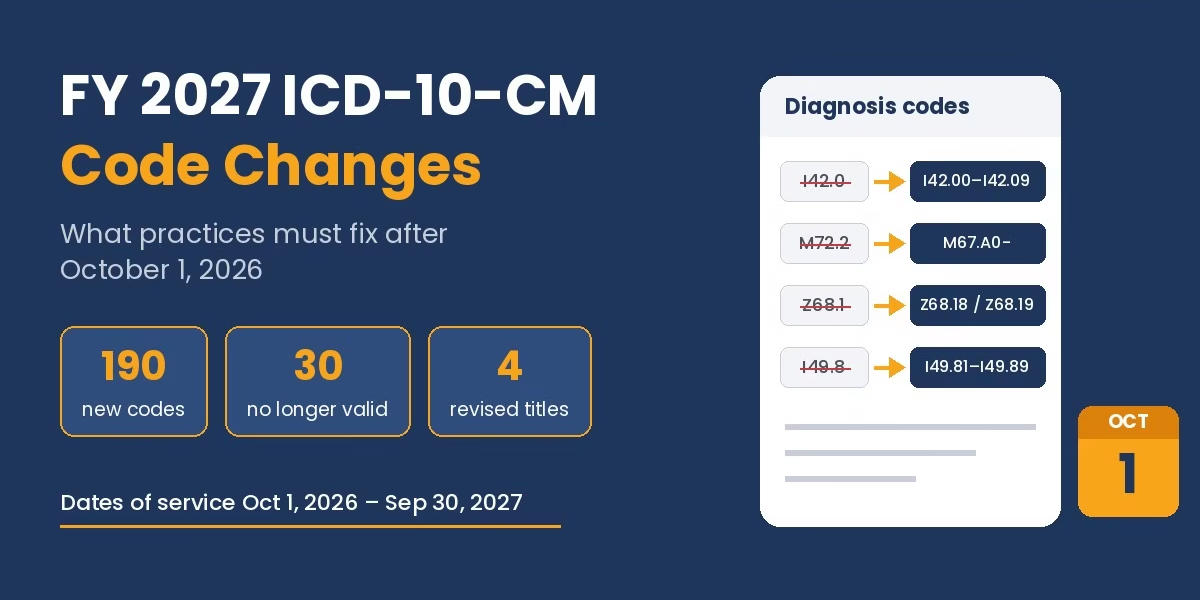
The FY 2027 ICD-10-CM code changes are the annual U.S. diagnosis code set update that took effect October 1, 2026, adding 190 new reportable codes, making 30 codes invalid for reporting and revising 4 code titles. Claims for dates of service from October 1, 2026, through September 30, 2027, must use the FY 2027 codes.
Since October 1, any claim that carries one of those 30 retired codes for a current date of service can be rejected before a payer even looks at it. This guide shows exactly which codes changed, what replaces them, how Medicare, Medicare Advantage, Medicaid and commercial plans handle the switch, and how to measure the impact with four simple formulas. A self-assessment checklist near the end tells you whether your practice is covered or exposed.
FY 2027 ICD-10-CM Code Changes: The Key Numbers at a Glance
The FY 2027 update adds 190 reportable diagnosis codes, retires 30 codes from reporting and revises 4 titles, according to the ICD-10-CM addendum published by the CDC’s National Center for Health Statistics (NCHS) and posted on CMS.gov. That is a much lighter year than FY 2026, which added 487 codes. The table below pairs the official counts with the practical targets a billing team should track.
| Metric | Practical target/range | Review frequency | Source type |
| New reportable codes in FY 2027 | 190 (vs. 487 in FY 2026) | Once per update cycle | Published standard (1) |
| Codes no longer valid for reporting | 30 (15 deleted, 15 kept as non-billable headers) | Once per update cycle | Published standard (1) |
| Retired codes still in favorites or templates | 0 | One full sweep, then quarterly | Practical target (2) |
| Invalid-diagnosis rejections for October dates of service | 0, with each hit corrected within 2–5 business days | Daily for 30 days, then weekly | Practical target (2) |
| Initial clean claim rate | 95% or higher | Monthly | Commonly reported across industry sources (3) |
| Unspecified-code share in a newly split code family | Falling month over month | Monthly | Practical target (2) |
| Medicare Part B timely filing limit | 12 months from date of service | Weekly check on aging rejections | Published standard (4) |
Source labels: (1) Published standard: CDC/NCHS FY 2027 addendum and conversion table; the 15/15 split reflects how the conversion table treats each code, and the FY 2026 comparison comes from the prior year’s files as summarized by HIA (2026). (2) Practical target: a Zmed Solutions team planning target, not a number mandated by CMS, AMA, AAPC or any payer. (3) A widely repeated industry convention; no standards body mandates it. (4) CMS regulation at 42 CFR 424.44.
If you already track these alongside your other medical billing KPIs and benchmarks for 2026, add the two update-specific rows for October and November, then drop them once rejections stay at zero.
What Changed in the FY 2027 ICD-10-CM Update?
The FY 2027 update is a low-volume, high-specificity year: most changes split one existing code into several more precise codes rather than adding new conditions. According to an analysis by Libman Education (2026), Chapter 19 (injury and poisoning) carries roughly 60 new codes, Chapter 15 (pregnancy) about 44, Chapter 13 (musculoskeletal) about 31 and Chapter 21 (Z codes) about 16.
That pattern matters for billing because diagnosis code specificity now decides whether a claim passes. A provider who documents “dilated cardiomyopathy” without a type will default the coder to an unspecified code, while a template that still offers the old code will produce a rejection.
Why do some sources report 238 new codes instead of 190?
Both numbers are correct; they count different things. The NCHS addendum counts 190 new reportable codes, while AAPC’s 2027 ICD-10-CM update overview (2026) and several vendors report 238 additions because they also count non-billable category headers. Their tallies of 21 deletions treat some retired codes as restructured rather than deleted. For claims, use 190 and 30, because only billable codes can appear on a claim.
Which specialties feel the FY 2027 changes most?
Cardiology, OB/GYN and foot and ankle care carry the largest share of changes that touch everyday claims, followed by oncology, endocrinology and primary care Z codes. The table lists the main new ICD-10 codes for 2027 by specialty and what documentation each one needs.
| Specialty | Key new FY 2027 codes | What the note must say |
| Cardiology / EP | I42.00–I42.09 dilated cardiomyopathy (I42.01 familial-genetic); I42.81 arrhythmogenic cardiomyopathy; I47.22 CPVT; I49.81 Brugada syndrome; I49.82 ventricular bigeminy | Type and cause of cardiomyopathy; the named arrhythmia |
| OB/GYN | Ectopic pregnancy by site: interstitial (O00.12-, O00.13-), cesarean scar (O00.31, O00.32), cervical (O00.41, O00.42), cornual (O00.51-, O00.52-); O31.4- continuing pregnancy after vanishing twin | Ectopic location and side; coexisting intrauterine pregnancy; trimester and fetus |
| Podiatry / orthopedics | M67.A01, M67.A02, M67.A09 plantar fasciitis; M72.20–M72.22 plantar fascial fibromatosis; M86.8X- osteomyelitis by site and side | Fasciitis versus fibromatosis; laterality; bone site |
| ENT / oral surgery | J34.830–J34.839 odontogenic sinusitis | Which sinus is involved |
| Oncology | C78.31 larynx, C78.32 pharynx, C79.83 oral cavity (secondary malignancies) | Metastatic site |
| Endocrinology / bariatrics | E89.830 post-bariatric hypoglycemia; E89.838 other postprocedural hypoglycemia | Link between hypoglycemia and the procedure |
| Hematology / rheumatology | D69.11 Glanzmann thrombasthenia; D69.19; M04.3 VEXAS syndrome | Named platelet defect or syndrome |
| Primary care / veterans’ health | Z77.32 burn pits; Z77.33 Agent Orange; Z77.40–Z77.49 blast overpressure; Z86.17 history of C. difficile; Z68.18–Z68.19 underweight adult BMI | Exposure history; exact BMI value |
| Radiology | R78.72 abnormal gadolinium level in blood; Z77.013 gadolinium exposure | Lab finding or exposure |
Source: CDC/NCHS FY 2027 ICD-10-CM addendum. Code titles shortened for space.
Which codes stopped working on October 1, 2026?
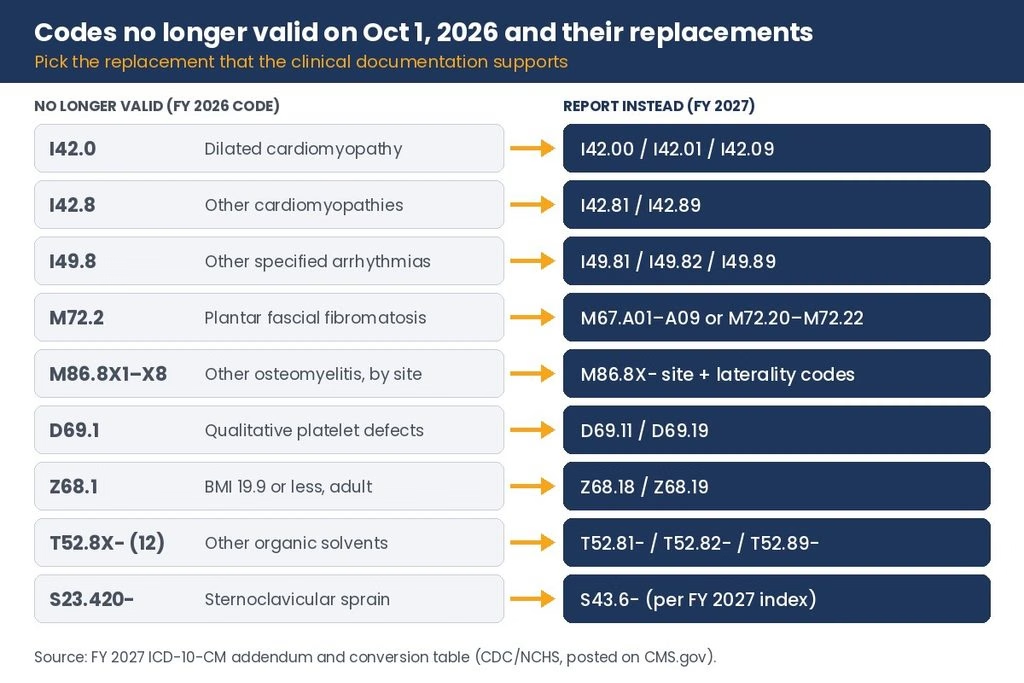
Thirty codes are no longer valid for dates of service on or after October 1, 2026: 15 were deleted outright and 15 became non-billable header codes that now require a more specific child code. These deleted ICD-10 codes are where denials start, because every one of them was valid last month.
| No longer valid (FY 2026 code) | Report instead (FY 2027), based on documentation |
| I42.0 Dilated cardiomyopathy | I42.00, I42.01 or I42.09 |
| I42.8 Other cardiomyopathies | I42.81 or I42.89 |
| I49.8 Other specified cardiac arrhythmias | I49.81, I49.82 or I49.89 |
| M72.2 Plantar fascial fibromatosis | M67.A01–M67.A09 (plantar fasciitis) or M72.20–M72.22 (fibromatosis) |
| M86.8X1–M86.8X8 Other osteomyelitis, by site | Site- and laterality-specific M86.8X- codes |
| D69.1 Qualitative platelet defects | D69.11 or D69.19 |
| Z68.1 BMI 19.9 or less, adult | Z68.18 or Z68.19 |
| Z87.890 (personal history subcategory) | Z87.8901–Z87.8909 |
| T52.8X1A–T52.8X4S (12 codes) | T52.81-, T52.82- or T52.89-, by substance |
| S23.420A, S23.420D, S23.420S | S43.6- sprain of sternoclavicular joint, per the FY 2027 index |
Source: CDC/NCHS FY 2027 addendum and conversion table.
The header trap: why “valid-looking” codes still reject
A header code such as I42.0 still appears in code books, search tools and old superbills, so it looks legitimate. It is not billable, and claim rejections follow when it is submitted for an October date of service. In billing audits, a common pattern is that a retired code survives longest in provider favorites lists and macros, long after the central code table has been updated.
What changed in the FY 2027 Official Guidelines?
The FY 2027 ICD-10-CM Official Guidelines for Coding and Reporting changed only lightly, with one new guideline and wording updates to a few others. The ICD-10-CM Official Guidelines for Coding and Reporting now say hypertension with “one or more” heart conditions goes to category I11, and the hypertensive crisis guideline adds I1A.- to its “code also” instruction. Chapter 21 now lists Z84.A, family history of diethylstilbestrol (DES) exposure, and adds a note that Z91.B applies to direct in utero DES exposure. In the Tabular List, the Excludes note at D05 (carcinoma in situ of breast) changed from Excludes1 to Excludes2, which permits reporting both conditions when documentation supports it.
Which Dates of Service Use the FY 2027 Codes?
The date of service decides the code set, not the date you bill. Outpatient encounters on or after October 1, 2026, and inpatient discharges on or after that date use FY 2027 codes; a September 30 visit billed on October 6 still uses FY 2026 codes. The CMS ICD-10 page states the FY 2027 files apply to encounters and discharges from October 1, 2026, through September 30, 2027.
There is no grace period built into the annual update. A code that is invalid for the date of service is invalid on the claim, so your billing system has to keep both code sets live until every September claim is out the door. Our team often sees well-meaning staff “update” September claims to the new codes during October follow-up, which creates the opposite rejection.
Diagnosis and procedure codes also follow different calendars, which is why it helps to revisit how ICD-10 and CPT codes work together in medical billing. CPT changes arrive January 1, so pair this cleanup with a CPT 2027 billing readiness checklist. CMS can also publish an April 1 ICD-10 update when one is approved, so check the CMS ICD-10 page in early 2027 before assuming the October files are final. The longer-term ICD-11 transition has no U.S. adoption date yet, so ICD-10-CM remains the code set for this fiscal year.
How Do Medicare, Medicare Advantage, Medicaid and Commercial Payers Handle the Update?
Every HIPAA-covered payer must accept the FY 2027 code set for October 1, 2026, dates of service, but each payer updates its coverage edits on its own schedule. That gap between a valid code and an updated policy list is where medical necessity denials appear even when the diagnosis code itself is correct.
| Payer type | Code validity | Where problems show up | What to watch |
| Medicare (MACs) | Invalid codes rejected as unprocessable at the front end | National and local coverage diagnosis lists, updated through CMS change requests | Correct and resubmit rejections; 12-month timely filing |
| Medicare Advantage | Same FY 2027 code set | Plan medical policies, prior authorization tools and HCC risk adjustment capture | Full specificity on chronic conditions such as cardiomyopathy |
| Medicaid (fee-for-service and managed care) | Same FY 2027 code set | State claims system edits and plan policy lists, which can lag | State Medicaid bulletins; timely filing set by each state |
| Commercial | Same FY 2027 code set | Medical policies, clearinghouse edits and contract-specific code lists | Payer bulletins; timely filing often 90–180 days by contract |
Illustrative summary of common payer behavior; actual edits and deadlines vary by payer, plan and state.
For Medicare, Physician Cure (2026) reports CMS instructions to end-date I42.0 and I42.8 in certain implantable defibrillator coverage groups and add the new codes, which shows how coverage lists move with the code set. When a claim denies with CARC 11 (diagnosis inconsistent with procedure) on a newly split code, check the payer’s policy list before recoding; our guide to preventing medical necessity denials covers the appeal path. Keep rejected claims inside each payer’s timely filing limits by state and payer, because a front-end rejection does not stop the filing clock.
How Should a Practice Implement the FY 2027 ICD-10-CM Code Changes?
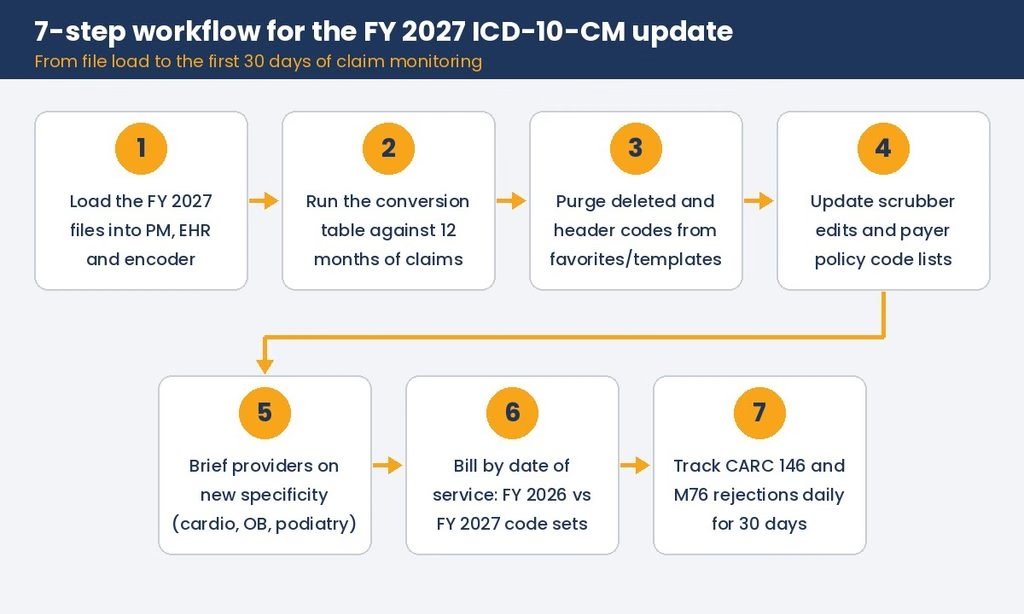
A practice implements the FY 2027 ICD-10-CM code changes by loading the files, finding every retired code in its own history and templates, replacing them, and then watching rejections daily for a month. The seven steps below work for a solo practice or a multi-location group.
- Confirm the files are live in every system. Check the practice management system, EHR, encoder and clearinghouse separately when vendors push updates on different dates. If the system build itself is out of date, Zmed’s EHR setup and configuration service can rebuild code tables and templates.
- Run the conversion table against 12 months of claims. Download it from the CDC/NCHS ICD-10-CM files page and match it to your diagnosis history to find every code family you actually use.
- Purge retired codes from favorites, order sets, superbills and charge templates. Do this provider by provider when favorites are stored at the user level.
- Update scrubber edits and payer policy lists. Load the 30 retired codes as hard stops in your claim scrubber for October dates of service.
- Brief providers by specialty. Focus on cardiomyopathy type, ectopic pregnancy site, plantar fasciitis laterality and BMI values, and show how complete clinical documentation supports the new codes.
- Route claims by date of service. Keep FY 2026 codes available for September encounters billed in October.
- Monitor rejections daily for 30 days. Watch for CARC 146 (diagnosis invalid for the date of service) and RARC M76 (missing, incomplete or invalid diagnosis), then run a focused coding audit on the new code families in late October.
How Do You Measure the Impact of the Code Changes?
Four numbers tell you how exposed your practice is and whether the cleanup worked: exposure rate, revenue at risk, invalid-diagnosis rejection rate and unspecified-code share. The walkthroughs below use one practice so the math connects.
Illustrative scenario (not an actual client record): a three-department practice with primary care, cardiology and podiatry submitted 18,000 claims over the last 12 months, with an average allowed amount of $142 per claim.
Affected-code exposure rate
Formula: claims containing any of the 30 retired codes ÷ total claims in the lookback period × 100.
The practice finds 270 claims with a retired code in the last 12 months. 270 ÷ 18,000 × 100 = 1.5%. Use this when deciding how much cleanup effort the update deserves; a podiatry-heavy or cardiology-heavy practice will usually sit well above a primary care practice.
Monthly revenue at risk
Formula: (affected claims per year ÷ 12) × average allowed amount per claim.
(270 ÷ 12) × $142 = 22.5 × $142 = $3,195 per month. That is the cash that stalls each month if templates stay unchanged, before counting the staff time to rework each rejection.
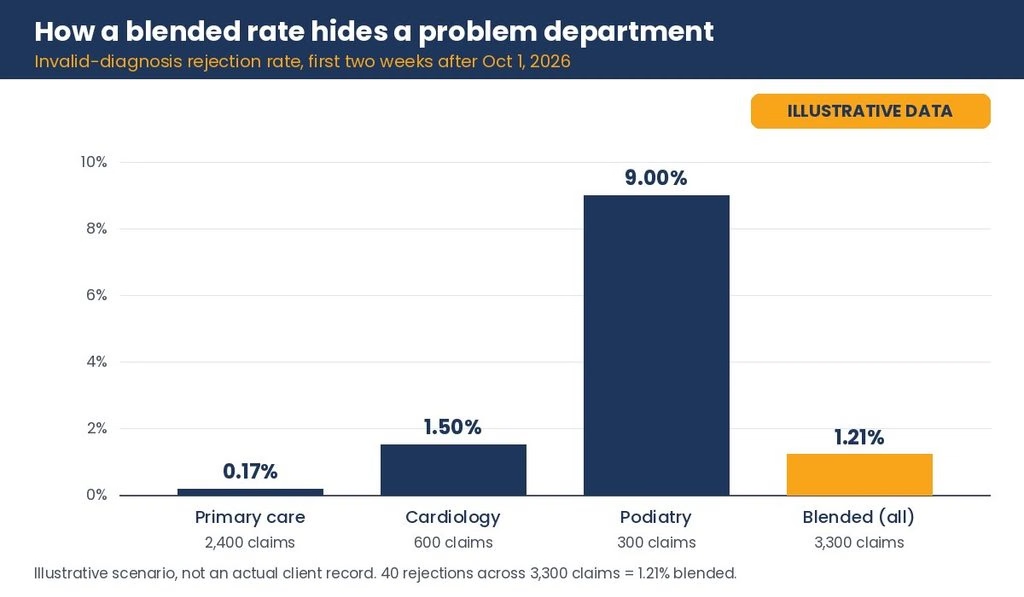
Invalid-diagnosis rejection rate, and how a blended rate hides a problem
Formula: claims rejected for an invalid diagnosis ÷ claims submitted for October dates of service × 100.
| Department | Claims (first 2 weeks) | Invalid-diagnosis rejections | Rate |
| Primary care | 2,400 | 4 | 0.17% |
| Cardiology | 600 | 9 | 1.50% |
| Podiatry | 300 | 27 | 9.00% |
| Blended practice total | 3,300 | 40 | 1.21% |
Illustrative: figures are invented for teaching; actual rates vary by specialty, payer mix and system.
The blended 1.21% looks manageable, yet podiatry is rejecting 9% of its claims because M72.2 is still in a shared template. A pattern that shows up in post-update reviews is exactly this: leadership watches the practice-wide rate while one provider’s favorites list drives most of the rejections. Split the rate by department and by provider when the blended figure is above zero.
Unspecified-code share in a newly split family
Formula: claims using the unspecified child code ÷ all claims in that code family × 100.
Cardiology bills 120 dilated cardiomyopathy claims in October, and 66 use I42.00 (unspecified). 66 ÷ 120 × 100 = 55%. An unspecified code is valid, but a share that high signals a documentation gap worth a provider query, especially for Medicare Advantage patients where specificity feeds risk adjustment.
How Should You Read These Numbers?
Compare like with like before reacting to any of these figures. Judge a cardiology group against its own September baseline, its own payer mix and its own claim volume, not against a primary care practice or a national average. A Medicaid-heavy practice may see policy-related denials weeks later than a Medicare-heavy one simply because state edits update later.
One missed target is a signal to investigate, not a verdict. A single October rejection usually points to one template or one provider, and the fix is a ten-minute favorites update. A rejection rate that stays above zero after week two, or an unspecified share that does not fall by November, points to a process gap.
How Long Does It Take to Clean Up After the Update?
Most practices can expect partial results within two to four weeks and full results within 60 to 90 days, depending on size and system access. Purging retired codes from central tables and templates often takes one to five business days. Bringing rejections for high-volume codes close to zero commonly takes two to four weeks, while stable documentation habits, caught-up payer edits and resolved rejected claims usually take one to three months. These are planning ranges, not guarantees.
What Mistakes Cause Denials After an ICD-10-CM Update?
Most post-update denials come from six avoidable habits, and each has a simple countermeasure.
- Recoding September claims to FY 2027 codes. Keep the FY 2026 set when the date of service is before October 1, even if you bill in October.
- Selecting a header code from an old superbill. Retire paper and PDF superbills when they still list I42.0, M72.2 or Z68.1.
- Trusting the vendor update without testing. Submit a test claim with a new code and a retired code when your clearinghouse confirms the load.
- Assuming payer policy lists updated on October 1. Check payer bulletins when a valid new code denies for medical necessity.
- Defaulting to unspecified codes. Query the provider when the note supports a more specific code that the template does not offer.
- Watching only the blended rejection rate. Split by department and provider whenever the practice-wide rate is above zero.
When rejections and denials pile up faster than staff can rework them, denial management and appeals support keeps corrected claims moving before filing deadlines pass.
Quick Summary
- The FY 2027 update adds 190 reportable codes, retires 30 and revises 4 titles (CDC/NCHS addendum).
- The date of service, not the billing date, decides which code set applies.
- Practical target: zero retired codes in templates and zero invalid-diagnosis rejections after the first two weeks.
- Split rejection rates by department and provider; a blended rate can hide a 9% problem.
- Treat a high unspecified-code share as a documentation query, not an error.
- Plan for partial results in two to four weeks and full results in 60 to 90 days.
Self-Assessment Checklist: Is Your Practice Ready for FY 2027?
Answer yes or no to each question.
- Have you confirmed in writing that your PM system, EHR, encoder and clearinghouse all loaded the FY 2027 files?
- Have you run the conversion table against 12 months of your own diagnosis history?
- Are all 30 retired codes removed from favorites, order sets, superbills and charge templates?
- Does your claim scrubber hard-stop retired codes for October dates of service?
- Can your system still bill FY 2026 codes for September encounters?
- Have providers in cardiology, OB/GYN and podiatry been briefed on the new specificity?
- Are you reviewing CARC 146 and RARC M76 rejections daily for the first 30 days?
- Do you track rejection rates by department and provider, not only practice-wide?
- Is every rejected claim corrected within 2–5 business days?
- Do you track the unspecified-code share for at least one newly split code family?
Scoring: 9–10 yes means you are on track. 6–8 yes means gaps exist; fix the “no” answers this week. 0–5 yes means high risk of avoidable rejections and aging claims.
When Should a Practice Bring in Professional Coding Support?
Outside support makes sense when the update work keeps losing to daily billing. Watch for these signals:
- Invalid-diagnosis rejections are still appearing after the second week of October.
- No one person owns code table, template and scrubber updates.
- You cannot see rejection rates by department or provider.
- Rejected claims are aging toward payer timely filing limits.
- Provider documentation queries go unanswered for more than a week.
Look for a partner with certified coders, documented annual update procedures, scrubber rule management, denial follow-up and reporting you can split by provider and payer. Zmed Solutions is one example: its team provides end-to-end billing, credentialing, coding, denial management and compliance support, including template reviews and claim monitoring around annual code updates. Results vary by practice, specialty and payer mix. You can review how the process works on the page for Zmed’s end-to-end revenue cycle management services.
Final Thoughts
The FY 2027 update is small by volume but sharp in effect, because almost every change replaces a code your team used last month. The firm, published facts are the counts (190 new, 30 no longer valid, 4 revised), the October 1, 2026, effective date and the date-of-service rule. The rejection, correction-time and unspecified-share targets in this guide are practical planning targets, and the department figures are illustrative.
If you handle the FY 2027 ICD-10-CM code changes well, October rejections drop to zero quickly and documentation gets more specific. The natural next question is how your own numbers look today. If you want help finding out, start with revenue cycle management support from Zmed Solutions.
Frequently Asked Questions
When do the FY 2027 ICD-10-CM codes take effect?
The FY 2027 ICD-10-CM codes took effect October 1, 2026, for outpatient dates of service and inpatient discharges on or after that date. They apply through September 30, 2027, unless CMS publishes an April 1 update. Encounters on or before September 30, 2026, keep FY 2026 codes, even when billed later.
How many new ICD-10-CM codes are there for FY 2027?
The CDC/NCHS addendum lists 190 new reportable ICD-10-CM codes for FY 2027, along with 30 codes no longer valid for reporting and 4 revised titles. Some sources, including AAPC, report 238 new codes because they also count non-billable category headers. For claims, the 190 reportable codes are what matter.
What is a good invalid-diagnosis rejection rate after the October update?
A practical target is zero invalid-diagnosis rejections for October dates of service after the first two weeks. No standards body sets this number. A few rejections in week one are common while templates are cleaned up, but any rejection after that points to a retired code still sitting in a template, favorites list or old superbill.
What is a good unspecified-code rate after new specificity codes arrive?
There is no published standard for unspecified-code share. A practical target is a share that falls month over month in each newly split family, such as dilated cardiomyopathy. Unspecified codes are valid when documentation lacks detail, but a high share, such as above half of claims, usually signals a documentation query opportunity.
Is there a grace period for deleted ICD-10-CM codes?
No. The annual update has no built-in grace period, so a code that is invalid for the date of service is invalid on the claim. Medicare contractors return such claims as unprocessable, and other payers reject them through front-end or clearinghouse edits. Correct the code and resubmit within the payer’s timely filing limit.
What is a good timeline for cleaning up templates after an ICD-10-CM update?
A good planning range is one to five business days to purge retired codes from central tables and templates, and two to four weeks to bring rejections close to zero. Full stabilization, including documentation habits and payer policy updates, usually takes 60 to 90 days. Timelines vary by practice size and system access.
Sources and Methodology
(a) Published standards and definitions from named bodies: CDC National Center for Health Statistics, FY 2027 ICD-10-CM addendum, conversion table and code files (2026), posted on the CMS ICD-10 page; CMS and NCHS, ICD-10-CM Official Guidelines for Coding and Reporting FY 2027 (2026); CMS Medicare timely filing rule, 42 CFR 424.44; X12 Claim Adjustment Reason Codes and Remittance Advice Remark Codes (CARC 11, CARC 146, RARC M76).
(b) Named benchmarking data providers: None. This article does not cite proprietary benchmark datasets such as MGMA or HFMA data.
(c) Practical or illustrative targets from general industry sources: The 95% clean claim rate is a commonly reported industry convention. Rejection, correction-time, unspecified-share and cleanup-timeline targets are Zmed Solutions team planning targets. All department and dollar figures in the worked examples are illustrative.
(d) Survey, study and secondary analysis with named sources: AAPC, “Sneak a Peek at the 2027 ICD-10-CM Updates” (2026) for the 238/21/4 count method; Libman Education, chapter-level counts (2026); HIA, FY 2026 comparison counts (2026); ACDIS, guideline summary (2026); Physician Cure, reported Medicare coverage edit changes (2026); ICD10Check, deleted versus header code breakdown (2026).
Results vary by practice, specialty, payer mix and system. Figures reflect information available at the time of research (October 2, 2026); recheck the CMS and CDC files when CMS posts any April 1 update.
Key Market Player
Ready to optimize your medical billing and boost your revenue? Look no further. Zmed Solutions LLC is your trusted partner in professional Medical Billing Services.
Join our growing network of healthcare providers who have already elevated their revenue with our expert services. Don't miss out on what could be your practice's most profitable decision.
Schedule a Consultation Today!
Contact Us Now, and experience the difference. Your financial success starts here!