G2211 pays for the ongoing relationship behind a visit, not for the visit’s diagnosis.
The G2211 add-on code is a Medicare HCPCS add-on code that pays for the visit complexity inherent in an ongoing, longitudinal care relationship between a practitioner and a patient. G2211 is reported with office/outpatient E/M visits (99202-99215) and, from January 1, 2026, home or residence E/M visits, adding roughly $16-$17 nationally per qualifying Medicare visit.
Many small practices handle G2211 in one of two costly ways. They never bill it and leave Medicare revenue uncollected, or they attach it to every office visit and invite denials and audit exposure. This guide gives you the 2026 rules for the G2211 add-on code, including the home-visit expansion, the modifier 25 exception, payer differences, the payment math and a documentation workflow providers can follow.
The code is small per visit but adds up across a Medicare panel. A ten-question self-assessment checklist near the end lets you score your current process in about five minutes.
G2211 Key Numbers Cheat Sheet
| Metric | Practical target / range | Review frequency | Source type |
| G2211 national Medicare payment (2026, non-APM) | About $16-$17 per qualifying visit; your exact rate depends on your Medicare locality | Each January | (a) / (b) |
| G2211 work RVU | 0.33 | Each January | (a) |
| 2026 conversion factor | $33.4009 non-APM; $33.5675 qualifying APM | Each January | (a) |
| Medicare patient share | 20% coinsurance after Part B deductible (about $3.40 on a $17 allowed amount) | Each January | (a) |
| National Medicare attachment rate | About 27% of eligible E/M visits by mid-2025 | Quarterly comparison | (d) |
| CMS original utilization assumption | 38% initially, rising toward 54% | Reference only | (a) |
| Traditional Medicare G2211 denial rate | Practical review trigger: investigate above roughly 3-5% | Monthly | (c) |
| Internal documentation audit pass rate | Practical target: 90%+ of sampled G2211 notes show the relationship | Quarterly | (c) |
Source labels: (a) published CMS rules, fee schedule files and MLN guidance; (b) a named specialty society’s fee schedule comparison (American Academy of Sleep Medicine, 2025-2026 E/M payment comparison); (c) practical targets commonly used across billing teams, not mandated by CMS, AMA, AAPC, MGMA or HFMA; (d) peer-reviewed study (Smith et al., Annals of Internal Medicine, 2026, Epic Cosmos data).
What Does the G2211 Add-On Code Pay For?
G2211 pays for the relationship, not the diagnosis. The code recognizes the extra work of serving as a patient’s continuing focal point for all needed care, or of providing ongoing care for a single, serious or complex condition. CMS proposed this visit complexity add-on in 2020, delayed its rollout, and began paying it on January 1, 2024.
The relationship test, not the clinical test
CMS illustrates the point with routine sinus congestion. When the treating practitioner is the patient’s primary care clinician, G2211 can apply, because the complexity sits in the longitudinal care relationship, not in the congestion itself (CMS MLN Matters MM13473). CMS’s 2024 FAQ adds that no specific diagnosis is required and that “longitudinal” has no fixed definition. That flexibility helps practices, but it places the burden of proof on the note.
Who can bill G2211, and how it differs from care management?
Any physician or nonphysician practitioner who can bill the base E/M visit may report G2211, regardless of specialty. A specialist qualifies when providing ongoing management, such as an infectious disease physician following a patient with HIV. A one-time consult with no continuing role does not qualify. G2211 is a Medicare Physician Fee Schedule code, so rural health clinics and federally qualified health centers, which Medicare pays through their own encounter-based systems, do not add it to RHC or FQHC claims. CMS also notes the relationship can carry across a care team: when a partner or advanced practice provider in the same practice sees a patient who is usually followed by a colleague, G2211 may still apply.
G2211 attaches to a face-to-face visit. The Medicare chronic care management (CCM) program pays for non-visit care between appointments. Because they describe different services, a practice can bill both for the same patient when each code’s own requirements are met and documented. Primary care groups carry most G2211 volume, which is why primary care medical billing workflows need the clearest rules.
Which Visits Qualify for the G2211 Add-On Code in 2026?
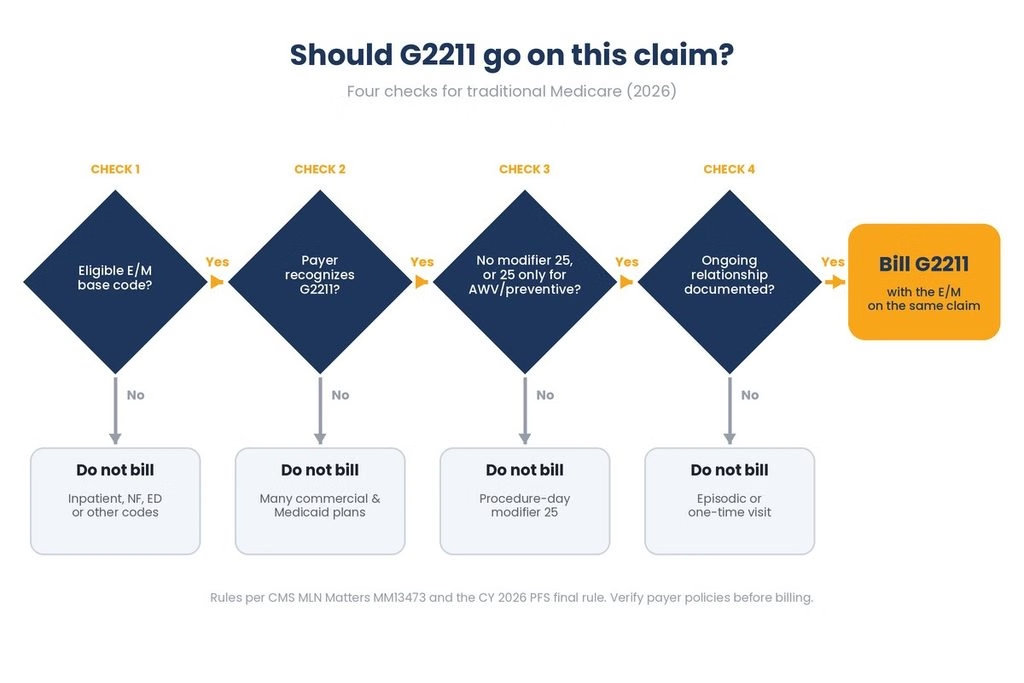
A visit qualifies when three conditions are met: the base code is an eligible E/M visit, the payer recognizes G2211, and the record shows the ongoing relationship. The table applies traditional Medicare rules to common scenarios.
| Scenario | Base code example | Payable under traditional Medicare? | Reason |
| Established patient, PCP follow-up for diabetes and hypertension | 99214 | Yes | Continuing focal point |
| New patient the practice intends to manage long term | 99204 | Yes, when the note shows intent to manage long term | Relationship can begin at the first visit |
| Home visit, homebound patient with heart failure | 99348 | Yes, for dates of service from January 1, 2026 | 2026 home/residence expansion |
| E/M plus annual wellness visit, modifier 25 on E/M | 99214-25 + G0439 | Yes, since January 1, 2025 | Preventive-service exception |
| E/M plus joint injection, modifier 25 on E/M | 99213-25 + 20610 | No | Modifier 25 with a procedure |
| One-time urgent care visit | 99213 | No | No ongoing relationship |
| Hospital inpatient or nursing facility E/M | 99232, 99309 | No | Ineligible base code family |
| Telehealth E/M | 99214 | Yes, when the telehealth visit itself is payable on that date | Code is on the telehealth list |
Base codes and the 2026 home-visit expansion
Office/outpatient codes 99202-99205 and 99211-99215 remain the core office/outpatient E/M visit base codes. For 2026, CMS revised the descriptor so G2211 can also attach to home or residence visits coded 99341, 99342, 99344, 99345 and 99347-99350 (CMS MLN MM14315, CY 2026 PFS final rule summary). When your practice runs house calls or assisted-living rounds, update your charge capture and coding rules for 2026 dates of service so the add-on is not missed. Inpatient, observation, nursing facility and emergency department E/M codes remain ineligible.
Telehealth and audio-only visits
G2211 can be reported with telehealth and audio-only E/M services, but the base visit must be payable first. Medicare telehealth flexibilities have lapsed and been extended several times since 2025, so confirm the base visit is payable as telehealth on the date of service before the add-on goes out. Our overview of telehealth billing compliance trends covers how these rules affect claims.
How Does Modifier 25 Change G2211 Payment?
Medicare denies G2211 when the base E/M carries modifier 25, with one exception. Since January 1, 2025, G2211 is payable when the modifier 25 E/M is billed on the same day as an annual wellness visit, vaccine administration or another Medicare Part B preventive service, including the Initial Preventive Physical Examination. CMS publishes the qualifying preventive and vaccine codes in a dedicated list, which Medicare contractors such as Noridian link to on their G2211 guidance page. Check that list before coding a same-day preventive service.
Procedures still block the add-on
When a provider performs a minor procedure, such as a joint injection or skin biopsy, and bills a separately identifiable E/M with modifier 25, G2211 is not payable. In billing audits, a common pattern is a claim scrubber that still blocks every modifier 25 and G2211 combination because its rules predate 2025. Review your scrubber edits when you see zero G2211 lines on annual wellness visit days. For a refresher on separately identifiable services, see our guide to coding modifiers for accurate healthcare billing.
How Much Is G2211 Worth to a Practice?
G2211 pays about $16-$17 nationally in 2026, but its value depends on visit volume, payer mix and documentation consistency. One specialty society comparison lists the 2026 non-APM national payment at $17.37, up from $15.53 in 2025. Your actual allowed amount depends on your Medicare locality, and the CMS Physician Fee Schedule Look-Up Tool shows the exact rate for your area. The examples below use an illustrative $17.00 allowed amount.
Formula 1: Medicare payment for G2211
Payment = [(Work RVU x Work GPCI) + (PE RVU x PE GPCI) + (MP RVU x MP GPCI)] x conversion factor. Relative value units (RVUs) set the code’s weight, and G2211 carries a work RVU of 0.33. The 2026 conversion factor is $33.4009 for non-APM clinicians and $33.5675 for qualifying APM participants. Medicare pays 80% of the allowed amount after the Part B deductible, so the patient coinsurance on a $17.00 allowed amount is $3.40.
Formula 2: G2211 attachment rate
Attachment rate = (Medicare E/M visits billed with G2211 / eligible Medicare E/M visits) x 100.
Illustrative scenario (not an actual client record): A four-provider family practice logs 1,200 eligible Medicare E/M visits in a quarter and bills G2211 on 216 of them. The attachment rate is 216 / 1,200 = 18%. National Medicare use stabilized near 27% by mid-2025, so 18% is a prompt to sample charts, not proof of lost revenue.
Formula 3: Annual revenue opportunity
Opportunity = eligible visits per year x additional percentage points supported by documentation x allowed amount.
Using the same illustrative practice: 4,800 eligible visits per year x 0.10 x $17.00 = $8,160 in additional allowed amount. Medicare would pay about $6,528 (80%), and patients would owe about $1,632. Count only visits whose notes already support the relationship; adding G2211 to unsupported visits creates repayment risk, not revenue.
Formula 4: G2211 denial rate, and how a blended average hides a problem
Denial rate = (denied G2211 lines / submitted G2211 lines) x 100.
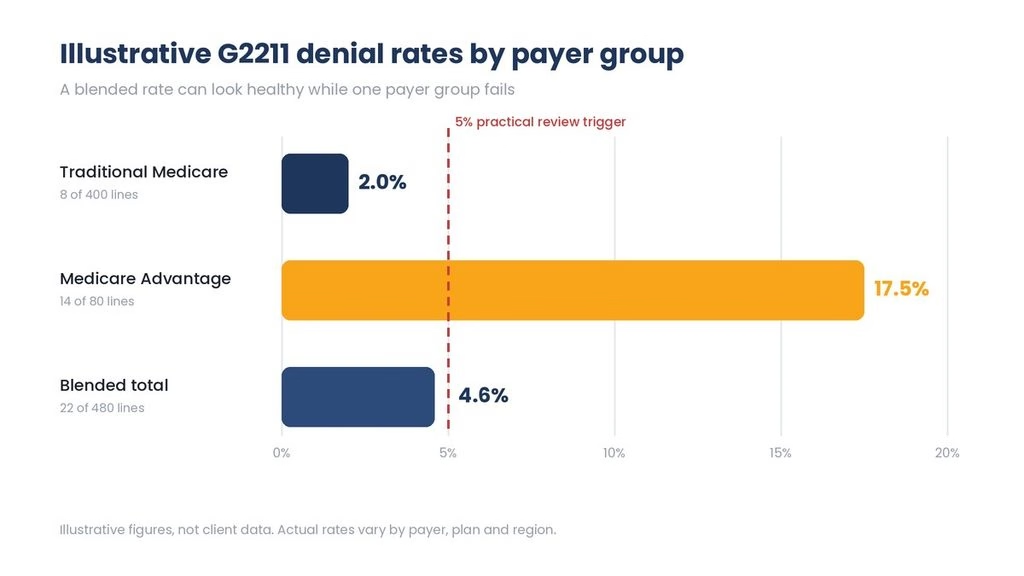
| Payer group (illustrative) | G2211 lines submitted | Denied | Denial rate |
| Traditional Medicare | 400 | 8 | 2.0% |
| Medicare Advantage | 80 | 14 | 17.5% |
| Blended total | 480 | 22 | 4.6% |
Illustrative figures; actual rates vary by payer, plan and region.
The blended 4.6% looks acceptable. The Medicare Advantage line shows a plan policy or contract problem that the blended number hides. Split every G2211 denial report by payer group first, then by provider.
Do Medicare Advantage, Medicaid and Commercial Plans Pay G2211?
Only traditional Medicare is required to pay G2211. Medicare Advantage, Medicaid and commercial plans set their own policies, and coverage varies by plan and state.
| Payer type | Typical status (illustrative summary) | Action |
| Traditional Medicare Part B | Payable when CMS rules are met | Bill per MM13473; collect coinsurance |
| Medicare Advantage | Many plans pay; varies by plan. UnitedHealthcare stated its MA plans continue to pay | Check each plan’s policy; watch for underpayment |
| Medicaid (fee-for-service and managed care) | State-specific; many state programs do not recognize the code | Check the state fee schedule and MCO policy |
| Commercial | Inconsistent. UnitedHealthcare commercial stopped separate payment on September 1, 2024 | Confirm in the contract or published policy before billing |
Payer policies change; verify each plan before billing.
Medicare Advantage plans can also pay incorrectly. In 2024, Aetna paid one cent per G2211 line until the Texas Medical Association raised the issue, and Aetna then corrected its system. In claim reviews, a recurring issue is an EHR rule that adds G2211 to every claim, including commercial plans that do not recognize it. Those avoidable denials clog work queues. When denials build up faster than staff can work them, structured denial management and appeals services can clear the backlog while the payer rules get fixed.
How Should Providers Document G2211? A 7-Step Workflow
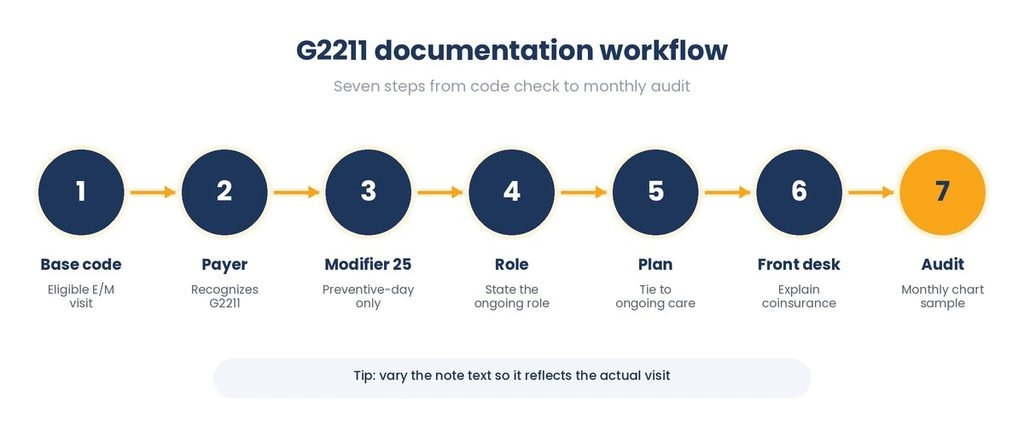
Document the relationship in every note that carries G2211. CMS expects the reason for G2211 to be clear and the visit to be medically reasonable and necessary. These G2211 documentation requirements fit into a seven-step workflow:
- Confirm the base code. It must be 99202-99205, 99211-99215 or, for 2026 dates of service, a home or residence code.
- Confirm payer recognition. Keep a payer matrix in the practice management system, update it during verification of benefits, and drop G2211 only for plans that pay it.
- Check for modifier 25. When modifier 25 is present, bill G2211 only if the same-day service is on CMS’s preventive or vaccine list.
- State the role. Name the relationship: “continuing focal point for all health care needs” or “ongoing management of [condition].”
- Tie the plan to ongoing care. Record follow-up intervals, medication management, care coordination and referral tracking.
- Prepare the front desk. When Medicare patients ask about a new line on their statement, staff should explain the roughly $3-$3.50 coinsurance.
- Audit monthly. Sample 10 G2211 visits per provider and track the documentation pass rate and denials by payer. Regular medical billing audits catch template and payer-rule errors before they repeat.
Illustrative documentation example (not an actual client record): “I serve as this patient’s primary care physician and continuing focal point for all health care needs. Type 2 diabetes and hypertension remain managed in this practice; coordinating with nephrology; follow-up in three months.”
In documentation reviews, the most common gap is a note that fully supports the E/M level but never states who manages the patient long term. A second pattern is identical G2211 text pasted into every note, which auditors may read as cloned documentation. Vary the statement so it reflects the actual visit.
How Should You Read Your G2211 Numbers?
Compare each provider against the same specialty, the same payer group and the same quarter. Specialty mix changes everything. In September 2025, endocrinology and internal medicine attached G2211 to about 47% and 40% of Medicare E/M visits, while dermatology stayed under 20%. A dermatologist at 15% may be documenting correctly; an internist at 15% probably deserves a chart review, since internal medicine billing relies heavily on longitudinal visits.
Track G2211 alongside your core medical billing KPIs and benchmarks, such as clean claim rate and denial rate. One missed benchmark is a signal to investigate, not a verdict. Low attachment can mean missed revenue, or a provider who correctly sees mostly episodic patients. High attachment can mean a strong primary care panel, or a template that adds the code without support. Confirm with a chart sample before acting either way.
How Long Does It Take to Improve G2211 Capture?
Plan for partial results within one to two months and stable results within one to two quarters. Payer matrix and scrubber updates usually take one to two weeks to configure. Provider documentation habits often improve within four to eight weeks with regular feedback. Measurable trends in attachment and denial rates usually need one to two quarters, because payment lag and seasonal visit mix blur short periods. These are general planning ranges, not guarantees.
What Are the Most Common G2211 Billing Mistakes?
- Attaching G2211 to every E/M by default. Use it only when the note supports the ongoing relationship.
- Billing G2211 on procedure days with modifier 25. Drop it when the same-day service is a procedure.
- Blocking it on preventive days. Allow it when modifier 25 accompanies an annual wellness visit, IPPE, vaccine or listed preventive service.
- Sending it to payers that do not recognize it. Use a payer matrix rather than a blanket EHR rule.
- Ignoring the 2026 home-visit expansion. Map 99341-99350 family codes for 2026 dates of service.
- Skipping patient communication. Brief front-desk staff when coinsurance questions start.
- Using it for one-time urgent or episodic care. Reserve it for continuing relationships.
Quick Summary
- G2211 pays roughly $16-$17 nationally per qualifying Medicare visit in 2026; the exact rate varies by Medicare locality.
- Eligible base codes: 99202-99205, 99211-99215 and, from 2026, home/residence codes 99341-99350 family.
- Modifier 25 blocks G2211, except on preventive-service, AWV, IPPE and vaccine days since 2025.
- National Medicare attachment stabilized near 27% by mid-2025; compare within your specialty.
- Practical review trigger: investigate traditional Medicare G2211 denials above roughly 3-5%.
- Practical audit target: 90%+ of sampled notes show the longitudinal relationship.
G2211 Self-Assessment Checklist
Answer yes or no:
- Do you know your G2211 attachment rate by provider for the last quarter?
- Do you compare each provider with peers in the same specialty, not a practice-wide average?
- Does your scrubber allow G2211 with modifier 25 on preventive days and block it on procedure days?
- Are 2026 home and residence E/M codes mapped for G2211?
- Does your system hold a payer matrix showing which plans recognize G2211?
- Is your traditional Medicare G2211 denial rate below roughly 3-5%?
- Do you split G2211 denials by payer group every month?
- Do at least 90% of audited G2211 notes show the longitudinal relationship?
- Can front-desk staff explain the G2211 coinsurance line to Medicare patients?
- Has someone reviewed G2211 rules since the CY 2026 final rule, with a date set to check the CY 2027 rule?
Scoring: 9-10 yes means your process is controlled; keep quarterly audits. 6-8 yes means partial control; fix the “no” items within one quarter, starting with the scrubber and payer matrix. 0-5 yes means the code is a revenue and compliance risk; run a focused G2211 audit before adding volume.
When Should a Practice Bring In Outside G2211 Support?
Consider outside support when the in-house process shows these signals:
- Attachment sits well below specialty peers for two straight quarters with no documented reason.
- Medicare Advantage or commercial G2211 denials stay in work queues for more than 30 days.
- No one owns the annual fee schedule and rule update.
- Providers ask whether to add G2211 and get different answers from different staff.
- A payer or contractor documentation request flags G2211 claims.
When you evaluate help, look for certified coders, payer-specific rules that are maintained and dated, chart-sample audits with provider feedback, and reports split by payer and provider. Ask how the partner tracks CMS changes each November.
Zmed Solutions is one example of this kind of support. The team provides end-to-end billing, credentialing, coding, denial management and compliance support. For G2211, that work means checking eligibility rules in the scrubber, maintaining payer recognition lists, sampling notes for relationship documentation and reporting denials by payer group. Results vary by practice, specialty and payer mix. Learn more about Zmed Solutions’ end-to-end revenue cycle management services.
Final Thoughts
The G2211 add-on code rewards continuity of care, and it pays only when the eligible base code, the payer and the documentation line up. The firm rules come from CMS: eligible base codes, the modifier 25 exception, the 2026 home-visit expansion, the 0.33 work RVU, the conversion factor and Medicare coinsurance.
The national attachment rate and specialty rates come from a named peer-reviewed study. The 3-5% denial trigger and the 90% audit pass rate are practical targets, not mandated standards. The worked examples are illustrative.
The natural next question is how many of your Medicare visits already qualify for the G2211 add-on code but go unbilled. A focused chart sample will answer it. If you want a second set of eyes, Zmed Solutions’ revenue cycle management team can walk through that review with you.
Frequently Asked Questions About G2211
Can G2211 be billed with 99213 or 99214?
Yes. G2211 can be added to any office/outpatient E/M code from 99202-99205 and 99211-99215, including 99213 and 99214, when the provider is the patient’s continuing focal point or manages a serious or complex condition over time. The E/M level does not change eligibility; the documented relationship does.
What is a good G2211 attachment rate?
No mandated target exists. A 2026 Annals of Internal Medicine study using Epic Cosmos data found Medicare G2211 use stabilizing near 27% of E/M visits by mid-2025, with internal medicine near 40% and dermatology under 20%. A good rate matches your documented longitudinal panel and specialty peers.
What is a good G2211 denial rate?
For traditional Medicare, a practical review trigger used by many billing teams is denials above roughly 3-5% of submitted G2211 lines. This is an industry convention, not a CMS standard. Measure Medicare Advantage, Medicaid and commercial plans separately, because coverage differs and a blended rate can hide problems.
Does G2211 require a specific diagnosis code?
No. CMS guidance states that no specific diagnosis is required for G2211. Eligibility comes from the ongoing relationship between practitioner and patient, so a routine problem treated by a primary care physician can qualify. The note must still show the longitudinal role and the medical necessity of the base visit.
Can specialists bill G2211?
Yes. CMS allows any practitioner who can bill eligible E/M visits to report G2211, regardless of specialty. A specialist qualifies when providing ongoing care for a single serious or complex condition, such as an infectious disease physician managing HIV. A one-time consultation without a continuing role does not qualify.
What is a good G2211 documentation statement?
A good statement names the provider’s ongoing role and ties it to the plan, for example: “I am this patient’s continuing focal point for all health care needs; managing diabetes and hypertension long term; follow-up in three months.” Avoid identical template text in every note, which auditors may treat as cloned documentation.
Sources and Methodology
(a) Published standards and definitions: CMS MLN Matters MM13473 (revised for 2025) on G2211 use, modifier 25 and documentation; CMS FAQs on G2211 (2024), including new-patient and care-team use; CMS MLN Matters MM14315, CY 2026 Medicare Physician Fee Schedule final rule summary (home/residence expansion); CY 2024 PFS final rule (38% initial utilization assumption); 2026 conversion factors from the CY 2026 PFS final rule.
(b) Named benchmarking data: American Academy of Sleep Medicine, 2025 vs. 2026 E/M payment and RVU comparison (G2211 national payment of $15.53 in 2025 and $17.37 in 2026).
(c) Practical or illustrative targets: The 3-5% denial review trigger, the 90% documentation audit target, timeframes and all worked examples reflect general billing industry practice and Zmed Solutions team observations. They are not mandated by any standards body.
(d) Survey and study data: Smith JA et al., Annals of Internal Medicine (2026), Epic Cosmos data on G2211 utilization from January 2024 to September 2025; ECG Management Consultants, 2025 Physician and APP Compensation Survey analysis; payer coverage reports from AAPC, the Texas Medical Association and the American College of Rheumatology.
Results vary by practice, specialty, payer mix and region. Figures reflect information available at the time of research (October 2026). CPT, HCPCS, fee schedule and payer policies change annually; verify current rules before billing.
Key Market Player
Ready to optimize your medical billing and boost your revenue? Look no further. Zmed Solutions LLC is your trusted partner in professional Medical Billing Services.
Join our growing network of healthcare providers who have already elevated their revenue with our expert services. Don't miss out on what could be your practice's most profitable decision.
Schedule a Consultation Today!
Contact Us Now, and experience the difference. Your financial success starts here!