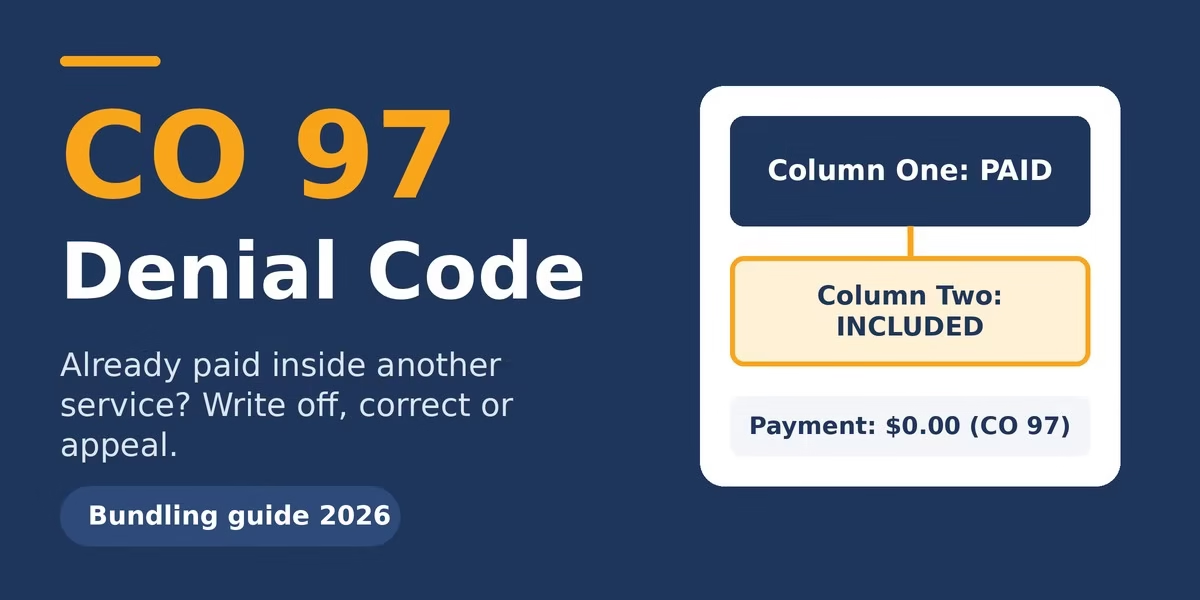
The CO 97 denial code means a payer treats a billed service as included in the payment or allowance for another service. CO makes the provider financially responsible, so the patient cannot be billed. The right response depends on why the services bundled: an NCCI edit, a global surgery period or a payer policy.
A CO 97 denial code turns a billed line into a zero payment, and the right next step is not always an appeal. Some bundled service denials are valid and should be written off, some need a missing modifier, and some deserve a documented appeal. This guide shows how to tell them apart using the remark code, the edit pair and the global period. It then covers deadlines, metrics and a 10-question self-assessment.
CO 97 reference numbers at a glance
Seven figures drive most CO 97 decisions: five published Medicare or CMS standards and two practical targets. Review them on the schedule shown. Treat the practical targets as starting points, and adjust them for your specialty and payer mix, since no standards body mandates them.
| Metric | Practical target or range | Review frequency | Source type |
| NCCI procedure-to-procedure edit files | Refreshed quarterly; Q4 2026 files effective Oct. 1, 2026 | Every quarter | A |
| Medicare redetermination (appeal) window | 120 days from the initial determination | Every denial | A |
| Medicare clerical error reopening window | 1 year from the initial determination | Every denial | A |
| Medicare timely filing limit | 12 months from the date of service | Every new claim | A |
| Global surgical package periods | 0, 10 or 90 days (11- and 92-day windows for 10- and 90-day codes) | Each procedure code | A |
| Overall initial denial rate | 5% to 10% is commonly cited | Monthly | C |
| CO 97 share of lines billed | No published benchmark; track your own trend by payer | Monthly, by payer | C |
Source types: A = published standard or definition from a named body (CMS and its Medicare contractors). C = practical or illustrative target commonly reported across industry sources. Actual figures vary by payer, specialty and contract.
What does the CO 97 denial code mean, and who absorbs the cost?
The CO 97 denial code pairs the group code CO with claim adjustment reason code (CARC) 97. X12 describes it as a benefit for a service included in the payment or allowance for another service. The X12 code list is the reference payers use, and its usage note points to the 835 policy identification segment when the payer supplies one.
Group code CO assigns the adjustment to the provider, so the practice cannot bill the patient for the denied amount. A bundled line is part of the payment already made for the primary service. Treat the balance as a contractual adjustment unless triage shows a legitimate correction or appeal.
How CO 97 differs from CO 18, CO 45 and CO 236
Four adjustment codes get confused because each can leave a line unpaid. Sorting them correctly keeps staff from appealing a duplicate or rebuilding a claim to chase a fee-schedule adjustment. Use the table as a first filter, then confirm the exact reason on the remittance.
| Code | Plain meaning (X12) | First move |
| 97 | Benefit included in the payment for another service | Check the RARC, NCCI edit and global period |
| 236 | Procedure or procedure and modifier combination conflicts with another same-day service under NCCI | Review the code pair and the modifier choice |
| 18 | Exact duplicate claim or service; X12 pairs it with group code OA in most cases | Confirm the first claim paid; do not resubmit |
| 45 | Charge exceeds the fee schedule or contracted amount | Usually a write-off; see the CO 45 guide |
Meanings paraphrased from the X12 claim adjustment reason code list.
How do NCCI code pairs decide whether a CO 97 is valid?
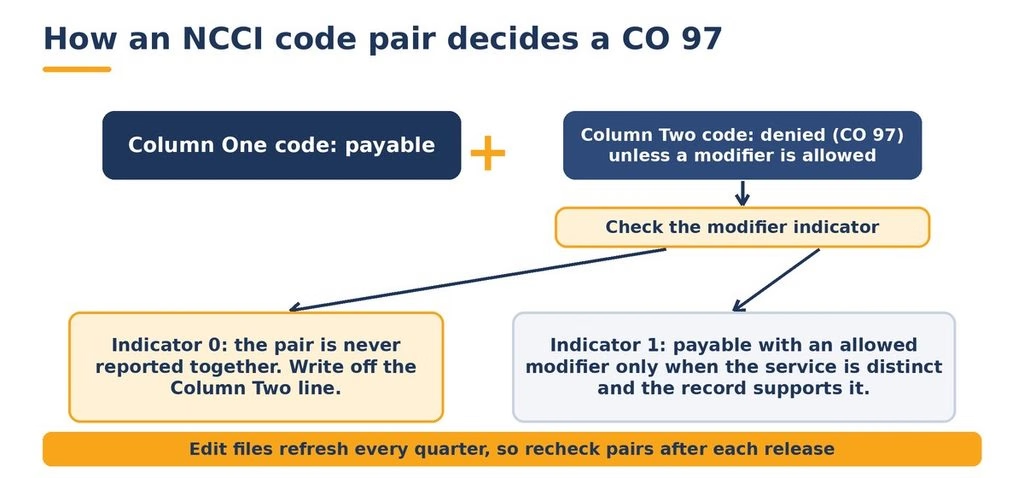
A CO 97 is valid when an edit pair, a global surgical package or a payer policy makes one service part of another. The National Correct Coding Initiative (NCCI) publishes procedure-to-procedure (PTP) edits as pairs. CMS describes the rule plainly: Column One is payable, and Column Two is denied unless a clinically appropriate modifier is reported.
Each pair carries a modifier indicator. An indicator of 0 means the two codes should never be reported together by the same provider for the same patient on the same date. No modifier changes that outcome. An indicator of 1 allows the pair together only in defined circumstances. It needs a specified modifier and documentation that supports it.
CMS updates the PTP edit files every quarter, adding, deleting and revising pairs and indicators. The fourth-quarter 2026 files took effect October 1, 2026. A charge master or EHR rule set built last quarter may now send pairs that payers deny. In billing audits, a common pattern is a cluster of CO 97 lines in the first weeks after each quarterly release.
Which remark code explains the bundle: M15, M144, N70, M80 or N390?
The remittance advice remark code (RARC) on the line tells you which bundling rule applied, so read it before checking anything else. Six codes appear often alongside CARC 97 in Medicare contractor guidance, and each points to a different first move.
| RARC | What it signals | First move |
| M15 | Separately billed service is a component of another procedure (examples include 97010, 99080 and 99090) | Stop billing codes that carry a bundled status on the fee schedule |
| M144 | Pre- or post-operative care is included in the surgery payment | Check the global period; add a modifier only if the care qualifies |
| N70 | Consolidated billing: the dates fall within a home health episode | Verify the home health plan of care and the responsible entity |
| M80 | Billed code is included in the payment for another service processed first, on the same date or session | Compare other lines on that date; appeal with documentation only if medically necessary |
| N390 | Billed code is included in the payment for a service already processed | Check the code pair and local coverage policy; contractors point to redetermination with documentation |
| M2 | Beneficiary was an inpatient on the billed date of service | Verify patient status on the date before any correction |
Sources: First Coast Service Options CO 97 guidance (June 18, 2026) for M15, M144 and N70; Noridian DME denial resolution pages for M80, N390 and M2. Other contractors and payers may pair additional remark codes with CARC 97.
Global surgery bundles and M144
A global surgical package covers the care a surgeon normally provides before, during and after a procedure. Related visits during the window are not paid separately. CMS’s Global Surgery booklet lists 0-day, 10-day and 90-day periods. The 10-day period spans 11 days, and the 90-day period spans 92 days because it includes the day before surgery.
Illustrative scenario (not an actual client record): a surgeon performs a procedure with a 10-day global period on October 1, so the window runs through October 11. A visit for a new problem on October 9 denies CO 97 with M144. Modifier 24 and a note showing the visit was unrelated would support payment.
Should you write off, correct or appeal a CO 97 line?
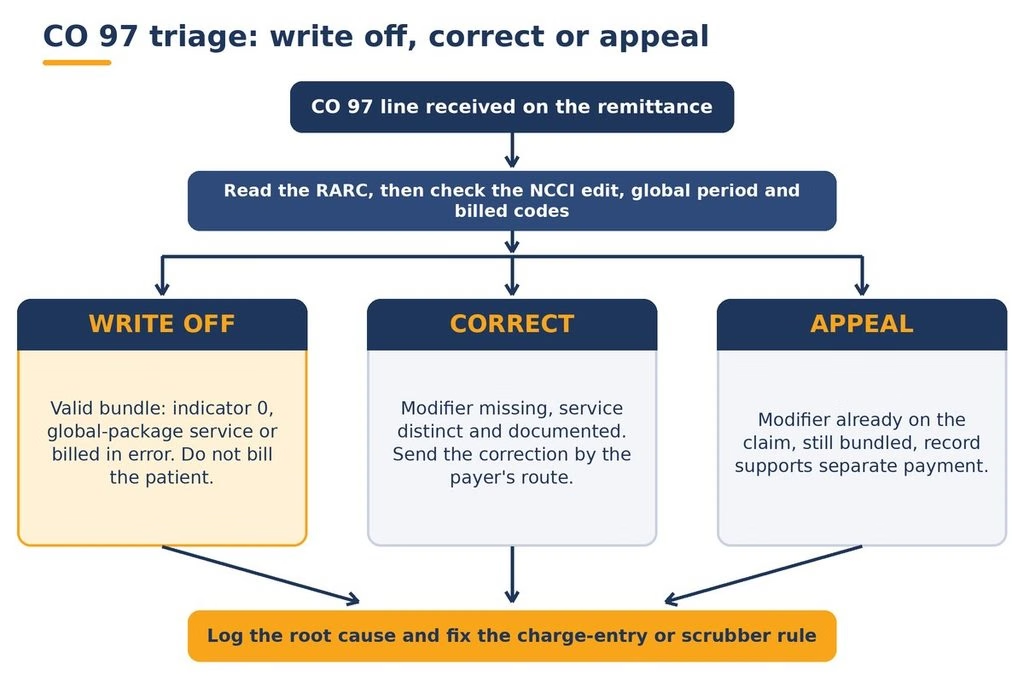
Choose among the three outcomes by testing the line against the edit pair, the global period and the documentation, in that order. A write-off is correct when the bundle is valid. A correction fits when a modifier or code was missing or wrong. An appeal fits when the claim was right and the payer still bundled the service.
| Finding | Outcome | Action |
| NCCI pair has an indicator of 0 | Write off | Adjust off as contractual and fix the charge-entry rule |
| Service falls inside a global package and no unrelated-care modifier applies | Write off | Adjust off; confirm related-care rules with the surgeon |
| Indicator 1, service distinct, modifier missing, record supports it | Correct | Add XE, XS, XP or XU (59 only if none fits) by the payer’s route |
| Modifier already on the claim, line still bundled, record supports separate payment | Appeal | Send the note showing the separate site, session or encounter |
| Code billed in error or duplicates a paid service | Write off | Adjust off and log the source of the error |
| M2 or N70 (inpatient date or home health episode) | Fix the payer or entity | Verify status and bill the responsible party |
General guidance based on CMS NCCI, global surgery and Medicare contractor materials. Payer contracts govern the exact route.
Working a CO 97 line in six steps
- Copy the group code, CARC and RARC from the remittance, along with the paid line that the denied line bundled into.
- Identify the Column One service: the line paid on the same date, or the procedure whose global window contains the denied visit.
- Look up the NCCI pair and its modifier indicator, or the fee schedule status, for the codes involved.
- Read the note and order when the indicator is 1: does it show a separate site, session, encounter or practitioner?
- Pick write-off, correction or appeal from the matrix, and record the reason in the denial log.
- Submit by the payer’s route, track the deadline, and post the adjustment correctly using payment posting rules so the balance does not age.
When does a modifier fix a CO 97, and which one applies?
A modifier fixes a CO 97 only when the record proves the service was separate from the paid service and the edit allows a modifier. For indicator 0 pairs and valid global-package care, no modifier changes the outcome, and adding one creates an unsupported claim instead of a corrected one.
Distinct-service modifiers: 59 and X{EPSU}
Modifier 59 identifies a non-E/M service as distinct from another service performed the same day. CMS guidance on modifier 59 and the X modifiers says the record must show a separate session, procedure, site, incision, lesion or injury. The X modifiers, valid since January 1, 2015, are more specific. CMS says to use one whenever it fits. Reserve 59 for cases where none does. Zmed’s guide to modifier 59 usage covers the basics.
| Modifier | Meaning (CMS) |
| XE | Separate encounter: the service occurred during a different patient encounter on the same date |
| XS | Separate structure: the service was performed on a different organ or structure |
| XP | Separate practitioner: a different practitioner performed the service |
| XU | Unusual non-overlapping service: the service does not overlap the usual components of the main service |
- The site, structure, session or encounter that separates the two services.
- For a diagnostic service before a therapeutic one, that the diagnostic result was the basis for the decision to treat.
- Support beyond a different diagnosis or a different code descriptor, because CMS says neither alone justifies a modifier.
In billing audits, a common pattern is modifier 59 appended to every CO 97 line to force payment. CMS warns against using modifiers to bypass an edit unless the criteria are met and the record supports them. A coding audit catches the pattern before a payer does, and the coding modifier strategies guide helps build a sound policy.
E/M and global-period modifiers
| Modifier | When it applies (CMS global surgery booklet) |
| 24 | Unrelated E/M visit by the same provider during a procedure’s post-operative period |
| 25 | Significant, separately identifiable E/M service by the same provider on the day of a procedure |
| 57 | E/M visit that results in the decision for major surgery, billed the day before or day of surgery |
| 58 | Planned or related procedure during the post-operative period; starts a new global period |
| 78 | Unplanned return to the operating room for a related complication; no new global period |
| 79 | Unrelated procedure by the same provider during the post-operative period; starts a new global period |
| 54, 55, 56 | Split care: surgery only, post-operative care only, or pre-operative care only |
How do Medicare, Medicare Advantage, Medicaid and commercial plans handle bundling?
Medicare Part B applies NCCI edits and global surgery rules directly, while other payers layer their own policies on top or alongside. Medicaid is the other program where federal law points to NCCI: Section 6507 of the Affordable Care Act directs states to use compatible methodologies. States must apply them to fee-for-service claims, and applying them to managed care organization claims is optional, according to CMS.
| Payer type | How bundling works | What to do |
| Medicare fee-for-service | NCCI PTP edits, global surgery rules and fee schedule status indicators | Use the CMS edit files and your MAC’s guidance |
| Medicare Advantage | Plan reimbursement policy; logic may resemble NCCI but terms vary | Read the plan’s provider manual and contract |
| Medicaid fee-for-service | States must use compatible NCCI methodologies | Check your state Medicaid billing manual |
| Medicaid managed care | NCCI use is optional for the plan; plan policy governs | Check each plan’s published policy |
| Commercial | Payer editing software and published reimbursement policies | Request the bundling and modifier policy in writing |
General guidance, not a substitute for your contracts. Payer contracts and state rules govern the exact logic.
What are the deadlines for correcting or appealing a CO 97?
For Medicare Part B, a first-level appeal called a redetermination generally must be requested within 120 days of the initial determination. A clerical error reopening generally has a one-year window. First Coast’s appeals guidance describes both, and the two routes suit different problems.
A reopening fixes minor clerical errors, and CGS guidance lists incorrect modifiers among them, so adding a missing modifier can qualify, though the contractor decides. A redetermination is a fresh review for disagreements that need documentation. Contractors also differ: First Coast advises resubmitting only the corrected lines for M144, and says resubmitting the whole claim causes a duplicate denial.
Medicare’s 12-month timely filing limit still matters whenever a new claim is needed, such as after a line was billed under the wrong provider. Other payers set filing and appeal limits by contract, so confirm them in the provider manual and track them with a timely claims submission routine.
Illustrative scenario (not an actual client record): a Medicare Part B remittance is received on October 1, 2026. Counting 120 days gives January 29, 2027 as the appeal deadline, while the clerical error reopening window runs a full year. Confirm the exact count with your contractor, because the receipt date rules decide the real deadline.
Formula: appeal deadline = date the initial determination is received plus 120 days (Medicare Part B redetermination).
How do you measure CO 97 and find recoverable revenue in the average?
Measure CO 97 by payer and by outcome. A blended rate hides both the payer driving it and the share of lines that can actually be recovered. The rate formula is CO 97 lines divided by lines billed, tracked monthly by payer and by billing provider.
| Payer (Illustrative) | Lines billed | CO 97 lines | CO 97 rate |
| Medicare | 3,000 | 45 | 1.5% |
| Commercial | 1,800 | 45 | 2.5% |
| Medicaid | 600 | 30 | 5.0% |
| Total (blended) | 5,400 | 120 | 2.22% |
Illustrative scenario (not an actual client record). Actual figures vary by payer, specialty and location.
In this illustrative example, the blended rate of 2.22% looks modest, but Medicaid runs at 5.0%, about 2.3 times the blended figure. The next step is to pull the Medicaid remark codes and code pairs. A concentrated pattern often points to one edit set or one provider’s charge-entry habit.
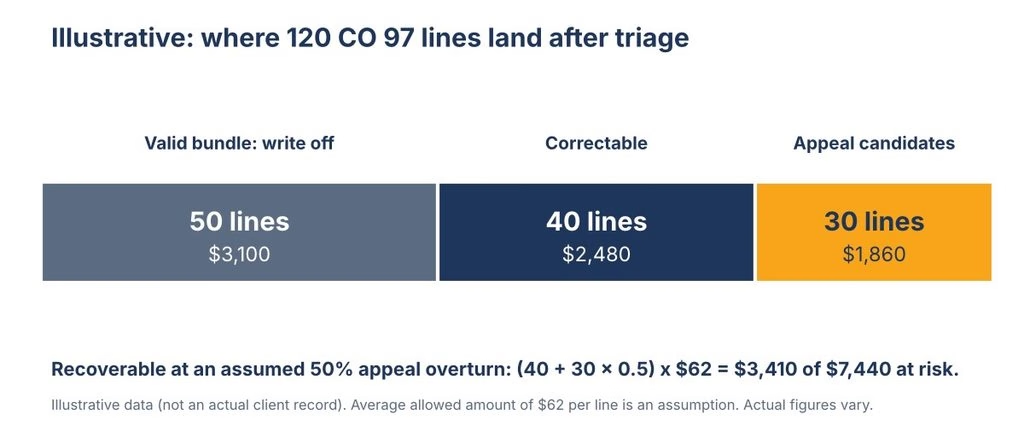
Dollars matter more than counts. Take 120 CO 97 lines at an assumed average allowed amount of $62, which is $7,440 at risk. Triage finds 40 correctable lines, 30 appeal candidates and 50 valid bundles. If appeals overturn at an assumed 50%, recoverable revenue is (40 + 30 × 0.5) × $62, or $3,410. The 50 valid bundles, worth $3,100, are write-offs to prevent upstream, not to chase.
Formula: recoverable revenue = (correctable lines + appeal candidates × overturn rate) × average allowed amount.
How to use these numbers correctly
Compare like for like: the same payer, specialty and month. One high month is a signal to investigate, not a verdict, especially in the quarter after an edit-file release. A rate that stays high for one provider points to charge-entry or modifier habits. A rate that stays high for one payer points to that payer’s edit logic. A pattern that staff cannot resolve may justify denial management and appeals support.
How do you prevent CO 97 denials before the claim leaves the office?
Prevent CO 97 denials by checking every same-day and global-period code pair against current edit files before release. Document distinct services at the time of care. Each control below has a trigger that tells the team when to use it.
- Load current edits. Update the claim scrubber and charge-entry rules after each quarterly NCCI release, including the October 1, 2026 files. See how claim scrubbing applies edits before submission.
- Flag pairs at charge entry. When two procedures, or an E/M and a procedure, share a date of service, require a pair check before the charge posts. Strong charge entry habits make this routine.
- Capture the distinguishing detail. When a modifier is appropriate, require the site, session or encounter detail in the note, because proper documentation is what supports payment.
- Track global periods. When a surgeon bills a 10- or 90-day code, set the window in the practice management system so related visits are blocked and unrelated ones prompt a modifier review.
- Keep bundled-status codes off the claim. When the fee schedule marks a code as bundled, do not bill it separately.
- Audit modifier use quarterly. When volume for 59, XE, XS, XP, XU or 25 rises, sample the records against the notes.
How long does improvement take?
Fixing the top recurring code pairs often shows a partial drop in CO 97 volume within roughly 30 to 60 days, because edit rules update quickly. Fuller results typically take 90 to 180 days. Documentation habits and global-period tracking change more slowly. These are planning ranges, not guarantees. A documented denial management workflow keeps corrections and appeals on schedule.
What mistakes keep CO 97 denials coming back?
Repeat CO 97 denials usually trace to a few habits that treat every bundled line the same way. Each fix below is conditional, so apply it only when its trigger appears. Log the outcome so the next review shows whether the habit changed or only moved to another team.
- Chasing a valid bundle. When the indicator is 0 or a global package applies, write off the line and fix the rule.
- Adding 59 by reflex. When the record does not show a distinct service, do not append the modifier.
- Choosing 59 when an X modifier fits. When XE, XS, XP or XU describes the service, use it instead.
- Appealing without the note. When the modifier is already on the claim, attach the documentation showing the separate site or session.
- Billing the patient. When the group code is CO, do not move the balance to patient responsibility.
- Ignoring quarterly releases. When a new NCCI file posts, update the edits before the next billing cycle.
Quick summary
- CO 97 means the payer treats the service as included in the payment for another service; group code CO keeps the balance with the practice.
- Read the RARC first, then the NCCI pair and modifier indicator, then the global period.
- Indicator 0 pairs and valid global-package care are write-offs; no modifier changes them.
- Use XE, XS, XP or XU when one fits, and 59 only when none does, with documentation behind each.
- For Medicare Part B, redetermination is generally 120 days and clerical error reopening one year; other payers follow their contracts.
- A 5% to 10% overall denial rate and a 95% clean claim rate are commonly cited practical targets, not mandates.
- Track CO 97 by payer and by recoverable dollars, and recheck edits after every quarterly release.
Self-assessment: how ready is your bundling process?
Answer yes or no to each question, then count your yes answers and match the total to the scoring guide below. Questions tied to practical targets use the commonly cited ranges from this guide, so adjust them for your specialty and payer mix before drawing conclusions.
- Does staff read the RARC before deciding on a write-off, correction or appeal?
- Is every CO 97 line checked against its NCCI pair and modifier indicator?
- Were scrubber and charge-entry edits updated after the October 1, 2026 NCCI release?
- Are global periods tracked in your practice management system?
- Does the note document the site, session, encounter or practitioner whenever a distinct-service modifier is used?
- Do you use XE, XS, XP or XU instead of 59 whenever one fits?
- Do you know your Medicare contractor’s deadlines for redetermination and clerical error reopening?
- Do you track the CO 97 rate by payer every month?
- Is your clean claim rate at or above the 95% practical target?
- Are write-offs for valid bundles logged with a root cause so rules get fixed?
| Yes answers | What it suggests |
| 9 to 10 | Strong process. Keep monthly payer-level tracking and refresh edits after every quarterly release. |
| 6 to 8 | Gaps exist. Start with any “no” on edit updates, global-period tracking or modifier documentation. |
| 0 to 5 | High risk of lost revenue and unsupported modifiers. Fix pair checks and documentation first, then consider outside support. |
When is it time to bring in outside billing support?
Outside support makes sense when internal rule updates have stopped moving the numbers and staff time keeps going to bundled lines. Five signals suggest the in-house approach has reached its limit, and any three together deserve a serious look at your process:
- CO 97 stays among your top denial reasons for three straight months after rule updates.
- Staff cannot say which CO 97 lines are valid bundles and which are recoverable.
- Appeals go out without the note that shows the separate site or session.
- Modifier use has risen with no audit of whether the record supports it.
- Quarterly edit releases reach your scrubber or charge master late, or not at all.
When comparing partners, ask for denial reporting by payer, remark code and code pair. Ask for a documented modifier policy tied to the record. Look for a clear appeal workflow with deadlines and compliance review of modifier use. Ask how the vendor separates write-offs from recoverable lines, not only how many appeals it files.
Zmed Solutions is one example of this model, providing end-to-end billing, credentialing, coding, denial management and compliance support. A practice evaluating any partner, Zmed included, can ask for a sample report that separates valid bundles from recoverable lines and for a written modifier-review process. Results vary by practice, so review how Zmed’s revenue cycle management services fit your payer mix, and its compliance support for modifier oversight.
Final thoughts
A CO 97 denial code is a sorting problem before it is a billing problem. The remark code and the edit pair show whether the service was truly bundled. Only then does a modifier, a correction or an appeal make sense. Sorting first protects revenue that can be recovered and stops effort on lines that cannot.
The firm published standards in this guide are the X12 definition of CARC 97 and NCCI’s column and modifier-indicator rules. They also include CMS global surgery periods and modifier definitions. Medicare’s 120-day redetermination window, one-year reopening window and 12-month timely filing limit are firm as well. The 5% to 10% denial range and the 95% clean claim rate are practical targets. So are the 30-to-180-day improvement ranges. The 50% overturn rate and every dollar figure are illustrative.
The natural next question is how many of your current bundled denials are truly recoverable. Sort last month’s CO 97 lines into write-off, correct and appeal, and price each group. Then ask whether Zmed Solutions’ revenue cycle management team should own the follow-up.
Frequently asked questions
What does CO 97 mean in medical billing?
CO 97 means the payer considers the billed service included in the payment or allowance for another service, so it is not paid separately. CO is the contractual obligation group code, which makes the provider responsible for the balance. The remark code, NCCI edit and global period show whether the bundle was valid.
Can you bill the patient for a CO 97 denial?
In general, no. Group code CO assigns the adjustment to the provider, so the practice corrects the claim, appeals with documentation or writes the balance off under its policy. Moving a bundled-service balance to the patient can conflict with payer contracts, so confirm the contract language when unsure.
Can you appeal a CO 97 denial, and how long do you have?
Yes, when the claim was correct and the record supports separate payment. For Medicare Part B, a redetermination generally must be requested within 120 days of the initial determination, and a clerical error reopening within one year. Other payers set their own limits by contract, so check the provider manual.
What is a good clean claim rate?
Many industry sources cite a clean claim rate of 95% or higher as a practical target, though no federal agency mandates it. Divide claims accepted on the first pass by claims submitted. Compare the result by payer and specialty. Treat a shortfall as a reason to investigate rather than a verdict.
What is a good denial rate for a medical practice?
An initial denial rate of 5% to 10% is commonly cited as an industry standard, according to TechTarget’s 2025 coverage of denial reason codes. Targets differ by specialty and payer mix, so compare your own trend first and break the rate down by payer and denial code before drawing conclusions.
What is a good CO 97 denial rate?
No published benchmark exists for CO 97 alone. A practical approach is tracking CO 97 lines divided by lines billed for each payer monthly. Investigate when one payer runs well above the blended figure or the rate jumps after a quarterly edit release. Trend and recoverable dollars matter more than one number.
Sources and methodology
This guide draws on web research completed October 16, 2026. Figures reflect information available at that time. Results vary by payer and practice, and annual or quarterly changes to NCCI edits, CPT, HCPCS, fee schedules and payer policies can alter details. Sources are grouped by type.
(a) Published standards and definitions from named bodies
- X12, Claim Adjustment Reason Codes (CARC 97, 236, 18 and 45 descriptions): x12.org
- CMS, NCCI Procedure-to-Procedure (PTP) edits (Column One and Column Two rule, quarterly updates, Q4 2026 files effective October 1, 2026): cms.gov
- CMS, NCCI Coding Edits overview: cms.gov
- CMS, MLN fact sheet on modifier 59 and the X{EPSU} modifiers (modifier indicators 0 and 1): hhs.gov
- CMS, Global Surgery booklet, MLN907166 (December 2025): cms.gov
- CMS, Medicaid National Correct Coding Initiative (ACA Section 6507): cms.gov
- First Coast Service Options, tips to prevent CARC CO 97 (June 18, 2026): medicare.fcso.com
- First Coast Service Options, new provider roadmap for appeals (120-day redetermination, one-year reopening): medicare.fcso.com
- CGS Medicare, reopening versus redetermination job aid (modifier errors as clerical errors): cgsmedicare.com
- Noridian Medicare, claim submission timeliness (12 months; 42 CFR 424.44): Noridian JF Part B
- Noridian Medicare DME, denial resolution for reason code 97 with M80, N390 and M2: Noridian JD DME, M80, N390
(b) Named benchmarking data providers
No proprietary benchmarking data, such as MGMA DataDive or payer-specific data sets, was used or cited. Every target in this guide is either a published standard listed in group (a) or a practical target in group (c). None should be read as a benchmark from a named data provider.
(c) Practical or illustrative targets from general industry sources
- The 5% to 10% overall denial range, as reported by TechTarget RevCycleManagement (March 2025): techtarget.com
- The 95% clean claim rate, the 30-to-180-day improvement ranges, the 50% overturn rate, all worked examples and every payer or dollar table: commonly reported across industry sources or illustrative, with no single named benchmark.
(d) Survey or study data with its named source
No survey or study data is cited in this guide, so no figure here comes from a named survey. Every number traces to a standards body or is labeled practical or illustrative.
Ready to optimize your medical billing and boost your revenue? Look no further. Zmed Solutions LLC is your trusted partner in professional Medical Billing Services.
Join our growing network of healthcare providers who have already elevated their revenue with our expert services. Don't miss out on what could be your practice's most profitable decision.
Schedule a Consultation Today!
Contact Us Now, and experience the difference. Your financial success starts here!