The CO 29 denial code means the payer says your claim arrived after its filing deadline, so it paid nothing. Because the group code is CO, the loss sits with the provider, not the patient. This guide explains how to read the code, how Medicare and other payers set deadlines, how to prove the claim was on time, which exceptions exist, and how to stop late claims from reaching the payer at all.
| Key takeaways CO 29 is a full denial for missing the payer’s filing limit; the patient cannot be billed for it.Medicare’s limit is one calendar year from the date of service; other payers set their own windows.A claim counts as filed only when the payer accepts it, so clearinghouse rejections do not stop the clock.You can overturn CO 29 only with proof of timely receipt or a recognized exception.Daily rejection work, clean eligibility and fast secondary billing prevent most of these denials. |
What the CO 29 Denial Code Means
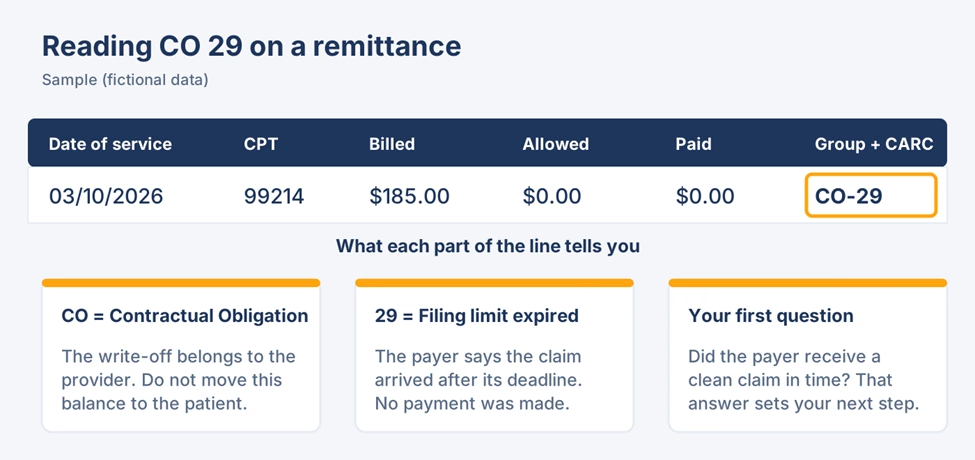
Every denial on an electronic remittance advice (ERA) or explanation of benefits (EOB) pairs a group code with a claim adjustment reason code (CARC). In the official X12 Claim Adjustment Reason Code list, reason code 29 reads: the time limit for filing has expired. It is one of the oldest codes on the list and one of the hardest to reverse.
The group code tells you who owns the balance. X12 lists CO as Contractual Obligation in its Claim Adjustment Group Codes, which means the adjustment is the provider’s responsibility under its contract or program rules. PR, by contrast, marks amounts the patient owes.
That is why CO 29 is different from a routine contractual reduction such as CO 45, where the payer trims a charge to its fee schedule. CO 45 still pays part of the claim; CO 29 pays nothing. When several codes like this start piling up, a structured denial management and appeals process keeps each one moving to the right fix.
Timely Filing Limits: Medicare vs Other Payers
Medicare gives most providers one calendar year from the date of service to file a claim, under 42 CFR 424.44. The Noridian Medicare timely filing page explains how this works in practice: professional and supplier claims with span dates use the From date, institutional claims use the Through date, and a February 29 service date runs to February 28 of the next year. If a deadline falls on a federal non-workday, it moves to the next workday.
Everyone else sets their own window. Commercial plans write it into the provider contract and manual, Medicare Advantage plans set it in their own agreements, and each state Medicaid program publishes its own limit. Our state-by-state guide to medical billing time limits is a good starting point for state rules.
| Payer type | Where the limit comes from | What to check |
| Original Medicare | Federal regulation (42 CFR 424.44) | One calendar year from the date of service, plus the listed exceptions |
| Medicare Advantage | The plan’s provider agreement and manual | In-network and out-of-network windows can differ |
| Medicaid | Each state’s Medicaid program rules | Separate rules for original, corrected and crossover claims |
| Commercial plans | Your contract and the payer’s provider manual | Original, corrected and secondary claim deadlines |
| Secondary payers | The secondary plan’s own rules | Whether the clock starts at the date of service or the primary payment date |
Why CO 29 Denials Happen
In practice, late filing rarely starts with someone forgetting a claim. It starts with a claim that looked sent but never landed, or one that went to the wrong place first. The usual causes:
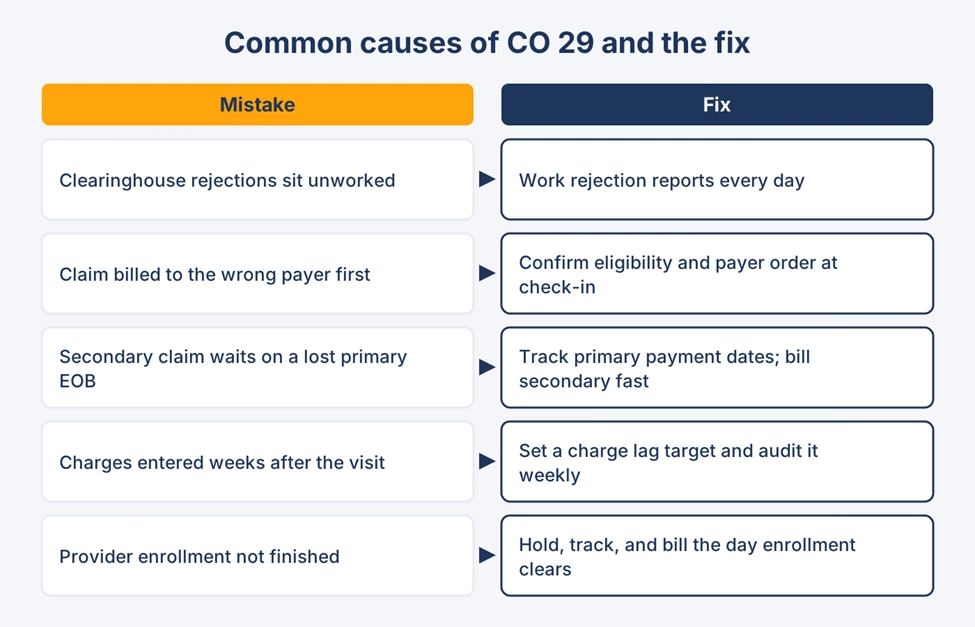
- Silent clearinghouse rejections. A rejected claim never reached the payer, so it was never filed. Knowing how clearinghouses screen and route claims helps staff read rejection reports correctly.
- Wrong payer billed first. By the time the denial from the other plan comes back, the right payer’s window may be closed. That first denial often shows up as CO 109, a claim not covered by this payer.
- Slow secondary billing. Waiting on a primary EOB can push the secondary claim past its limit, especially when coordination of benefits details are out of date.
- Charge lag and enrollment holds. Late charge entry or claims held while a provider’s enrollment is pending eat into the window.
- Corrected claims sent as new claims. Some payers judge a resubmitted claim by its new receipt date, not the original one.
How to Fix a CO 29 Denial
The fix depends on one fact: whether the payer received a clean claim before the deadline. Work every CO 29 denial in this order.
- Confirm the dates. Compare the date of service, the payer’s received date on the remit or portal, and the filing limit that applies to that plan.
- Find your first accepted submission. Search clearinghouse and payer acknowledgment reports for the earliest date the payer accepted this claim.
- Check for an exception. Look for retroactive eligibility, a payer or government error, or a retroactive plan change that reopens the window.
- Send the request the payer’s way. Use the payer’s reconsideration, reopening or appeal channel, with the proof attached and the claim number on every page.
- If neither proof nor exception exists, write it off. Post the balance as a CO adjustment, keep it off the patient statement and record the root cause.
Medicare is stricter than most. Noridian notes that a claim denied for timely filing carries no appeal rights, so the only real paths are showing the claim was filed on time or qualifying for one of the regulation’s exceptions.
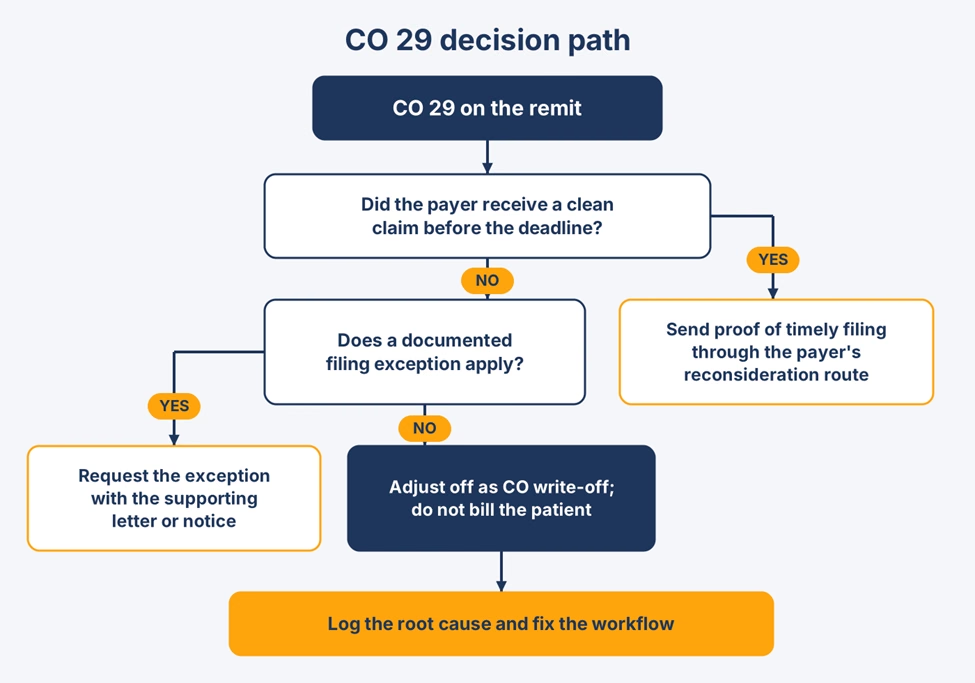
In short: proof of timely receipt goes to reconsideration, a documented exception goes to an exception request, and anything else is a provider write-off with a root-cause note.
What Counts as Proof of Timely Filing
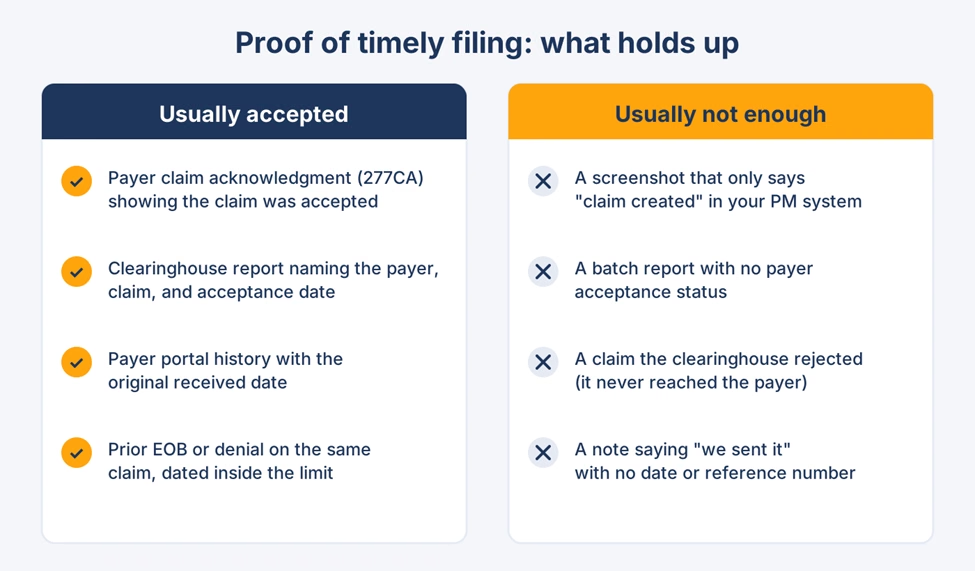
Payers want to see that they received the claim on time, not just that your software created it. Strong proof names the payer, the claim and an acceptance date, such as a 277CA claim acknowledgment, a clearinghouse acceptance report, payer portal history, or an earlier EOB on the same claim dated inside the limit. Batch summaries, internal screenshots and rejected submissions rarely hold up.
Medicare Timely Filing Exceptions
The regulation lists four situations that extend the one-year limit. Each extension runs through the last day of the sixth calendar month after the month of the triggering notice or recovery.
| Exception | When it applies | Extension starts from |
| Administrative error | An error or misrepresentation by Medicare, a contractor or an HHS employee caused the late filing (not available if requested more than four years after the date of service) | The month the provider or beneficiary is notified the error was corrected |
| Retroactive Medicare entitlement | The patient was later granted Medicare entitlement back to or before the date of service | The month of the entitlement notice |
| Retroactive entitlement plus Medicaid recovery | As above, and the state Medicaid agency recovered its payment six or more months after the service | The month of the Medicaid recovery |
| Retroactive Medicare Advantage or PACE disenrollment | The plan disenrolled the patient retroactively and recovered its payment six or more months after the service | The month of the plan’s recovery |
Sample Timely Filing Reconsideration Letter
Sample (fictional data). Replace the practice, payer, patient, claim and date details with your own, attach your acceptance report and the denial remit, and follow your payer’s required form if it has one.
| Lakeview Family Medicine October 2, 2026 Northbridge Health Plan, Provider Reconsiderations Re: Request for reconsideration of a timely filing denial (CO 29) Patient: Jordan Ellis Member ID: NBH4472190 Claim number: NB-26-0047731 Date of service: March 10, 2026 Billed amount: $185.00 We are requesting reconsideration of the claim above, which was denied with reason code CO 29 on September 22, 2026. Our records show the claim was submitted electronically on March 14, 2026, and accepted by Northbridge Health Plan on March 15, 2026, well within the 120-day filing limit in our provider agreement. Enclosed are the payer claim acknowledgment showing the March 15 acceptance, our clearinghouse transmission report and the September 22 remittance. Please reprocess the claim using the original received date. Contact: Maria Lopez, Billing Manager, Lakeview Family Medicine |
How to Prevent CO 29 Denials
Prevention is cheaper than any appeal. The habits below close the gaps that cause most late claims, and they build on the broader case for submitting claims promptly after every visit.
- Work clearinghouse and payer rejection reports every business day, and treat each rejection as an unfiled claim.
- Confirm eligibility and payer order before the visit, not after the first denial.
- Keep a payer filing-limit table in your practice management system and set alerts well before each deadline.
- Track primary payment dates so secondary claims go out as soon as the primary remit posts.
- Measure charge lag and claims on hold for enrollment, and review both weekly.
- Save acknowledgment reports for every claim so proof is ready if you ever need it.
Frequently Asked Questions
Can you appeal a CO 29 denial?
Sometimes. Commercial payers usually accept a reconsideration when you can prove the claim reached them on time or an exception applies. Medicare is stricter: a claim denied for timely filing has no appeal rights, so your options are showing the original claim was filed on time or qualifying for one of the four regulatory exceptions.
Can I bill the patient for a CO 29 denial?
No. The CO group code means the adjustment is a contractual obligation of the provider. Post it as a write-off and keep it off the patient statement. Billing the patient for a late claim can also breach your payer contract. Only amounts carrying the PR group code belong to the patient.
What is the Medicare timely filing limit?
Original Medicare allows one calendar year from the date of service. For claims with span dates, professional and supplier claims use the From date while institutional claims use the Through date. Deadlines that land on a federal non-workday roll forward to the next workday. Medicare Advantage plans set their own limits in their contracts.
Does a rejected claim count as filed?
No. A claim the clearinghouse or payer front end rejected was never accepted into the payer’s system, so the filing clock keeps running. Only an accepted claim, shown on a payer acknowledgment or acceptance report, counts. That is why rejection reports need daily attention rather than a weekly sweep.
Does a corrected claim get a new filing window?
Usually not. Most payers measure the deadline from the date of service, and many apply separate, shorter windows to corrected or replacement claims. Sending a correction as a brand-new claim can trigger CO 29 even when the original was on time. Check your payer’s provider manual for its corrected claim rules.
Get Help Clearing Timely Filing Denials
A single CO 29 denial is usually a lost claim, but a steady stream points to a workflow problem in rejections, eligibility or secondary billing. Fixing the CO 29 denial code at the source protects revenue you have already earned. If your team needs support, Zmed Solutions offers revenue cycle management services that include denial management and claim follow-up, so you can see where late claims start and close those gaps.
Sources: X12 Claim Adjustment Reason Codes and Claim Adjustment Group Codes; 42 CFR 424.44 (time limits for filing Medicare claims); Noridian Healthcare Solutions, Jurisdiction E Part B timely filing guidance. This article is general billing information, not legal advice; payer rules change, so confirm limits in your contracts and payer manuals.
Ready to optimize your medical billing and boost your revenue? Look no further. Zmed Solutions LLC is your trusted partner in professional Medical Billing Services.
Join our growing network of healthcare providers who have already elevated their revenue with our expert services. Don't miss out on what could be your practice's most profitable decision.
Schedule a Consultation Today!
Contact Us Now, and experience the difference. Your financial success starts here!