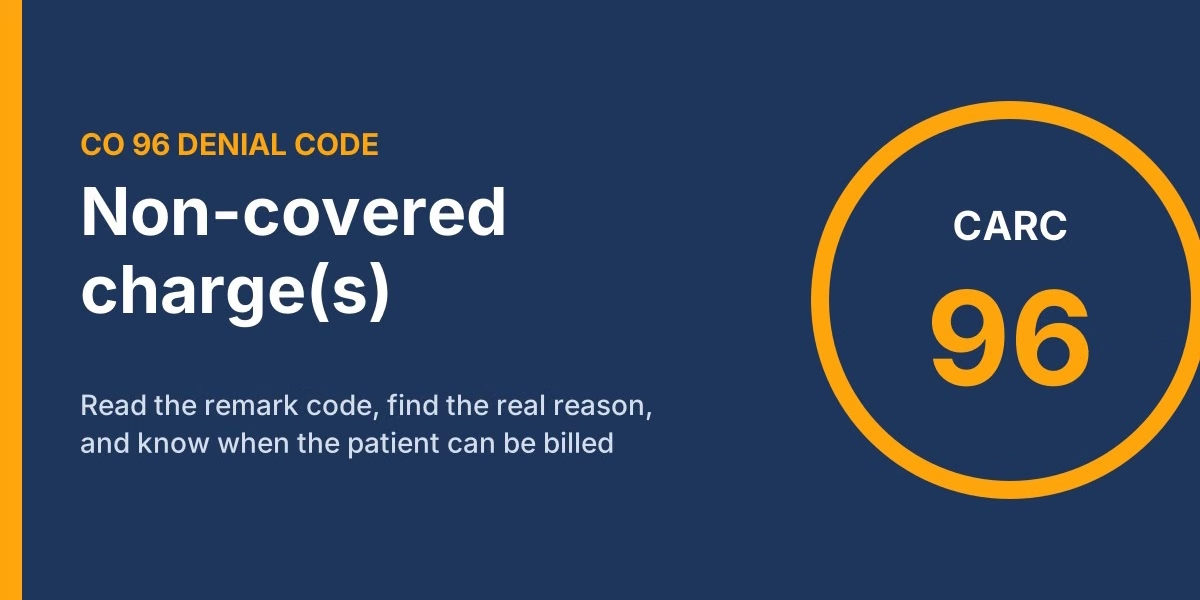
The CO 96 denial code means the payer treated a billed service as a non-covered charge and paid nothing for it. Because the group code is CO, the balance stays with the provider unless a valid waiver shifts it to the patient. This guide shows how to read CO 96 with its remark code, separate coding errors from true exclusions, decide when a patient can be billed, appeal when the payer is wrong, and stop these denials at the front desk.
| Key takeaways CO 96 is a non-covered charge denial, and X12 requires at least one remark code to explain it.The remark code, not the reason code, usually tells you whether to correct, appeal or write off.With a CO group code, the patient cannot be billed unless a valid ABN or plan waiver was signed first.Many CO 96 denials are fixable coding or policy mismatches, not true plan exclusions.Benefit checks, policy matching and correct notice modifiers prevent most of them. |
What the CO 96 Denial Code Means
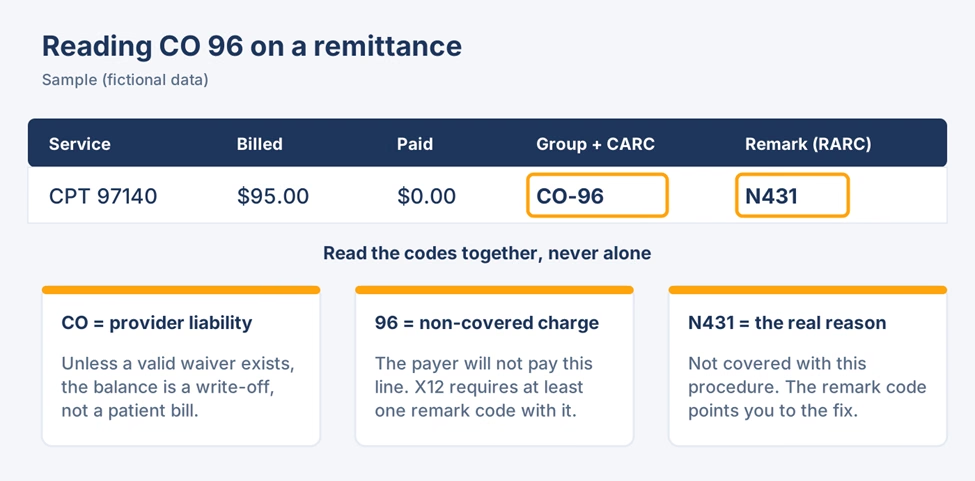
A denial on an electronic remittance advice (ERA) or explanation of benefits (EOB) combines a group code, a claim adjustment reason code (CARC) and often a remittance advice remark code (RARC). In the X12 Claim Adjustment Reason Code list, code 96 means non-covered charge(s). The same entry requires at least one remark code and points billers to the payer’s policy reference in the 835 remittance, when one is sent.
That rule matters in practice. CARC 96 on its own only says the payer will not pay; the remark code and any policy identifier tell you why. A remark code such as N431, not covered with this procedure, points to a code pairing problem, while other remarks point to plan exclusions, missing information or medical policy limits.
The CO group code means Contractual Obligation: the provider absorbs the adjustment. If CO 96 is one of several denials stacking up on your aging report, a structured denial management and appeals workflow keeps each one moving to the right fix instead of sitting unworked.
CO 96 vs Similar Non-Covered Denial Codes
Several CARCs describe services a payer will not pay. Picking the right response starts with knowing how CO 96 differs from its neighbors, all defined in the X12 code list.
| Code | Official meaning in plain words | Typical next step |
| 96 | Non-covered charge; a remark code must explain why | Read the remark code and policy reference first |
| 49 | Routine or preventive exam, or a screening done with one, that the plan does not cover | Check preventive benefits and the diagnosis coding |
| 50 | Not medically necessary in the payer’s view | Compare documentation with the coverage policy, then appeal |
| 204 | Not covered under the patient’s current benefit plan | Confirm benefits; bill the patient only with a valid waiver |
| 109 | Not covered by this payer; send it to the correct payer | Find the right payer and rebill |
Two related denials are often confused with CO 96. When the remark says another payer is responsible, treat it like a CO 109 wrong-payer denial and rebill the correct plan. When the payer says the service is already paid as part of another procedure, that is a bundling issue closer to CO 97 and how bundled services are paid.
Common Causes of CO 96 Denials
In day-to-day billing, CO 96 tends to come from a short list of front-end and coding gaps:
- True plan exclusions. Cosmetic, experimental or excluded services the patient’s plan does not cover at all.
- Procedure and code pairing. Two codes billed together where the payer covers one but not the other on the same claim.
- Diagnosis does not meet policy. The diagnosis on the claim does not appear in the payer’s coverage policy or Local Coverage Determination (LCD), a pattern close to medical necessity denials.
- Missing or wrong modifiers. A modifier that would show a distinct service, or a required Medicare notice modifier, was left off.
- Benefit changes. The patient’s plan or benefit year changed, and the service is no longer included.
Noridian, a Medicare Administrative Contractor (MAC), lists non-covered procedure codes such as certain ambulance and molecular diagnostic services among the triggers in its Noridian guidance on CO 96 non-covered charges, and pairs the denial with remark code N431.
How to Fix a CO 96 Denial
Work every CO 96 line in the same order, so you do not appeal a denial you could have corrected in minutes.
- Read the remark code and policy reference. Note the RARC, any policy identifier on the 835 and the service line it applies to.
- Check the coding. Compare the procedure, diagnosis and modifiers with the medical record. If you find an error, send a corrected claim, or ask for a reopening when the payer handles clerical fixes that way.
- Check coverage. Pull the payer’s coverage policy, LCD or the patient’s benefit summary for that service and diagnosis.
- Appeal when the payer is wrong. If the service is covered and correctly coded, file an appeal with the policy language and supporting records. Noridian notes that these Medicare denials carry appeal rights.
- Decide liability. If the service truly is not covered, check for a valid ABN or plan waiver. With one, bill the patient; without one, post a CO write-off and record the root cause.
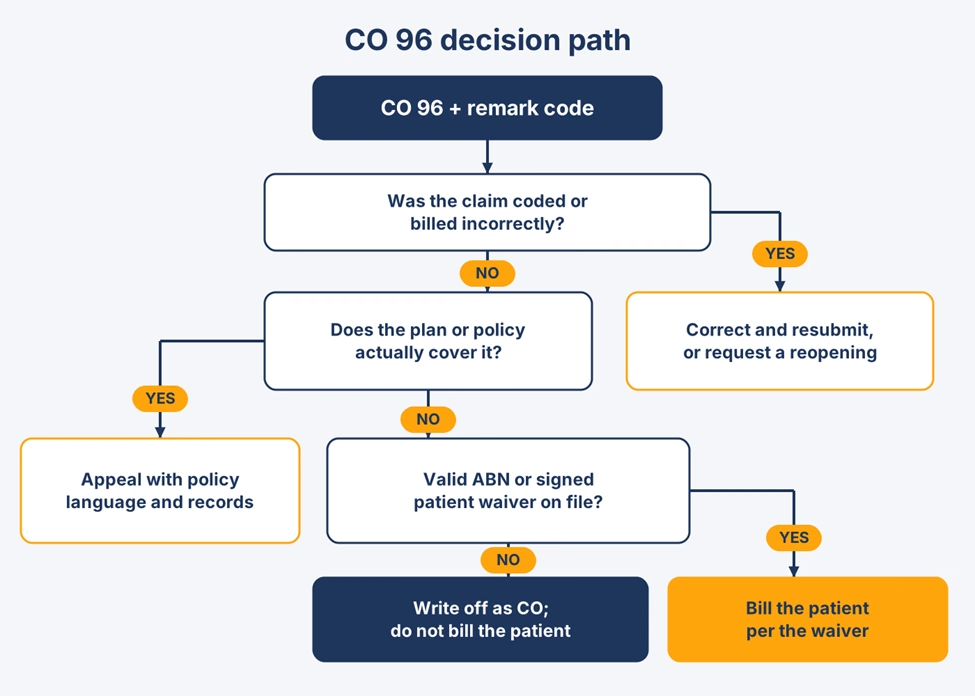
In short: coding errors get corrected, covered services get appealed, and true non-covered services become a patient bill only when a valid waiver was signed before care.
When You Can Bill the Patient
For Original Medicare, the Advance Beneficiary Notice of Noncoverage (ABN) decides who pays. The CMS Medicare ABN booklet from the Medicare Learning Network explains that an ABN is required when you expect Medicare to deny a service as not reasonable and necessary, and is only voluntary for services Medicare never covers by law. If you should have known Medicare would deny and no valid ABN was issued, you cannot collect from the patient and must refund anything already collected.
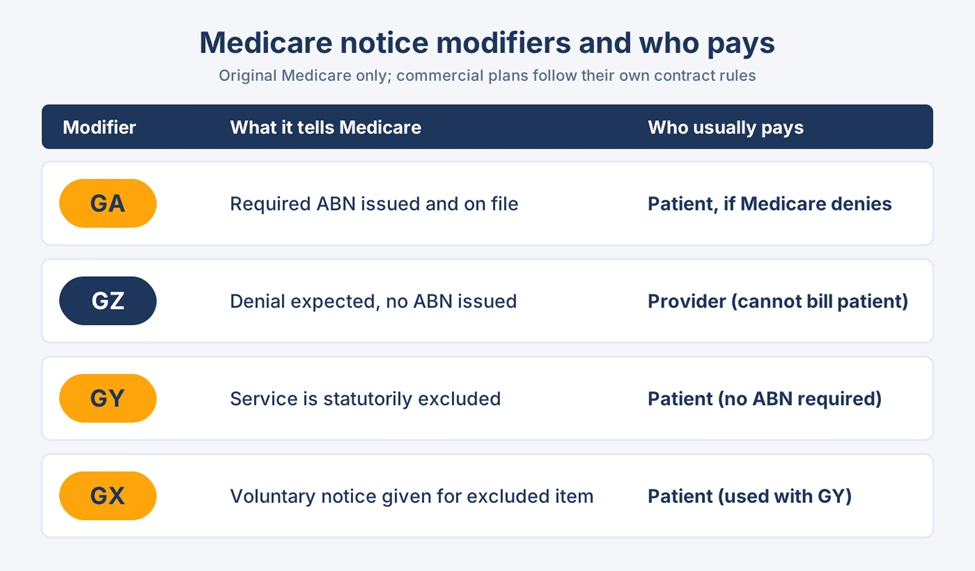
The notice modifiers on the claim tell Medicare which situation applies. Getting them right is the difference between a patient balance and a provider write-off; our guide to how the ABN works in medical billing covers form completion and signatures in more detail.
| Modifier | Meaning | Usual liability if denied |
| GA | Required ABN issued and kept on file | Patient |
| GZ | Denial expected as not reasonable and necessary, no ABN issued | Provider |
| GY | Item or service is statutorily excluded or not a Medicare benefit | Patient (no notice required) |
| GX | Voluntary notice issued for an excluded service, used with GY | Patient |
Commercial and Medicare Advantage plans do not use the ABN. Their contracts and provider manuals set whether, and how, a patient can agree in writing to pay for a non-covered service, and state law may add limits. Check your payer’s manual before you bill any CO 96 balance to a patient.
Sample CO 96 Appeal Letter
Sample (fictional data). Replace the practice, payer, patient, claim, policy and date details with your own, attach the records and policy pages you cite, and use your payer’s appeal form if it requires one.
| Lakeview Physical Therapy November 3, 2026 Northbridge Health Plan, Provider Appeals Re: Appeal of non-covered charge denial (CO-96, remark N431) Patient: Jordan Ellis Member ID: NBH4472190 Claim number: NB-26-0081520 Date of service: October 6, 2026 Service: CPT 97140, manual therapy Billed amount: $95.00 We are appealing the denial of the service above as a non-covered charge. The member’s plan includes outpatient physical therapy, and manual therapy appears as a covered service in Section 4 of the enclosed benefit summary. This was the member’s sixth visit of a 30-visit annual benefit. The enclosed treatment note documents manual therapy to the lumbar spine for 15 minutes, performed separately from the therapeutic exercise billed on the same date. We ask that the line be reprocessed for payment under the member’s physical therapy benefit. Contact: Maria Lopez, Billing Manager, Lakeview Physical Therapy |
How to Prevent CO 96 Denials
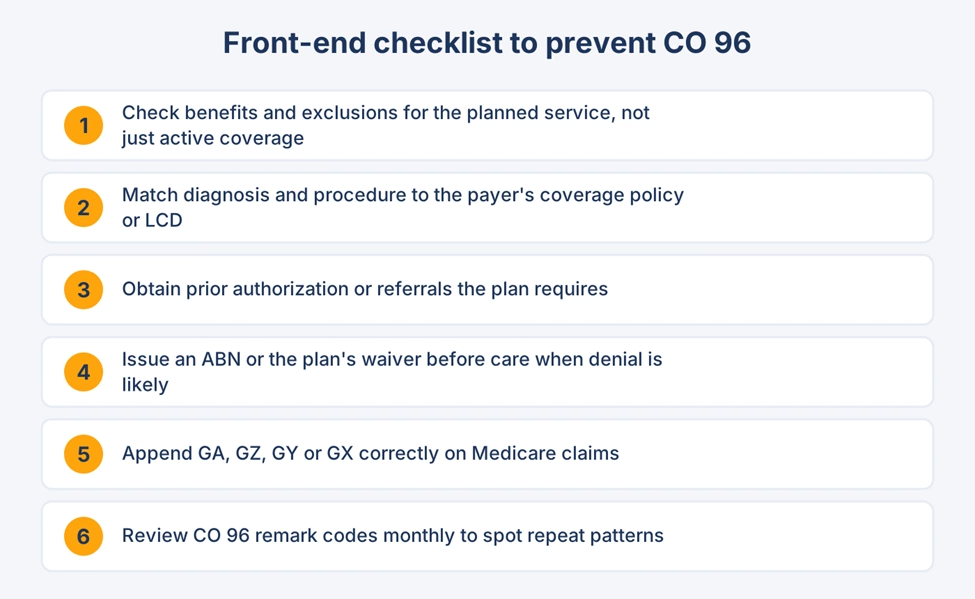
Prevention happens before the patient is seen. A benefit check that confirms active coverage is not enough; staff need to confirm the specific service is covered, which is where strong eligibility and benefits verification pays off.
- Check benefits and exclusions for the planned service, not just whether the policy is active.
- Match the diagnosis and procedure with the payer’s coverage policy or LCD before scheduling.
- Get any required prior authorization or referral on file before the visit.
- Issue an ABN, or the plan’s own waiver form, when you expect a denial, and have the patient sign before care.
- Use GA, GZ, GY and GX correctly on Medicare claims, and never add GA to every line by habit.
- Track CO 96 by remark code each month so repeat causes surface quickly.
Frequently Asked Questions
Can I bill the patient for a CO 96 denial?
Only with a valid waiver signed before the service. For Original Medicare, that means a properly completed ABN, or a statutorily excluded service billed with GY. Without it, the CO group code makes the balance a provider write-off. Commercial plans set their own waiver rules in the contract, so check the provider manual first.
What is the difference between CO 96 and PR 96?
The reason code is the same, but the group code changes who pays. CO 96 leaves the non-covered amount with the provider. PR 96 assigns it to the patient, which usually happens when the patient signed a valid waiver or the service is a plan exclusion the patient is responsible for under the plan terms.
Which remark codes come with CO 96?
X12 requires at least one remark code with reason code 96, so CO 96 should never arrive alone. Noridian pairs it with N431, meaning not covered with this procedure. Other payers use different remarks for exclusions, missing information or policy limits. Always read the remark and any 835 policy reference before choosing your next step.
Can a CO 96 denial be appealed?
Yes, when the service is covered and correctly billed. Gather the payer’s coverage policy, the patient’s benefit summary and the medical record, then file through the payer’s appeal process. Noridian states that Medicare CO 96 denials carry appeal rights. If the service is truly excluded, an appeal will not change the outcome.
Is CO 96 the same as a medical necessity denial?
Not exactly. A medical necessity denial normally uses reason code 50, meaning the payer judged the service not necessary. CO 96 is broader and covers any non-covered charge, explained by the remark code. Some CO 96 denials still come down to diagnosis and policy mismatches, so the fix can overlap.
Get Help Working Non-Covered Denials
An occasional CO 96 denial is a coverage question. A steady flow usually means benefit checks, coding or notice modifiers need attention. Treating the CO 96 denial code as a workflow signal, not just a write-off, protects revenue you have already earned. If your team needs support, Zmed Solutions offers revenue cycle management services that include denial management and claim follow-up, so you can find where non-covered charges start and close those gaps.
Sources: X12 Claim Adjustment Reason Codes; Noridian Healthcare Solutions, Jurisdiction E Part B non-covered charge reason code guidance; CMS Medicare Learning Network, Medicare Advance Written Notices of Noncoverage booklet. This article is general billing information, not legal advice; coverage rules change, so confirm them in your payer contracts and manuals.
Ready to optimize your medical billing and boost your revenue? Look no further. Zmed Solutions LLC is your trusted partner in professional Medical Billing Services.
Join our growing network of healthcare providers who have already elevated their revenue with our expert services. Don't miss out on what could be your practice's most profitable decision.
Schedule a Consultation Today!
Contact Us Now, and experience the difference. Your financial success starts here!