Optimizing revenue cycle performance is one of the most critical, complex and challenges facing healthcare practices today. Zmed Solutions delivers end-to-end medical billing solutions designed to reduce claim denials, accelerate reimbursements and strengthen your practice’s financial foundation. Learn more about who we are and explore our full range of specialized billing services.
R13.10 (unspecified), R13.11 (oral phase), R13.12 (oropharyngeal), R13.13 (pharyngeal), R13.14 (pharyngoesophageal), R13.19 (other, including cervical and neurogenic). After a stroke, code the I69 dysphagia code (final characters -91) first, then add the R13.1- phase code.
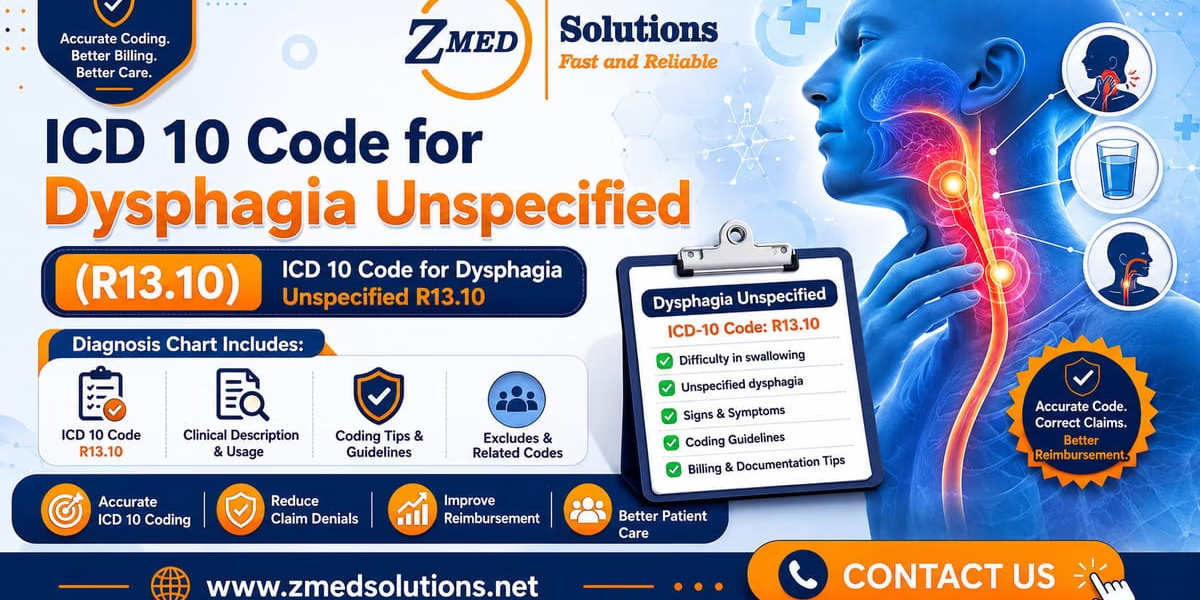
What Is the ICD 10 Code for Dysphagia Unspecified?
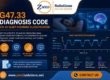
The ICD 10 code for dysphagia unspecified is R13.10. This code belongs to the R13 category in the ICD-10-CM system, which covers dysphagia broadly. R13.10 is classified as a billable and specific code, meaning it can be used directly on medical claims without requiring further specification — provided the clinical documentation supports the “unspecified” designation.
The term “unspecified” does not mean the diagnosis is vague or improperly documented. Rather, it indicates that the exact phase or etiology of the swallowing difficulty has not yet been identified or is not clinically necessary to specify at the time of the encounter. This is a common and acceptable scenario in initial evaluations or emergency presentations.
Understanding when to use R13.10 versus a more specific code is one of the most important skills in medical coding dysphagia scenarios. Coders and clinicians must work together to ensure documentation supports whichever code is selected, whether it is the unspecified version or a more granular alternative.
Understanding Dysphagia: A Clinical Overview
Dysphagia is the medical term for difficulty swallowing. It is derived from the Greek words “dys” (difficult) and “phagein” (to eat). The condition affects millions of people globally and can range from mild discomfort during eating to complete inability to swallow food, liquids, or saliva. Recognizing its clinical presentation is essential before selecting any swallowing disorder medical code.
The Swallowing Process
The act of swallowing involves three distinct phases: the oral phase, the pharyngeal phase, and the esophageal phase. Each phase relies on precise neuromuscular coordination. A disruption in any one of these phases leads to what clinicians classify as a deglutition disorder. The ICD-10-CM system has codes that map to each of these phases individually.
Who Is at Risk?
Dysphagia does not discriminate. However, it disproportionately affects older adults, stroke survivors, individuals with neurological conditions such as Parkinson’s disease, and patients undergoing head and neck cancer treatments. It is also commonly seen in premature infants and patients on long-term mechanical ventilation. Identifying the patient population helps guide both clinical management and the appropriate dysphagia diagnosis code selection.
Consequences of Untreated Dysphagia
When dysphagia goes undiagnosed or untreated, the consequences can be severe. These include aspiration pneumonia, malnutrition, dehydration, weight loss, and in extreme cases, death. Because of these serious outcomes, early and accurate coding — particularly the use of an aspiration risk diagnosis code when applicable — plays a vital role in triggering appropriate care pathways.
The Complete Dysphagia ICD 10 Code List
The ICD-10-CM system organizes dysphagia codes under category R13, which is part of Chapter 18: Symptoms, Signs and Abnormal Clinical and Laboratory Findings. Here is the complete dysphagia unspecified diagnosis code list along with all related subcategories:
R13 – Aphagia and Dysphagia Category
| ICD-10-CM Code | Description |
| R13.0 | Aphagia (complete inability to swallow) |
| R13.10 | Dysphagia, unspecified |
| R13.11 | Dysphagia, oral phase |
| R13.12 | Dysphagia, oropharyngeal phase |
| R13.13 | Dysphagia, pharyngeal phase |
| R13.14 | Dysphagia, pharyngoesophageal phase |
| R13.19 | Other dysphagia (including cervical dysphagia and neurogenic dysphagia) |
Each of these codes is billable and can be used independently. The selection depends entirely on what the physician or speech-language pathologist has documented in the clinical record. When the documentation does not specify the phase, R13.10 ICD 10 code is the correct choice. This dysphagia ICD 10 code list forms the backbone of all swallowing-related diagnosis coding.
R13.10 Explained: Dysphagia Unspecified in Detail
Is R13.10 a Billable Code?
Yes. R13.10 is a billable ICD-10-CM code and remains valid in the FY2027 code set, effective October 1, 2026.. It is valid for submission on HIPAA-covered transactions and can be used on both inpatient and outpatient claims. Payers including Medicare, Medicaid, and commercial insurers accept this code when it is supported by appropriate clinical documentation.
The dysphagia unspecified R13.10 designation is valid even when additional workup is pending. For example, if a patient arrives in the emergency department with complaints of trouble swallowing and the physician documents dysphagia but has not yet completed a barium swallow study or modified barium swallow evaluation, R13.10 is the appropriate code to use at that encounter.
ICD-10-CM Index and Tabular Reference
In the ICD-10-CM Alphabetic Index, you can find this code by searching “Dysphagia” → “unspecified” → R13.10. In the Tabular List, R13.10 falls under:
- Block R10-R19: Symptoms and signs involving the digestive system and abdomen
- Category R13: Aphagia and dysphagia
- Code R13.10: Dysphagia, unspecified
Always verify against the Tabular List to confirm there are no instructional notes, “use additional code” directives, or “code first” requirements attached to the parent category. For instance, when dysphagia is a manifestation of another disease, such as a stroke or Parkinson’s disease, coding guidelines may require sequencing that underlying condition first.
Applicable To and Excludes Notes
The ICD-10-CM Tabular List includes important notations for the R13 category:
Applicable to: Difficulty in swallowing NOS (R13.10).
Code first: Under R13.1, the Tabular List says to code first, if applicable, dysphagia following cerebrovascular disease (I69. with final characters -91).
Excludes 1: Psychogenic dysphagia (F45.8). This is one of the most important distinctions in dysphagia coding. When dysphagia is a sequela of stroke, the I69 code comes first and the R13.1- code is added after it to show the phase. R13.10 is not dropped; it is sequenced second.
Types of Dysphagia and Their Specific ICD-10-CM Codes
Understanding the different subtypes of dysphagia is foundational to accurate ICD 10 CM dysphagia coding. Each subtype corresponds to a distinct anatomical phase of the swallowing process and carries its own specific code.
Oropharyngeal Dysphagia ICD 10 (R13.12)
Oropharyngeal dysphagia involves difficulty initiating a swallow or transferring a food bolus from the mouth to the pharynx. It is common in patients with neurological conditions, including ALS, Parkinson’s disease, and multiple sclerosis. The correct oropharyngeal dysphagia ICD 10 code is R13.12, which represents the oropharyngeal phase. Symptoms often include coughing, choking, drooling, or nasal regurgitation during swallowing.
Speech-language pathologists frequently diagnose oropharyngeal dysphagia during clinical swallowing evaluations or during instrumental assessments like the Fiberoptic Endoscopic Evaluation of Swallowing (FEES). When the SLP documents this specific phase, coders should use R13.12 rather than the unspecified R13.10 code.
Esophageal Dysphagia ICD 10 (R13.19 or R13.14)
Esophageal dysphagia refers to difficulty moving food or liquid through the esophagus to the stomach. Patients often describe food “sticking” in the chest. Causes include strictures, achalasia, reflux disease and motility disorders. The ICD-10-CM Alphabetic Index does not list “esophageal” as a subterm under Dysphagia. It lists oral, oropharyngeal, pharyngeal and pharyngoesophageal phases, plus cervical, neurogenic and “specified NEC”, which all go to R13.19. Because esophageal dysphagia is a specified type with no entry of its own, many coders report R13.19. Use R13.14 when the provider documents the pharyngoesophageal phase (for example, upper esophageal sphincter dysfunction). When the cause is diagnosed, such as an esophageal stricture (K22.2) or achalasia (K22.0), code the cause. Check your payer and AHA Coding Clinic guidance for your setting.
Oral Phase Dysphagia ICD 10 (R13.11)
Oral phase dysphagia occurs when the patient has difficulty chewing, manipulating, or moving food toward the pharynx. It is common in patients with facial nerve palsy, oral cancer, severe dental problems, or after oral surgery. The oral phase dysphagia ICD 10 code is R13.11. This code is relatively less used than R13.12 or R13.10 but is important in head and neck oncology and post-surgical care settings.
Pharyngeal Dysphagia ICD 10 (R13.13)
Pharyngeal dysphagia is difficulty during the pharyngeal swallowing phase — the involuntary, reflex-driven part of swallowing that moves the bolus through the pharynx while protecting the airway. The corresponding pharyngeal dysphagia ICD 10 code is R13.13. This is especially important in patients with a history of radiation therapy to the head and neck, as radiation fibrosis commonly affects the pharyngeal musculature.
Dysphagia Due to CVA and Neurogenic Causes
Neurological conditions are among the leading causes of dysphagia. This makes neurogenic dysphagia ICD 10 coding a particularly important skill set for coders working in neurology, rehabilitation, and long-term care settings.
Dysphagia Due to CVA ICD 10 – The I69 Series
When a patient develops dysphagia as a direct consequence of a cerebrovascular accident (CVA), the R13 codes must NOT be used. Instead, ICD-10-CM directs coders to the I69 category (Sequelae of cerebrovascular disease). The relevant dysphagia due to CVA ICD 10 codes include:
| Code | Description |
| I69.091 | Dysphagia following nontraumatic subarachnoid hemorrhage |
| I69.191 | Dysphagia following nontraumatic intracerebral hemorrhage |
| I69.291 | Dysphagia following other nontraumatic intracranial hemorrhage |
| I69.391 | Dysphagia following cerebral infarction |
| I69.891 | Dysphagia following other cerebrovascular disease |
| I69.991 | Dysphagia following unspecified cerebrovascular disease |
These codes are critical for correct medical coding dysphagia when the patient has a CVA history. The I69 codes include a “Use additional code to identify type of dysphagia” note, which means coders should add an R13 code as a secondary code to specify the dysphagia phase — for example, adding R13.12 to indicate oropharyngeal involvement.
Neurogenic Dysphagia in Parkinson’s Disease
In Parkinson’s disease, the underlying condition is sequenced first, followed by the dysphagia code. Since October 1, 2023, G20 is no longer a billable code; Parkinson’s disease is reported with G20.A1–G20.C based on dyskinesia and fluctuations, for example G20.A1 (Parkinson’s disease without dyskinesia, without mention of fluctuations). A patient with oropharyngeal swallowing difficulty would be coded G20.A1 + R13.12. If the provider documents only “neurogenic dysphagia”, the index points to R13.19.
How to Code Dysphagia Unspecified Correctly?
Accurate coding begins with thorough documentation. Here is a step-by-step guide on how to code dysphagia unspecified without errors or compliance risk.
Step 1 – Review Clinical Documentation Carefully
Before assigning any code, read the entire encounter note including the HPI, assessment, plan, and any consultation reports. Look for specific language describing the swallowing problem. Terms like “oral phase dysphagia,” “esophageal dysphagia,” or “oropharyngeal dysphagia” signal that a more specific code than R13.10 should be used.
When the documentation simply states “dysphagia” or “difficulty swallowing” without phase specification, R13.10 or dysphagia NOS ICD 10 is appropriate. Do not make assumptions about the phase based on clinical context alone. Coding guidelines require specificity to be documented by the treating provider.
Step 2 – Check for Underlying Conditions
Determine whether the dysphagia is a manifestation of another condition. If the patient has a history of stroke, Parkinson’s disease, multiple sclerosis, or esophageal cancer, the underlying condition typically gets coded first. This affects sequencing, which in turn can affect DRG assignment for inpatient claims and reimbursement on outpatient claims.
Step 3 – Apply ICD-10-CM Official Guidelines
The ICD-10-CM Official Guidelines for Coding and Reporting provide specific instructions for symptom codes like dysphagia. Key principles include:
- Use sign/symptom codes (like R13.10) when no definitive diagnosis has been established.
- Do not use sign/symptom codes when a confirmed underlying diagnosis fully explains the symptom.
- When dysphagia is the confirmed diagnosis (e.g., idiopathic dysphagia), R13.10 is appropriate as a primary code.
Step 4 – Assign Additional Codes as Needed
When applicable, assign additional codes to capture the full clinical picture. This may include aspiration pneumonia (J69.0), malnutrition (E41-E46), dehydration (E86.0), or a feeding disorder. The aspiration risk diagnosis code is particularly important to add when documentation specifically mentions aspiration risk, as it can influence care planning and resource allocation.
Dysphagia Diagnosis Code Billing: A Complete Guide
Billing for dysphagia-related services involves more than just assigning the correct dysphagia diagnosis code. It requires matching the right diagnosis codes to the right procedure codes, understanding payer-specific policies, and ensuring documentation supports medical necessity.
ICD-10 and Medical Necessity
Payers require that the diagnosis code submitted on a claim supports the medical necessity of the services rendered. For example, if a speech-language pathologist performs a clinical swallowing evaluation, the claim must include a diagnosis code — such as the ICD 10 code for difficulty swallowing (R13.10) — that justifies the evaluation. Without an appropriate dysphagia code, the claim is likely to be denied.
Inpatient vs. Outpatient Coding
Inpatient coding follows the Uniform Hospital Discharge Data Set (UHDDS) and IPPS guidelines. In inpatient settings, the principal diagnosis drives DRG assignment. Dysphagia coded as R13.10 as a principal diagnosis will map to a specific MS-DRG, affecting payment.
Outpatient coding follows guidelines that direct coders to code the confirmed condition when known, or the highest-degree reason for the encounter if no diagnosis is confirmed. For initial evaluations where dysphagia type is not yet confirmed, dysphagia unspecified R13.10 is the standard choice.
Medicare and Medicaid Considerations
Medicare covers dysphagia evaluation and treatment services when medical necessity is established. This includes both the diagnosis code and supporting clinical documentation. For dysphagia diagnosis code billing on Medicare claims, coders should be aware of:
- Local Coverage Determinations (LCDs) that may specify required diagnoses for coverage of swallowing studies or speech therapy services.
- NCCI (National Correct Coding Initiative) edits that may bundle certain procedure codes together.
- The importance of linking the correct swallowing disorder medical code to each individual service line on the claim.
Dysphagia CPT Codes and Procedure Coding
Beyond the ICD-10 diagnosis code, healthcare providers also need to submit the correct dysphagia CPT code for procedures performed. Here are the most commonly used CPT codes in dysphagia management:
Evaluation CPT Codes
| CPT Code | Description |
| 92610 | Evaluation of oral and pharyngeal swallowing function |
| 92611 | Motion fluoroscopic evaluation of swallowing function by cine or video recording (modified barium swallow) |
| 92612 | Flexible fiberoptic endoscopic evaluation of swallowing (FEES) |
| 92614 | Flexible endoscopic evaluation, laryngeal sensory testing, by cine or video recording |
| 92616 | Flexible endoscopic evaluation of swallowing and laryngeal sensory testing, by cine or video recording |
Treatment CPT Codes
| CPT Code | Description |
| 92526 | Treatment of swallowing dysfunction and/or oral function for feeding |
When submitting any of these procedure codes, the ICD 10 code for dysphagia unspecified (R13.10) or the appropriate specific dysphagia code must be included as the supporting diagnosis. Mismatched procedure and diagnosis codes are a common source of claim denials in dysphagia billing.
Related and Associated Diagnosis Codes
Dysphagia rarely exists in isolation. Accurate medical coding dysphagia often requires assigning additional codes for related conditions, complications, or co-morbidities.
Globus Sensation ICD 10
Globus sensation — the persistent feeling of a lump in the throat without an identifiable structural cause — is closely related to dysphagia but is a distinct diagnosis. The globus sensation ICD 10 code is R09.89 (Other specified symptoms and signs involving the circulatory and respiratory systems). Some patients with globus sensation may also carry a dysphagia diagnosis. In those cases, both codes can be reported if both conditions are documented.
Odynophagia ICD 10
Odynophagia refers to painful swallowing, which is a different symptom from dysphagia (difficulty swallowing). The odynophagia ICD 10 code is R13.10 when documented as difficulty swallowing with pain, but pain with swallowing as a primary complaint may be captured under R07.0 or R10.13 depending on the location. Clinicians should document both dysphagia and odynophagia separately to allow accurate coding.
Aspiration Pneumonia and Aspiration Risk
When dysphagia leads to aspiration, the following codes become relevant:
- J69.0 – Pneumonitis due to inhalation of food and vomit (aspiration pneumonia)
- Z87.09 – Personal history of other diseases of the respiratory system (when a history of aspiration pneumonia is documented)
The aspiration risk diagnosis code is important for documenting patient safety risk and justifying preventive interventions such as modified diet textures or thickened liquids.
Deglutition Disorder ICD 10
The term deglutition disorder is synonymous with dysphagia in ICD-10-CM coding. The ICD-10-CM Alphabetic Index lists “Deglutition disorder” and cross-references it to the R13 category. So when a provider documents “deglutition disorder,” the appropriate deglutition disorder ICD 10 code remains within the R13 subcategory based on the phase or unspecified status — most commonly R13.10.
Clinical Documentation Requirements
The accuracy of any ICD 10 code for dysphagia unspecified or its specific variants depends entirely on the quality of clinical documentation. This section outlines what physicians, advanced practice providers, and speech-language pathologists should document to support appropriate coding.
Minimum Documentation Standards
To support the use of R13.10, the clinical record should contain at least:
- A patient complaint of difficulty swallowing or similar language.
- A physician or licensed provider assessment identifying dysphagia as a diagnosis.
- A statement that the specific phase or cause has not yet been determined (or no documentation specifying the phase).
To support a more specific code (e.g., R13.12 for oropharyngeal dysphagia), the documentation should include:
- Results of clinical swallowing evaluation or instrumental assessment.
- Identification of the phase where the swallowing deficit occurs.
- Clinical judgment linking the findings to a specific dysphagia type.
The Role of the Speech-Language Pathologist
Speech-language pathologists (SLPs) play a central role in dysphagia documentation. Their evaluation reports are often the primary source of phase-specific information that allows coders to move from R13.10 to a more specific code. Coders must read SLP notes carefully and query the SLP or treating physician when documentation is ambiguous.
Query Best Practices
When documentation is unclear or does not support a specific code, the coder should initiate a compliant clinical documentation query. The query should be:
- Non-leading (not suggesting a specific answer).
- Based on clinical evidence in the medical record.
- Documented according to the facility’s CDI (Clinical Documentation Integrity) policy.
Effective clinical documentation improvement in dysphagia cases can significantly impact case mix index, quality metrics, and reimbursement accuracy for both inpatient and outpatient facilities.
Common Coding Errors and How to Avoid Them?
Even experienced coders make mistakes when dealing with dysphagia. Here are the most frequent errors in ICD 10 code for dysphagia unspecified assignment and how to avoid them.
Error 1 – Using R13.10 Instead of I69 Codes for Post-CVA Dysphagia
This is the most common and significant error. When a patient has dysphagia as a sequela of stroke, the R13 codes are excluded per Excludes 1 notation, and the I69 series must be used. Always check for CVA history before defaulting to R13.10.
Fix: Create a checklist or coding workflow that prompts review of neurological history before assigning any dysphagia code.
Error 2 – Failing to Code Aspiration Pneumonia Separately
Dysphagia can lead to aspiration, which in turn can cause aspiration pneumonia. Many coders capture only the dysphagia and miss the aspiration pneumonia code (J69.0), which is a separately reportable and clinically significant condition.
Fix: Review the admitting diagnosis and lab/imaging results for any evidence of aspiration. If documented, report J69.0 in addition to the dysphagia code.
Error 3 – Upcoding to a More Specific Dysphagia Code Without Documentation
Some coders incorrectly assign R13.12 (oropharyngeal dysphagia) or R13.13 (pharyngeal dysphagia) because they seem clinically logical, even when the documentation only says “dysphagia.” This is a compliance risk and could be considered fraudulent if it results in higher reimbursement.
Fix: Always default to R13.10 unless the specific phase is explicitly documented by a treating provider or specialist.
Error 4 – Not Linking Dysphagia Codes to Procedure Codes
On outpatient claims, each procedure code must be linked to the diagnosis code that supports medical necessity. Coders sometimes forget to link R13.10 to procedures like 92610 or 92611, resulting in claims being denied for lack of medical necessity support.
Fix: Review the claim form or electronic claim data before submission to ensure every CPT code has an appropriate dysphagia diagnosis code linked to it.
Error 5 – Missing “Code First” or “Use Additional Code” Instructions
The Tabular List contains important instructional notes that affect how dysphagia codes are sequenced. Missing these notes can lead to incorrect principal diagnosis selection or missed secondary codes.
Fix: Always consult the full Tabular List entry for R13 and its parent category when assigning ICD 10 CM dysphagia codes. Do not rely solely on the Alphabetic Index.
ICD-10 Code for Dysphagia 2027: Updates and Validity
The ICD-10 code for dysphagia unspecified remains R13.10 in the FY2027 code set, which takes effect October 1, 2026. The code set is updated every year by CMS and the CDC’s National Center for Health Statistics (NCHS). Coders should still review the annual addenda for any change to the R13 category or to the I69 dysphagia codes before updating templates..
CMS releases the updated ICD-10-CM code files each year, effective October 1. It is best practice for coding teams and billing departments to review the release notes for any changes to the R13 category at the start of each fiscal year to maintain compliance and coding accuracy.
Frequently Asked Questions
What is the ICD 10 code for dysphagia unspecified?
The ICD 10 code for dysphagia unspecified is R13.10. This is a billable ICD-10-CM code used when a patient has difficulty swallowing but the specific phase of the swallowing disorder has not been identified or documented. It falls under category R13 (Aphagia and Dysphagia) in Chapter 18 of the ICD-10-CM system. R13.10 is valid in both inpatient and outpatient settings and remains current in the FY2027 code set.
When should I use R13.10 instead of a more specific dysphagia code?
You should use R13.10 when the clinical documentation states “dysphagia,” “difficulty swallowing,” or “swallowing disorder” without specifying the phase (oral, pharyngeal, oropharyngeal, or pharyngoesophageal). If the provider documents a specific phase — such as “oropharyngeal dysphagia” — then you should use the more specific code (e.g., R13.12). Never assign a specific code based on clinical inference alone; it must be clearly documented by the treating provider or specialist.
Can I use R13.10 for a patient with dysphagia after a stroke?
Not as the first code. For dysphagia caused by a previous stroke, code the I69 dysphagia code first, for example I69.391 (dysphagia following cerebral infarction). The I69 code carries a “use additional code” note, so R13.10 or a phase-specific R13.1- code is then added as a secondary code.
What CPT codes are commonly paired with R13.10?
The most commonly used dysphagia CPT codes paired with R13.10 include:
- 92610 – Clinical evaluation of swallowing function
- 92611 – Modified barium swallow (videofluoroscopic swallowing study)
- 92612 – Flexible fiberoptic endoscopic evaluation of swallowing (FEES)
- 92526 – Treatment of swallowing dysfunction
Always ensure each procedure code is linked to R13.10 (or the appropriate specific dysphagia code) on the claim form to satisfy medical necessity requirements and prevent denials.
Is dysphagia NOS the same as dysphagia unspecified?
Yes. Dysphagia NOS (Not Otherwise Specified) is clinically and coding-equivalent to dysphagia unspecified in ICD-10-CM. The ICD-10-CM Alphabetic Index cross-references “Dysphagia NOS” to R13.10, the same code used for dysphagia unspecified. The term “NOS” is an older convention from ICD-9-CM that remains in use colloquially. In ICD-10-CM, the preferred term is “unspecified,” but both descriptions map to the same billable code: R13.10.
What is the ICD-10 code for esophageal dysphagia?
The Alphabetic Index has no “esophageal” entry under Dysphagia, so many coders use R13.19 (other dysphagia). Use R13.14 when the pharyngoesophageal phase is documented, and code the cause, such as K22.2 for an esophageal stricture, when it is diagnosed.
What is R13.12?
R13.12 is dysphagia, oropharyngeal phase. Use it when the provider or speech-language pathologist documents difficulty moving food from the mouth into the pharynx.
Final Thoughts
The ICD 10 code for dysphagia unspecified, R13.10, is one of the most widely used symptom codes in clinical and billing settings across the United States and internationally. It serves as the default code when swallowing difficulty is documented but the specific phase or underlying etiology has not been identified. Mastery of this code — and the broader dysphagia ICD 10 code family — is essential for anyone involved in clinical documentation, medical coding, or healthcare billing.
Accurate medical coding dysphagia requires more than just memorizing a code number. It demands a solid understanding of dysphagia physiology, careful review of clinical documentation, knowledge of ICD-10-CM guidelines and instructional notes, and the ability to identify when more specific codes or complementary codes are needed. When these elements come together, the result is cleaner claims, fewer denials, better quality data, and ultimately better patient care.
Always stay current with annual ICD-10-CM updates and lean on your CDI program to improve documentation. Dysphagia often travels with unintentional weight loss (R63.4) and aspiration pneumonia, so code the full picture. Practices that want a second check on these claims can look at revenue cycle management support from Zmed Solutions.
Key Market Player
Ready to optimize your medical billing and boost your revenue? Look no further. Zmed Solutions LLC is your trusted partner in professional Medical Billing Services.
Join our growing network of healthcare providers who have already elevated their revenue with our expert services. Don't miss out on what could be your practice's most profitable decision.
Schedule a Consultation Today!
Contact Us Now, and experience the difference. Your financial success starts here!