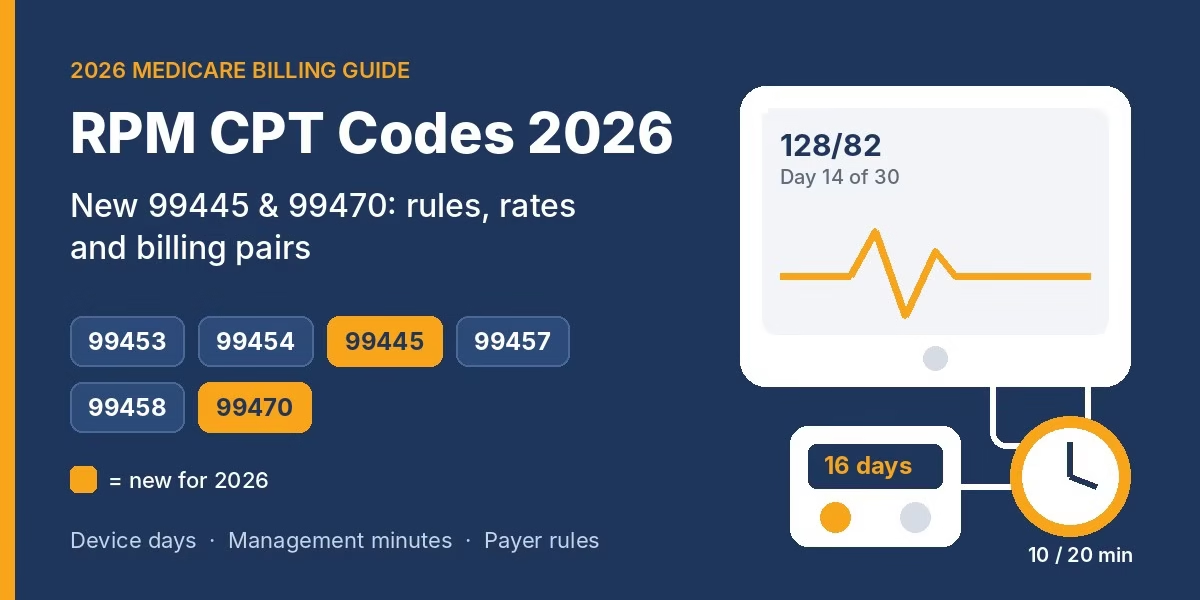
RPM CPT codes 2026 are the CPT codes used to bill remote physiologic monitoring: 99453 for setup and education, 99454 and new 99445 for device supply (16–30 or 2–15 days of data), and 99457, 99458 and new 99470 for treatment management time. The 2026 update lets practices bill shorter monitoring periods and 10–19 minute months.
Until December 31, 2025, a patient who transmitted readings on 15 days, or a care manager who logged 18 minutes of calls, produced no billable remote monitoring claim. Practices did the work and wrote it off. The 2026 code set closes those gaps, but it also adds new pairing rules, payer exceptions and audit questions that billing teams have to get right.
This guide gives you a code-by-code table with 2026 national rates, a matrix of which codes can be billed together, payer-by-payer differences, four worked examples with real arithmetic and an eight-step billing workflow. A self-assessment checklist near the end shows whether your remote patient monitoring billing process is ready for the new codes.
2026 RPM Thresholds and Numbers at a Glance
Billing under the 2026 RPM rules turns on two separate counts: days of device data in each 30-day period and minutes of treatment management in each calendar month. Everything else on this sheet, from rates to denial tracking, follows from getting those two counts right.
| Metric | Practical target / range | Review frequency | Source type |
| Days of device data per 30-day period | Under 2 days: no device code; 2–15 days: 99445; 16–30 days: 99454 | Every 30-day period | Published standard (AMA CPT 2026) |
| Treatment management time per calendar month | Under 10 min: nothing; 10–19 min: 99470; 20+ min: 99457; each extra full 20 min: 99458 | Monthly | Published standard (AMA CPT 2026) |
| Interactive communication | At least one real-time exchange in every month billed with 99470 or 99457 | Monthly | Published standard (CPT; CMS definition) |
| Practitioners billing RPM per patient | One per 30-day period | Every 30-day period | Published standard (CMS) |
| 2026 national non-facility rates | 99453 ~$22; 99454/99445 ~$47–$52; 99457 ~$52; 99458 ~$41; 99470 ~$26 | Annually (fee schedule) | Named data (CMS PFS, as summarized by NACHC and vendors, 2026) |
| Billable-month capture rate | Track the trend; investigate any month-over-month drop of 5 points or more | Monthly | Practical target (illustrative) |
| RPM denial rate by payer | Investigate any payer running above your practice-wide denial rate | Monthly | Practical target |
Source labels: “Published standard” means a code descriptor or rule set by the AMA CPT Editorial Panel or CMS. “Named data” means a figure published by a named organization. “Practical target” means a working threshold commonly used in billing operations, not a rule any agency mandates.
What Are the RPM CPT Codes for 2026?
For 2026, remote physiologic monitoring is billed with three groups of codes: one setup code (99453), two mutually exclusive device supply codes (99445 and 99454) and three treatment management codes (99470, 99457 and 99458). CPT 99091 sits beside them as a separate physician-time option.
The AMA released the CPT 2026 code set on September 11, 2025, with 288 new codes, and the AMA CPT 2026 code set announcement confirms new remote monitoring codes for 2–15 day periods and a management code that starts at 10 minutes. Noridian’s 2026 RPM update for Part B providers confirms that 99445 and 99454 cannot be reported for the same monitoring period.
| Code | What it covers | Threshold | Billing frequency | Approx. 2026 national rate* |
| 99453 | Initial device setup and patient education | Start of an RPM episode | Once per episode of care | ~$22 ($21.71) |
| 99454 | Device supply with daily recordings or programmed alerts | 16–30 days of data | Once per 30-day period | ~$47–$52 |
| 99445 (new) | Same device supply service, shorter period | 2–15 days of data | Once per 30-day period | ~$47–$52 |
| 99470 (new) | Treatment management, first 10 minutes | 10–19 minutes plus one real-time interactive communication | Once per calendar month | ~$26 ($26.05) |
| 99457 | Treatment management, first 20 minutes | 20+ minutes plus interactive communication | Once per calendar month | ~$52 ($51.77) |
| 99458 | Each additional 20 minutes | Each full extra 20 minutes after 99457 | Add-on to 99457 only | ~$41 ($41.42) |
| 99091 | Physician/QHP collection and interpretation of data | 30 minutes of physician or QHP time | Once per 30 days | ~$55 ($55.45) |
Approximate 2026 national non-facility Medicare amounts as summarized by NACHC (2026) and CareTrack (2026). Sources conflict on the device codes: NACHC, CareTrack and Advanta list 99454 and 99445 at about $47, while ThoroughCare and Vivo Care list about $52.10. Your exact rate depends on your Medicare locality.
The two new codes: 99445 and 99470
CPT 99445 covers the same device supply and data transmission service as 99454 when a patient sends readings on only 2–15 days in a 30-day period. Several 2026 coding summaries report that 99445 pays the same as 99454, because the device, connectivity and monitoring platform cost the same whether a patient transmits on 9 days or 25.
CPT 99470 covers the first 10 minutes of treatment management time in a calendar month and requires at least one real-time interactive communication with the patient or caregiver. It fills the 10–19 minute range only. Once the month reaches 20 minutes, 99457 replaces it, and 99458 can never attach to 99470.
What stayed the same?
Setup (99453), the 20-minute management codes (99457 and 99458) and 99091 keep their structure. CMS rules carried into 2026 still require an established patient relationship before RPM begins, a device that meets the FDA definition of a medical device, data transmitted automatically rather than typed in by the patient, and only one practitioner billing RPM for a patient in a 30-day period. For a wider view of how RPM fits alongside telehealth, see our overview of telemedicine and RPM billing trends.
In RPM claim reviews, a common pattern is a practice running 99454 on a 30-day cycle and 99457 on a calendar month, then filing a reading or a phone call under the wrong period. Keep two clocks in your tracking tool from day one, and label every log entry with both.
Did the 16-Day Rule Go Away With the RPM CPT Codes 2026 Update?
No. The 16-day rule still governs CPT 99454; what changed is that 2–15 days of data now has its own code, 99445, instead of producing no device payment at all. The 20-minute threshold for 99457 also remains, with 99470 now covering 10–19 minutes.
A month with fewer than 2 days of data still supports no device code, and a month with fewer than 10 management minutes still supports no management code. Coding references published in 2026 differ on whether 99453 setup can now be reported once monitoring reaches 2 days rather than 16. Confirm your MAC’s position before billing 99453 on a short first episode, and do so when a patient enrolls late in a month.
Rates also changed. The 2026 Medicare Physician Fee Schedule conversion factor is $33.4009 for most clinicians and $33.5675 for qualifying APM participants, according to Holland & Knight’s summary of the CY 2026 final rule. Because the fee schedule, CPT descriptors and payer policies all update every January, treat every rate in this article as a 2026 figure to re-check next year.
Which RPM Codes Can Be Billed Together in 2026?
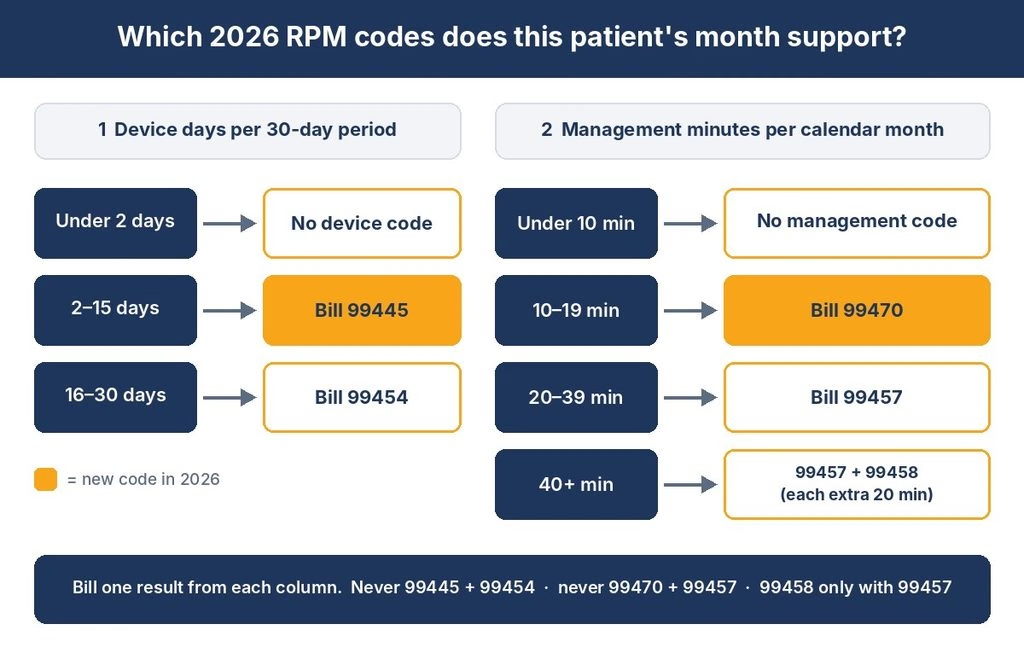
In any month, a practice can bill one device supply code (99445 or 99454) and one management pathway (99470 alone, or 99457 with any 99458 units), and the two groups can be mixed freely. What cannot happen is two device codes in one 30-day period or two management starting codes in one calendar month.
| Combination | Allowed? | Reason |
| 99454 + 99445, same 30-day period | No | Mutually exclusive device codes; day count picks one |
| 99470 + 99457, same calendar month | No | Total minutes pick one starting code |
| 99470 + 99458 | No | 99458 is an add-on to 99457 only |
| 99445 + 99457 | Yes | Device days and management minutes are counted separately |
| 99454 + 99470 | Yes | Same reason |
| RPM + RTM, same patient and period | No | CMS allows one remote monitoring program or the other |
| RPM + CCM, PCM, TCM or BHI | Yes | Separate time; no minute counted twice |
| RPM + APCM (G0556–G0558) | Yes, per 2026 coding summaries | APCM replaces CCM and PCM, not RPM |
| RPM management + 99091, same period | No | CPT excludes 99091 with RPM management codes |
Running RPM alongside care management
RPM and Medicare chronic care management can be billed for the same patient in the same month when each service has its own documented minutes. Chronic care management (CCM) time covers care planning and coordination, while RPM time covers acting on the physiologic data.
In billing audits, a common pattern is a single 25-minute nurse call logged in full to both 99457 and 99490. Split the call in the log at the moment it happens, and do so whenever one conversation covers both readings and care coordination.
RPM versus remote therapeutic monitoring
Remote therapeutic monitoring (RTM) tracks non-physiologic data such as therapy adherence, musculoskeletal status or respiratory status. A patient can be in RPM or RTM in a given period, not both, so pick the program that matches the data the device actually captures.
How Much Does RPM Pay per Patient per Month in 2026?
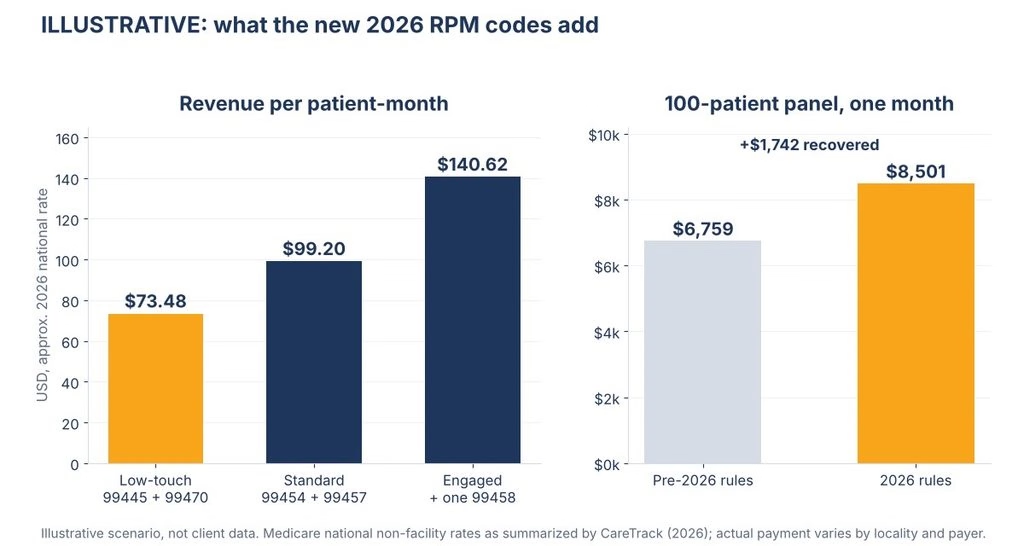
At approximate 2026 national Medicare rates, one month of RPM pays about $73 for a low-touch month (99445 + 99470), about $99 for a standard month (99454 + 99457) and about $141 when one 99458 unit is added. Setup adds about $22 once per episode.
These figures use the CareTrack (2026) national non-facility amounts and the lower $47.43 device rate. Medicare Part B deductible and 20% coinsurance generally apply to RPM, so explain the patient’s share at enrollment and record that discussion with the consent.
Worked example 1: Monthly RPM revenue per patient
Formula: monthly RPM revenue = device code + management code + (99458 units × $41.42) + 99453 when it is the first month.
- Low-touch month: 99445 ($47.43) + 99470 ($26.05) = $73.48
- Standard month: 99454 ($47.43) + 99457 ($51.77) = $99.20
- Engaged month: $99.20 + one 99458 ($41.42) = $140.62
- First standard month with setup: $99.20 + 99453 ($21.71) = $120.91
Twelve standard months for one patient come to $1,190.40 before any 99458 units. The new codes matter most for patients who drift between 12 and 18 transmission days.
Worked example 2: Billable-month capture rate
Formula: capture rate = patients with at least one billable RPM code ÷ patients enrolled that month × 100.
Illustrative scenario (not an actual client record): a cardiology practice has 100 Medicare fee-for-service patients enrolled in one month.
| Patient group | Patients | Codes billed | Revenue |
| 16+ days, 20–39 min | 45 | 99454 + 99457 | $4,464.00 |
| 16+ days, 40+ min | 10 | 99454 + 99457 + 99458 | $1,406.20 |
| 16+ days, 10–19 min | 10 | 99454 + 99470 | $734.80 |
| 2–15 days, 20–39 min | 8 | 99445 + 99457 | $793.60 |
| 2–15 days, 10–19 min | 15 | 99445 + 99470 | $1,102.20 |
| Under 2 days and under 10 min | 12 | None | $0.00 |
| Total | 100 | $8,500.80 |
Capture rate = 88 ÷ 100 = 88%. Average revenue per enrolled patient = $8,500.80 ÷ 100 = $85.01. The 12 non-billable patients are the outreach list for next month.
Worked example 3: Revenue the new codes recover
Formula: recovered revenue = revenue under 2026 rules − revenue the same activity would earn under pre-2026 rules.
Using the same illustrative panel and 2026 rates, pre-2026 rules would pay nothing for the 15 low-touch patients, only 99454 for the 10 patients with 10–19 minutes ($474.30) and only 99457 for the 8 patients with 2–15 days ($414.16). That totals $6,758.66. The 2026 rules earn $8,500.80, so the new codes recover $1,742.14 for the month, about 26% more for identical work.
Worked example 4: How a blended denial rate hides a payer problem
Formula: denial rate = denied RPM claim lines ÷ submitted RPM claim lines × 100.
Illustrative scenario (not an actual client record): a practice submits 100 RPM claim lines and 13 are denied, a blended 13%. Split by payer, Original Medicare denied 3 of 60 lines (5%), while one commercial plan denied 10 of 40 (25%). The commercial plan’s policy does not cover 99445 or 99470, so every low-touch month billed to it fails. The blended figure looked moderate; the payer view shows a coverage gap, not a coding error.
How Do Medicare, Medicare Advantage, Medicaid and Commercial Payers Treat the New Codes?
Original Medicare pays all six RPM codes under the 2026 Physician Fee Schedule, but Medicare Advantage, Medicaid and commercial plans set their own policies, and some have not adopted 99445 and 99470. Verify coverage per plan before a patient’s first short month is billed.
| Payer type | 2026 position on RPM and the new codes | What to check before billing |
| Original Medicare | Covers 99453, 99454, 99445, 99457, 99458 and 99470; payment adjusted by locality | CMS Physician Fee Schedule Look-Up Tool and your MAC’s articles |
| Medicare Advantage | Must cover Medicare-covered benefits but can apply its own medical policy, prior authorization and network rules | Plan medical policy; UnitedHealthcare announced a policy limiting RPM to heart failure and hypertensive disorders of pregnancy for January 1, 2026, then postponed it in December 2025 (Becker’s Payer Issues) |
| Medicaid | Varies by state, from broad coverage to limited condition lists | Your state Medicaid fee schedule and any managed care plan policy |
| Commercial | Varies by plan; Aetna’s policy updated February 27, 2026 lists 99445 and 99470 as not covered and limits RPM to heart failure, hypertension and diabetes (University of Arizona Telemedicine Program summary, April 2026) | Plan bulletin, your contract and a pre-enrollment benefits check |
Because payer positions on RPM moved several times in the past year, run insurance eligibility verification that names the specific RPM codes, not just “telehealth” or “DME.” Re-check whenever a plan publishes a policy update.
FQHCs and RHCs
Federally qualified health centers and rural health clinics no longer report G0511 for care management; NACHC’s 2026 fact sheet confirms it is no longer reportable, and centers bill the individual codes instead. Confirm your MAC’s payment method for RPM lines before submitting, and see our guide to FQHC and RHC billing with UDS reporting support for the wider workflow.
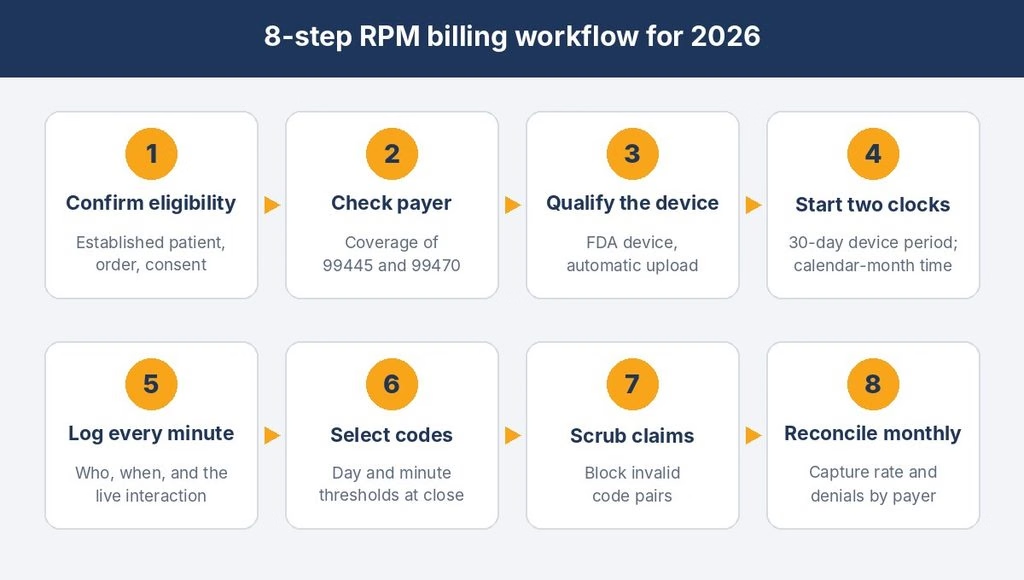
How Should a Practice Bill the 2026 RPM Codes, Step by Step?
Bill the 2026 RPM codes by confirming eligibility and consent first, counting device days per 30-day period and management minutes per calendar month separately, then choosing one device code and one management pathway before claims go out.
- Confirm the patient is eligible. Document an established relationship, a treating practitioner’s order, the clinical indication and patient consent, including the cost-sharing discussion.
- Check payer coverage of each code. Do this at enrollment when the patient’s plan is not Original Medicare, because some plans exclude 99445 and 99470.
- Confirm the device qualifies. Use a device that meets the FDA medical device definition and transmits automatically, such as the connected cuffs covered in our article on remote hypertension monitoring devices or remote glucose monitoring devices.
- Start two clocks. The 30-day device period starts with the first reading; management time runs on the calendar month.
- Log every minute with its purpose. Record date, staff member, minutes and whether the contact was interactive communication, which CMS defines as real-time, synchronous, two-way audio that can be enhanced with video.
- Select codes at period close. Apply the day and minute thresholds from the cheat sheet; never bill a code before its period ends.
- Scrub before submission. Build claim scrubbing edits that block 99454 with 99445, 99470 with 99457, 99458 without 99457 and RPM with RTM.
- Reconcile monthly. Track capture rate and denial rate by payer, and work the non-billable patient list.
What Documentation Protects RPM Claims in an Audit?
RPM claims hold up in audit when the record shows the order, consent, established relationship, device day counts for each 30-day period, dated time logs and at least one interactive communication for every management month billed. Missing any one of these turns a paid claim into an overpayment.
Federal scrutiny is real. The HHS Office of Inspector General’s 2024 report, Additional Oversight of Remote Patient Monitoring in Medicare Is Needed, found that about 43% of enrollees who received RPM did not receive all three components: setup and education, device supply and treatment management. OIG’s August 2025 follow-up reported Medicare RPM payments above $500 million in 2024 and proposed flags such as many enrollees with no prior history at the practice and multiple devices billed per enrollee in one month.
When our team reviews RPM records, the most frequent gap is a time log that lists minutes but never identifies the live conversation that qualifies the month. Build a required “interactive communication” field into the template, and treat complete medical billing documentation as part of the service. A periodic internal review, as described in our article on how medical billing audits prevent revenue loss, catches these gaps before an outside auditor does.
How Should You Read Your RPM Numbers?
Read RPM numbers by comparing like with like: one payer against its own history, low-touch patients against other low-touch patients and one device type against the same device type. A single missed number is a signal to investigate, not a verdict on the program.
A capture rate that drops in February may reflect a 28-day month, not staff performance. A higher denial rate on one plan may reflect coverage policy, as worked example 4 shows. Revenue per patient will fall as more patients move to 99445 and 99470, even when the program is working better, because those patients previously produced nothing. Set your RPM figures beside the broader medical billing KPIs and benchmarks for 2026 so the program is judged inside the whole revenue cycle.
How Long Does It Take to Fix an RPM Billing Workflow?
Most practices can correct code selection within one to two billing cycles, while documentation habits and payer coverage problems usually take three to six months to settle fully. These are general planning ranges, not guarantees, and they depend on staffing and software.
- Partial results, 30–60 days: updated scrubber edits, the day and minute decision rules and a corrected 99470/99457 split.
- Fuller results, 2–3 months: revised time-log templates, staff trained on interactive communication documentation and a working non-billable outreach list.
- Full results, 3–6 months: payer-specific coverage mapping, appeals of wrongly denied claims and a stable monthly reconciliation routine.
Which RPM Coding Mistakes Are Most Common in 2026?
The most common 2026 RPM mistakes are billing both device codes in one period, attaching 99458 to 99470 and assuming every payer covers the new codes. Each one is preventable with a rule in the scrubber or a check at enrollment.
- Billing 99445 and 99454 together. Fix: let the day count choose one code at the close of the 30-day period.
- Adding 99458 to 99470. Fix: 99458 needs 99457 and a full 40 minutes in total.
- Billing 99470 or 99457 without a live exchange. Fix: require the interactive communication field before the code can be selected.
- Mixing the 30-day and calendar-month clocks. Fix: label every reading and every log entry with both periods.
- Assuming commercial plans follow Medicare. Fix: confirm coverage of 99445 and 99470 per plan before billing a short month.
- Counting one call toward RPM and CCM. Fix: split minutes in real time and keep separate logs.
When the same denial reason keeps returning after these fixes, dedicated denial management and appeals services can trace whether the cause is coding, documentation or payer policy.
Quick Summary
- Device codes: 2–15 days in a 30-day period bills 99445; 16–30 days bills 99454; under 2 days bills nothing.
- Management codes: 10–19 minutes in a calendar month bills 99470; 20+ minutes bills 99457; each extra full 20 minutes adds 99458.
- Approximate 2026 national rates: about $73 for a low-touch month, $99 for a standard month and $141 with one 99458 unit.
- Practical targets: track capture rate monthly and investigate any payer whose denial rate runs above your practice-wide rate.
- Payers differ: Original Medicare covers the new codes; some Medicare Advantage and commercial plans do not.
- Audit readiness depends on order, consent, day counts, time logs and documented interactive communication.
RPM Billing Readiness Checklist
Answer yes or no to each question.
1. Does your system choose 99445 or 99454 automatically from the day count in each 30-day period?
2. Does it choose 99470 or 99457 from total minutes in each calendar month?
3. Do your claim edits block 99458 unless 99457 is on the same claim?
4. Does every billed management month show at least one documented real-time interactive communication?
5. Do you verify each non-Medicare plan’s coverage of 99445 and 99470 before billing a short month?
6. Is consent, including the cost-sharing discussion, on file for every enrolled patient?
7. Do you keep separate time logs when a patient is in both RPM and CCM?
8. Do you calculate your billable-month capture rate every month?
9. Do you review RPM denial rates by payer, not just in total?
10. Have you confirmed your MAC’s position on 99453 for episodes with fewer than 16 days of data?
Scoring: 9–10 yes answers: your workflow is ready for the 2026 rules. 6–8: revenue is likely leaking from specific gaps; fix the “no” items first. 5 or fewer: the 2026 changes are probably causing both missed revenue and audit exposure, and a full workflow review is worth doing.
When Does Outside RPM Billing Support Make Sense?
Outside support makes sense when the in-house team can no longer keep both RPM clocks, payer policies and documentation in step. These signals usually show it first:
- Your capture rate has dropped for two or more consecutive months without a clinical explanation.
- One or more payers keep denying 99445 or 99470 and nobody owns the appeals.
- Staff cannot say, for a given patient, which 30-day period a reading belongs to.
- Time logs are reconstructed at month end instead of recorded during the contact.
- An internal review finds management months billed without a documented live exchange.
Look for a partner that works inside your existing EHR and monitoring platform, maps coverage payer by payer, builds RPM-specific claim edits and reports capture and denial rates by payer every month. Ask how they document interactive communication and how they handle a plan that changes policy mid-year.
Zmed Solutions is one example of this kind of partner. The team provides end-to-end billing, credentialing, coding, denial management and compliance support, and can review RPM code selection, documentation templates and payer coverage as part of its revenue cycle management services. Results vary by practice, specialty and payer mix.
Final Thoughts
The RPM CPT codes 2026 update rewards practices that count carefully. Two new codes, 99445 and 99470, turn short monitoring periods and 10–19 minute months into billable services, but only when device days, management minutes and interactive communication are tracked on their correct clocks.
Some numbers in this guide are firm published standards: the 2-, 16-, 10- and 20-unit thresholds come from the AMA CPT 2026 descriptors and CMS rules. The dollar figures are approximate national averages from named summaries of the 2026 fee schedule and will differ by locality. Capture-rate and denial-rate targets are practical working thresholds, and the panel examples are illustrative.
The natural next question is how much of your current RPM activity is already billable under the new codes and how much is still being written off. If you want a second set of eyes on that answer, talk to the Zmed team about RPM billing and revenue cycle support.
Frequently Asked Questions
What are the new RPM CPT codes for 2026?
The new RPM CPT codes for 2026 are 99445 and 99470. CPT 99445 covers device supply and data transmission when a patient sends readings on 2–15 days in a 30-day period. CPT 99470 covers the first 10 minutes of treatment management in a calendar month, with at least one real-time interactive communication. Both took effect January 1, 2026.
Can 99445 and 99454 be billed together?
No. CPT 99445 and 99454 are mutually exclusive for the same 30-day monitoring period. The number of days with transmitted data decides the code: 2–15 days supports 99445, and 16–30 days supports 99454. Fewer than 2 days supports neither code. Only one device supply code is billed per period, regardless of how many devices the patient uses.
What is a good RPM capture rate?
No agency publishes a required RPM capture rate. A practical approach is to track the share of enrolled patients who generate at least one billable code each month and investigate any drop of 5 points or more. In the illustrative panel in this article, 88% of enrolled patients produced a billable month under the 2026 rules.
What is a good RPM reimbursement per patient per month in 2026?
At approximate 2026 national Medicare rates, a low-touch month (99445 + 99470) pays about $73, a standard month (99454 + 99457) about $99 and an engaged month with one 99458 unit about $141. Your actual payment depends on your Medicare locality, payer contracts and how many patients reach each threshold.
Can RPM and chronic care management be billed in the same month?
Yes. Medicare allows RPM and chronic care management for the same patient in the same month, provided each service has its own documented time and no minute is counted toward both. RPM cannot be billed with remote therapeutic monitoring for the same period. Many 2026 coding summaries also report that RPM can be billed alongside APCM codes G0556–G0558.
Do commercial insurers cover 99445 and 99470?
Coverage varies by plan. Original Medicare pays both codes in 2026, but some commercial plans have not adopted them. Aetna’s policy updated in February 2026 lists 99445 and 99470 as not covered, according to a University of Arizona Telemedicine Program summary. Verify each plan’s policy before billing a short monitoring period.
Sources and Methodology
(a) Published standards and definitions from named bodies
- AMA CPT 2026 code set (released September 11, 2025): descriptors and thresholds for 99445, 99454, 99470, 99457 and 99458.
- Noridian JF Part B, “Remote Physiologic Monitoring (RPM): 2026 E/M Updates” (last updated December 26, 2025): 99445 and 99454 exclusivity; 99470 description.
- CMS Physician Fee Schedule rules (CY 2024–2026): established patient requirement, one practitioner per 30-day period, RPM and RTM exclusivity, concurrent billing with CCM, PCM, TCM and BHI, definition of interactive communication.
- NACHC Medicare FQHC Updates fact sheet (2026): G0511 no longer reportable.
(b) Named data providers
- CMS Physician Fee Schedule Look-Up Tool: locality-specific 2026 payment amounts.
- Holland & Knight summary of the CY 2026 PFS final rule (November 2025): conversion factors of $33.4009 and $33.5675.
- National rate summaries (2026) from NACHC, CareTrack, Advanta, ThoroughCare and Vivo Care; where they conflict on 99454 and 99445, this article gives the range.
(c) Practical or illustrative targets
- Capture-rate and payer denial-rate review thresholds, timeframe ranges and the 100-patient panel are practical or illustrative figures, commonly reported across industry sources or constructed for explanation.
(d) Survey, study and policy data
- HHS OIG, “Additional Oversight of Remote Patient Monitoring in Medicare Is Needed,” OEI-02-23-00260 (September 2024): about 43% of enrollees did not receive all three RPM components.
- HHS OIG, “Billing for Remote Patient Monitoring in Medicare,” OEI-02-23-00261 (August 2025): Medicare RPM payments above $500 million in 2024.
- Becker’s Payer Issues (December 18, 2025): UnitedHealthcare postponed its RPM coverage policy.
- University of Arizona Telemedicine Program (April 2, 2026): summary of Aetna’s RPM policy update.
Results vary by practice, specialty, locality and payer mix. Figures reflect information available at the time of research (October 2026); CPT codes, fee schedule rates and payer policies change annually, so re-check them each January.
Key Market Player
Ready to optimize your medical billing and boost your revenue? Look no further. Zmed Solutions LLC is your trusted partner in professional Medical Billing Services.
Join our growing network of healthcare providers who have already elevated their revenue with our expert services. Don't miss out on what could be your practice's most profitable decision.
Schedule a Consultation Today!
Contact Us Now, and experience the difference. Your financial success starts here!