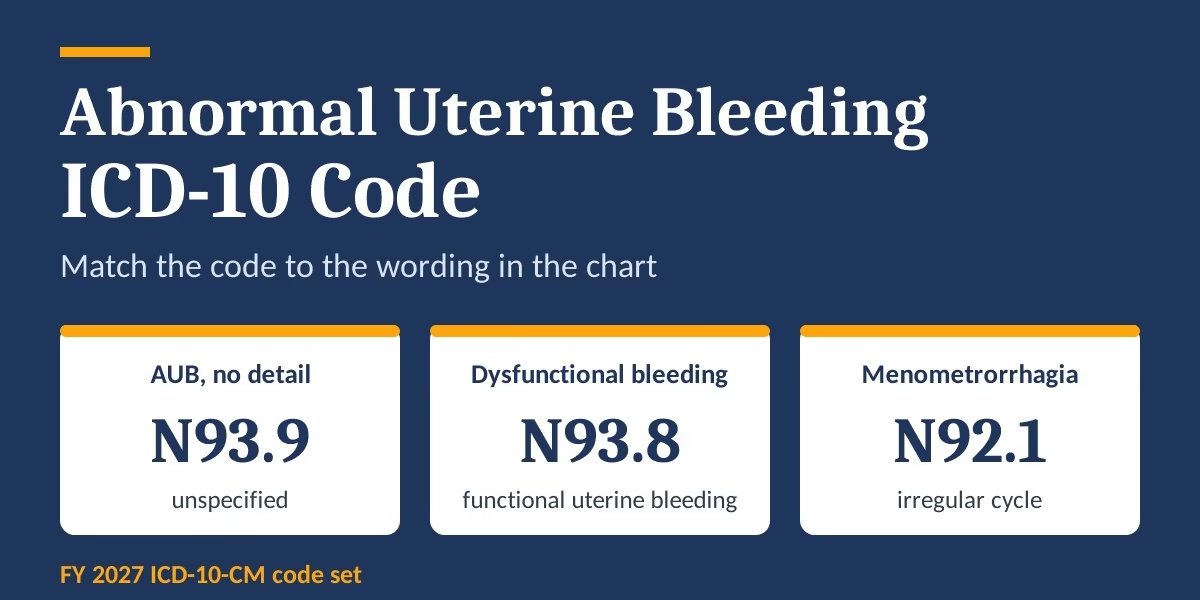
Abnormal uterine bleeding (AUB) has no single ICD-10-CM code. Report N93.9 when the provider documents only abnormal bleeding, N93.8 for dysfunctional or functional bleeding, and N92.1 for menometrorrhagia or metrorrhagia.
This guide covers the related codes, how to tell them apart, which pairs are not reported together and what the provider should document. It uses the FY 2027 code set, in effect for dates of service from October 1, 2026, and supports the coding step of a clean revenue cycle management workflow.
| Key takeaways N93.9 is the code for abnormal uterine bleeding with no further detail. N93.8 covers dysfunctional or functional bleeding.Menometrorrhagia and metrorrhagia index to N92.1, which assumes an irregular cycle.Postmenopausal bleeding is N95.0, and the N92 category excludes it.Report the most specific code the note supports, and never repeat the same finding with a second bleeding code. |
Abnormal Uterine Bleeding ICD-10 Code by Documented Wording
AUB is a description, not a diagnosis, so the code follows the provider’s words. “Abnormal uterine bleeding” alone indexes to N93.9. “Dysfunctional” or “functional” uterine bleeding indexes to N93.8. Menometrorrhagia and metrorrhagia index to N92.1. Match the assessment to the table, then confirm the code in your encoder.
| What the provider documented | Code | Code title |
| Abnormal uterine bleeding, abnormal vaginal bleeding | N93.9 | Abnormal uterine and vaginal bleeding, unspecified |
| Dysfunctional or functional uterine bleeding | N93.8 | Other specified abnormal uterine and vaginal bleeding |
| Menometrorrhagia or metrorrhagia | N92.1 | Excessive and frequent menstruation with irregular cycle |
| Heavy periods with a regular cycle | N92.0 | Excessive and frequent menstruation with regular cycle |
| Heavy bleeding before menopause | N92.4 | Excessive bleeding in the premenopausal period |
| Bleeding after intercourse | N93.0 | Postcoital and contact bleeding |
| Bleeding after menopause | N95.0 | Postmenopausal bleeding |
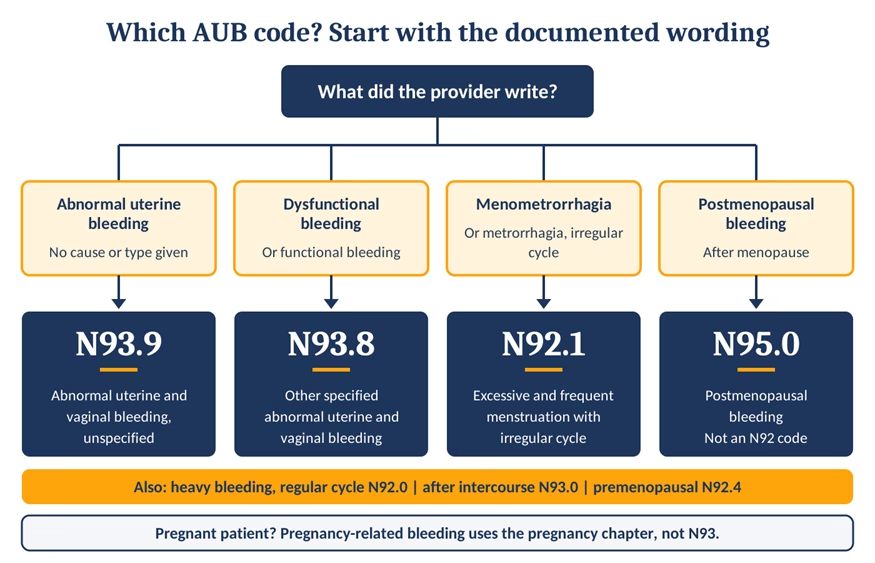
Summary: AUB with no detail goes to N93.9, dysfunctional bleeding to N93.8, menometrorrhagia to N92.1 and postmenopausal bleeding to N95.0.
What AUB Means and Why the Wording Matters
AUB describes bleeding that falls outside a normal pattern in timing, amount or length. The Office on Women’s Health guidance on the menstrual cycle says a normal cycle lasts between 24 and 38 days. It lists soaking through a pad or tampon every one to two hours, passing clots larger than a quarter, and bleeding longer than eight days as signs of heavy bleeding.
N93.9 vs N93.8: When Unspecified Is Correct
N93.9 fits when the provider documents abnormal uterine or vaginal bleeding and nothing more, for example while a work-up is still pending. Section I.B.18 of the FY 2027 ICD-10-CM Official Guidelines says to use an unspecified code when it best reflects what is known at that encounter, and not to order extra testing just to reach a more specific one.
The same reasoning applies to other unspecified codes, as our guide to unspecified depression codes shows. N93.8 applies when the provider writes dysfunctional or functional uterine bleeding. If the note says only “AUB,” do not pick N93.8 yourself. Send a query instead.
Sample (fictional data) provider query: “Dr. Lee, the April 12 note for this patient says abnormal uterine bleeding. Can you clarify whether this is dysfunctional uterine bleeding, menometrorrhagia or another type, so the most specific diagnosis can be reported?” Change the name, date and wording to match your chart.
N92.1 for Menometrorrhagia and Metrorrhagia
The ICD-10-CM index sends both menometrorrhagia and metrorrhagia to N92.1, excessive and frequent menstruation with irregular cycle. If the provider describes heavy bleeding with a regular cycle, the code is N92.0, which our guide to coding heavy menstrual bleeding covers in depth.
Perimenopause, postmenopause and pregnancy
Heavy bleeding in the premenopausal period is N92.4. Bleeding after menopause is N95.0, and the two are kept apart by Excludes1 notes. If the patient is pregnant, bleeding is reported with codes from the pregnancy chapter (O00 through O9A), not N93, so confirm pregnancy status before choosing a code.
Excludes1 Notes to Check Before You Bill
An Excludes1 note means two conditions are not reported together. These are the notes that matter most for bleeding codes.
| Code pair | Together? | Reason |
| N92.- and N95.0 | No | The N92 category excludes postmenopausal bleeding (N95.0). |
| N92.6 and N92.1 | No | N92.6 excludes shortened intervals or excessive bleeding, which belong in N92.1. |
| N95.0 and N92.4 | No | The N95 category excludes excessive bleeding in the premenopausal period (N92.4). |
Section I.A.12.a of the official guidelines allows both codes of an Excludes1 pair only when the two conditions are unrelated. If it is unclear, query the provider.
When the Provider Documents a Cause
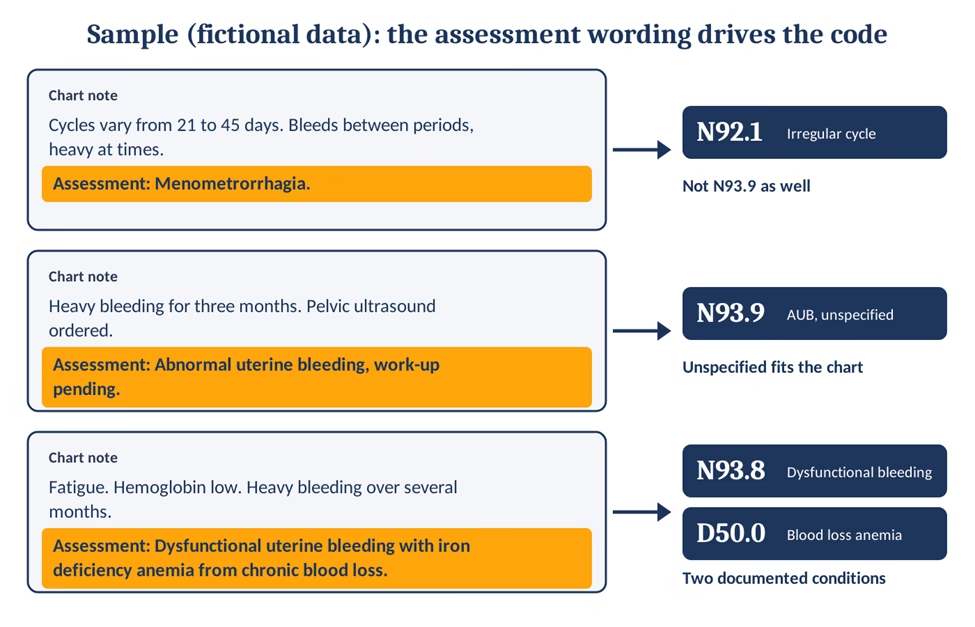
AUB is often a symptom of something confirmed later. If the note names a cause, such as a uterine fibroid (D25.9) or an endometrial polyp (N84.0), code the confirmed condition. Section I.B.5 says signs and symptoms routinely associated with a disease are not coded separately, so ask before adding N93.9 on top of a confirmed cause.
Anemia is a separate condition. If the provider documents iron deficiency anemia due to chronic blood loss, D50.0 can be reported with the bleeding code. D50.0 excludes acute posthemorrhagic anemia (D62), and a low lab value alone is not a diagnosis.
Sample Chart Notes and the Codes They Support
Common AUB Coding Mistakes and How to Prevent Them
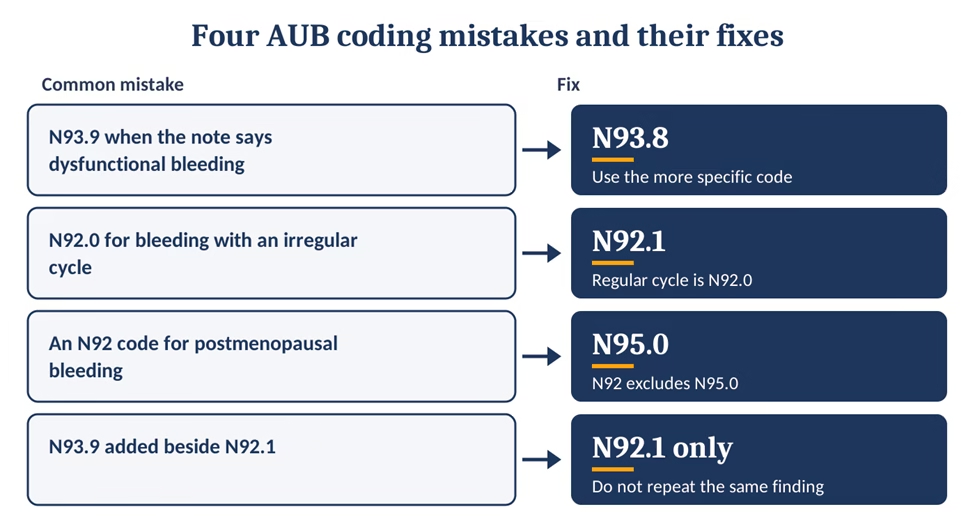
- Add an encoder prompt. Flag N93.9 when the note contains “dysfunctional” or “functional,” so the coder reviews N93.8.
- Keep a query template. Use the sample query above whenever the assessment is only “AUB.”
Bleeding codes often support tests such as a pelvic ultrasound, so review how to prevent medical necessity denials. Medicare contractors and commercial payers set their own coverage rules, so check the payer’s policy and provider manual. See also these common medical coding errors.
What the Provider Should Document
- The bleeding pattern: timing, amount and length, and whether the cycle is regular or irregular.
- Menopausal status and pregnancy status.
- The assessment in words: abnormal uterine bleeding, dysfunctional uterine bleeding, menometrorrhagia or another type.
- Any confirmed cause and related conditions, such as anemia.
Frequently Asked Questions
What is the ICD-10 code for abnormal uterine bleeding?
N93.9, abnormal uterine and vaginal bleeding, unspecified, is the code when the provider documents abnormal uterine bleeding without more detail. Use N93.8 for dysfunctional or functional bleeding and N92.1 for menometrorrhagia or metrorrhagia. The provider’s assessment wording decides which one applies.
What is the ICD-10 code for dysfunctional uterine bleeding?
N93.8, other specified abnormal uterine and vaginal bleeding. The ICD-10-CM index sends both dysfunctional and functional uterine bleeding to N93.8. If the provider writes only abnormal uterine bleeding, use N93.9 instead, or query the provider for a more specific diagnosis before billing.
What is the ICD-10 code for menometrorrhagia?
N92.1, excessive and frequent menstruation with irregular cycle. The index lists both menometrorrhagia and metrorrhagia under N92.1. Do not add N93.9 for the same finding. If the cycle is regular with heavy bleeding, N92.0 applies instead, so the cycle pattern in the note matters.
Can you code abnormal uterine bleeding and anemia together?
Yes, when the provider documents both. Iron deficiency anemia secondary to chronic blood loss is D50.0, which can be reported with the bleeding code. D50.0 excludes acute posthemorrhagic anemia (D62). Do not assume anemia from a low lab value; the provider must document the diagnosis.
What is the ICD-10 code for postmenopausal bleeding?
N95.0, postmenopausal bleeding. The N92 category excludes postmenopausal bleeding, so an N92 code should not stand in for it. N92.4 is for excessive bleeding in the premenopausal period. The provider’s documentation of menopausal status decides which one applies.
Do the AUB codes change in FY 2027?
No. N93.9 and N92.1 show no changes in the FY 2027 code set, effective October 1, 2026. Still review the full list of updates before the new year, as our summary of the FY 2027 ICD-10-CM code changes explains.
Final Thoughts
Choosing an abnormal uterine bleeding ICD-10 code comes down to the provider’s wording. Plain AUB is N93.9, dysfunctional or functional bleeding is N93.8, menometrorrhagia and metrorrhagia are N92.1, and postmenopausal bleeding is N95.0. Excludes1 notes keep the groups apart.
Need Help With Gynecology Claims?
If gynecology claims keep returning with diagnosis edits or denials, a coding review can show where documentation and codes drift apart. Zmed Solutions supports OB-GYN practices with eligibility verification, denial management and compliance support, as described in our OB-GYN medical billing and coding guide. You can reach the team through the contact page.
Sources and note: CMS (FY 2027 ICD-10-CM Official Guidelines), the HHS Office on Women’s Health, and the FY 2027 ICD-10-CM code set. Educational information only, not legal or medical advice.
Ready to optimize your medical billing and boost your revenue? Look no further. Zmed Solutions LLC is your trusted partner in professional Medical Billing Services.
Join our growing network of healthcare providers who have already elevated their revenue with our expert services. Don't miss out on what could be your practice's most profitable decision.
Schedule a Consultation Today!
Contact Us Now, and experience the difference. Your financial success starts here!