The PR 1 denial code means the payer applied some or all of the allowed amount to the patient’s deductible, so that portion is the patient’s to pay. It is a processed claim, not a rejection, but it is not always a clean patient bill either. This guide explains how to read PR 1 on a remittance, how the math works, when you must not bill the patient, how to spot a wrong deductible and how to collect the right amount without surprises.
| Key takeaways PR 1 is reason code 1, deductible amount, under the Patient Responsibility group.Only the PR amount can go to the patient; the CO-45 difference is always the provider’s write-off.Bill any secondary payer before sending a patient statement for a PR 1 balance.Patients in the QMB program cannot be billed for Medicare deductibles, even when PR 1 appears.Check the deductible total before billing; payers sometimes apply it in error. |
What the PR 1 Denial Code Means
Every line on an electronic remittance advice (ERA) or explanation of benefits (EOB) can carry adjustments made of a group code and a claim adjustment reason code (CARC). In the X12 Claim Adjustment Reason Code list, code 1 simply means deductible amount. Paired with PR, Patient Responsibility, it tells you the payer expects the patient, not the plan, to cover that part of the allowed amount.
Billers call it a denial because the payer often pays nothing on early-year claims, but nothing is wrong with the claim itself. The payer accepted it, priced it and applied its benefit rules. If you are new to reading these documents, our guide to understanding the explanation of benefits walks through each field.
The trap is treating every PR 1 as an automatic patient bill. Secondary coverage, Medicaid, QMB status or a payer error can all change what the patient really owes, which is why PR lines belong in the same disciplined denial management and appeals process as true denials.
PR 1 vs PR 2, PR 3 and CO 45
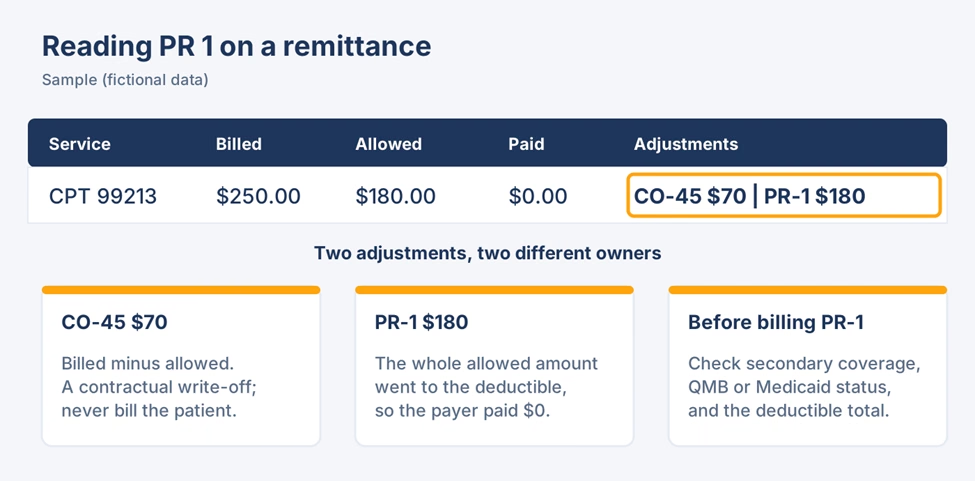
PR 1 often shows up beside other adjustments on the same service line. Each one has a different owner and a different next step.
| Adjustment | Meaning | Who owes it | What to do |
| PR-1 | Deductible amount | Patient, unless secondary, Medicaid or QMB rules apply | Check other coverage, then bill the patient |
| PR-2 | Coinsurance amount | Patient, with the same checks | Bill after the secondary payer, if any |
| PR-3 | Co-payment amount | Patient | Usually collected at the visit |
| CO-45 | Charge above the fee schedule or contracted rate | Provider | Write off; never bill the patient |
The billed-versus-allowed difference is the piece most often billed in error. It belongs to the provider as a CO 45 contractual adjustment, even when the rest of the line goes to the patient’s deductible.
Worked Example: How a PR 1 Amount Is Calculated
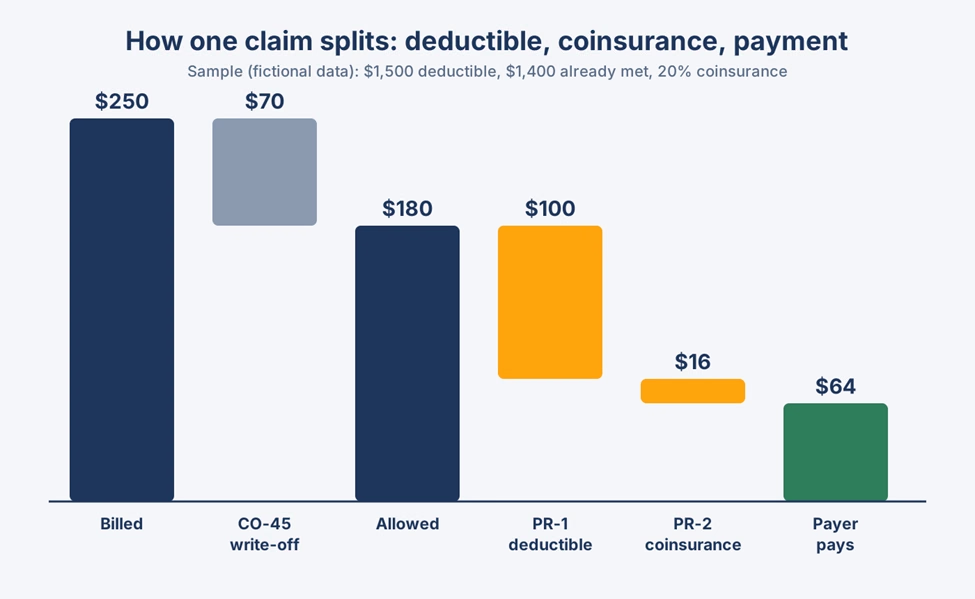
Sample (fictional data). A patient’s commercial plan has a $1,500 annual deductible, of which $1,400 is already met, and 20% coinsurance after that. The practice bills $250 for an office visit, and the contracted allowed amount is $180.
- CO-45: $70. Billed $250 minus allowed $180, written off by the practice.
- PR-1: $100. The remaining deductible comes out of the $180 allowed amount first.
- PR-2: $16. Coinsurance of 20% on the $80 left after the deductible.
- Payer pays: $64. The rest of the allowed amount.
The patient owes $116 in total, never the $70 contractual difference. Posting these amounts to the right buckets is a core part of accurate payment posting in medical billing.
Medicare and the Part B Deductible
For Original Medicare Part B, PR 1 reflects the annual Part B deductible, which CMS resets each calendar year. According to the CMS 2026 Medicare Parts A and B premiums and deductibles fact sheet, the Part B deductible for 2026 is $283. That is why January and February claims often come back with PR 1 and little or no payment.
Commercial and Medicare Advantage plans set their own deductibles, plan years and network rules. Some reset on a date other than January 1, and in-network and out-of-network deductibles may be tracked separately, so always check the patient’s plan details rather than assuming a calendar-year reset.
QMB and Medicaid Patients: When PR 1 Is Not Billable
Patients enrolled in the Qualified Medicare Beneficiary (QMB) program are a key exception. The CMS Medicare Learning Network fact sheet on the QMB billing prohibition states that Original Medicare and Medicare Advantage providers may not bill QMB patients for Part A or Part B deductibles, coinsurance or copayments, even if Medicaid pays nothing. Amounts already collected must be refunded.
Medicare remittances can still show PR 1 for these patients. Noridian, a Medicare Administrative Contractor, explains that QMB claims may carry remark code N781, meaning no deductible may be collected, alongside the PR adjustment. Treat that remark as a stop sign, and bill the state Medicaid program or its managed care plan instead.
How to Work a PR 1 Line Before Billing the Patient
Use the same order every time so a statement never goes out too early or to the wrong person.
- Post the adjustments correctly. Record CO-45 as a write-off and PR-1 as patient responsibility, matching the ERA to the cent.
- Check for other coverage. If a secondary plan or Medicare crossover exists, send the claim there first and hold the patient statement. Up-to-date coordination of benefits records make this step reliable.
- Check QMB and Medicaid status. Look for remark codes such as N781 and confirm eligibility before billing a Medicare patient.
- Confirm the deductible amount. Compare the PR-1 total with the remaining deductible from eligibility and earlier remits.
- Bill the patient or call the payer. If everything matches, send the statement. If it does not, ask the payer to reprocess.
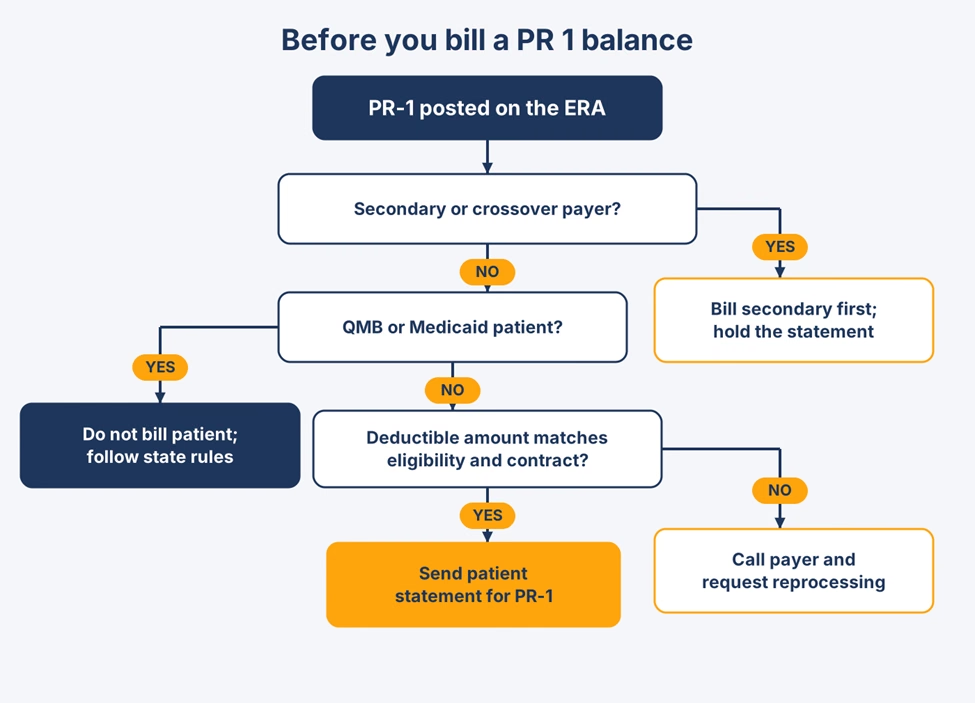
In short: other coverage first, protected patients never, and a patient statement only when the deductible amount checks out.
When a PR 1 Amount Is Wrong
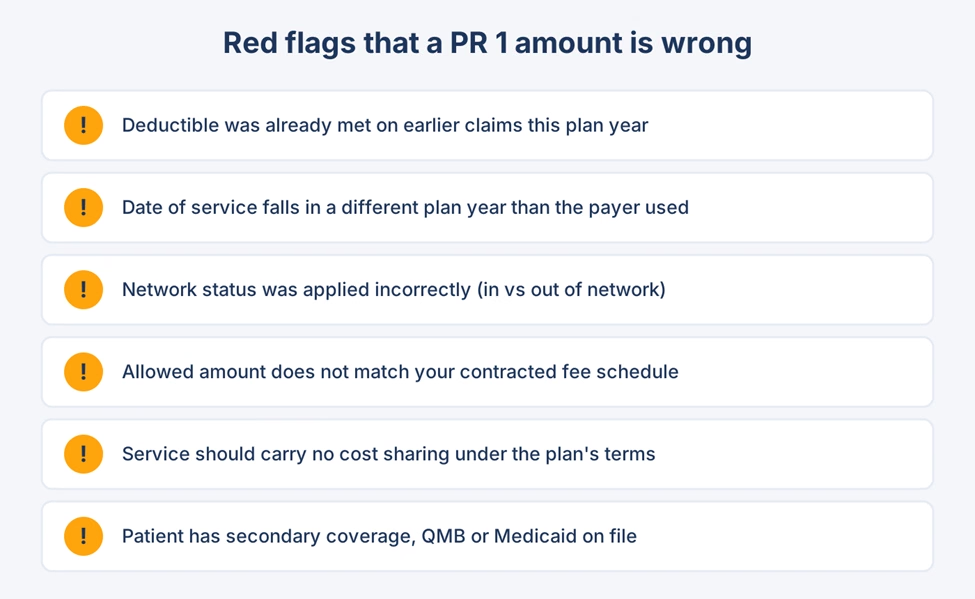
Payers make deductible mistakes, especially early in a plan year or after a plan change. PR 1 is rarely appealed the way a denial is, but you can and should ask for reprocessing when the numbers do not add up.
- The deductible was already met on earlier claims in the same plan year.
- The payer applied the wrong plan year or a terminated plan.
- An in-network service was processed with the out-of-network deductible, or the reverse.
- The allowed amount does not match your contract, which inflates the PR-1 figure.
- The service should carry no cost sharing under the plan’s terms, such as many preventive benefits.
Gather the eligibility response, earlier remittances showing deductible payments and the contract rate, then call the payer or submit a reconsideration through its provider portal, as the payer’s manual directs.
Collecting PR 1 Balances Without Surprises
A deductible bill that arrives weeks after a visit is one of the most common reasons patients call upset. Confirm the remaining deductible before the visit, give patients a cost estimate and decide your policy for collecting at check-in. The legal and contractual limits on collecting deductibles upfront are worth reviewing before you change front-desk scripts.
After adjudication, send clear statements quickly and offer simple payment options. Practical patient balance collection strategies keep PR 1 balances from aging into bad debt.
Frequently Asked Questions
Is PR 1 a denial?
Not in the usual sense. PR 1 means the claim was processed and the payer applied all or part of the allowed amount to the patient’s deductible. The plan may pay nothing on that line, but there is usually nothing to correct. Your job is to confirm the amount and decide who owes it, not to resubmit the claim.
Can I bill the patient for a PR 1 amount?
Usually, but only after you rule out secondary coverage, Medicaid and QMB status, and confirm the deductible is accurate. Bill only the PR amount, never the CO-45 difference between billed and allowed charges. Medicare QMB patients cannot be billed for deductibles at all, even when the remittance shows PR 1.
Can you appeal a PR 1 adjustment?
Rarely, because PR 1 reflects the plan’s benefit design. If the payer applied the deductible in error, for example after it was already met or under the wrong network tier, request reprocessing or a reconsideration with earlier remittances and eligibility records. Follow the payer’s provider manual for the right channel and deadline.
What if the patient has secondary insurance?
Send the claim to the secondary payer with the primary remittance before billing the patient. Many secondary plans pick up some or all of the primary deductible. Bill the patient only for what remains after the secondary payer processes the claim, and make sure the order of benefits on file is correct.
Why do PR 1 adjustments spike in January?
Many deductibles, including the Original Medicare Part B deductible, reset at the start of the calendar year. Early visits are applied to the new deductible, so payers pay little or nothing until it is met. Plans with a different plan year see the same spike around their own reset date.
Get Help With Patient Responsibility Posting
Handled well, the PR 1 denial code is just a routing instruction: it tells you which balance to move to the next payer or the patient. Handled poorly, it creates improper bills, refunds and unhappy patients. If your team needs support, Zmed Solutions offers revenue cycle management services that include payment posting and denial follow-up, so deductible balances land with the right party the first time.
Sources: X12 Claim Adjustment Reason Codes; CMS fact sheet, 2026 Medicare Parts A and B Premiums and Deductibles; CMS Medicare Learning Network, Prohibition on Billing Qualified Medicare Beneficiaries; Noridian Healthcare Solutions, QMB remittance guidance. This article is general billing information, not legal advice; plan rules vary, so confirm them in your payer contracts and manuals.
Ready to optimize your medical billing and boost your revenue? Look no further. Zmed Solutions LLC is your trusted partner in professional Medical Billing Services.
Join our growing network of healthcare providers who have already elevated their revenue with our expert services. Don't miss out on what could be your practice's most profitable decision.
Schedule a Consultation Today!
Contact Us Now, and experience the difference. Your financial success starts here!