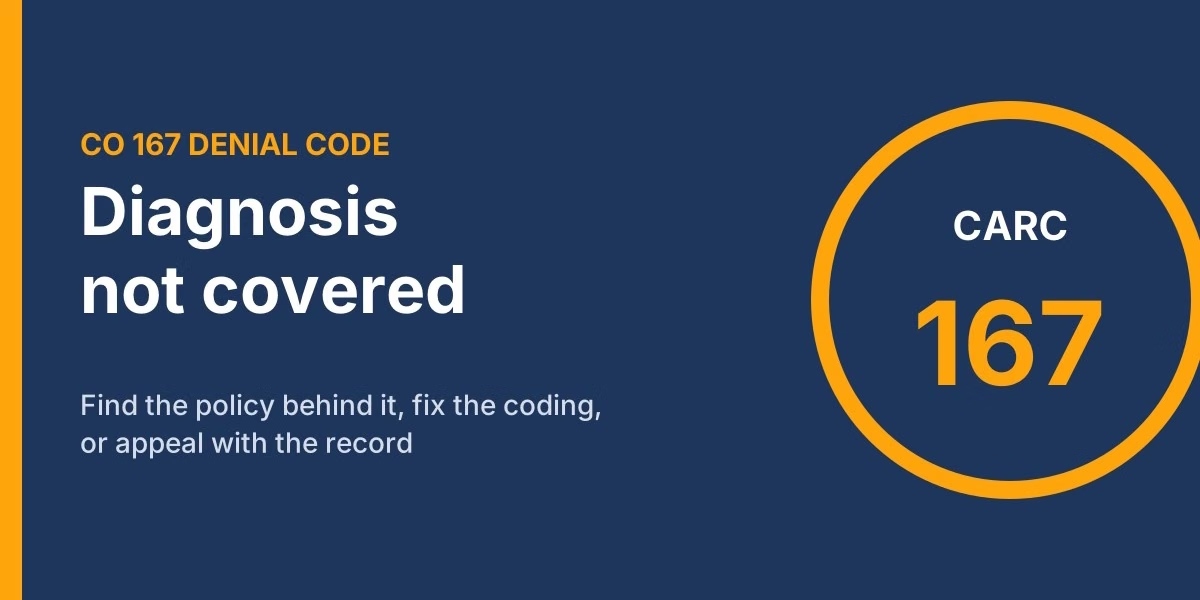
The CO 167 denial code means the payer will not cover the service for the diagnosis reported on the claim. Because the group code is CO, the loss stays with the provider unless a valid waiver was signed before care. This guide explains how to read CO 167, how it differs from similar diagnosis denials, how to decide between a corrected claim, an appeal and a write-off, and how to stop these denials before claims go out.
| Key takeaways CO 167 means the diagnosis on the claim is not covered for the billed service.The fix starts with the medical record: a more specific, documented diagnosis often resolves it.If the record supports a covered diagnosis already on the claim, appeal with the payer’s own policy.With a CO group code, the patient cannot be billed unless a valid ABN or plan waiver was signed first.Policy checks, specific coding and scrubber edits prevent most CO 167 denials. |
What the CO 167 Denial Code Means
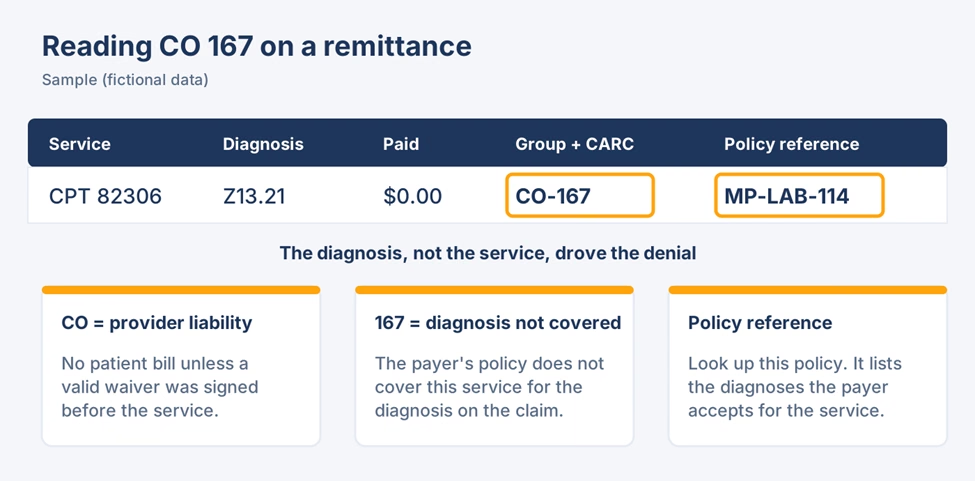
Each adjustment on an electronic remittance advice (ERA) or explanation of benefits (EOB) pairs a group code with a claim adjustment reason code (CARC). In the X12 Claim Adjustment Reason Code list, code 167 states that the diagnosis or diagnoses are not covered. Its usage note directs billers to the payer’s policy reference in the 835 remittance, when one is sent.
In plain terms, the payer looked at the diagnosis codes on the claim and found none that its coverage rules accept for that service. The service itself may be covered for other conditions; the problem is the pairing. CO, Contractual Obligation, means the provider absorbs the adjustment.
Because the cause usually sits in coding or documentation, CO 167 works best inside a structured denial management and appeals process where coders and billers review the denial together.
CO 167 vs Other Diagnosis-Related Denials
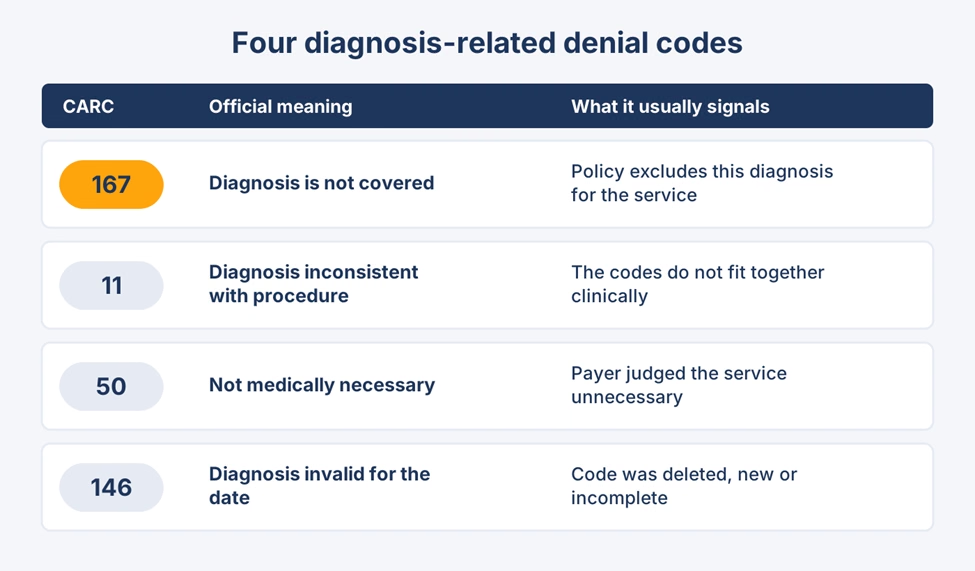
Several reason codes point at the diagnosis, and each calls for a different fix. All four below are defined in the X12 code list.
| CARC | Official meaning | Usual cause | First step |
| 167 | Diagnosis is not covered | Payer policy does not list the diagnosis for the service | Check the record and the payer policy |
| 11 | Diagnosis is inconsistent with the procedure | Diagnosis and procedure do not fit clinically | Review coding and linkage on the claim |
| 50 | Not deemed a medical necessity by the payer | Payer judged the service unnecessary | Compare documentation with coverage criteria |
| 146 | Diagnosis invalid for the date of service | Deleted, new or incomplete code | Code with the code set in effect that date |
CO 167 and CARC 50 often overlap in practice, since both depend on whether the diagnosis meets coverage criteria. The same documentation habits behind preventing medical necessity denials help with both.
Common Causes of CO 167 Denials
- Unspecified or symptom codes. The record supports a specific condition, but the claim carries a vague code the policy does not accept.
- Wrong diagnosis linked to the line. The covered diagnosis is on the claim but not pointed to the service line that needs it.
- Screening versus diagnostic coding. A test coded as screening when the plan only covers it for a documented condition.
- Policy limits. The payer’s policy or a Medicare Local Coverage Determination (LCD) lists a narrower set of covered diagnoses.
- Code set or policy changes. Annual ICD-10-CM updates and policy revisions change which codes are valid or covered.
Coding to the documentation is not optional. The FY 2027 ICD-10-CM Official Guidelines for Coding and Reporting require codes at the highest specificity the record supports and allow signs and symptoms only when no definitive diagnosis has been established. Changing a diagnosis just to get paid, without documentation, is never an acceptable fix.
How to Fix a CO 167 Denial
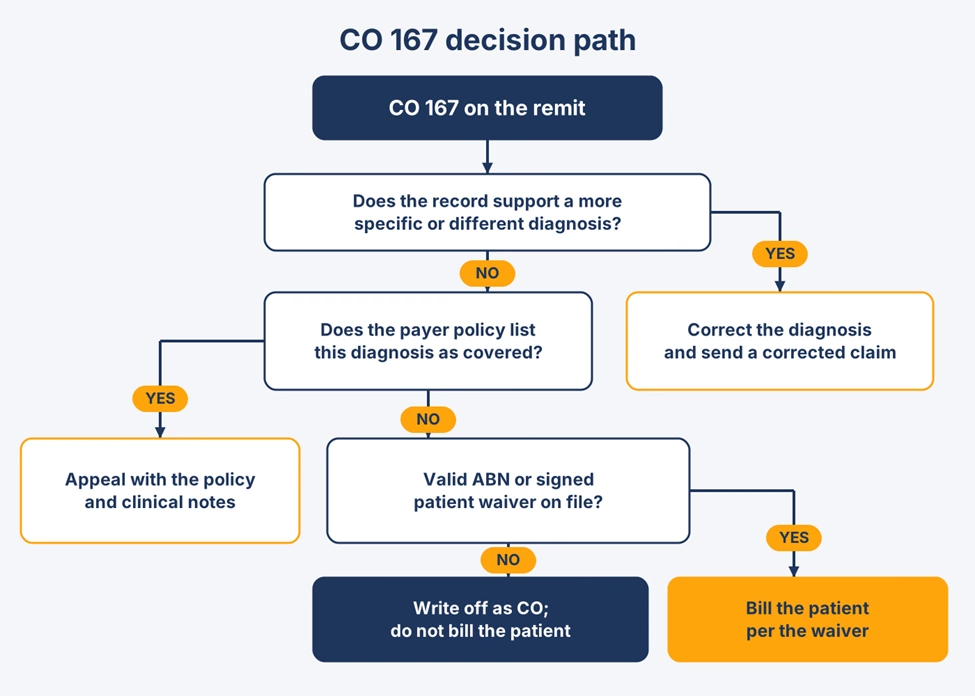
Work CO 167 denials in this order, so coding errors are corrected before anyone writes an appeal.
- Find the policy. Note the policy reference on the 835 and pull the payer’s coverage policy, or for Medicare, the LCD and its billing and coding article.
- Compare the record with the claim. Have a coder check whether the documentation supports a more specific or different diagnosis than the one billed, and whether it was linked to the right line.
- Correct and resubmit when the claim was wrong. Send a corrected claim with the documented diagnosis, following the payer’s corrected-claim rules.
- Appeal when the payer was wrong. If a covered, documented diagnosis was already on the claim, appeal with the policy language and clinical notes.
- Decide liability when coverage truly does not apply. With a valid ABN or plan waiver, bill the patient; without one, post a CO write-off and log the cause.
Medicare coverage policies are public. The CMS guide to searching the Medicare Coverage Database shows how to find national and local coverage documents by code, keyword or contractor, which is the fastest way to see the diagnoses an LCD accepts.
When the Patient Can Be Billed
For Original Medicare, a provider who expects a denial because the diagnosis does not meet coverage criteria should issue an Advance Beneficiary Notice of Noncoverage (ABN) before the service and append the GA modifier. Without a valid ABN, the patient generally cannot be billed. Our guide to using the ABN correctly in medical billing covers timing and completion.
Commercial and Medicare Advantage plans set their own rules for patient waivers in the provider contract and manual, so check those before billing any CO 167 balance to a patient.
Sample CO 167 Appeal Letter
Sample (fictional data). Replace the practice, payer, patient, claim, policy and clinical details with your own, attach the record and policy pages you cite, and use the payer’s appeal form if one is required.
| Lakeview Internal Medicine November 9, 2026 Northbridge Health Plan, Provider Appeals Re: Appeal of diagnosis-not-covered denial (CO-167) Patient: Jordan Ellis Member ID: NBH4472190 Claim number: NB-26-0093318 Date of service: October 20, 2026 Service: laboratory test, line 1 Billed amount: $68.00 We are appealing the denial of line 1 above as a diagnosis not covered. The remittance references Northbridge medical policy MP-LAB-114. Section 3 of that policy lists the documented condition on this claim as a covered indication for the test. The enclosed progress note from October 20, 2026, documents that condition and the physician’s order for the test. The diagnosis was reported and linked to line 1 on the original claim. We ask that the line be reprocessed for payment. Contact: Maria Lopez, Billing Manager, Lakeview Internal Medicine |
How to Prevent CO 167 Denials
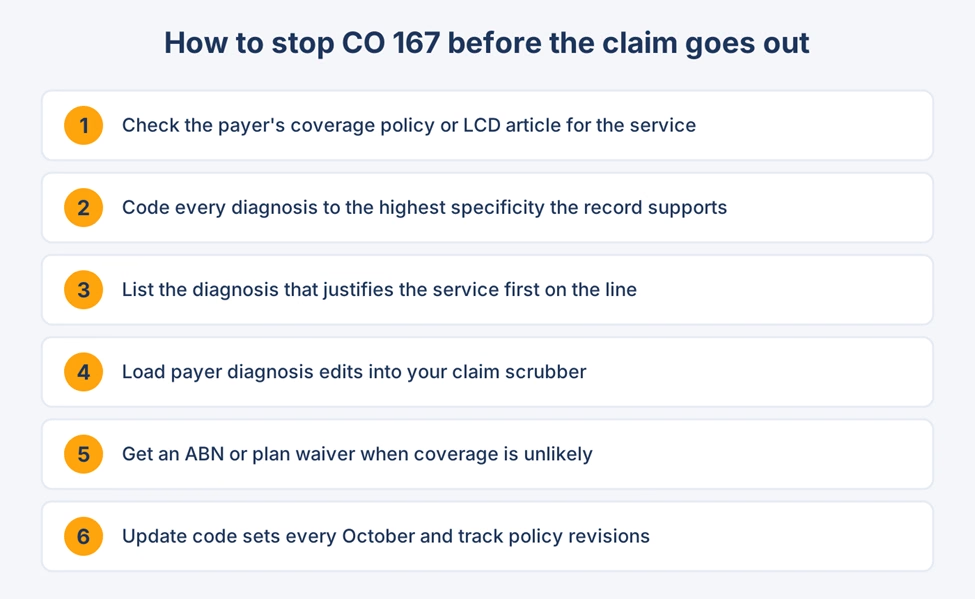
Prevention depends on matching each diagnosis to the payer’s policy before the claim leaves. A clear grasp of how ICD-10 and CPT codes work together on a claim is the foundation; the steps below build on it.
- Check the payer’s coverage policy or LCD article for high-denial services before scheduling them.
- Code each diagnosis to the highest specificity the documentation supports, and query providers when notes are vague.
- Link the diagnosis that justifies each service to that line, listing it first where the payer expects it.
- Load payer diagnosis edits into your claim scrubbing rules so mismatches stop before submission.
- Confirm plan type and benefits at intake with reliable eligibility verification tools, since policies differ by plan.
- Review CO 167 trends in regular coding audits, and update code sets and policies each October.
Frequently Asked Questions
Can I change the diagnosis code and resubmit after a CO 167 denial?
Only if the medical record supports the new code. If the documentation shows a more specific or different diagnosis that was missed, send a corrected claim. Changing a diagnosis without documentation to fit a payer policy is improper coding and creates compliance risk. When the record is unclear, query the provider before resubmitting.
Can I bill the patient for a CO 167 denial?
Not unless a valid waiver was signed before the service. For Original Medicare, that means a properly completed ABN and the GA modifier on the claim. Without it, the CO group code makes the balance a provider write-off. Commercial plans set their own waiver rules in the provider contract.
What is the difference between CO 167 and CO 11?
CO 11 says the diagnosis is inconsistent with the procedure, meaning the codes do not fit together clinically. CO-167 says the diagnosis is not covered, meaning the pairing may be clinically sensible but the payer’s policy excludes it. CO 11 usually points to a coding fix, while CO 167 sends you to the coverage policy.
How do I find which diagnoses a payer covers for a service?
Start with the policy reference on the remittance, then search the payer’s medical or coverage policies. For Original Medicare, use the Medicare Coverage Database to find the National Coverage Determination or the LCD and its billing and coding article, which lists covered ICD-10-CM codes for many services.
Can a CO 167 denial be appealed?
Yes, when the claim already carried a documented diagnosis that the payer’s policy covers, or when the policy was applied in error. Attach the policy section, the clinical notes and the original claim. If the diagnosis truly falls outside the policy, an appeal is unlikely to change the result.
Get Help Reducing Diagnosis Denials
A steady flow of the CO 167 denial code usually points to coding specificity, diagnosis linkage or missing policy checks rather than bad luck. Fixing those habits protects revenue on every future claim. If your team needs support, Zmed Solutions offers revenue cycle management services that include coding review and denial management, so diagnosis denials are caught and corrected at the source.
Sources: X12 Claim Adjustment Reason Codes; CDC/NCHS ICD-10-CM Official Guidelines for Coding and Reporting, FY 2027; CMS, How to Search the Medicare Coverage Database. This article is general billing information, not legal or coding-compliance advice; payer policies change, so confirm them in your contracts and payer manuals.
Ready to optimize your medical billing and boost your revenue? Look no further. Zmed Solutions LLC is your trusted partner in professional Medical Billing Services.
Join our growing network of healthcare providers who have already elevated their revenue with our expert services. Don't miss out on what could be your practice's most profitable decision.
Schedule a Consultation Today!
Contact Us Now, and experience the difference. Your financial success starts here!