An OA-23 denial code shows the dollar impact of a prior payer’s payment and adjustment on a secondary claim. The “OA” (Other Adjustment) group code means neither the practice nor the patient owes this amount — it’s simply the portion already accounted for elsewhere. This article covers how the OA-23 math works, when it signals a real problem, and how to prevent avoidable ones.
| Key Takeaways CARC 23 (“Use only with Group Code OA”) reflects the impact of a prior payer’s payment and adjustment — it doesn’t require a remark code. OA-23 is often a routine coordination-of-benefits (COB) calculation, not a true denial, so check the math before appealing it.Per X12’s 835 guidance, the OA-23 amount must equal the prior payer’s payment plus its own contractual adjustment, combined. A wrong OA-23 figure usually traces back to a missing primary EOB, a flipped payer sequence, or the amount being split across claim and line levels. Verifying coverage order at registration prevents most OA-23 problems before the claim is ever billed. |
What Does OA-23 Mean on Your Remittance Advice?
The X12 Claim Adjustment Reason Codes list defines CARC 23 as: “The impact of prior payer(s) adjudication including payments and/or adjustments. (Use only with Group Code OA)” Unlike CO-234 or CO-252, it doesn’t require a remark code — the amount itself is the explanation. It appears on a secondary claim’s remittance to show what a prior payer already paid and adjusted, before the secondary payer calculates its own share.
Is OA-23 a Real Denial or Just an Expected Adjustment?
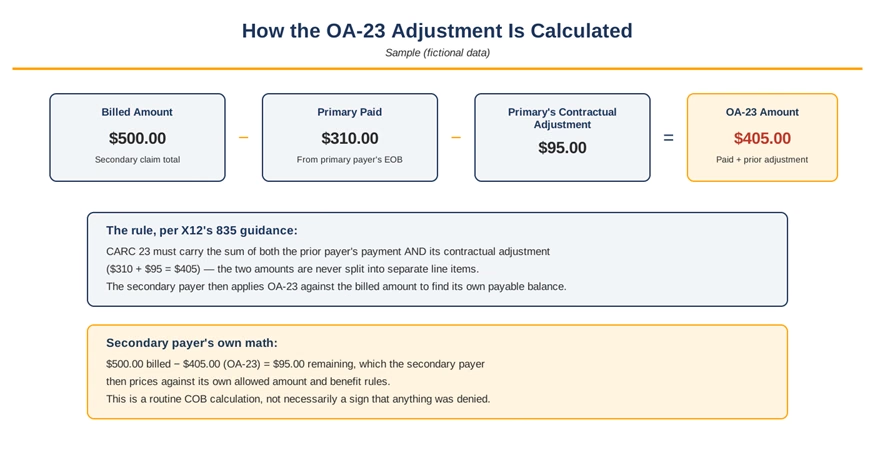
Most of the time, OA-23 is not a denial at all — it’s bookkeeping. When a patient has two payers, the secondary payer needs to know what the primary already covered so it doesn’t pay twice. OA-23 carries that figure. The line only deserves a closer look when the amount doesn’t match what the primary payer’s own EOB shows, or when it shows up on a claim that shouldn’t have involved a prior payer at all.
How the COB Math Behind OA-23 Works
Per an X12 interpretation on OA-23 reporting, the code “must include the sum of both the prior payment(s) and adjustment(s)” — the two figures are never split into separate line items, and the total should be reported once, at either the claim level or the line level, not both. The worked example below shows the calculation.
Common Reasons an OA-23 Amount Looks Wrong
The Primary Payer’s EOB Is Missing or Incomplete
The secondary payer can only calculate OA-23 correctly if it has the primary payer’s actual paid and adjusted amounts. A missing or estimated EOB produces a figure that won’t reconcile with the real numbers.
The Payer Sequence Is Reversed
If the plans were billed in the wrong order — the true secondary payer billed as primary, or vice versa — the OA-23 math will be built on the wrong starting numbers entirely, and the whole claim needs to be reprocessed in the correct order.
The Amount Was Reported at Both Claim and Line Level
X12’s guidance is explicit that the same prior-payer dollars should not be adjusted twice — once at the line level and again at the claim level. When that happens, the reported OA-23 total overstates the real adjustment and the secondary payment comes out too low.
How to Verify and Fix an OA-23 Adjustment
- Pull the primary payer’s EOB and add its paid amount to its contractual adjustment for that line.
- Compare that total to the OA-23 amount on the secondary remittance — they should match exactly.
- If they match, the adjustment is correct; price the remaining balance under the secondary plan’s own benefits.
- If they don’t match, check whether the figure was split across claim and line levels, or whether the payer sequence is correct.
- Contact the secondary payer with both EOBs in hand if the discrepancy remains after those checks.
OA-23 vs. CO-22: What’s the Difference?
Both codes involve a prior payer, which is why they’re easy to confuse. CO-22 denial code means the claim was denied because it may be covered by another payer under coordination of benefits — the claim hasn’t been priced yet. OA-23 is different: it shows up after COB is already applied, carrying the dollar figure of what the prior payer contributed. CO-22 asks “who pays this?”; OA-23 reports “here’s what the other payer already did.”
Payer Sequencing: Medicare vs. Commercial COB
| Area | Medicare Secondary Payer | Commercial COB |
| Who decides payer order | CMS’s Medicare Secondary Payer (MSP) rules, based on the type of other coverage (group plan, liability, no-fault, workers’ comp). | NAIC model COB rules and the plan’s own COB provision, often using the birthday rule for dependents. |
| Who recovers a mispaid claim | The Benefits Coordination & Recovery Center or Commercial Repayment Center. | The payer’s own COB or overpayment recovery unit. |
| Where to confirm the rule | CMS’s Coordination of Benefits & Recovery guidance. | The payer’s provider manual or COB policy. |
Whichever rule set applies, the underlying OA-23 math is the same: the secondary payer’s adjustment should always reconcile against the primary payer’s own figures.
How to Prevent OA-23 Problems
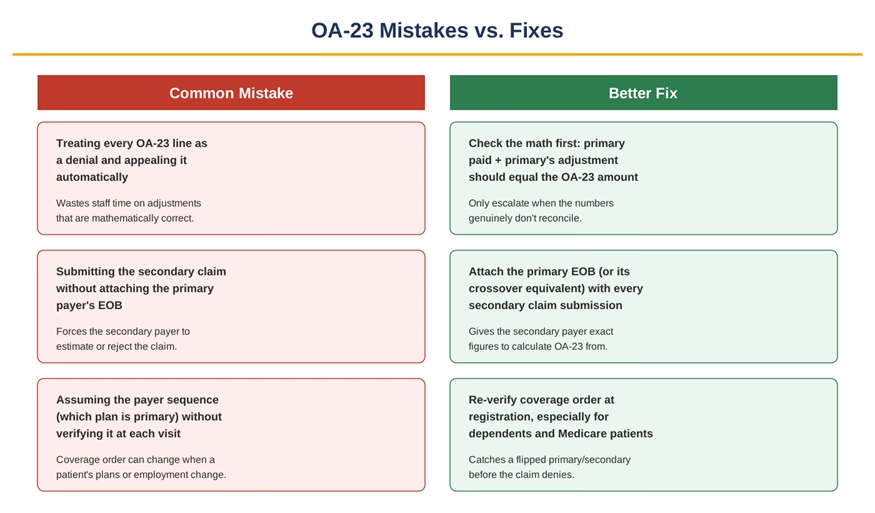
- Re-verify coverage order at registration, especially for dependents, Medicare patients, and recently changed employment.
- Attach the primary payer’s EOB (or its electronic crossover equivalent) with every secondary claim.
- Reconcile the OA-23 amount against the primary EOB before posting payment, not after.
- Report prior-payer adjustments once, at a consistent level (claim or line), per X12’s guidance.
- Track OA-23 discrepancies by payer to spot a recurring COB data problem rather than one-off errors.
Reading a Sample OA-23 Remittance Line
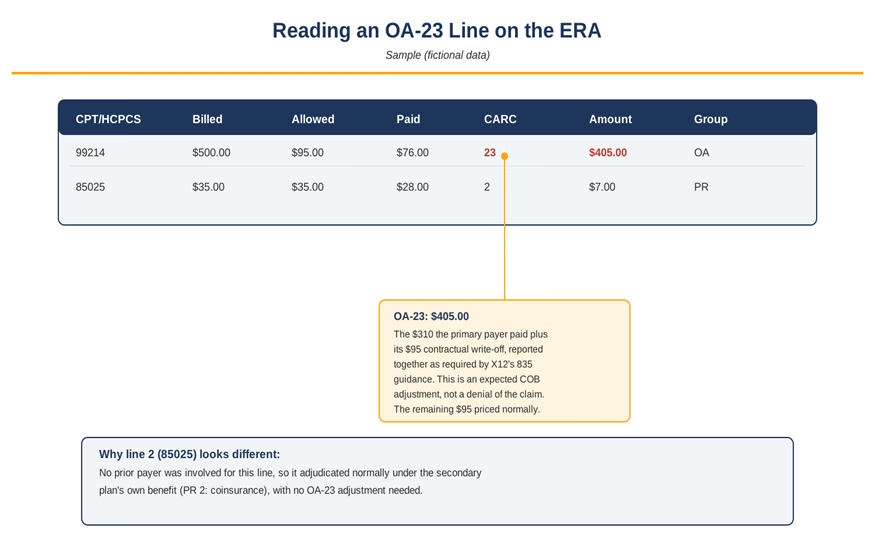
The annotated remittance below shows an OA-23 line next to a line with no prior payer involved, to illustrate the difference.
Frequently Asked Questions
What does OA-23 mean on an EOB?
It shows the combined dollar impact of a prior payer’s payment and adjustment on a secondary claim. It’s usually a routine coordination-of-benefits calculation, not a denial.
Can a patient be billed for an OA-23 amount?
No. The “OA” group code (Other Adjustment) means this amount is neither a provider write-off nor a patient responsibility — it’s accounted for by the prior payer.
Does OA-23 need a remark code?
No. Unlike CO-234 or CO-252, X12’s code list doesn’t require a remark code with CARC 23; the amount itself carries the explanation.
Why doesn’t my OA-23 amount match the primary EOB?
Usually because the primary EOB was incomplete. The payer sequence was reversed, or the adjustment was reported at both the claim and line level instead of once.
Is OA-23 the same as CO-22?
No. CO-22 is a denial saying another payer may owe first. OA-23 is the dollar figure reported once that other payer’s portion is known. See the CO-22 denial code guide for the fuller comparison.
Should every OA-23 line be appealed?
No. Check the math first — if the amount equals the primary payer’s payment plus its adjustment, the line is correct and doesn’t need an appeal.
Need Help Reviewing COB Adjustments?
Recurring OA-23 discrepancies often point to a coverage-verification or COB data gap upstream of billing. Zmed Solutions’ denial management and appeals services team can help audit secondary claims and tighten the COB verification process.
Sources: X12 Claim Adjustment Reason Codes and Requests for Interpretation (RFI 2570); CMS Coordination of Benefits & Recovery overview. This article is general billing information, not legal or payer-specific advice; always confirm current rules against your payer’s own provider manual.
Ready to optimize your medical billing and boost your revenue? Look no further. Zmed Solutions LLC is your trusted partner in professional Medical Billing Services.
Join our growing network of healthcare providers who have already elevated their revenue with our expert services. Don't miss out on what could be your practice's most profitable decision.
Schedule a Consultation Today!
Contact Us Now, and experience the difference. Your financial success starts here!