A CO-234 denial code means the payer will not pay separately for a billed service because it is bundled into another service already paid on the same claim. The claim adjustment group code “CO” (Contractual Obligation) tells the biller that the write-off is required under the payer’s contract, not optional and not the patient’s responsibility. This article covers why CO-234 happens, how to read it on the remittance, how to fix it, and how to keep it from recurring.
| Key Takeaways CARC 234 means “This procedure is not paid separately” and always arrives with at least one remark code. The three most common triggers: global surgery package bundling, NCCI procedure-to-procedure edits, and an add-on code billed without its primary. A modifier only fixes the denial when the facts support it — 24/58/78/79 for a global-period exception, or 59/XE/XS/XP/XU for an NCCI bypass. Commercial payers set their own bundling edits; Medicare’s NCCI rule doesn’t automatically apply to every payer. A pre-submission claim scrub for global periods and NCCI pairs prevents most CO-234 denials before they happen. |
What Does CO-234 Mean on Your Remittance Advice?
CO-234 on an Electronic Remittance Advice (ERA) or Explanation of Benefits (EOB) means the payer determined the procedure is not separately reimbursable because it is packaged into another line item’s payment. The “CO” group code means the balance cannot be billed to the patient.
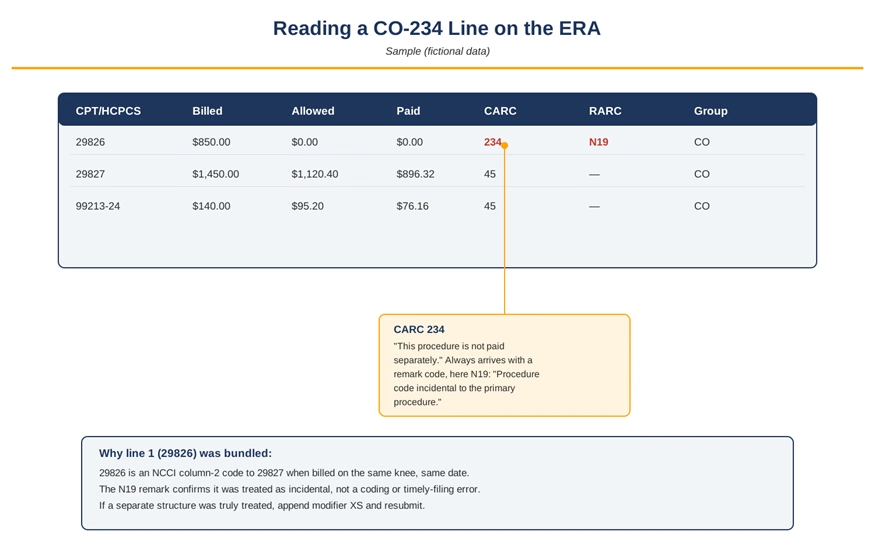
The X12 Claim Adjustment Reason Codes list defines CARC 234 as: “This procedure is not paid separately.” It also “requires at least one Remark Code,” which is why a CO-234 line is always paired with a remark code (RARC) explaining the specific reason. Three common pairings:
| Remark Code | What It Confirms |
| N19 | Procedure code incidental to the primary procedure. |
| M80 | Not covered when performed during the same session or date as a previously processed service for the patient. |
| M144 | Pre-/post-operative care payment is included in the allowance for the surgery or procedure. |
The remark code shows which cause below applies.
Why Payers Deny Claims with CO-234
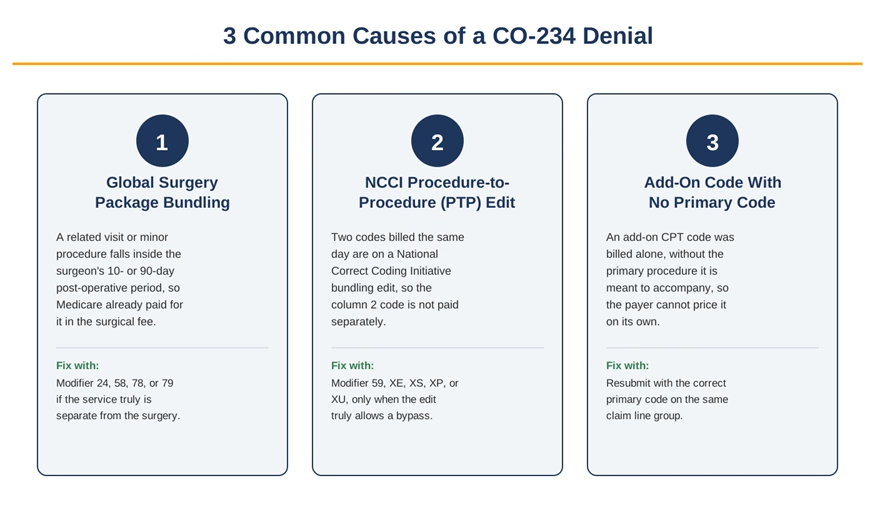
Global Surgery Package Bundling
Medicare’s global surgery package bundles a surgeon’s typical pre-, intra-, and post-operative care into one payment. CMS assigns every surgical CPT code a global period of 0, 10, or 90 days (a 90-day period runs from 1 day before surgery through 90 days after). A visit or minor procedure billed inside that window, for the same condition, is routinely bundled and denied CO-234. The fix depends on why the second service was billed: modifier 24 for an unrelated post-op E/M visit, 58 for a staged procedure planned at the original surgery, 78 for an unplanned return to the OR for a complication, or 79 for an unrelated procedure. Each requires supporting documentation.
NCCI Procedure-to-Procedure (PTP) Bundling Edits
The National Correct Coding Initiative’s Procedure-to-Procedure (PTP) edits exist, in CMS’s words, “to prevent improper payment when incorrect code combinations are reported.” When two same-day codes form a PTP pair, the “column 2” code denies as bundled into “column 1” unless a modifier shows the services were genuinely distinct. CPT guidance treats modifier 59 as the last resort — “only if no more descriptive modifier is available” — and CMS created XE, XS, XP, and XU as more specific alternatives for a separate encounter, structure, practitioner, or non-overlapping service. A different diagnosis alone never justifies any of them.
Add-On Codes Billed Without a Primary Procedure
Add-on CPT codes (marked “+” in the CPT book) are never billed alone. If the primary procedure is missing from the claim — left off, billed separately, or denied for another reason — the payer has nothing to price the add-on against, and it denies CO-234. This is common with codes like G2211, which must accompany a qualifying E/M visit on the same claim.
Payer-Specific Packaging Policies
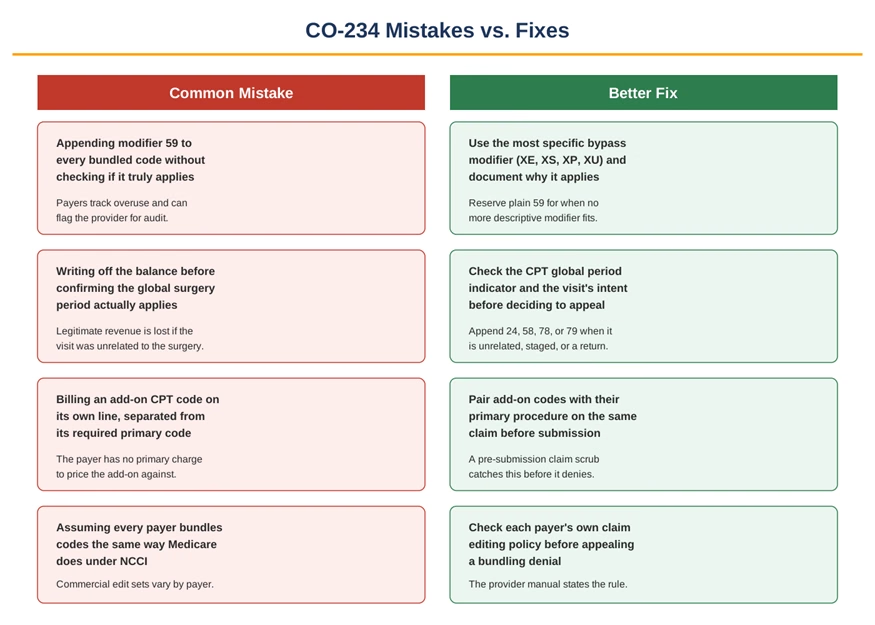
Commercial payers maintain their own bundling rules, which can differ from NCCI. A combination that pays cleanly with one payer can trigger CO-234 with another, so the payer’s provider manual — not Medicare assumptions — is the source to check first.
How to Fix a CO-234 Denial
- Read the remark code first. N19, M80, and M144 point to different root causes; don’t guess.
- Check whether a global surgery period applies by comparing the CPT code’s global period to the date of the earlier surgery.
- Check whether an NCCI PTP edit applies, and confirm the facts genuinely support a bypass modifier before appending one.
- For add-on code denials, confirm the primary procedure was billed on the same claim and wasn’t denied separately.
- Resubmit a corrected claim with the supporting modifier, or file a formal appeal with documentation if the denial still looks wrong. Watch for a fresh CO-18 denial code if the payer flags the correction as a duplicate instead of processing it.
- Track the outcome so the same mistake isn’t repeated on the next claim for that CPT pair.
CO-234 vs. CO-97: What’s the Difference?
CO-234 and CO-97 denial code both signal a bundled service, which is why claims staff often confuse them. CO-97 is the broader “included in the payment for another service” message, while CO-234 is the more specific “not paid separately” statement that must carry a remark code. If a CO-97 denial lacks enough detail to act on, check whether the payer also uses CO-234 for the same scenario — its remark code is usually the faster path to a root cause.
Medicare vs. Commercial Payer Rules for CO-234
| Area | Medicare (NCCI) | Commercial Payers |
| Source of the bundling rule | National Correct Coding Initiative PTP edits and global surgery package rules, published and updated quarterly. | The payer’s own claim-editing software and provider manual, which may follow, adapt, or diverge from NCCI. |
| Global period lengths | 0, 10, or 90 days, set per CPT code in the Medicare Physician Fee Schedule. | Often mirrors Medicare’s global days, but the provider manual should be checked for exceptions. |
| Where to confirm the rule | The NCCI edit files and the Medicare Physician Fee Schedule database. | The payer’s provider portal, claim-editing policy, or provider services line. |
A pattern correct under NCCI should still be checked against the payer’s own manual before assuming it applies.
How to Prevent CO-234 Denials
- Run a pre-submission claim scrub that flags known NCCI PTP pairs and missing primary codes.
- Keep a quick-reference list of your most-billed CPT codes with their global period (0, 10, or 90 days).
- Train schedulers and clinicians to flag visits unrelated to a recent surgery, so the correct modifier goes out the first time.
- Review each payer’s claim-editing policy annually, since commercial bundling rules change independently of NCCI.
- Track CO-234 denials by CPT pair to spot a recurring habit instead of relitigating the same mistake claim by claim.
Common Mistakes That Trigger CO-234
Most CO-234 denials trace back to a handful of repeated habits, paired below with the fix for each.
Reading a Sample CO-234 Remittance Line
The annotated remittance below shows how a CO-234 line typically appears next to unrelated adjustment codes, and how the remark code narrows down the reason.
Frequently Asked Questions
What does CO-234 mean on an EOB?
It means the payer won’t pay for this procedure separately because it’s bundled into another service already covered on the claim. The “CO” group code means the write-off is contractual, so the patient can’t be billed the difference.
Can a patient be billed for a CO-234 denial?
No. CO means Contractual Obligation — the provider absorbs this amount under the payer contract. A payer that intends the patient to owe the balance instead uses a PR (Patient Responsibility) group code, not CO.
Is CO-234 the same as CO-97?
Related but not identical. CO-97 is a broader “included in another service’s payment” statement, while CO-234 is the more specific “not paid separately” message that always carries a remark code. See the CO-97 denial code guide for the fuller comparison.
Does modifier 59 always fix a CO-234 denial?
No. It only applies when the services are genuinely distinct and no more specific modifier (XE, XS, XP, or XU) fits better. Appending it to every bundled pair without reviewing the facts is an audit risk, not a reliable fix.
How do I know if a CPT code has a global surgery period?
The global period (0, 10, or 90 days) is listed in the Medicare Physician Fee Schedule for that CPT code. Commercial payers generally follow the same days, but check the provider manual for exceptions.
What’s the first step after seeing a CO-234 denial?
Read the paired remark code first. N19, M80, and M144 point to different root causes, telling you whether to check a global period, an NCCI edit, or a missing primary procedure code. If the remark instead points to missing claim information, see the CO-16 denial code guide instead.
Need Help Working CO-234 Denials?
Recurring bundling denials often signal that claim edits or modifier use need a closer look. Zmed Solutions’ denial management and appeals services team can review your CO-234 patterns and tighten claim-scrubbing before submission.
Sources: X12 Claim Adjustment Reason Codes and Remittance Advice Remark Codes; CMS NCCI Coding Edits (Procedure-to-Procedure and Medically Unlikely Edits); CMS Global Surgery Booklet (MLN907166); CMS Proper Use of Modifiers 59, XE, XP, XS, and XU (MLN1783722). This article is general billing information, not legal or payer-specific advice; always confirm current rules against your payer’s own provider manual.
Ready to optimize your medical billing and boost your revenue? Look no further. Zmed Solutions LLC is your trusted partner in professional Medical Billing Services.
Join our growing network of healthcare providers who have already elevated their revenue with our expert services. Don't miss out on what could be your practice's most profitable decision.
Schedule a Consultation Today!
Contact Us Now, and experience the difference. Your financial success starts here!