CO-151 is a Contractual Obligation denial that means a payer decided the documentation submitted doesn’t support the number of units or the frequency of the service you billed. It usually shows up when a claim line exceeds a payer’s frequency limit, a Local Coverage Determination (LCD) rule, or a Medicare Medically Unlikely Edit (MUE).
This guide explains what triggers CO-151, how to read the remark code that comes with it, the steps to fix or appeal it, and how to stop it from recurring on future claims.
| Key Takeaways CO-151 means the payer capped payment because billed units or frequency exceeded its limit — not because the code itself was wrong. It almost always arrives with a remark code (RARC) such as N115, M86, or N362 that names the specific rule that was applied.Because the group code is CO (Contractual Obligation), the adjusted amount is a write-off, not a patient balance. Fixing it starts with comparing billed units to the payer’s published frequency or MUE limit before refiling or appealing. Tracking payer-specific frequency rules in advance prevents most CO-151 denials from recurring. |
What Does CO-151 Mean on a Remittance Advice?
Every electronic remittance advice (ERA) — the payer’s explanation of how it paid or adjusted a claim — carries a Claim Adjustment Reason Code (CARC) for each line. CARC 151, as defined by the X12 Claim Adjustment Reason Code list, means: “Payment adjusted because the payer deems the information submitted does not support this many/frequency of services.” In plain terms, the payer isn’t disputing that the code was billed correctly — it’s saying you billed more units, visits, or sessions than it will pay for under its own frequency rules.
CO-151 is one of several specific adjustment codes practices run into alongside the broader set of common denial codes in medical billing, but it has a narrow, predictable cause: volume, not accuracy. The group code attached to 151 is almost always CO, for Contractual Obligation. Under CO, the provider agreed by contract not to bill the patient for the adjusted amount, so a CO-151 denial is a write-off question for the practice, not a patient-responsibility one — unless the remittance pairs it with PR instead, which happens occasionally and is worth checking line by line.
Why Payers Deny Claims with CO-151
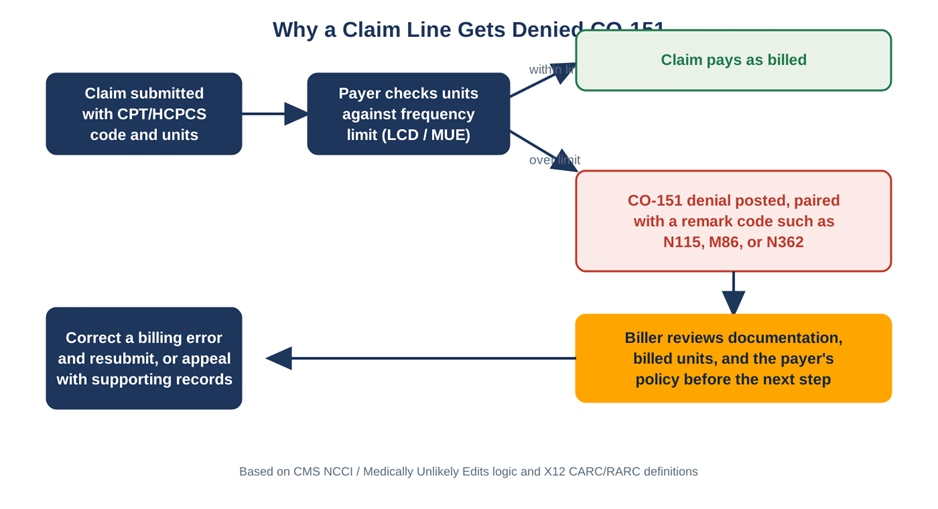
A CO-151 denial means the payer’s system compared the units or visits billed against a frequency limit — an LCD, a Medicare MUE, or the payer’s own plan policy — and the claim exceeded it. The same code also appears when a service duplicates one already paid within a set time frame.
- Billed units exceed the payer’s MUE or daily/unit maximum for that CPT or HCPCS code
- Visit frequency exceeds an LCD limit (for example, more therapy sessions in a period than the policy allows)
- A same or similar service was already paid for the same date range
- Documentation doesn’t show medical necessity for repeating the service
- A modifier that would separate a distinct, medically necessary repeat service is missing
Remark codes commonly paired with CO-151
| Remark code (RARC) | What it tells the biller |
| N115 | Decision was based on a Local Coverage Determination (LCD). |
| M86 | Service denied because payment was already made for the same or a similar procedure within a set time frame. |
| N362 | The number of days or units of service exceeds the payer’s acceptable maximum. |
How to Fix a CO-151 Denial
- Read the remark code first. N115 points to an LCD rule, M86 points to a duplicate-service edit, and N362 points to a units/MUE cap — each needs a different response.
- Pull the payer’s frequency or MUE limit for that code and compare it to what was actually billed.
- Check the documentation. If the repeat service was medically necessary, confirm the notes support it and that the correct distinct-service modifier was used.
- If the claim was billed correctly, file a redetermination or appeal with the supporting records before the payer’s deadline — appeal windows vary by payer, so check medical billing time limits by state for how these timelines are typically structured.
- If units or dates were billed in error, correct the claim and resubmit — don’t simply resend the same claim unchanged.
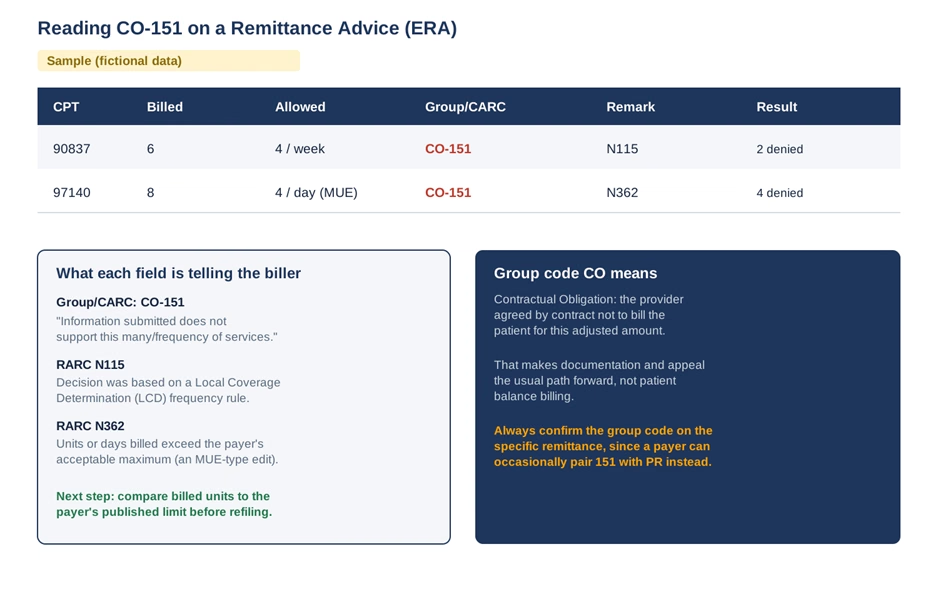
In the sample above, a practice billed six units of CPT 90837 when the payer’s policy allowed four per week, and eight units of CPT 97140 against a daily MUE limit of four — both lines came back CO-151, each with a different remark code explaining which limit applied.
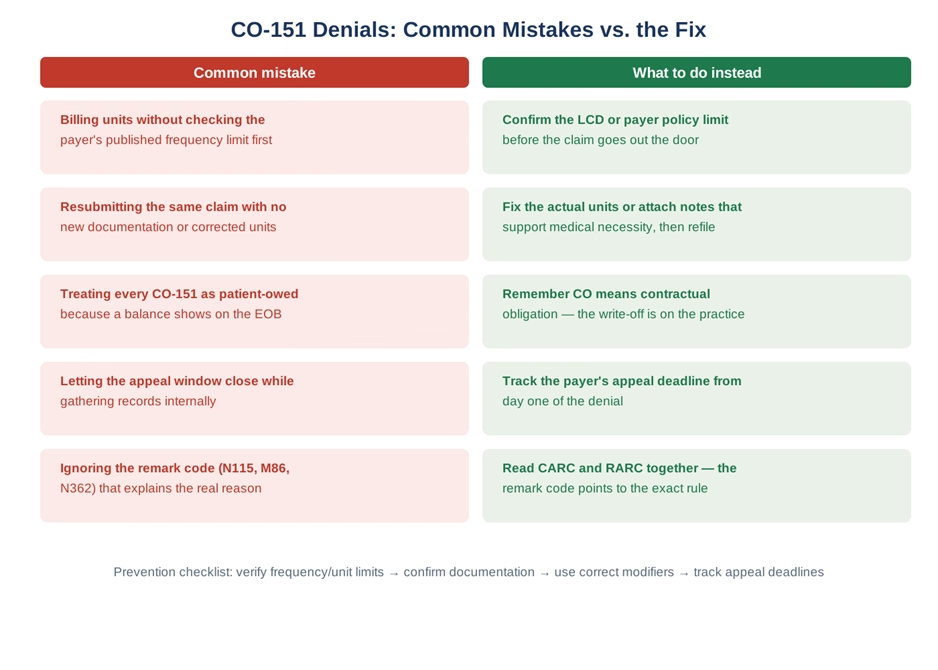
Common Mistakes That Trigger CO-151 Denials
Unlike a CO-16 denial code, which flags missing or incomplete claim information, CO-151 is strictly about volume — the claim has everything the payer needs, there’s just too much of it. That distinction is where most billing teams go wrong.
Medicare vs. Commercial Payer Frequency Rules
Medicare’s frequency and unit limits come from published LCDs and the CMS National Correct Coding Initiative‘s Medically Unlikely Edits, which exist to prevent improper payment for incorrect units of service. Commercial payers aren’t bound by LCDs; they set their own frequency and unit caps in the provider contract and policy manual, and those limits can be stricter or looser than Medicare’s. Before appealing a CO-151 denial from a commercial plan, check that payer’s manual rather than assuming the Medicare rule applies.
How to Prevent CO-151 Denials
- Confirm frequency and unit limits for high-volume codes (therapy, injections, E/M add-ons) before billing
- Build payer-specific frequency edits into your claim scrubber or practice management system
- Document medical necessity whenever a service repeats beyond the typical course of care
- Use the correct distinct-service modifier when two same-day services really are separate
- Track each payer’s appeal deadline the day the denial posts, not after records are gathered
Frequently Asked Questions
What does CO-151 mean in medical billing?
It means the payer reduced or denied payment because the documentation submitted doesn’t support the number of units or the frequency of the service billed. It’s a volume issue, not a coding-accuracy issue, and it almost always arrives with a remark code that names the exact limit that exceed.
Is a CO-151 denial the patient’s responsibility?
No, not under the CO group code. CO stands for Contractual Obligation, meaning the provider agreed in its payer contract not to bill the patient for that adjustment. Confirm the group code on the specific remittance, since the same reason code can occasionally post with PR instead.
Can I appeal a CO-151 denial?
Yes. If the service was medically necessary and properly documented, submit a redetermination or appeal with supporting records before the payer’s deadline. If the units or dates were bill incorrectly, correct the claim and resubmit instead of appealing.
What’s the difference between CO-151 and CO-16?
CO-16 means the claim is missing information or has a submission error; CO-151 means the claim is complete but exceeds a frequency or unit limit. The fix differs too — CO-16 needs a corrected claim, while CO-151 needs documentation of necessity or a frequency-limit check.
Does a modifier fix a CO-151 denial?
Sometimes. If two same-day services were genuinely separate and medically necessary, the correct distinct-service modifier can support resubmission. A modifier won’t help if the service truly exceeded the payer’s allowed frequency or unit cap.
Where can I find a payer’s frequency or unit limits?
For Medicare, check the relevant Local Coverage Determination and the CMS NCCI Medically Unlikely Edits. For commercial payers, the limit is in the provider manual or medical policy for that specific code, since each payer sets its own rules in the contract.
Need Help Fixing Recurring Denials?
CO-151 denials are rarely about bad coding — they’re about volume rules that differ by payer and change over time. If your practice is seeing a pattern of frequency or unit denials across multiple payers, Zmed Solutions’ revenue cycle management services can review your claim-scrubbing rules and denial trends to catch these before they reach the payer.
Sources: X12 Claim Adjustment Reason Codes and Remittance Advice Remark Codes; CMS National Correct Coding Initiative (Medically Unlikely Edits). This article is for general informational purposes and is not billing or legal advice for a specific claim — always confirm frequency and unit limits with the specific payer.
Ready to optimize your medical billing and boost your revenue? Look no further. Zmed Solutions LLC is your trusted partner in professional Medical Billing Services.
Join our growing network of healthcare providers who have already elevated their revenue with our expert services. Don't miss out on what could be your practice's most profitable decision.
Schedule a Consultation Today!
Contact Us Now, and experience the difference. Your financial success starts here!