A CO-252 denial code means the payer needs an attachment or other documentation before it will adjudicate the claim. The “CO” (Contractual Obligation) group code means the practice carries this step, not the patient. This article covers what the paired remark code is telling you to send, how to submit it, and how to stop the request from recurring.
| Key Takeaways CARC 252 means “An attachment/other documentation is required to adjudicate this claim/service” and always carries a remark code. The remark code tells you exactly what to send — notes, a chart, a report, a summary, or a coordination-of-benefits EOB. Submit the document through the payer’s preferred channel (portal, fax, or mail) with a cover sheet referencing the claim. The PWK segment on an electronic claim can flag that documentation is coming, but payers may still issue CO-252 if it’s needed and missing. Tracking submission dates and following up prevents a slow documentation request from becoming a written-off claim. |
What Does CO-252 Mean on Your Remittance Advice?
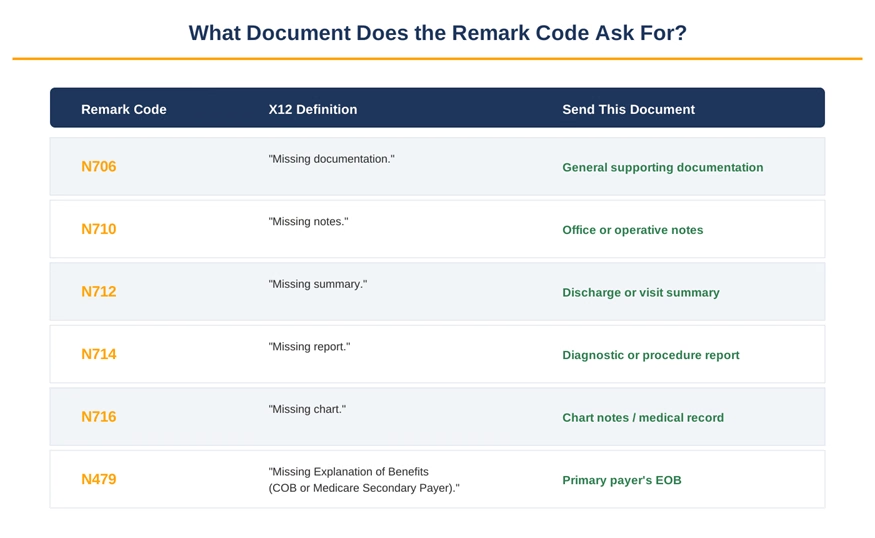
The X12 Claim Adjustment Reason Codes list defines CARC 252 as: “An attachment/other documentation is required to adjudicate this claim/service.” Like CO-234, it always arrives with a remark code (RARC) that names the specific document. The table below maps the most common pairings to what to send.
| Remark Code | X12 Definition | Send This Document |
| N706 | “Missing documentation.” | General supporting documentation |
| N710 | “Missing notes.” | Office or operative notes |
| N712 | “Missing summary.” | Discharge or visit summary |
| N714 | “Missing report.” | Diagnostic or procedure report |
| N716 | “Missing chart.” | Chart notes / medical record |
| N479 | Missing EOB (COB or Medicare Secondary Payer) | The primary payer’s EOB |
If the remark code isn’t one of these six, read it directly — RARCs are specific by design, and the exact wording tells you what the payer is missing.
Why Payers Request Attachments or Documentation
The Service Needs Clinical Support
Some CPT codes, especially higher-level E/M visits, unlisted procedure codes, or services billed with modifier 22 (increased procedural service), routinely require notes or a report before a payer will price the claim. The payer isn’t disputing medical necessity yet — it simply has nothing on file to review.
A Coordination of Benefits or Secondary Payer Issue
When a patient has more than one payer, the secondary payer typically needs the primary payer’s EOB before it will process its share. Remark code N479 signals exactly this: the claim is otherwise payable once that EOB is attached.
Missing Operative, Progress, or Discharge Notes
Surgical claims, therapy visits, and inpatient stays are the most common sources of N710, N712, and N716 denials, because the payer’s system flagged the code or billed amount as needing supporting notes before release.
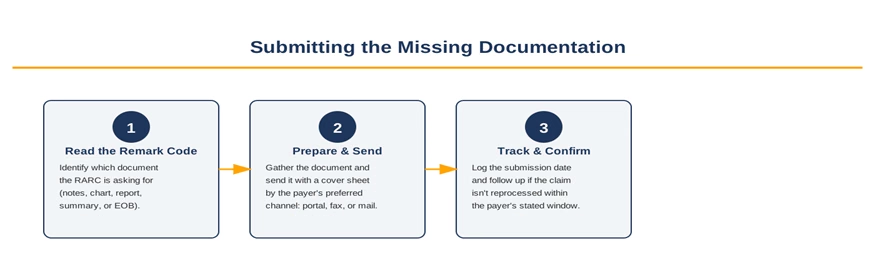
How to Submit the Missing Documentation
On an electronic claim, the PWK (Paperwork) segment can flag that documentation is coming by mail, fax, or electronically through esMD, using an attachment control number that must match the cover sheet. Using PWK is voluntary, and a payer can still issue CO-252 afterward if the documentation is needed and hasn’t arrived.
How to Fix a CO-252 Denial
- Read the remark code to identify the exact document requested.
- Locate or request the document from the clinician, health information team, or the primary payer (for an EOB).
- Submit it through the payer’s preferred channel with a cover sheet referencing the claim and attachment control number.
- Log the submission date so a missed response doesn’t quietly become a written-off claim.
- Follow up if the claim isn’t reprocessed within the payer’s stated window, and escalate to a formal appeal if it’s denied again without explanation.
CO-252 vs. CO-16: What’s the Difference?
CO-252 and CO-16 denial code both point to missing information, which is why billers often mix them up. CO-16 is the broader “claim lacks information needed for adjudication” message, usually about missing or invalid data on the claim itself (a modifier, an NPI, a diagnosis pointer). CO-252 is narrower: the claim data is fine, but a separate attachment or clinical document is required. The remark code attached to each tells you which kind of fix applies.
Medicare vs. Commercial Payer Rules for CO-252
| Area | Medicare / DME MACs | Commercial Payers |
| How documentation is flagged | The PWK segment on the electronic claim, or a development letter from the MAC. | A remark code on the denial, or a portal message requesting records. |
| How to submit it | Mail, fax, or esMD, matched to a PWK cover sheet with an attachment control number. | Whatever channel the payer’s provider portal or manual specifies. |
| Where to confirm the rule | The MAC’s published PWK/esMD guidance. | The payer’s provider manual or provider services line. |
A workflow built around Medicare’s PWK and esMD process should still be check against each commercial payer’s own portal and documentation rules.
How to Prevent CO-252 Denials
- Flag CPT codes that routinely need supporting notes (high-level E/M, unlisted codes, modifier 22) before the claim goes out.
- Attach the primary payer’s EOB up front on every secondary claim instead of waiting for N479.
- Use the PWK segment when documentation will follow, so the payer expects it rather than denying outright.
- Keep a standard cover sheet template so records never go out unlabeled or unmatched to the claim.
- Track CO-252 denials by document type to see which clinicians or services need a documentation workflow fix.
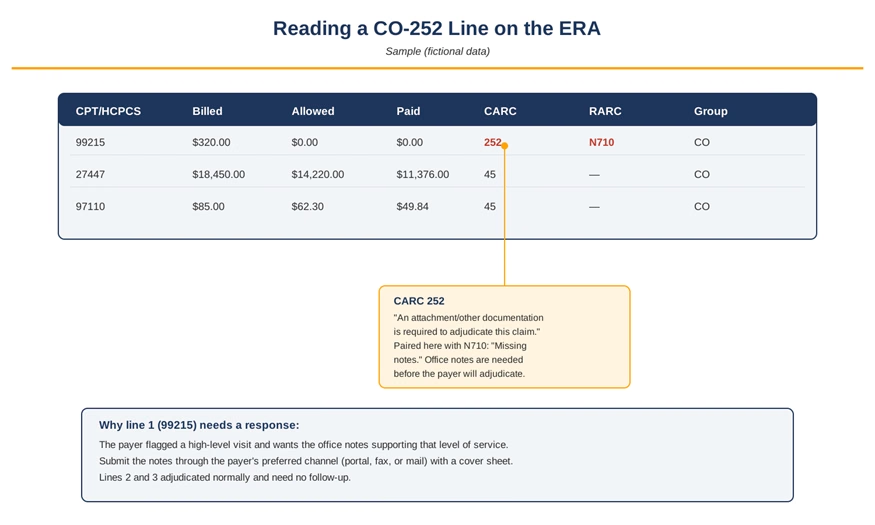
Reading a Sample CO-252 Remittance Line
The annotated remittance below shows a CO-252 line next to two normally adjudicated lines, and how the remark code narrows down exactly what to send.
Frequently Asked Questions
What does CO-252 mean on an EOB?
It means the payer needs an attachment or other documentation before it can process the claim. The “CO” group code means the practice, not the patient, is responsible for resolving it.
Can a patient be billed for a CO-252 denial?
No. CO means Contractual Obligation, so the provider is responsible for supplying the missing documentation, not the patient.
How do I know exactly what to send?
Read the paired remark code. N706, N710, N712, N714, N716, and N479 each point to a specific document — general documentation, notes, a summary, a report, a chart, or a coordination-of-benefits EOB.
Does the PWK segment prevent a CO-252 denial?
Not always. PWK tells the payer documentation is coming, but it’s voluntary and the payer isn’t require to wait indefinitely. If the document hasn’t arrive when the claim is review, CO-252 can still post.
Is CO-252 the same as CO-16?
No. CO-16 usually means the claim itself is missing or has invalid data, while CO-252 means the claim data is fine but a separate clinical document is require. See the CO-16 denial code guide for the fuller comparison.
What happens if the documentation is never submitted?
The claim typically stays unpaid or is eventually closed out as a write-off, since the payer has no basis to adjudicate it. Tracking open CO-252 denials is the only way to catch this before timely-filing limits apply.
Need Help Working Documentation Denials?
A steady stream of CO-252 denials often means a documentation workflow gap between clinical and billing staff. Zmed Solutions’ denial management and appeals services team can help identify which services are triggering these requests and tighten the submission process.
Sources: X12 Claim Adjustment Reason Codes and Remittance Advice Remark Codes; CGS Medicare (DME MAC) PWK Segment guidance; CMS Electronic Submission of Medical Documentation (esMD). This article is general billing information, not legal or payer-specific advice; always confirm current rules against your payer’s own provider manual.
Ready to optimize your medical billing and boost your revenue? Look no further. Zmed Solutions LLC is your trusted partner in professional Medical Billing Services.
Join our growing network of healthcare providers who have already elevated their revenue with our expert services. Don't miss out on what could be your practice's most profitable decision.
Schedule a Consultation Today!
Contact Us Now, and experience the difference. Your financial success starts here!